
Ancient Egypt was the civilization that grew up along the Nile around 3100 BC, when Upper and Lower Egypt were united under one king, and lasted roughly three thousand years, until Cleopatra's death in 30 BC. It built the pyramids, created one of the world's first writing systems and left temples, tombs and museum collections you can still see on a single trip through Cairo, Luxor and Aswan.
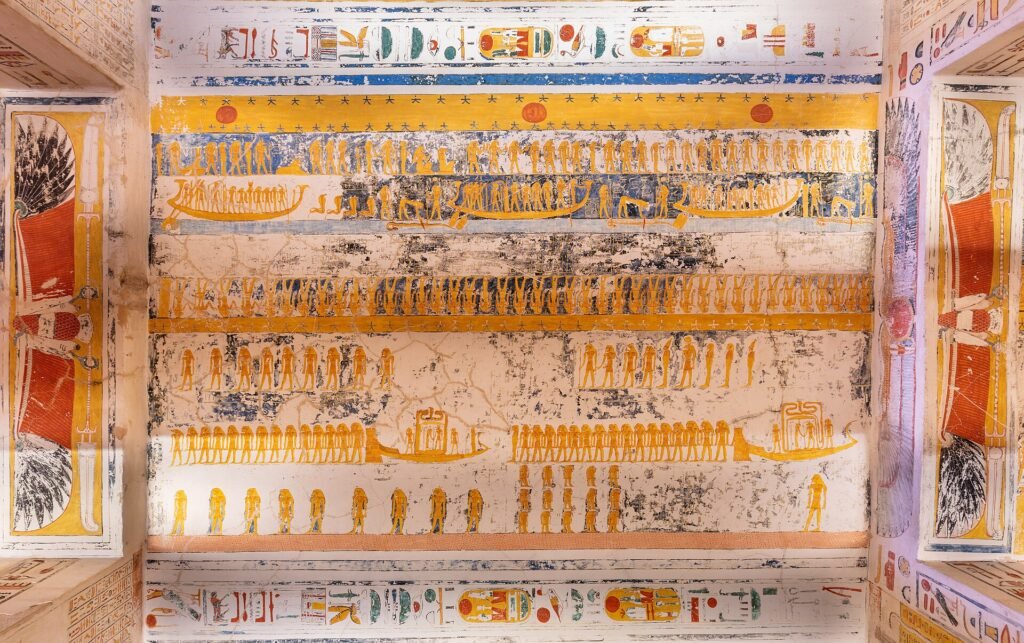
Most people arrive in Egypt with a handful of images already in mind: a pyramid at sunset, Tutankhamun's gold mask, a wall covered in hieroglyphs. They are fragments of a story so long that, by Cleopatra's time, the Egyptians themselves looked at the pyramids as ancient ruins. Once you know how those fragments fit together, a temple stops being a pile of impressive stone and starts telling you something.
This guide puts the whole story in one place: what ancient Egypt actually was, how historians divide it, which pharaohs matter, what the Egyptians believed, how they wrote and how ordinary people lived. Every section links to our in-depth guide on that topic, and the last part maps each era to the sites where you can stand in front of it, which is what counts when you are planning the trip.
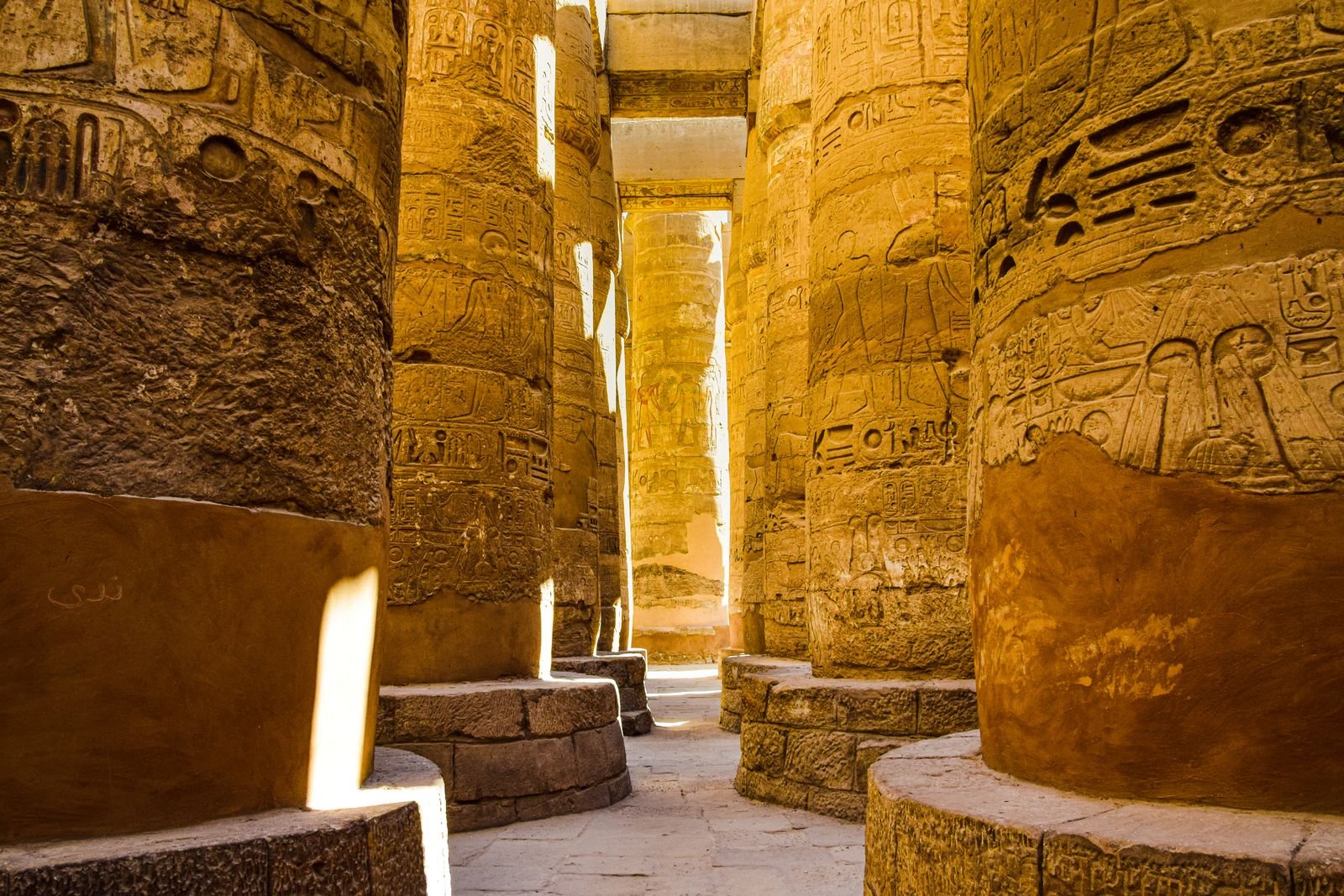
Ancient Egypt is the name for the civilization of the Nile Valley and Delta from the unification of the country, around 3100 BC, to its conquest by Rome in 30 BC. Those three millennia saw wars, collapses, foreign rulers and new capitals, yet something rare in world history held steady: the same language, the same religion and the same idea of kingship, recognizable from beginning to end.
The Egyptians called their country Kemet, the black land, after the dark, fertile silt the river left behind every year. Beyond it lay Deshret, the red land of the desert. That line between green and sand is still sharp enough to see from a plane window, and it explains almost everything: where towns were built, where the dead were buried and why the river was sacred.
The country was really two regions. Upper Egypt is the south, the narrow valley from Aswan to just below Cairo; Lower Egypt is the north, the wide Delta opening onto the Mediterranean. The names confuse many visitors because they follow the river's flow, not the map. That is why the pharaoh wore a double crown, called himself Lord of the Two Lands and appears in so many reliefs tying the lotus of the south to the papyrus of the north.
Historians divide those three thousand years into kingdoms, the long stretches of strong central rule, separated by intermediate periods when the country split apart. The count of about thirty dynasties goes back to Manetho, an Egyptian priest who wrote his country's history in Greek in the 3rd century BC. Dates shift by a few years depending on the source, but the sequence is the same everywhere.
| Period | Approximate dates | What defines it |
|---|---|---|
| Predynastic | before 3100 BC | Farming villages and rival chiefdoms in the north and south |
| Early Dynastic | 3100 to 2686 BC | Unification, Memphis as capital, the first hieroglyphic writing |
| Old Kingdom | 2686 to 2181 BC | The pyramid age: Saqqara, Dahshur and Giza |
| First Intermediate Period | 2181 to 2055 BC | Central power breaks down, local governors rule |
| Middle Kingdom | 2055 to 1650 BC | Reunification from Thebes, classic literature, irrigation works |
| Second Intermediate Period | 1650 to 1550 BC | The Hyksos rule the north and bring the horse and chariot |
| New Kingdom | 1550 to 1069 BC | Imperial Egypt: Karnak, Luxor, Abu Simbel, the Valley of the Kings |
| Third Intermediate and Late Periods | 1069 to 332 BC | Libyan, Nubian and Saite dynasties, two Persian conquests |
| Ptolemaic Period | 332 to 30 BC | Alexander the Great and his Greek successors, down to Cleopatra |
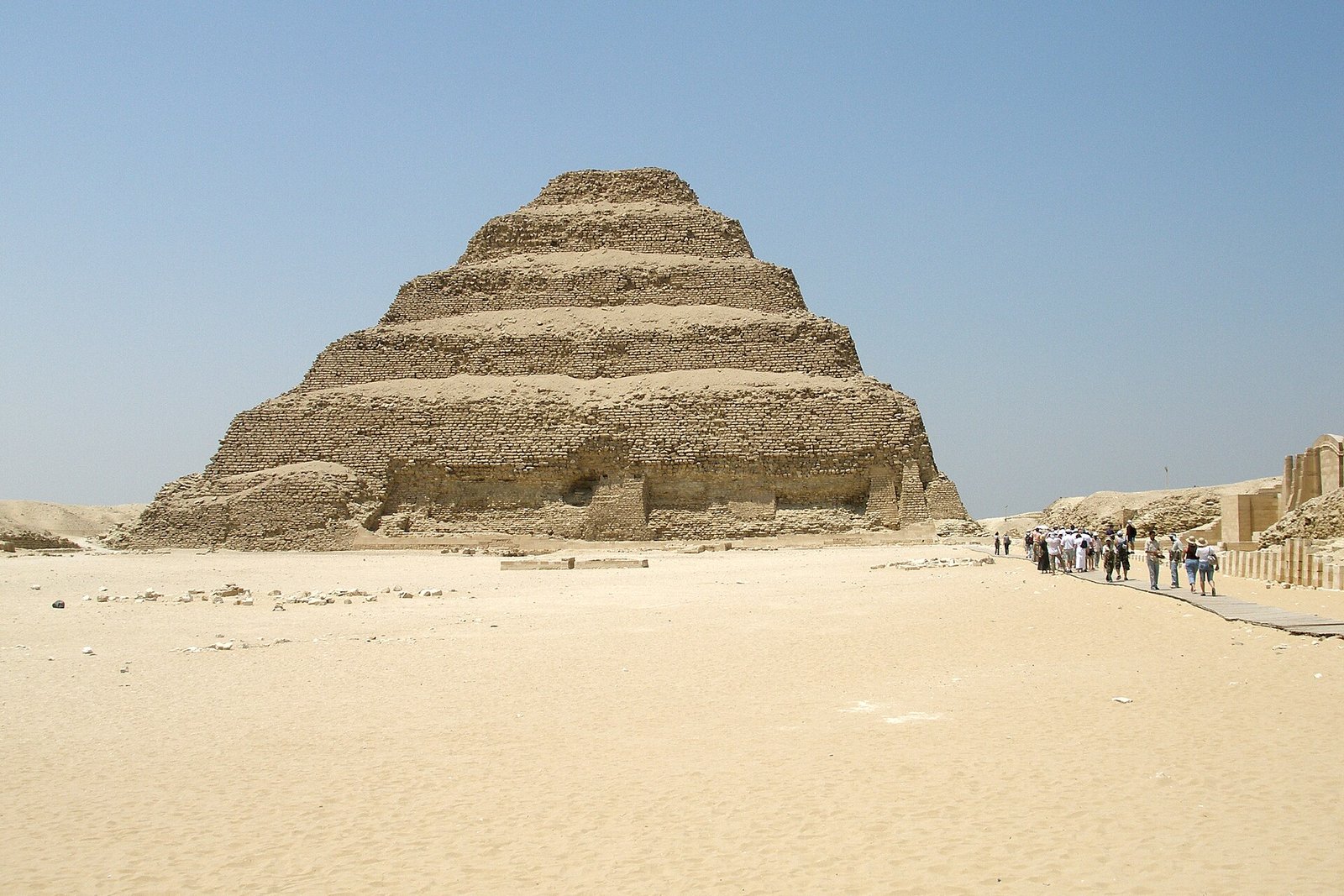
The story speeds up with King Djoser and his architect Imhotep, who around 2650 BC stacked six stone mastabas on top of each other and created the Step Pyramid of Djoser at Saqqara, the first monumental stone building in history. Within a century the Egyptians went from that experiment to the true pyramids of Dahshur and the Great Pyramid of Khufu at Giza, which stayed the tallest human-made structure on Earth for close to four thousand years. How they managed it without iron tools or pulleys is the subject of how the pyramids were built.
After more than a century of division, kings from Thebes reunited Egypt. The era left fewer giant monuments for today's visitor, but the Egyptians themselves saw it as their classical age: its stories and teachings were copied by scribes for over a thousand years, the Fayum oasis was turned into farmland, and royal portraits began to show a king who worried about his people, not just a distant god.
After driving out the Hyksos, Egypt became an empire stretching from Nubia to Syria, and nearly every name travelers know comes from this era: Hatshepsut, the woman who ruled as pharaoh; Akhenaten and Nefertiti, who tried to replace the old gods with a single sun disk; Tutankhamun, whose nearly intact tomb was found in 1922; and Ramesses II, who reigned for sixty-six years and carved his name across the country. Kings stopped building pyramids and cut their tombs into the Valley of the Kings, across the river from Thebes, today's Luxor.
The last millennium belonged largely to foreign rulers who governed in Egyptian style: Libyans, Nubians, Persians and, from 332 BC, Greeks. Alexander the Great founded Alexandria, and after his death his general Ptolemy started a dynasty that lasted three centuries. The Ptolemies built some of the best-preserved temples you will visit, Edfu, Kom Ombo and Philae, with the same gods and the same hieroglyphs used two thousand years earlier. The last of the line was Cleopatra VII, and with her death Egypt became a Roman province.
Egypt is almost entirely desert, and without the Nile River none of what you will visit would exist. Every summer, rain in the Ethiopian highlands swelled the river until it spilled over the valley; when the water drew back, it left a fresh layer of black silt ready for planting. Egyptian life ran on that rhythm, and the year had three seasons: flood, growing and harvest.
Watching the river gave the Egyptians one of their lasting inventions, the 365-day calendar: twelve months of thirty days plus five extra days at the end. The new year began when the star Sirius reappeared on the horizon just before dawn, roughly when the flood arrived. The Nile was also the country's highway. Granite from Aswan, kings, armies and statues of the gods in their sacred boats all traveled on it, and sailing between Luxor and Aswan on a Nile cruise today follows the same route.
A pharaoh was more than a king. Egyptians saw him as the link between gods and people, responsible for maat, the order of the universe, against the constant threat of chaos. That is why he appears in every temple making offerings, why his battles were carved on the walls even when the result was a draw, and why his burial was a matter of state: if the king did not reach the afterlife safely, the balance of the whole country was at risk.
More than 170 pharaohs ruled over three thousand years, and most are little more than names on king lists. A few, though, you will meet again and again. Our guide to the pharaohs of Egypt puts them in order and tells you where each one left a mark, from Khufu at Giza to Ramesses II at Abu Simbel.
The Egyptians worshipped hundreds of gods, many with a human body and an animal head, each with a home city, a temple and a job. Ra was the sun sailing across the sky in a boat; Osiris, the murdered king who came back to life and ruled the dead; Isis, his wife, the great magician and mother; Horus, their falcon-headed son and protector of the pharaoh; Anubis, the jackal who guided souls. Our guide on how to recognize the Egyptian gods helps you spot them on temple walls, and Egyptian mythology tells their stories, from creation to the war between Horus and Seth. How temples, priests and rituals actually worked is covered in ancient Egyptian religion.
Egyptian religion was obsessed with eternal life rather than death. Surviving in the next world required a preserved body, hence mummification, a process of about seventy days. It also meant passing the judgment of Osiris, where the dead person's heart was weighed against the feather of maat, the best-known scene in the Book of the Dead. Amulets offered protection along the way: the Eye of Horus, the scarab and the ankh, all covered in ankh, scarab and Eye of Horus amulets.
This is the key to the monuments. Temples were the house of a god, getting darker and more enclosed toward the sanctuary; tombs were houses for eternity, painted with the texts and scenes the dead would need. When you walk into one of the tombs in the Valley of the Kings, you are quite literally reading a travel guide to the afterlife.
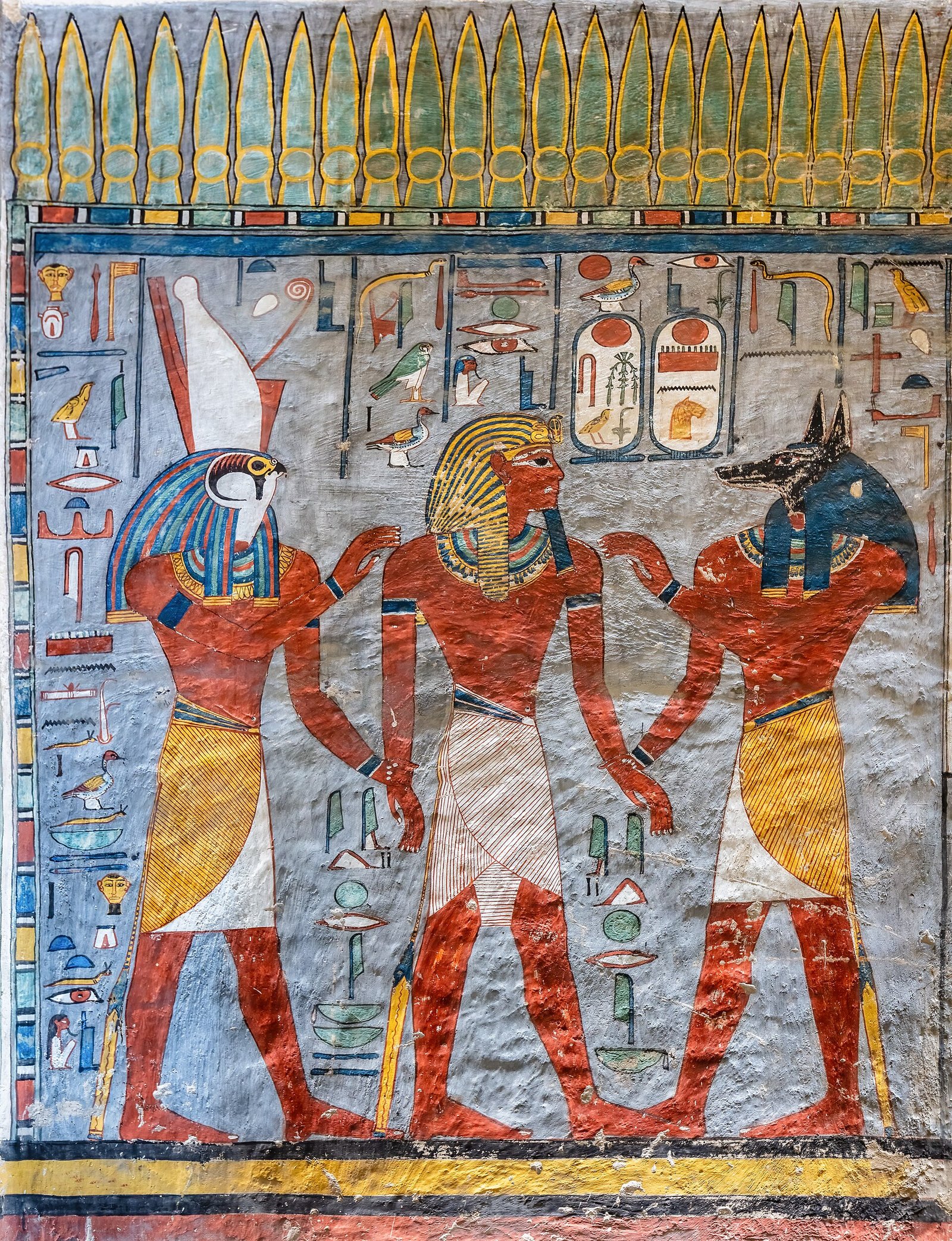
Hieroglyphs appear around 3200 BC, among the oldest writing systems anywhere. They are not picture puzzles: they mix signs that stand for sounds with signs that show what kind of word you are reading, and they can run left to right, right to left or in columns. For everyday business, scribes used faster cursive scripts, hieratic and later demotic, written in ink on papyrus, a sheet made from the stem of a Delta plant. Our guide to real vs fake papyrus shows you how to tell the genuine article in a shop.
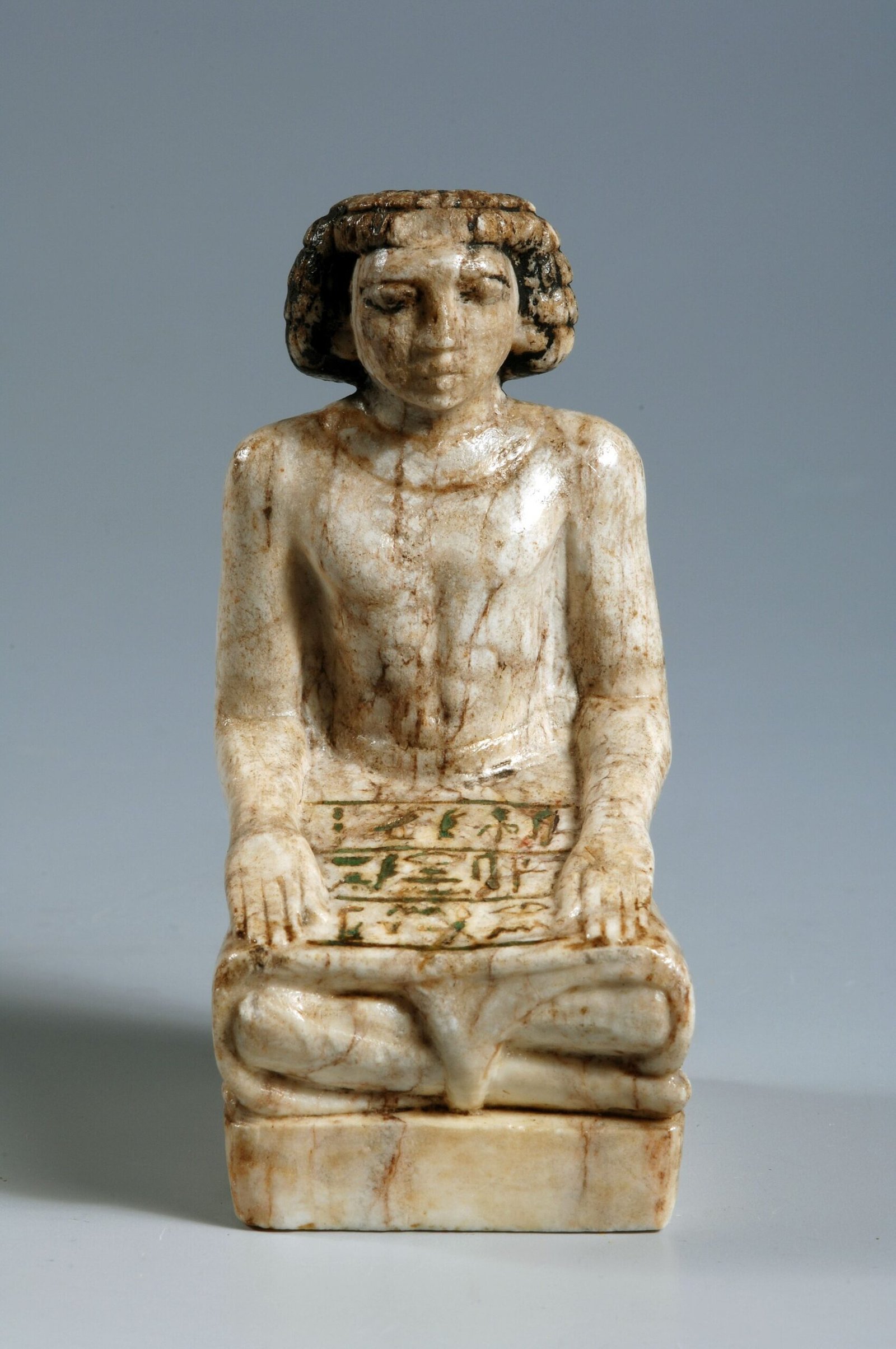
Literacy was a privilege of very few, and scribes were respected officials; ancient Egyptian writing explains how they trained and what they recorded. When the last temples closed, the script was forgotten, and for roughly fourteen centuries nobody could read it. The breakthrough was the Rosetta Stone, a decree carved in hieroglyphic, demotic and Greek, which let Jean-François Champollion crack the system in 1822. If you want to arrive with some good reading behind you, our picks are in books about ancient Egypt.
Most Egyptians were not kings or priests but farmers who worked the land to the river's schedule and paid their taxes in grain. They ate bread, onions, beans and fish, and drank a thick, mildly alcoholic beer that was part of the daily diet. Wages were paid in rations of bread and beer, and meat was mostly for festivals.
We know a surprising amount about ordinary people thanks to Deir el-Medina, the village of the craftsmen who cut and painted the royal tombs. Thousands of notes written on pottery fragments survive there: shopping lists, letters, work registers recording absences for a scorpion sting or for brewing beer, and even the first documented labor strike in history, when rations ran late under Ramesses III.
Egyptian women had more legal rights than in almost any other ancient society: they could own property, inherit, sign contracts, testify in court and divorce. The Tombs of the Nobles in Luxor are the best place to see this everyday world painted on the walls: banquets, musicians, fishermen, grape harvests and children at play, in colors that still look fresh.
One of the first things visitors notice is that a statue from 4,500 years ago and one from 2,000 years ago look remarkably alike. That was deliberate. Egyptian art served religion and followed strict rules: figures were laid out on a grid of fixed proportions, with head and legs in profile and eye and shoulders facing forward, so each part of the body appeared in its most complete form. Size showed importance rather than distance, which is why the pharaoh is always the biggest figure in the scene. Our full guide to ancient Egyptian art and architecture covers the colors, techniques and column types in depth.
Architecture followed the same logic. Anything meant to last forever, temples and tombs, was built in stone, while houses and even palaces were mud brick and have mostly disappeared. For the evolution of temples at a glance, our 10 must-see temples in Egypt runs from oldest to newest, with Karnak as the prime example of a sanctuary that kept growing for two thousand years.
The beauty of Egypt is that you can travel through its history almost in chronological order by following the river. The oldest sites are in the north around Cairo, imperial Egypt is in Luxor, and the Ptolemaic and Nubian temples sit between Luxor, Aswan and Abu Simbel. A classic itinerary breaks down like this:
Seeing all three great eras without rushing takes eight to ten days; how many days in Egypt explains how to split them. Every itinerary we run, with a licensed Egyptologist guide at each site, is on our Egypt tour packages page.
You will find plenty more in fun facts about Egypt, and the open questions, including what really happened to the Sphinx's nose, in mysteries of the Sphinx.
It is usually dated from about 3100 BC, when Upper and Lower Egypt were united under one king, to 30 BC, when Cleopatra VII died and Rome made Egypt a province. That is roughly three thousand years with the same language and religion.
The three great kingdoms, Old, Middle and New, separated by three intermediate periods of division, plus the Early Dynastic Period at the start and the Late and Ptolemaic Periods at the end. The system of about thirty dynasties comes from the priest Manetho.
It depends on what you value. Ramesses II is the best known for his long reign and his temples, Khufu for the Great Pyramid, Tutankhamun for his treasure and Hatshepsut for ruling as a woman. For the Egyptians themselves, the model great king was Thutmose III, who took the empire to its greatest extent.
Hundreds. The main ones were Ra, the sun; Amun, the great god of Thebes; Osiris, lord of the dead; Isis, his wife; Horus, their son and protector of the king; Anubis, guide of the dead; Ptah, the creator god of Memphis; and Hathor, goddess of love and music.
Egyptian work crews, not slaves. Excavations of the workers' town at Giza show organized teams with rations of bread, beer and meat, medical care and their own tombs beside the pyramids, joined by farmers who worked in rotating shifts.
Cairo and Giza for the pyramids and the museums, Luxor for the New Kingdom temples and tombs, and a Nile cruise between Luxor and Aswan for Edfu, Kom Ombo and Philae. Abu Simbel is visited from Aswan. Eight to ten days covers all three great eras.
You can visit on your own, but temples and tombs have very little signage. An Egyptologist guide reads the reliefs with you, places each site in its era and knows which tombs are worth your time that day, which changes the visit completely.
Plan your ancient Egypt trip on WhatsApp
All our itineraries are on Egypt tour packages.
Keep exploring