Ancient Egyptian religion was something you did every day, not something you believed
Ancient Egyptian religion was something you did every day, not something you believed
Ancient Egyptian religion was a set of practices, not a set of beliefs. There was no scripture, no creed and no weekly congregation. There was a god living in a dark room at the back of a temple, a priesthood that woke, washed, dressed and fed him every morning on behalf of the king, and festivals when the god came out on a boat carried on shoulders and ordinary people finally saw him. At home, families kept their own small gods against snakes, scorpions and difficult births. Under all of it sat one idea, Maat, the right order of the world, which every offering was meant to keep in place. Here is how it worked and where to see it.
A religion you did, not a religion you believed
The first thing to unlearn is the idea that Egyptian religion was a body of doctrine. Nobody was asked to believe anything. Gods merged and swapped jobs without contradiction: Amun of Thebes combined with Ra of Heliopolis into Amun-Ra, and all three kept existing at once.
What held the system together was action. You offered, you purified, you celebrated, you buried your dead correctly, and the world kept turning.
The stories of Osiris, Isis and Horus are in our guide to Egyptian mythology, and the crowns and heads that tell one god from another are in how to recognize the Egyptian gods. This page is about the temple, the priest, the festival, the house and the tomb, where the religion actually happened.
The temple was the god's house, and it ran like one
An Egyptian temple was not a church or a mosque. It was a residence. The god, present in a small statue of gold or gilded wood, lived in a shrine in the deepest, darkest room. The public never went inside.
Because the god was a resident, he was looked after like a person of rank, with the main service at dawn and shorter ones at midday and dusk:
- Purification. The officiating priest washed in the sacred lake, dressed in fresh linen and walked the axis to the sanctuary.
- Opening the shrine. He broke the clay seal on the naos and greeted the god with a hymn as light reached the statue for the first time that day.
- Toilet of the god. The statue was undressed, washed, anointed, painted with eye paint and dressed in new cloth of white, green, blue and red.
- The meal. Bread, beer, meat, fowl, fruit and wine were set out. The god took the essence, and the food then went back out to feed the priests, which is how a temple paid its staff.
- Withdrawal. The priest resealed the doors and backed out, sweeping away his own footprints.
The full sequence is carved at Abydos and, in shorter form, all over Karnak.
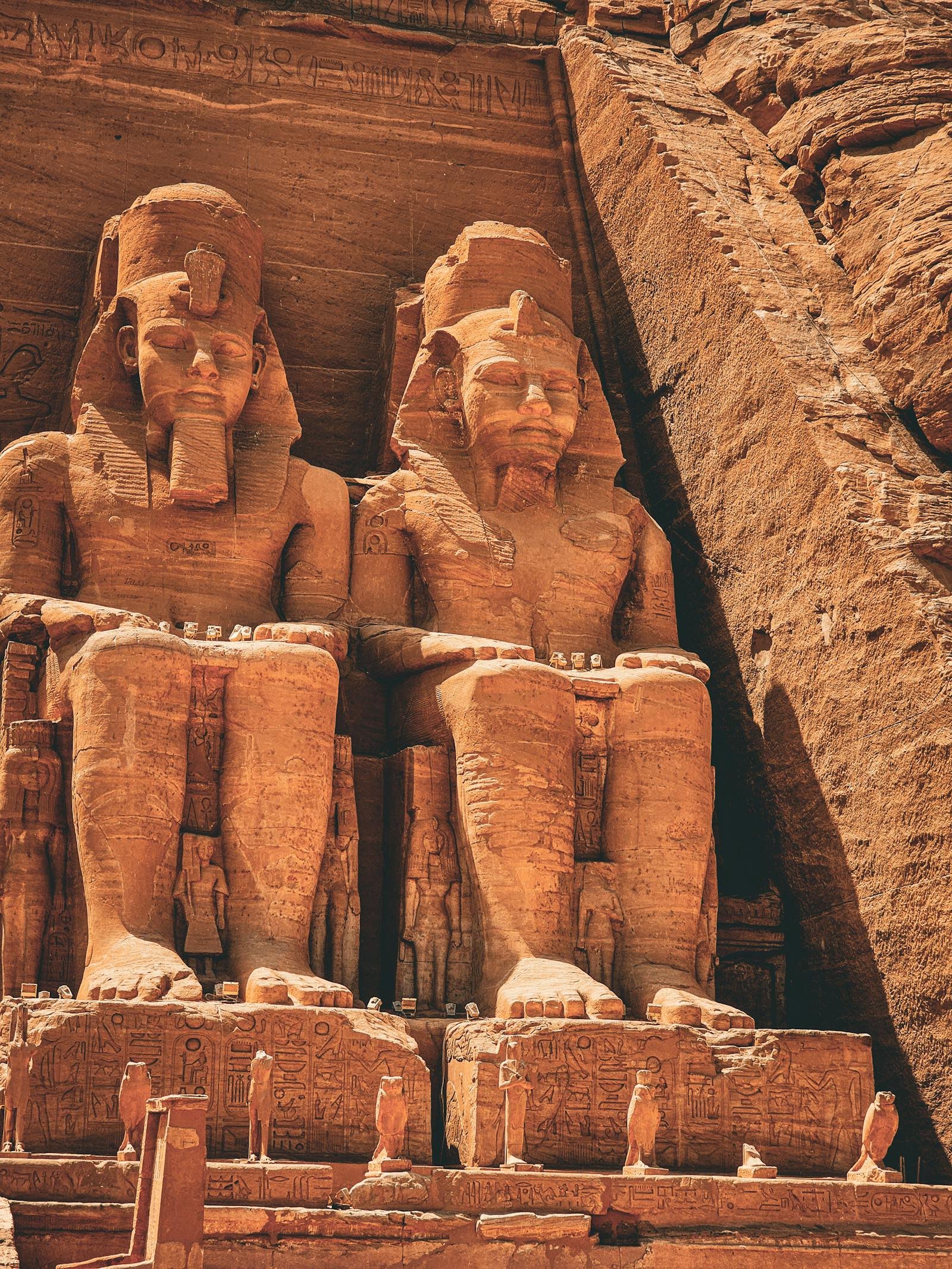
Priests, and why the king was the only real officiant
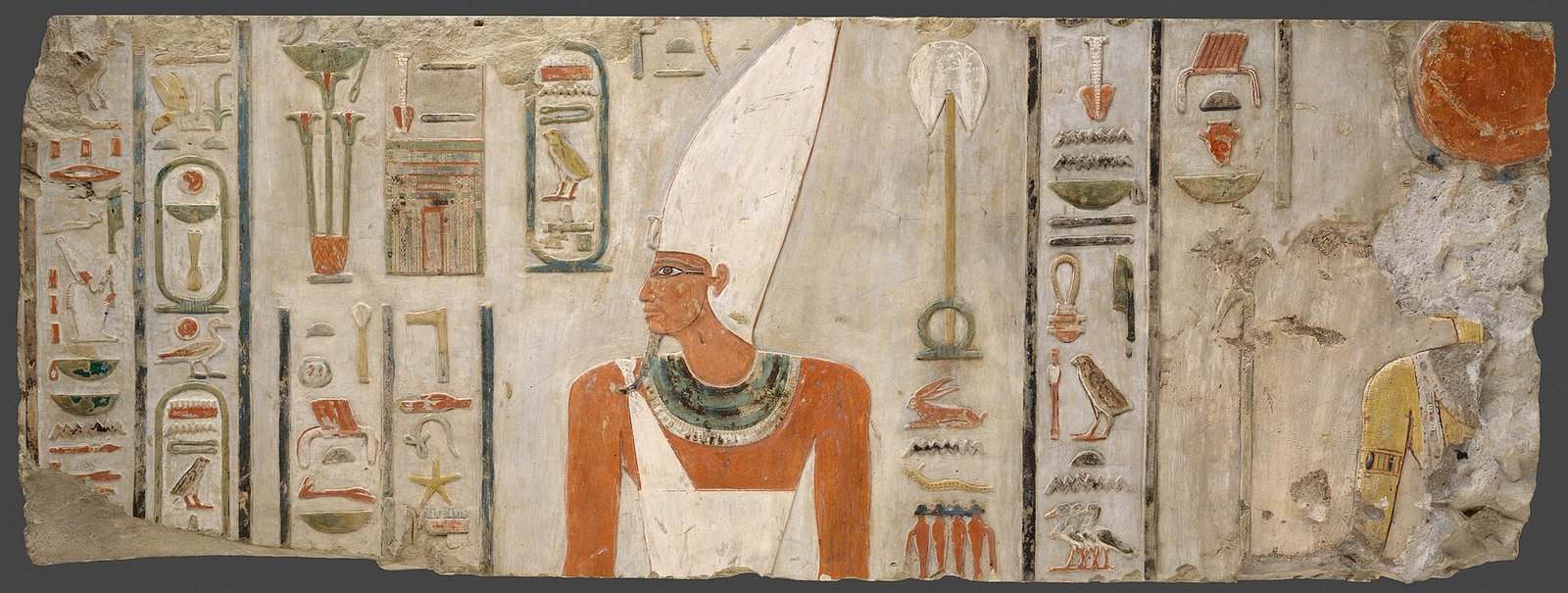
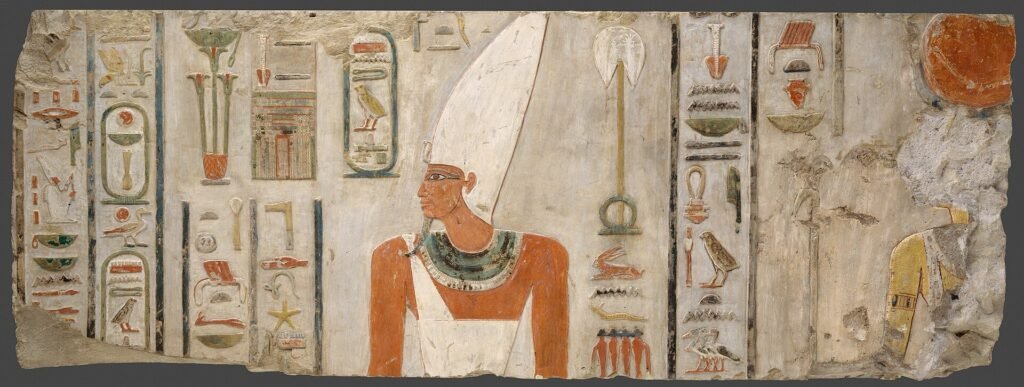
Look at any temple wall and one thing jumps out: the person making the offering is always the king, never a priest. In theory only the pharaoh, as the living Horus, could stand before a god, and every priest in the country was his stand-in.
In practice priesthood was a job, and for most of Egyptian history a part-time one. Priests served in rotating groups, one month in the temple and three back on their land. On duty they shaved their whole bodies, washed several times a day and night, wore only linen and avoided certain foods.
The ranks you will hear about
- Hem-netjer, "servant of the god". The senior priests who entered the sanctuary. The First Prophet of Amun at Karnak became one of the most powerful men in the country.
- Wab, "the pure one". The ordinary priests who carried the sacred boat and handled the offerings.
- Sem priest. The funerary officiant in a leopard skin, often the eldest son, who performed the Opening of the Mouth on the mummy.
Festivals: the days the god came out
If the daily ritual was for priests, the festival was for everyone else. On set days the statue left its shrine inside a cabin on a gilded boat, carried on poles on the shoulders of priests out through the pylon and down the avenue. This was the only time most Egyptians came close to their god, and they turned out in crowds.
- Opet. During the flood season Amun of Karnak traveled about two miles south to Luxor Temple to renew his bond with the king. Tutankhamun's colonnade at Luxor Temple shows the whole procession, boats, dancers and cattle included.
- The Beautiful Festival of the Valley. Once a year Amun crossed the Nile to the west bank and visited the royal memorial temples along the cliffs. Families followed, spent the night at the tombs of their relatives, ate and drank, and in a real sense had dinner with the dead.
Festivals were also when you asked the god a question. A yes or no petition was placed in the path of the boat, the carriers stopped, the boat dipped forward or back, and that was the verdict. At Deir el-Medina the oracle of the deified king Amenhotep I settled who owned a donkey and who stole a chisel, and the written rulings survive.
Religion at home: Bes, Taweret and the amulet drawer
The state gods lived in temples the public could not enter, so households had their own gods, and these were the ones people turned to when a child was sick. Bes is the bandy-legged dwarf with a lion's mane and his tongue out, who scared off snakes, scorpions and bad dreams and watched over childbirth. Taweret is the standing pregnant hippopotamus with lion paws and a crocodile tail, protector of pregnant women.
Houses at Deir el-Medina, the village of the tomb builders, still have the wall niches where these figures stood, next to painted busts of ancestors who were asked to intercede from the other side.
Then there were amulets, worn in life and wrapped into the bandages in death: the ankh for life, the scarab for rebirth, the wedjat eye of Horus for healing, the djed pillar for stability. Each was activated by a spell. Our guide to the ankh, the scarab and the eye of Horus goes through them one by one.
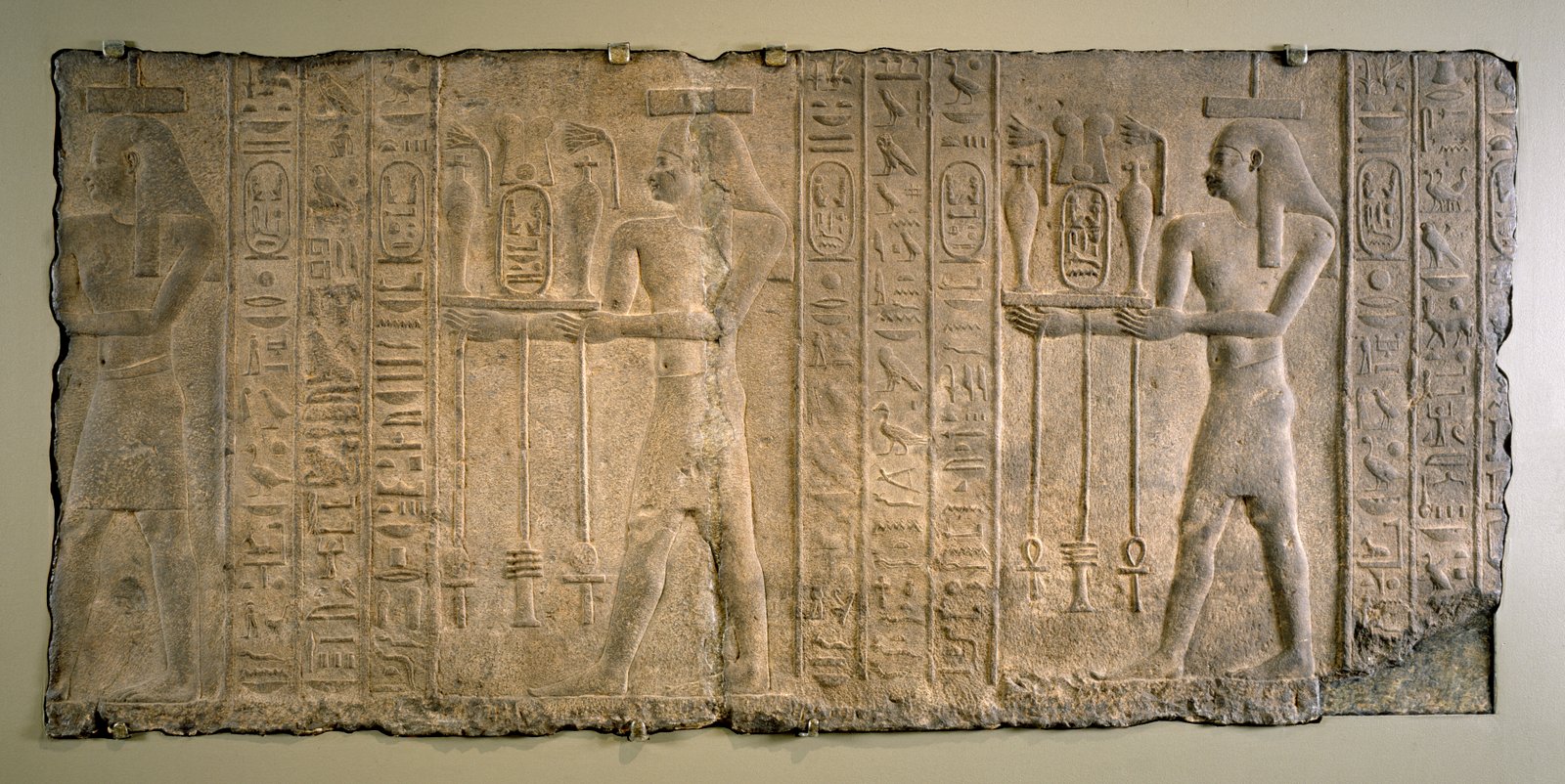
The tomb as an eternal house, and what the afterlife required
Egyptians called the tomb the "house of eternity" and meant it literally. A person was made of several parts that had to stay together after death: the body, the ka or life force that needed to eat, the ba that flew out by day as a human-headed bird, and the name. Lose one and the person ceased to exist.
That is why the body was preserved over seventy days in a specialist workshop, a process we describe step by step in mummification in ancient Egypt. It is also why a tomb had a false door, a carved doorway that went nowhere, through which the ka came out to receive the bread and beer on the offering table.
The dangerous part came in between. The dead crossed a landscape of gates and guardians, then stood in the hall of judgment while Anubis weighed the heart against the feather of Maat, Thoth recorded the result and a crocodile-headed monster waited for a heart that tipped the scale. Pass, and Osiris welcomed you into a field of reeds much like a well-run Egyptian farm.
Maat, the idea that holds everything else up
One word explains why any of this was done. Maat means truth, justice, order and balance at once. It was pictured as a woman with an ostrich feather on her head, but it was less a goddess than a condition: the world as it should be, the Nile rising on time, the courts fair, the strong not eating the weak.
The king's real job, above war and administration, was to maintain Maat. That is why he is shown again and again holding out a tiny seated figure of the goddess to the gods. He is not giving a present. He is handing in a report that the world is in order.
The same standard applied to everyone. In the judgment hall the dead recited what they had not done: I have not stolen, I have not cheated on the grain measure, I have not diverted my neighbor's water, I have not made anyone weep.
Sacred animals and the animal cults
The animal side of the religion puzzles visitors, so separate two things. The first is the sacred animal, a single living creature chosen as the earthly vessel of a god. The Apis bull of Memphis, picked for its markings, lived in a palace, gave oracles, and on its death was mummified and buried in a granite sarcophagus in the Serapeum at Saqqara before a new bull was found. Elephantine had its rams and Kom Ombo its crocodiles.
The second is the votive animal mummy. From the Late Period onward pilgrims bought a mummified ibis, cat, falcon or baboon at the temple and dedicated it as a prayer in physical form. The temples bred the animals for the purpose, and catacombs at Saqqara and Tuna el-Gebel hold millions of them.
The mummified crocodiles on show at Kom Ombo are the easiest place on a Nile cruise to see it for yourself.
The Aten interlude, when one king tried to close the system
The one serious attempt to replace all of this came from inside the palace. Amenhotep IV renamed himself Akhenaten, declared the visible sun disk, the Aten, the only god worth worshipping, shut the temples of Amun, had the god's name chiseled off monuments and built a new capital at Amarna, halfway between Cairo and Luxor.
The new religion had no dark sanctuary. Aten temples were open to the sky and heaped with offering tables in the sunlight, and the disk was shown with rays ending in small hands that held the ankh to the noses of the king and queen alone. Ordinary people could reach the god only through the royal family, which is probably why almost nobody outside the court adopted it.
It lasted about seventeen years. After his death the court returned to Thebes, the young Tutankhamun restored Amun, and within a generation Akhenaten's own name had been erased.
Greeks, Romans and the last temples at Philae
The religion did not end with the pharaohs. When the Ptolemies took Egypt after Alexander, and when Rome took it from Cleopatra, the new rulers had themselves carved on temple walls as pharaohs making offerings to the local gods. The best preserved temples in the country, Edfu, Dendera, Kom Ombo, Esna and Philae, were all built or finished under Greek and Roman rule, which is why they look so complete.
The real decline came with Christianity in the fourth and fifth centuries, when temple income was cut off, the cults were banned and the priesthoods dissolved. Many temples became churches. The chiseled-out faces and the crosses cut into the columns at Philae and Luxor Temple date from this period.
The last holdout was Philae, the temple of Isis south of Aswan, kept alive by Nubian pilgrims from the upper Nile. The last dated hieroglyphic inscription anywhere was carved there in the late fourth century, and the cult was finally closed by the emperor Justinian in the sixth.
How to read a temple on your visit: axis, light and darkness
Once you know the temple was a house with a resident, the architecture explains itself. Almost every temple follows one straight axis designed to move you from the world of people to the world of the god:
- The pylon. The two gateway towers are shaped like the hieroglyph for horizon, with the sun rising between them. Outside, the king smites Egypt's enemies.
- The open court. Sunlit and colonnaded, where the crowd stood on festival days, the one part most Egyptians ever entered.
- The hypostyle hall. A forest of columns with papyrus and lotus capitals, painted as the marsh of creation. The roof closes over you and light comes only from stone grilles high up.
- The floor rises, the ceiling drops. With every doorway the floor steps up and the ceiling lowers, so the space shrinks and darkens as you go in. You are climbing the mound that rose from the waters at the beginning of time.
- The sanctuary. A small windowless room where the statue lived. At Edfu the granite shrine is still in place.
Also look for the sacred lake beside Karnak where priests washed at dawn, the roof chapels at Dendera where the statue of Hathor was carried each New Year to meet the sun.
Where to see it, and how Explora Egipto builds it into a trip
Every piece of this religion is still visible somewhere between Cairo and Aswan. The trick is to see them in an order that makes sense, with someone beside you who can read the walls.
| What you want to understand | Where it is best seen | What to look for |
|---|---|---|
| The daily ritual | Abydos, Karnak, Edfu | The king opening the shrine, dressing and feeding the god |
| The Opet festival | Luxor Temple, the sphinx avenue | Tutankhamun's colonnade with the boats, dancers and cattle |
| The Beautiful Festival of the Valley | Deir el-Bahari, the Tombs of the Nobles | Family banquets in the tombs, the god's boat on the west bank |
| The afterlife and judgment | Valley of the Kings, Deir el-Medina tombs, papyri in Cairo | The weighing of the heart, the field of reeds, the false door |
| Sacred animals | Serapeum at Saqqara, Kom Ombo | The Apis bull sarcophagi, the mummified crocodiles |
| The Greek and Roman continuation | Edfu, Dendera, Kom Ombo, Esna, Philae | Emperors dressed as pharaohs, birth houses, crosses and erased faces |
A first trip usually runs in this order: Saqqara and the museums in Cairo for the tomb and the animal cults, a domestic flight to Luxor for Karnak, Luxor Temple and the west bank, a Nile cruise south through Esna, Edfu and Kom Ombo, and Philae at Aswan to close the story where it actually closed. Our guides are Egyptologists and point these things out on the spot.
Frequently asked questions
What was the main belief of ancient Egyptian religion?
If it has to be one thing, it is Maat, the idea that the world has a correct order which gods, king and people keep in place through right action. Everything else follows: the daily offerings, the king as guardian of order, the judgment of the dead against the feather of truth, and the tomb built for the next life.
Could ordinary Egyptians go inside a temple?
Not past the first courtyard, and usually only on festival days. The inner halls and the sanctuary belonged to the priests and, in theory, the king. Most people met their god at the rear wall of the temple, built for public prayer, or when the statue came out in procession on its boat. At home they had their own protective gods.
Were the priests full time?
Most were not. Priests served in rotating groups, typically one month in the temple and three months back at their normal work as scribes, farmers or officials. On duty they shaved, washed repeatedly, wore linen only and followed food rules. A small senior staff, including the high priest, was permanent.
Why did the Egyptians worship animals?
They did not worship the animal as such. A god could show himself in a living creature, so one bull, one crocodile or one ram was chosen, cared for and buried with honors as the god's vessel. Separately, from the Late Period onward pilgrims dedicated mummified cats, ibises and falcons as prayers in physical form, by the million.
When did ancient Egyptian religion end?
Gradually, under Christianity in the fourth and fifth centuries, when the temples lost their income and the cults were banned. The last dated hieroglyphic inscription was carved at Philae in the late fourth century, and the temple of Isis there stayed active for Nubian pilgrims until the emperor Justinian closed it in the sixth.
Which temples show the religion best on a first trip?
Karnak for scale and the sacred lake, Luxor Temple for the Opet festival reliefs, Edfu because it is complete from pylon to sanctuary with the shrine in place, Kom Ombo for the crocodile cult, Dendera for the roof chapels, and Philae for the end of the story. Add the Luxor west bank for the judgment scenes.
Walk the axis from the sunlit court to the dark sanctuary
Tell us your dates and how many days you have, and we send you an itinerary that follows the religion of the pharaohs in the right order, from the tombs at Saqqara to the last temple at Philae, with an Egyptologist guide who reads the walls for you. No prices on this page, just a quote in your inbox.