
Ancient Egyptian art is recognizable by its formal, timeless poses, figures with head and legs in profile but eye and shoulders facing forward, size that reflects importance, and a system of proportions that held for nearly three thousand years. It was not made for its own sake: it had a religious purpose and was meant to last forever. Its architecture of pyramids, temples and rock-cut tombs still stands in Cairo, Luxor and Aswan.
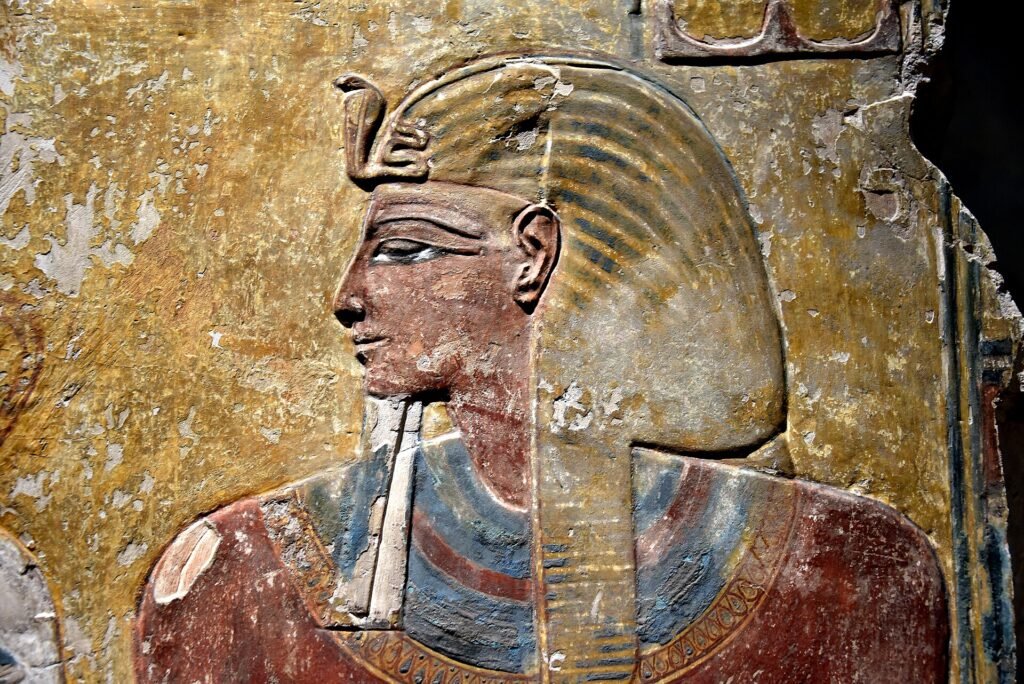
Walk into an Egyptian temple for the first time and the same feeling usually hits: everything is huge, everything is covered in figures, and yet they all look alike. There is a reason for that, and understanding it changes the whole visit. Egyptian art was not art in the modern sense. It was not signed, it did not chase originality and it was not made to be admired in a gallery. It was made to work: to keep the dead alive, to feed the gods and to hold the world in order.
This guide explains its main features, how Egyptians painted and carved, what the colors meant, how temples and tombs were built and where to see each of these on your trip. For the full historical background, start with our guide to ancient Egypt.
The big exception is the reign of Akhenaten, around 1350 BC, when art suddenly loosened up: elongated bodies, expressive faces and intimate scenes of the royal family playing with their daughters. The bust of Nefertiti comes from this moment. After his death, art went back to the old rules.
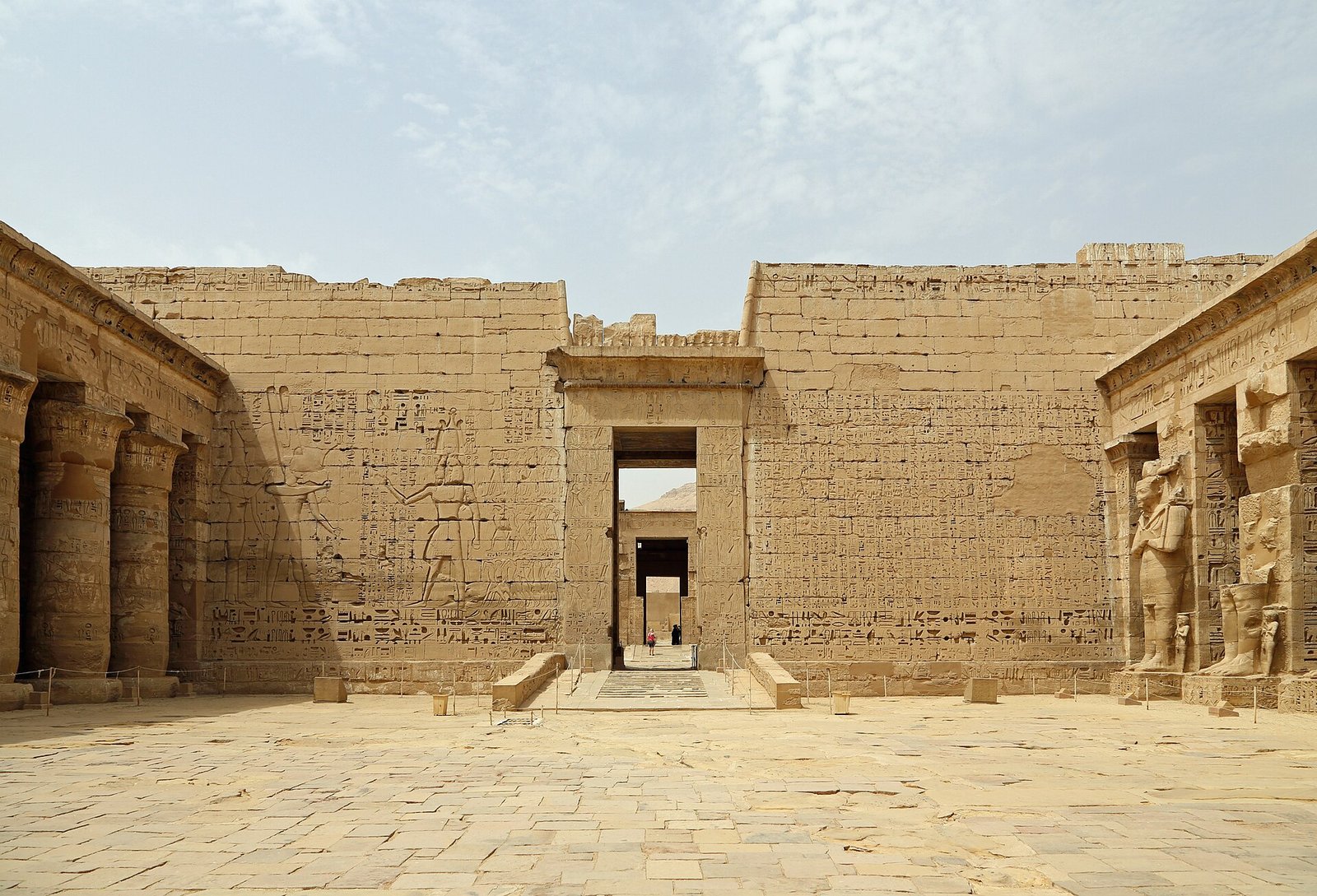
Egyptians used two ways of carving walls. In raised relief, the stone around the figure is cut back so the figure stands out; it is the more delicate technique and was used mainly indoors, where the light is soft, as in the temple of Seti I at Abydos, covered in our guide to Dendera and Abydos. In sunk relief, the figure is cut into the stone and the surface around it is left intact. Under the strong outdoor sun, sunk relief throws deep shadows that read from a distance, which is why it covers the facades and courtyards of temples such as Medinet Habu.
Nearly everything was painted, including the reliefs and stone statues we now see in bare stone. Artists painted onto dry plaster with mineral pigments bound with plant gum. The Egyptians also invented Egyptian blue, often called the first synthetic pigment in history, made by heating sand, copper and lime. The tombs of the Valley of the Kings and the Tombs of the Nobles are the best places to see those colors almost untouched.
One more convention: men were painted with reddish-brown skin and women with a lighter yellowish tone, reflecting the outdoor life expected of one and the indoor life expected of the other.
Egyptian statues are designed to be seen from the front and keep the shape of the stone block they came from: arms close to the body, legs joined to a back pillar, one foot forward on standing male figures as a sign of striding ahead. The types were fixed: the king seated on his throne, the king standing, the seated scribe with a papyrus across his knees, or the block statue, a figure sitting with knees drawn up and wrapped in a cloak so that only the head shows.
At the other extreme are the colossi, giant royal statues meant to overwhelm anyone arriving at the temple. Those of Ramesses II at Abu Simbel and Luxor Temple are visible from far away. In Ptolemaic Egypt, sculpture blended Egyptian tradition with Greek realism for the first time, which you can see in portraits of Cleopatra and her ancestors.
Egyptian architecture drew a line between what had to last forever and what did not. Houses, palaces and city walls were built of mud brick and have almost entirely vanished. Temples and tombs, the houses of the gods and the dead, were built in stone: limestone in the north, sandstone in the south and Aswan granite for obelisks, sarcophagi and statues. The hallmarks are sloping walls, flat roofs carried on columns, symmetry along a central axis and a scale designed to make people feel small.
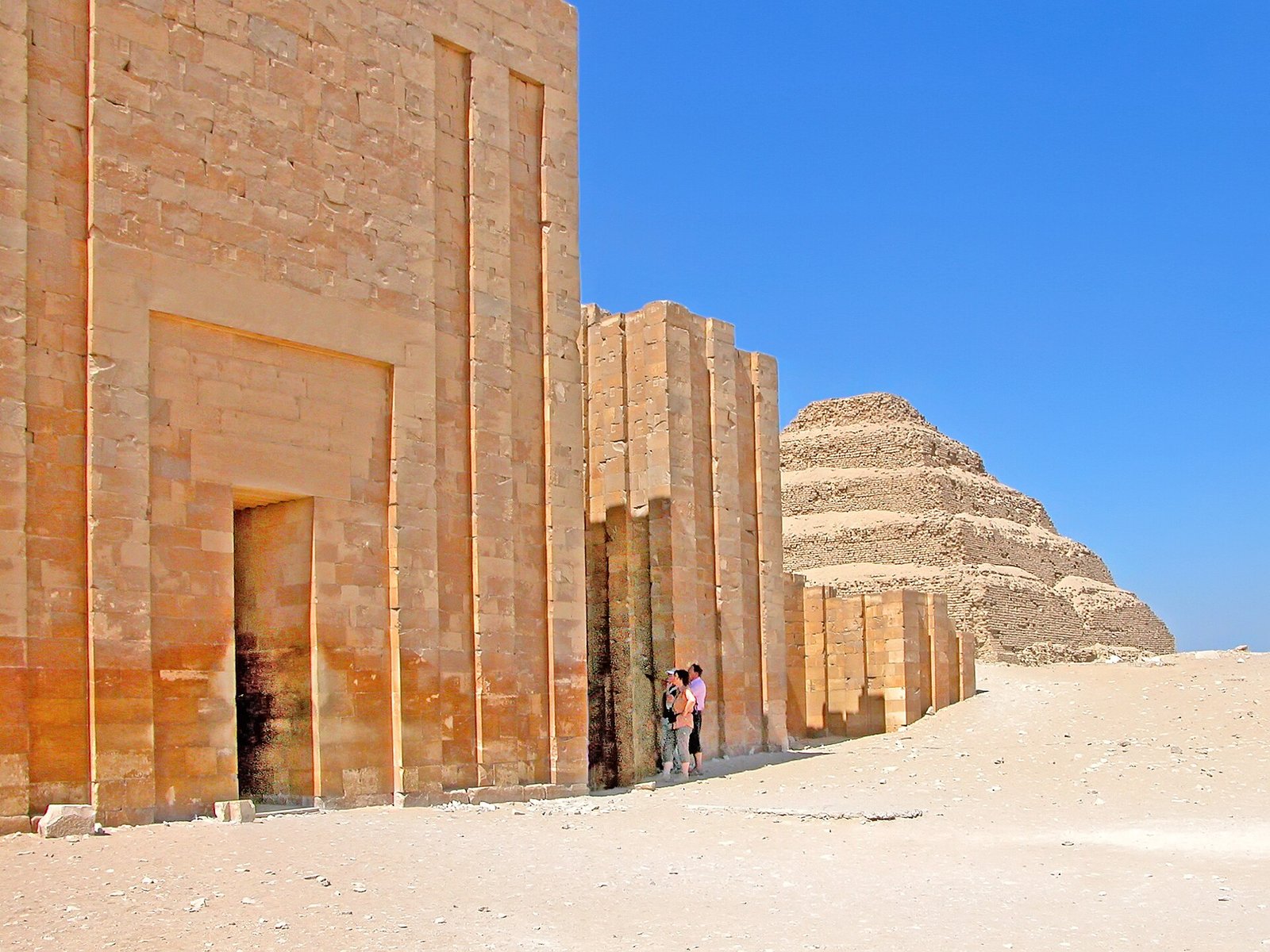
The first royal tombs were mastabas, flat-topped rectangular buildings over a burial shaft. Around 2650 BC the architect Imhotep stacked six stone mastabas of decreasing size for King Djoser, and the Step Pyramid of Djoser, the world's first large stone building, was born. Its complex already has fluted columns that recall Greek ones two thousand years early. From there came the smooth-sided pyramids of Dahshur and the perfection of Giza, explained in how the pyramids were built.
New Kingdom temples follow an almost fixed plan, best understood as a path from the outside world to the god. First an avenue of sphinxes and the pylon, the monumental two-towered gateway; then an open, sunlit courtyard; then the hypostyle hall, a forest of columns in half-light; and finally the sanctuary, small and dark, where the god's statue lived. As you move inward, the floor rises, the ceiling drops and the light fades. Karnak is the largest example, and our 10 must-see temples in Egypt covers the rest.
Columns imitated plants: papyrus columns with closed or open capitals, lotus columns, palm columns and Hathor columns crowned with the goddess's face, as at Dendera. Together they turned the hypostyle hall into a stone version of the primeval marsh where, in Egyptian myth, creation began.
In the New Kingdom, kings gave up pyramids and cut their tombs into the rock: long decorated corridors sloping down to the burial chamber. Whole temples were also carved into cliffs, such as Abu Simbel. Obelisks, single-block granite needles dedicated to the sun, were cut in the Aswan quarries, where the Unfinished Obelisk still lies in the bedrock and shows exactly how the work was done.
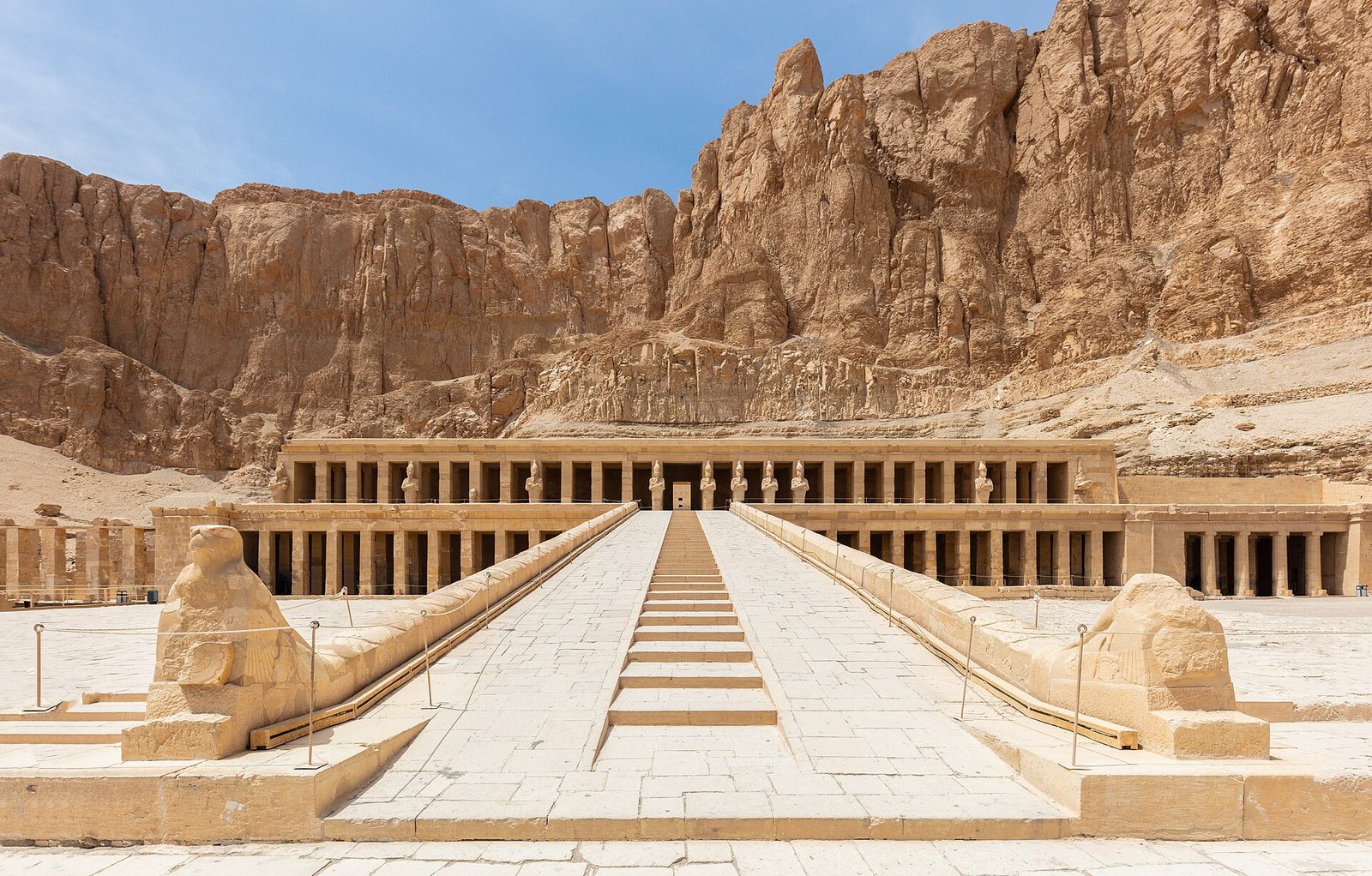
Hatshepsut's temple at Deir el-Bahari is a magnificent exception: three colonnaded terraces set against the foot of the cliff, a fusion of building and landscape that feels strikingly modern.
If you want to try drawing a figure the way Egyptian artists did, at home or with kids before the trip, follow their own rules:
All of these fit into an eight to ten day trip with a Nile cruise. Our itineraries, with an Egyptologist guide who teaches you to read every wall, are on Egypt tour packages.
Formal, timeless poses; the composite view, with head and legs in profile and eye and shoulders facing forward; hierarchical scale, where size shows importance; a grid-based canon of proportions; and a religious purpose, since art served to keep the world in order and secure eternal life.
Because artists wanted to show each body part in its most recognizable form: head and legs read best in profile, eye and shoulders from the front. It was not a lack of skill but a convention with religious meaning.
Because it followed fixed rules, including a grid of proportions, set poses and symbolic colors, that were taught in workshops and copied for about three thousand years. Art was meant to preserve order, not to innovate. The main break was the Amarna period under Akhenaten.
Stone for temples and tombs and mud brick for houses and palaces, sloping walls, flat roofs carried on plant-shaped columns, symmetry along an axis and monumental scale. Its main types are pyramids, temples and rock-cut tombs.
An avenue of sphinxes, the pylon or monumental gateway, an open courtyard, the hypostyle hall full of columns and the sanctuary holding the god's statue. From the courtyard to the sanctuary the floor rises, the ceiling drops and the light fades.
At Saqqara and Giza for the first stone buildings, in Cairo's museums for sculpture and Tutankhamun's treasure, in Luxor for temples and painted tombs, and at Dendera, Abydos, Aswan and Abu Simbel for color, fine relief and rock-cut architecture.
All our itineraries are on Egypt tour packages.
Keep exploring