Memphis and Saqqara are the half day that explains the Pyramids of Giza, and this is how to do it right
Memphis and Saqqara are the half day that explains the Pyramids of Giza, and this is how to do it right
Memphis and Saqqara sit side by side about 19 miles (30 km) south of downtown Cairo and are visited as one half day: Saqqara first, then the open-air museum at Memphis on the way back. Memphis was the capital of the Old Kingdom, the city that built the Pyramids of Giza, and almost nothing of it stands beyond a palm garden of rescued sculpture around a fallen colossus of Ramesses II and an alabaster sphinx. Saqqara was its cemetery for three thousand years and has far more to walk through: the Step Pyramid, the Pyramid Texts inside Teti, the carved mastabas, the Serapeum and the Imhotep Museum. Pair it with Giza or with Dahshur. Here is how we run it.
Memphis, the capital that ran Egypt for most of its history
Tradition says Menes, the king who joined Upper and Lower Egypt around 3100 BC, founded Memphis at the seam between the two, where the Nile valley opens into the delta. Whoever held Memphis held the river, the road north and the road south.
Its first name was Inebu-hedj, White Walls. The name we use comes from Men-nefer, "enduring and beautiful", the pyramid town of Pepi I that grew into the city. The temple of Ptah, its creator god, was Hut-ka-Ptah, and the Greek rendering of that, Aigyptos, gave the whole country the name Egypt.
Through the Old Kingdom the court ruled from here and buried itself along the desert edge: Saqqara, Abusir, Dahshur and, for three kings of the fourth dynasty, the plateau at Giza. When power moved to Thebes and later to the delta, Memphis stayed the administrative hub. Ramesses II filled its temples with colossi and Alexander was crowned pharaoh here. Then Alexandria took the trade, and the builders of medieval Cairo took the stone.
What actually remains at Memphis: the open-air museum at Mit Rahina
Set your expectations. The city was mostly mud brick, the Nile shifted east and buried what was left in silt, and the cut stone went to Cairo. What survives is a walled palm garden in the village of Mit Rahina, with a two-story pavilion and sculpture along gravel paths. It takes 30 to 45 minutes.
The fallen colossus of Ramesses II
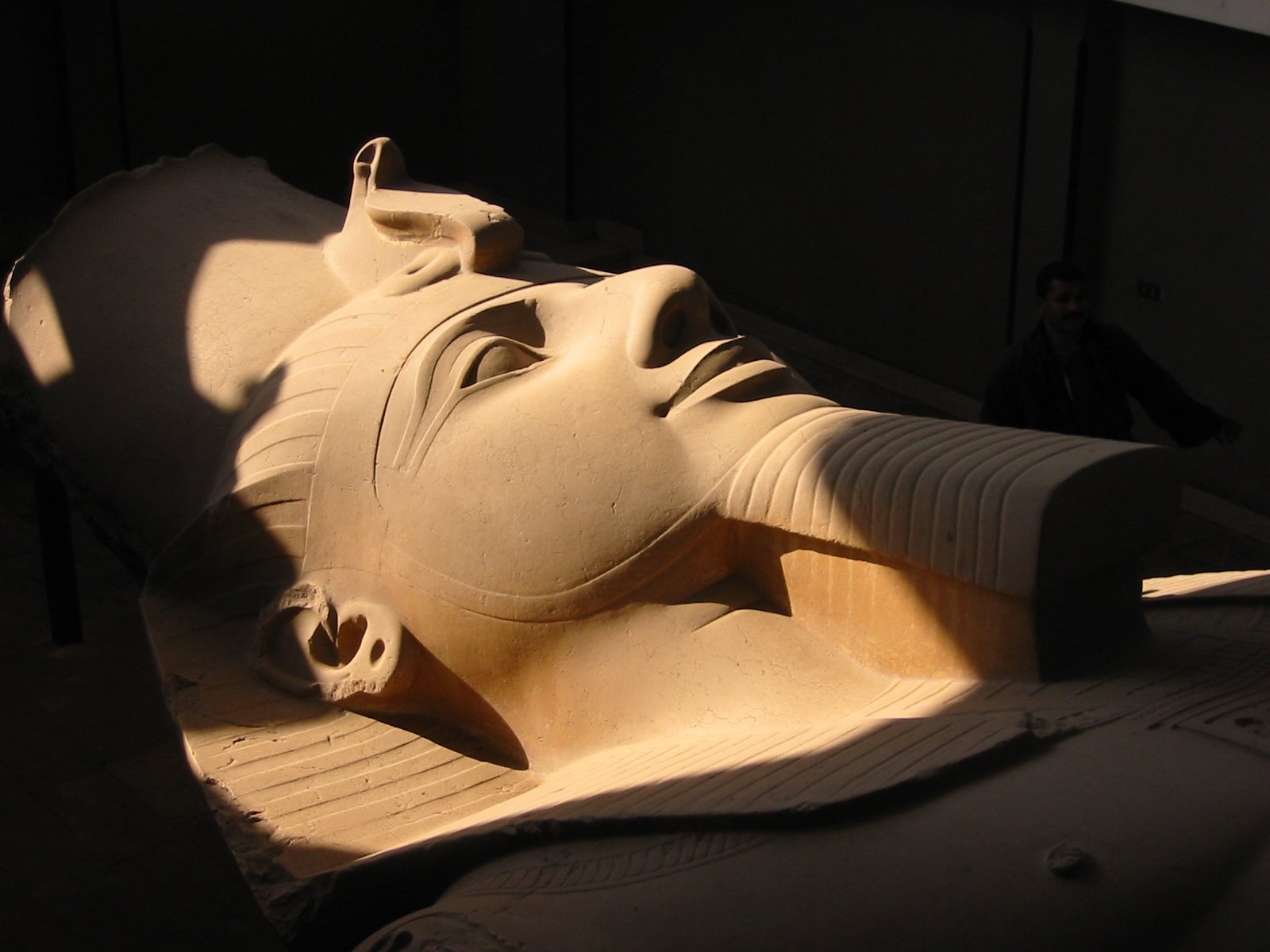
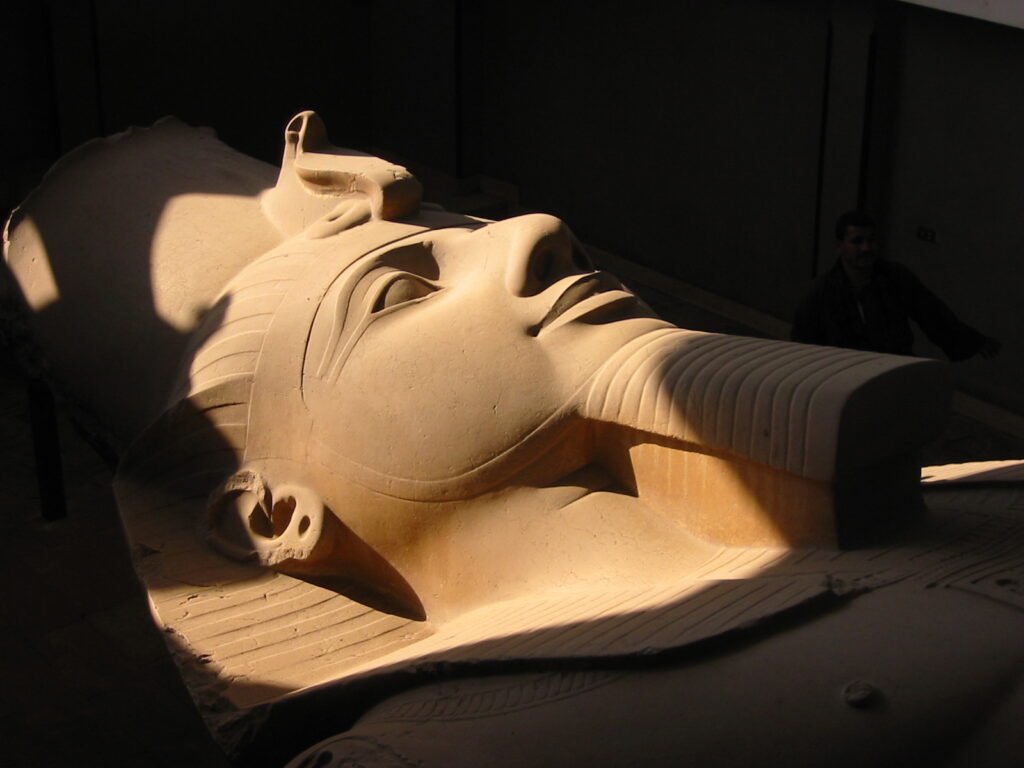
The pavilion was built around one piece: a limestone colossus of Ramesses II, about 33 feet (10 m) as carved, missing its lower legs and lying on its back. You walk a gallery at first-floor level and look down on a face that is almost undamaged, then along the belt to the cartouches and the dagger in the waistband.
It had a twin, which stood for decades in Ramses Square outside Cairo's railway station and now stands in the atrium of the Grand Egyptian Museum.
The alabaster sphinx and the rest of the garden
Outside is a sphinx carved from a single block of calcite, the honey-colored stone Egyptians call alabaster, roughly 26 feet (8 m) long. It carries no royal name and the face is usually placed in the eighteenth dynasty. It lay half buried in wet ground for centuries, which is why one flank is paler than the other.
- A standing granite colossus of Ramesses II among the palms.
- The calcite embalming tables where the Apis bulls were prepared before burial at Saqqara.
- Column drums, statue fragments and reliefs from the Ptah temple, which lies in the fields beyond the fence.
Saqqara, the cemetery that outlived the city
Saqqara is the desert shelf above Memphis, a plateau about 4 miles (6 km) long that served as the capital's burial ground from the first dynasty to Roman times. Roughly a dozen kings built pyramids here, most now rubble hills, and thousands of officials built tombs around them.
Giza is scale: three perfect pyramids and a sphinx, seen mostly from outside. Saqqara is detail: you go inside, you read the walls, and you do it with a fraction of the crowd. People who leave Giza slightly underwhelmed usually leave Saqqara converted.
The site is spread out and you drive between its clusters: from the entrance and the Imhotep Museum up to the Djoser complex, a few minutes northeast to Teti and its mastabas, further north to Ti and the Serapeum. Without a vehicle and a plan it becomes a long, hot walk between fences.
The Step Pyramid complex of Djoser
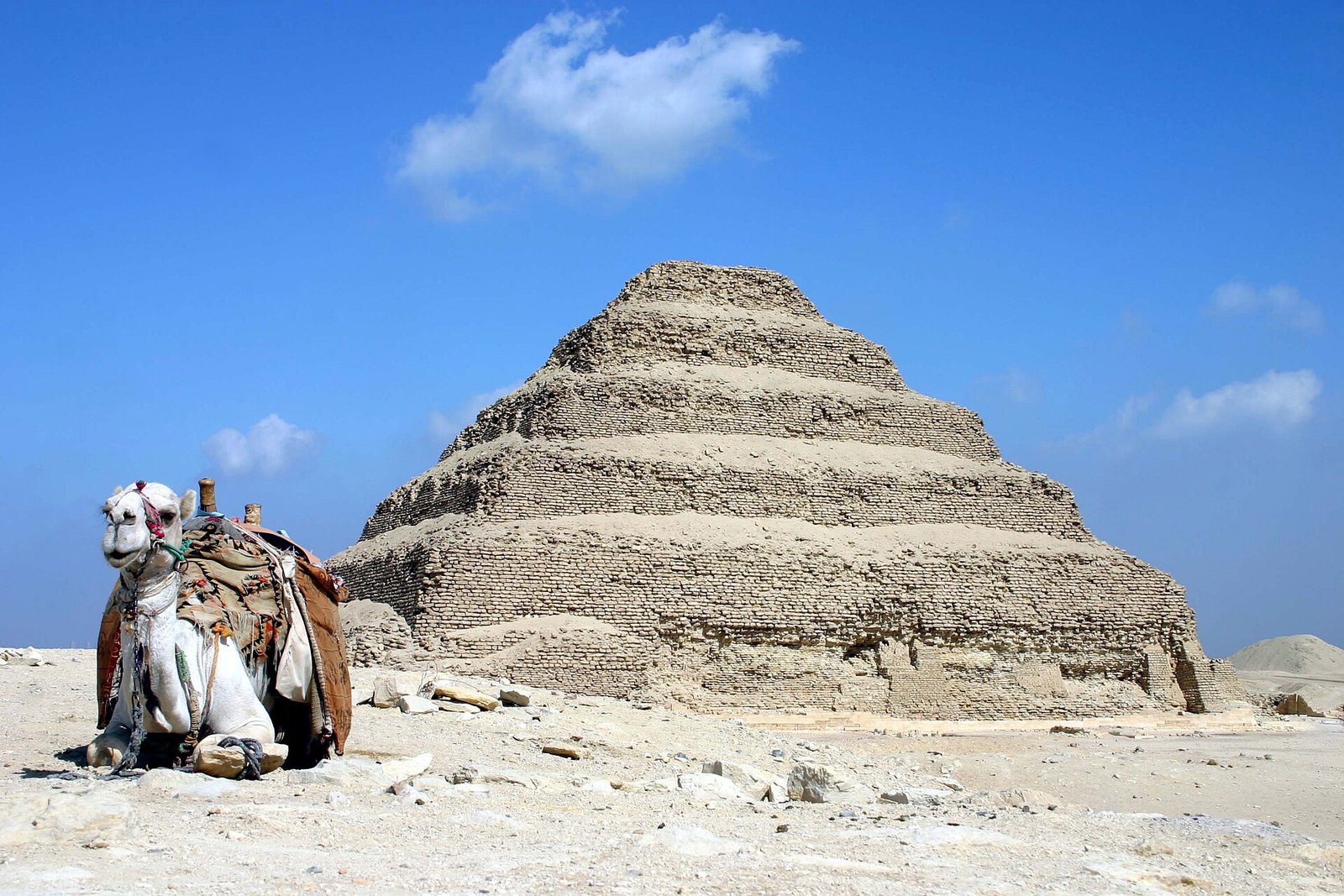
Around 2650 BC, King Djoser of the third dynasty and his architect Imhotep raised the first large stone building in the world. It began as a mastaba, the flat tomb everyone before him had used, and was enlarged in stages until it rose in six steps to about 200 feet (60 m). Every later pyramid is an answer to this one.
The pyramid sits inside a walled enclosure nearly a mile around, and the enclosure is where the genius is:
- The wall and the colonnade. Fourteen false doors and one real one, leading into a passage of forty engaged columns shaped like bundled reeds, the first stone columns anywhere.
- The Great Court and the Heb Sed court. The space where the king ran between two markers in his jubilee rite, and a row of dummy chapels in stone copying the reed shrines of Upper and Lower Egypt.
- The serdab. A sealed stone box with two holes at eye level. Look in and a seated statue of Djoser looks back. It is a replica; the original is in the Egyptian Museum in Tahrir.
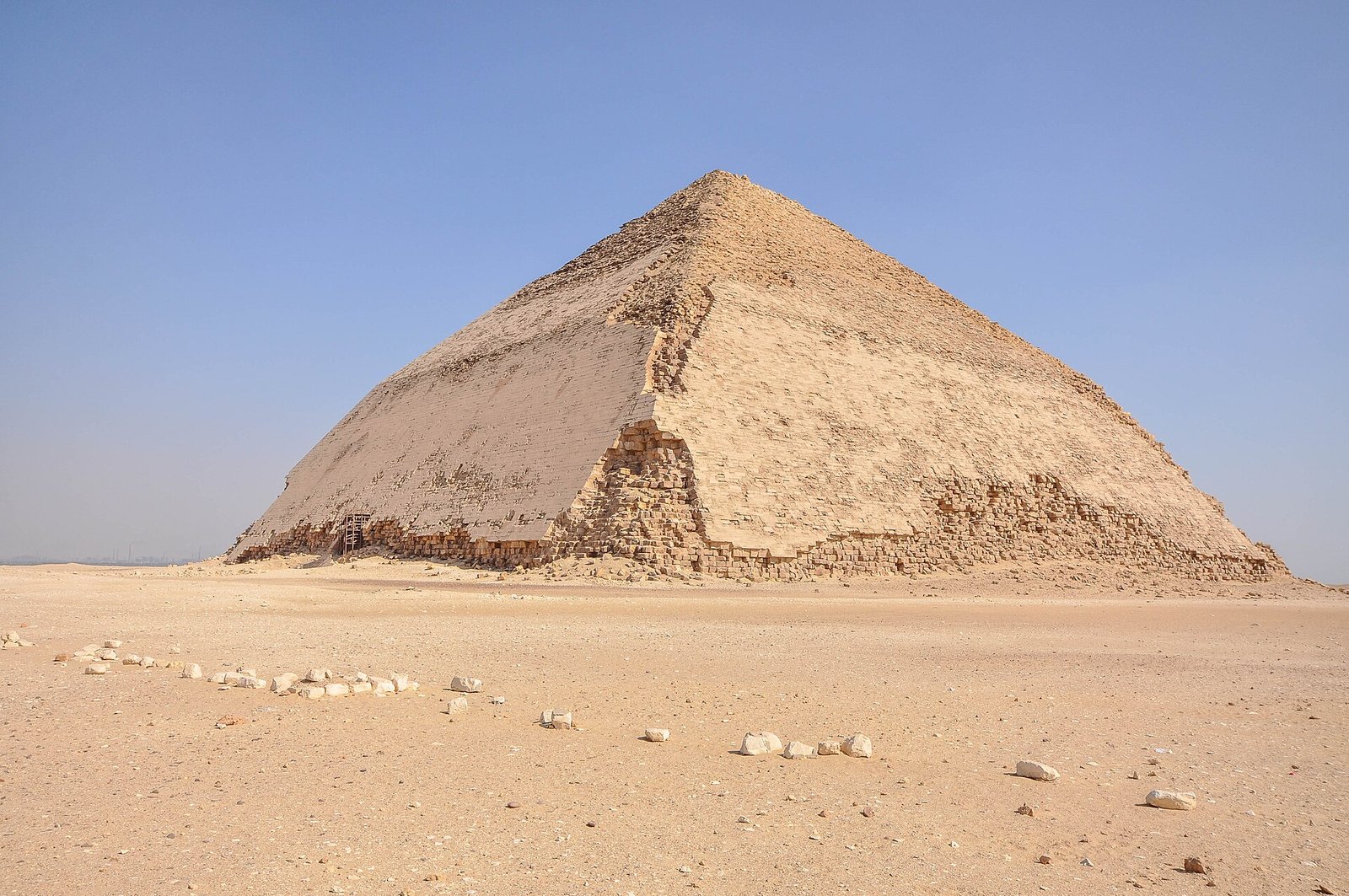
The interior, a maze of galleries around a central shaft, reopened after a long restoration and needs its own ticket and steady legs. On a clear morning, stand in the Great Court and look south: the Bent and Red Pyramids of Dahshur sit on the horizon.
The Pyramid of Teti and the Pyramid Texts
From outside, the pyramid of Teti, first king of the sixth dynasty, is a hill of rubble you would drive past. Go in anyway. A low corridor, about 20 yards of walking bent double, drops to a burial chamber whose walls are covered in columns of hieroglyphs under a ceiling of carved stars, with the dark stone sarcophagus still in place.
These are the Pyramid Texts, the oldest body of religious writing in the world: spells to get the dead king out of the tomb, past the gatekeepers of the sky and into the boat of the sun god. Everything that came after descends from them, down to the papyri of the Book of the Dead.
The first king to carve them was Unas, south of the Djoser enclosure, whose texts are finer and picked out in blue; Teti is the one more reliably open. If both are open, do both. The descent takes 15 minutes, it is hot inside, and it is not for bad knees or a fear of tight spaces.
The mastabas: Kagemni, Mereruka and Ti
A mastaba is a private tomb shaped like a bench, with chapel rooms inside for offerings and a shaft down to the burial. The chapels are the point: their walls carry the daily life of the Old Kingdom in low relief, carved by the best sculptors in the country for the men who ran it.
Mereruka
Vizier to Teti and married to his daughter, Mereruka built the largest private tomb at Saqqara, more than thirty rooms beside the king's pyramid. The scenes run from a hippopotamus hunt to goldsmiths weighing metal, hyenas force-fed for the table and tax collectors beating village headmen. In the offering hall a life-size statue of Mereruka steps out of the false door to eat.
Kagemni
Next door, and also one of Teti's viziers, Kagemni has a smaller tomb with some of the most delicate carving on the site: fishermen hauling nets, cattle fording a canal with a calf carried across, acrobatic dancers. It is quieter than Mereruka and easier to read.
Ti
North of the Djoser complex, near the Serapeum, is the fifth dynasty tomb of Ti, overseer of the royal pyramids at Abusir. The reliefs are the most celebrated at Saqqara: the hippo hunt with Ti standing calm in his boat, a shipyard, harvest and threshing. Peer through the slots in the serdab wall and a statue of Ti looks out at you.
There are more when open, such as Ankhmahor, Ptahhotep and the New Kingdom tomb of the general Horemheb. Which you can enter changes with the conservation schedule, which is why a guide with today's information beats any printed list.
The Serapeum and the Imhotep Museum
In every generation one bull was chosen as the living Apis, the earthly presence of Ptah. It lived in the temple at Memphis, and when it died it was embalmed on the calcite tables you saw at Mit Rahina and carried up to Saqqara. The Serapeum is where the bulls lie.
Auguste Mariette found it in 1851 by following an avenue of sphinxes described by an ancient geographer. What he opened was a long gallery cut into the rock, with side chambers each holding a sarcophagus of granite or basalt carved from a single block and weighing on the order of 70 tons. Two dozen line the corridor. It is cool, dim and usually nearly empty.
The Imhotep Museum, beside the entrance, is the other stop people skip and should not. It is small and air-conditioned, and half an hour there makes everything on the plateau make sense: the base of a Djoser statue carrying Imhotep's titles, the blue tiles from the South Tomb, objects from the newest digs and the reconstructed study of Jean-Philippe Lauer, who spent his life rebuilding the Step Pyramid complex.
A site that keeps growing
Saqqara is not a finished excavation. It has been the most productive dig in Egypt for several years: a painted fifth dynasty tomb of a priest with its colors intact, caches of sealed coffins stacked in shafts near the Bubasteion, a mummification workshop with its embalming beds, a queen's funerary temple beside Teti. Our page on recent archaeological discoveries in Egypt keeps the running list.
Two practical consequences follow. What is open changes: tombs close for conservation and new ones open after study, so a guidebook a few years old is already wrong about access. And many of the best new objects have gone to the Grand Egyptian Museum, so a Saqqara morning pairs naturally with a museum afternoon.
How the half day runs: Saqqara with Giza, or Saqqara with Dahshur
Geography decides the shape. Giza to Saqqara is 40 to 60 minutes through the suburbs, Saqqara to Memphis 10 minutes down through the palm groves, Saqqara to Dahshur 15 minutes further south. Everything is close; the traffic in and out of Cairo is what eats the day.
| Plan | Time door to door | What you see | Best for |
|---|---|---|---|
| Giza in the morning, Saqqara and Memphis after lunch | 8 to 9 hours | Giza, then the Step Pyramid, Teti, one or two tombs, Memphis | Travelers with a single day for the pyramids |
| Dahshur, Saqqara and Memphis | 7 to 8 hours | The Bent and Red Pyramids, the full Saqqara circuit, Memphis | Travelers with two Cairo days; the quietest and most complete option |
| Saqqara and Memphis alone | 4 to 5 hours | The Djoser complex, Teti, two mastabas, the Serapeum if time allows, Memphis | Anyone who has already seen Giza, or a short stopover |
Two rules apply whichever you choose. Do Saqqara before Memphis, because the museum garden makes far more sense once you have seen the cemetery it served. And in summer, start at opening time and do the interiors first.
The Dahshur version is the one we recommend most, because it walks the story in order: Sneferu's failed and then perfected pyramids, the first pyramid of all, and the city that paid for them. It slots cleanly into a two-day Cairo plan, with Giza and the Grand Egyptian Museum filling the other day.
Heat, walking and what to bring
Saqqara is an exposed plateau with no shade between the clusters. From May to September it reaches 95 to 104 F (35 to 40 C) by late morning. From November to February the days are a pleasant 65 to 72 F (18 to 22 C), but early mornings on the ridge can be cold and windy, so bring a layer you can shed.
Count on 2 to 3 miles (3 to 5 km) of walking over sand, uneven paving and stairs, plus the crouched descent into Teti. It is more physical than Giza.
- Closed shoes with grip. Sandals fill with sand within minutes.
- A hat, sunglasses and sunscreen; the glare off the limestone is fierce even in winter.
- Two bottles of water per person. The van carries more.
- Small cash for restroom attendants and the tomb guardians who open gates.
- Photography rules inside tombs change, so ask your guide before shooting.
With limited mobility, the Djoser enclosure, the Imhotep Museum and Memphis are manageable on flat ground, and Teti and the Serapeum can be skipped.
What a guide adds, and how Explora Egipto builds the day
Giza rewards a guide. Saqqara requires one. Without someone reading the walls, the mastabas are a blur of small figures and the Pyramid Texts are wallpaper; with one, a fishing scene becomes a tax record and a column of hieroglyphs becomes a king climbing to the stars. At Memphis, a garden of statues stays a garden of statues until someone explains why the sphinx has no name.
A guide also handles what quietly wrecks the day: the ticket desk and its separate interior tickets, which tombs are open this week, the driving order between clusters, and the guardians who expect a tip.
This is how we run it inside our Cairo excursions and the longer Egypt tour packages:
- A private air-conditioned vehicle from your hotel, with an early pickup in summer.
- A licensed Egyptologist guide for the whole day.
- All site and interior tickets handled, with the tombs chosen on the day by what is open and what interests you.
- Saqqara before Memphis, with Dahshur or Giza added as you prefer.
- Lunch at a village restaurant among the palms near Saqqara, or back in the city.
- No shop stops unless you ask. The carpet schools on the Saqqara road are optional.
Send me a quote for a private Saqqara, Memphis and Dahshur day
Frequently asked questions
Is Saqqara worth visiting if I have already seen the Pyramids of Giza?
Yes, and for many travelers it becomes the highlight of Cairo. Giza gives you scale from the outside; Saqqara lets you inside. You walk through the first stone building in the world, see the oldest religious texts ever written inside the pyramid of Teti, and stand in chapels carved with Old Kingdom daily life, with a fraction of the crowd.
How far is Saqqara from Cairo and how long does the trip take?
Saqqara is about 19 miles (30 km) south of downtown Cairo and 40 to 60 minutes' drive from Giza, depending on traffic. Memphis is 10 minutes below it, Dahshur 15 minutes beyond. A Saqqara and Memphis half day runs 4 to 5 hours door to door; with Giza or Dahshur added it becomes a full day.
Can you go inside the Step Pyramid of Djoser?
The interior reopened after a long restoration and can be entered with a separate ticket, down stairs and through galleries to the central shaft. It is dim and steep and not for anyone unsteady on their feet. Most visitors find the enclosure outside more rewarding, and Teti the better interior for its carved texts.
What is the difference between Memphis and Saqqara?
Memphis was the city of the living, the Old Kingdom capital on the floodplain, of which almost nothing survives beyond the open-air museum at Mit Rahina. Saqqara was its city of the dead, the cemetery on the plateau above, where its kings and officials built pyramids and tombs for three thousand years. They belong together, which is why every tour visits both.
Should I combine Saqqara with Giza or with Dahshur?
With one day for pyramids, combine it with Giza: Giza in the morning, Saqqara and Memphis after lunch. With two days in Cairo, do Dahshur, Saqqara and Memphis together and give Giza its own morning with the Grand Egyptian Museum. The Dahshur pairing is quieter, walks the history in order and lets you go inside the Red Pyramid.
How much time do you need at Memphis?
Thirty to forty-five minutes. The open-air museum is a single garden with a pavilion for the fallen colossus of Ramesses II, the alabaster sphinx outside, the Apis embalming tables and a scatter of statues. Make it the last stop of the half day rather than the first, because the pieces mean more once you have seen the cemetery that served this city.
Walk the ground the pyramid builders walked
Tell us your dates in Cairo and whether you want Giza or Dahshur alongside, and we come back with a private Saqqara and Memphis day built around what is open that week, an Egyptologist who reads the walls for you, and the driving, tickets and lunch handled. Ask us for the quote.