Grand Egyptian Museum 2026: Tickets, Hours and Visit Guide
Grand Egyptian Museum 2026: Tickets, Hours and Visit Guide
The Grand Egyptian Museum stands on the Giza plateau about two kilometers from the pyramids, and it is the largest archaeological museum in the world devoted to a single civilisation, with a collection running past 100,000 objects. It holds the complete Tutankhamun collection, shown together for the first time. Allow more time than you think you need, pair it with Giza on the same day, and check what your ticket covers before you go.
What the Grand Egyptian Museum is
The Grand Egyptian Museum, known nearly everywhere by its initials GEM, stands on the Giza plateau about two kilometers from the pyramids. It is the largest archaeological museum in the world devoted to a single civilisation. The site covers roughly 50 hectares, the collection runs past 100,000 objects, and the display spans the whole of ancient Egyptian history, from prehistory through to the Greco-Roman period.
It arrived slowly. Partial openings began in October 2024, with a limited run of galleries, and the complete museum, all twelve main halls included, opened in November 2025. Anything you read that describes restricted access, a soft opening or a Tutankhamun wing that is still closed was written before that date and no longer applies.
The reason this matters to a traveler is geography. For decades, seeing the pyramids and seeing the great pharaonic collection were two separate expeditions on opposite sides of one of the world's largest cities, with Cairo traffic in between. They are now a five to ten minute drive apart. That is the biggest practical change to an Egypt itinerary in years, and it is why most well-built Cairo days now put the two together.
Tickets: prices and how buying actually works
Tickets are sold online through the museum's official website. At the time of writing there is no counter sale for foreign visitors, so arriving at the gate without a booking is not a plan. Buy in advance, or let whoever is running your day in Giza handle it for you. This is the sort of rule that can be revised without much notice, so confirm on the official site close to your travel date rather than trusting any guide, including this one, as the final word.
Tariffs are set by the Ministry of Tourism and Antiquities and are adjusted periodically. These are the reference prices for 2026.
| Ticket | Price in EGP | Approximate USD | Includes |
|---|---|---|---|
| Foreign adult, 18 and over | 1,450 | about 28 | All galleries plus the Tutankhamun collection |
| Foreign student, 13 to 25, with a valid card | Reduced rate | not applicable | All galleries plus the Tutankhamun collection |
| Foreign child, 6 to 12 | Reduced rate | not applicable | All galleries plus the Tutankhamun collection |
| Under 6 | Free | Free | Proof of age may be requested |
| Egyptian adult or Arab resident | Reduced rate | not applicable | National ID required |
The Egyptian pound figures are the ones that count, because the pound is what the ticket is priced in. The dollar column reflects recent exchange rates, and the pound has moved a long way in recent years, so treat those numbers as an order of magnitude rather than a quote, and check the day's rate before you budget. Concession bands are also the ones most often revised, so reconfirm the student and child rate at the point of sale. We keep the current figures for every major site on one page, entrance fees for Egyptian sites, so they do not go stale inside a dozen separate guides.
Two details are worth knowing before you pay. Since late 2025, the Tutankhamun collection has been included in general admission, so there is no separate ticket for the gold mask, the nested coffins or the rest of the burial. And a permit for professional cameras with a detachable lens carries a small additional charge; phones and ordinary compacts do not.
Measured against the major museums of Europe, this remains inexpensive. For under thirty dollars you walk into the densest concentration of pharaonic material anywhere in the world, most of it never previously shown together.
Opening hours
The museum opens every day of the year, on two different timetables depending on the day of the week. The important detail, and the one that catches people out, is that the complex and the galleries do not open at the same moment. The gates open at 8:30, the galleries themselves at 9:00. Last entry is always an hour before the galleries close.
| Days | Complex | Galleries | Last entry |
|---|---|---|---|
| Sunday, Monday, Tuesday, Thursday, Friday | 8:30 to 19:00 | 9:00 to 18:00 | 17:00 |
| Wednesday and Saturday, extended hours | 8:30 to 22:00 | 9:00 to 21:00 | 20:00 |
When to turn up
Arrive for the gallery opening at 9:00 if you want the Tutankhamun rooms before the tour groups reach them, and before the midday sun turns the glazed atrium into a furnace of reflected light. The alternative, and it is a good one, is a Wednesday or Saturday evening. The extended timetable runs to 21:00 in the galleries, the building thins out after about 18:00, and the temperature outside becomes civilised.
Friday around midday is the slot to avoid. It coincides with congregational prayers and with the Egyptian weekend, which falls on Friday and Saturday, so the museum fills with domestic visitors from early afternoon onward. Heat is a separate planning question and worth settling before you fix dates, since the best months to visit change how much of your day can realistically be spent outdoors at Giza.
What to see inside
The Tutankhamun collection, complete
This is why most people come. For the first time in over a century, all 5,398 objects from the tomb of the boy king are displayed together, in a gallery of 7,500 square meters. Howard Carter found the tomb in 1922; clearing and recording its contents took him and his team most of the following decade, and until now the material has been split, stored and shown in fragments.
You will see the gold funerary mask, the nested coffins, the gilded thrones, the chariots, the jewelry, and the ordinary domestic objects packed for the king's journey into the next world. The gallery is organized into five sections: the discovery, his life, the rebirth, the funeral, and the question of who Tutankhamun actually was. Allow more time here than you think you need. People routinely spend an hour in this gallery alone and still leave feeling rushed.
The colossus of Ramses II
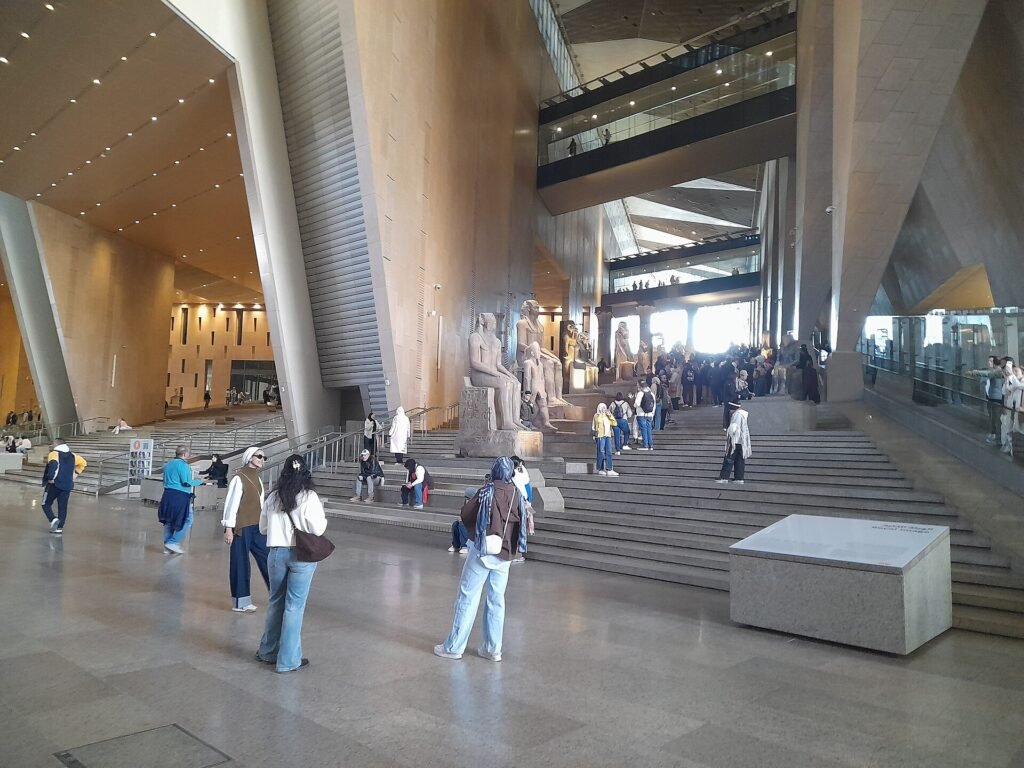
Cross the main entrance and you are met by Ramses II in pink granite, 11 meters tall and weighing 83 tonnes. The statue was moved out of central Cairo, where it stood for decades in a traffic-choked square, and now presides over the atrium as the guardian of the building. It is the first thing almost every visitor photographs, and the scale only registers once there are people standing at its feet.
The grand staircase
The staircase that climbs through the museum's levels is the best piece of design in the building. Colossal statues of kings and gods line it in chronological order, so the ascent is a walk forward through pharaonic time. At the top, a vast window frames the pyramids of Giza in the distance. Whoever planned that sightline knew exactly what they were doing.
The twelve chronological galleries
Beyond the headline pieces, the main halls cover the whole of pharaonic history, arranged by period and by three themes: society, kingship and belief. Khufu's solar boat is here as well, restored and moved from the old pavilion that stood beside the Great Pyramid.
These rooms reward a little preparation. A visitor who can tell Horus from Thoth, or read what a jackal head or a sun disk is signalling, gets far more out of a case of funerary equipment than one who cannot, and the same knowledge pays off again at Karnak and in the Valley of the Kings. Our guide to how to recognize the gods is worth twenty minutes on the plane.
What about the old museum in Tahrir
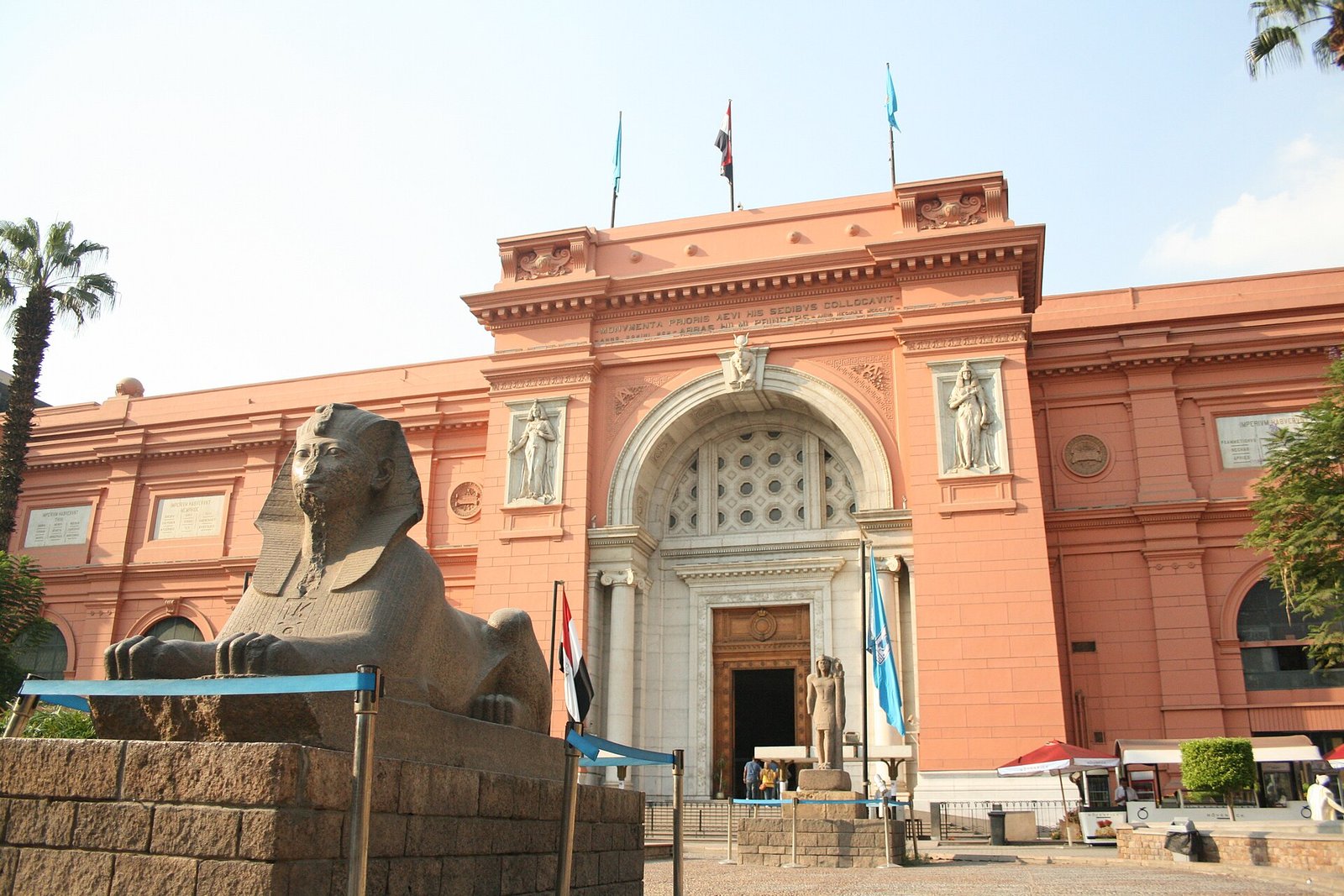
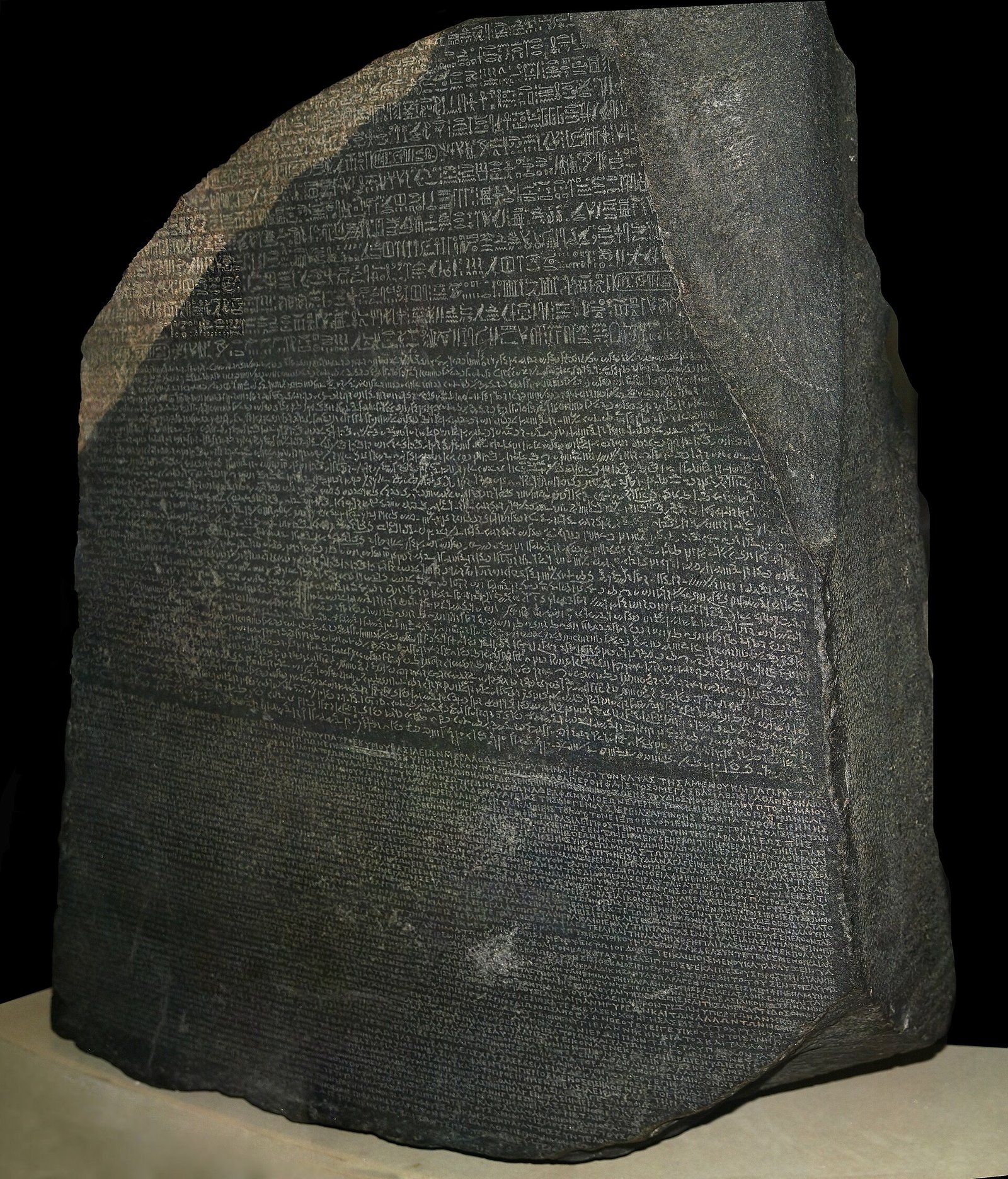
English-speaking visitors ask this more than almost anything else, usually because an older guidebook has them booked into both. The Egyptian Museum in Tahrir Square is still open and still holds an enormous collection, but its two most famous groups have left. The Tutankhamun material is now in Giza, and the royal mummies were moved to the National Museum of Egyptian Civilisation in Fustat. Tahrir is now a quieter, old-fashioned museum, crowded in the best sense, and rewarding if you have the days to spare. It is no longer the unmissable stop it once was, and if your Cairo time is short, the Grand Egyptian Museum is where it should go.
Getting there
The museum sits in Giza beside the Cairo to Alexandria desert road, roughly 20 kilometers from central Cairo and 2 kilometers from the pyramids. No metro line reaches it, so the realistic options are these.
- Taxi or ride-hailing app. Uber and Careem both operate in Cairo. From the city center, expect 40 to 60 minutes depending on traffic, which in Cairo means anything. Agree the fare before you set off, or use the app so the price is fixed.
- From Giza or the pyramids. Five to ten minutes by car. That proximity is the whole argument for combining the two in one day.
- Private transfer. The simplest option if you are already on a tour, since the driver waits while you are inside and the ticket is handled with the rest of the day.
How long to allow, and pairing it with Giza
Three hours is the minimum that makes sense. Four to five is the right figure if you are with a guide and want to understand what you are looking at rather than photograph it. If you only have a morning, prioritise Tutankhamun, Ramses II and the grand staircase, and accept that you are leaving the rest for another trip.
The strongest Cairo day pairs the pyramids and the Sphinx in the morning, while the plateau is still cool and the light is good, with the museum in the afternoon, when air conditioning stops being a luxury. It works in reverse too, and on a Wednesday or Saturday the extended evening hours let you take Giza in the afternoon and the museum after sunset. Either way it is a full day, and bolting Saqqara or Islamic Cairo onto the same schedule is how people end up seeing three sites badly. Most of our Cairo and Giza excursions are built around this pairing, with day trips starting from US$120.
Where the museum sits inside a longer trip depends on how much time you have in the country. Two nights in Cairo covers Giza, the museum and a little of the old city. From there most itineraries move south to Luxor and Aswan on a domestic flight, often continuing on a Nile cruise between the two. If you are still shaping the trip, our note on how many days to spend sets out what each length actually buys you. International flights into and out of Egypt are yours to arrange; everything on the ground once you land is ours.
Practical advice for the visit
- Book online, well ahead. There is no counter sale for foreign visitors. If you travel with us, the ticket and the transfer are arranged as part of the day.
- Wear something you can walk in for four hours. The building is enormous and the floors are hard. Shoulders and knees covered is the sensible default across Egypt, and there is more in our note on what to wear.
- Drink more than you think you need. There are cafes and water points inside, but the complex is vast and Cairo is hot for most of the year.
- Leave the tripod and the long lens at the hotel, or pay for the permit. Phone photography is fine throughout the galleries.
- Carry small notes in Egyptian pounds. Useful for the cafes, for tips, and for anything you buy on the way out.
- Check your government's travel advice before departure, and confirm what entry documents your nationality needs. Visa arrangements for Egypt depend on published nationality lists and are not the same for every passport.
Visiting with an Egyptologist guide
The museum is well labeled by the standards of the region, but a label tells you what an object is, not why it was made or what it meant to the person buried with it. A licensed Egyptologist turns a corridor of glass cases into a story with a beginning, and in a collection this size, a guide who knows which twenty objects deserve your remaining hour is the difference between a good visit and an exhausting one.
We are based in Egypt and run the museum with Giza as a private day, or as one stop inside a longer program. Our Egypt tour packages combine Cairo, the museum, Luxor and Aswan, with entrance tickets, transfers and domestic flights arranged for you. To have the day put together for your own dates and group, message us on WhatsApp at +201032295513.
Planning this trip yourself takes hours. We build it for you, and we answer every question before you commit to anything.
Common questions about the Grand Egyptian Museum
What is the Grand Egyptian Museum?
How do you buy tickets for the Grand Egyptian Museum?
What is there to see inside?
Is the old museum in Tahrir still worth visiting?
How long do you need at the Grand Egyptian Museum?
Is it worth visiting with an Egyptologist guide?
Who designed the Grand Egyptian Museum?
The building was designed by Heneghan Peng Architects, a Dublin-based practice that won an international design competition for the project in 2003. Its most striking features are the translucent alabaster facade that faces the pyramids and the Grand Staircase lined with statues, which rises toward a view of the Giza plateau.
Let us put the trip together
We are a local agency in Egypt. Tell us your dates and what you want to see, and we will come back with a plan, the practical details sorted and someone to ask when you are here.
Part of our guide to
Destinations and Monuments 6 guides
This article is part of that pillar. The rest of it:
- ▸Abu Simbel Sun Festival: 22 October and 22 February
- ▸Abu Simbel: Tickets, Timing and Getting There
- ▸Climbing Mount Sinai at Sunrise: the Night Ascent, the Summit and St Catherine's Monastery
- ▸The National Museum of Egyptian Civilization and Its Royal Mummies
- ▸The Sinai Peninsula: Where Egypt Crosses Into Asia
- ▸Valley of the Kings: Tickets, Tombs and How to Visit in 2026
Keep exploring
To finish planning your trip to Egypt
- ▸The National Museum of Egyptian Civilization and Its Royal Mummies
- ▸Great Sphinx of Giza: History, Missing Nose and How to Visit
- ▸El Gouna, Egypt: things to do, lagoons and kitesurfing
- ▸What to See in Aswan: Philae, High Dam, Nubia and Abu Simbel
- ▸Things to Do in Aswan: 12 Experiences Beyond the Temples
- ▸Best Tombs in the Valley of the Kings: Which Three to See
- ▸Traveling to Egypt with a Baby: Heat, Cruise, Cribs, Formula
- ▸See all our Egypt tours