Egyptian Hieroglyphs: What They Mean and How to Read Them
Egyptian Hieroglyphs: What They Mean and How to Read Them
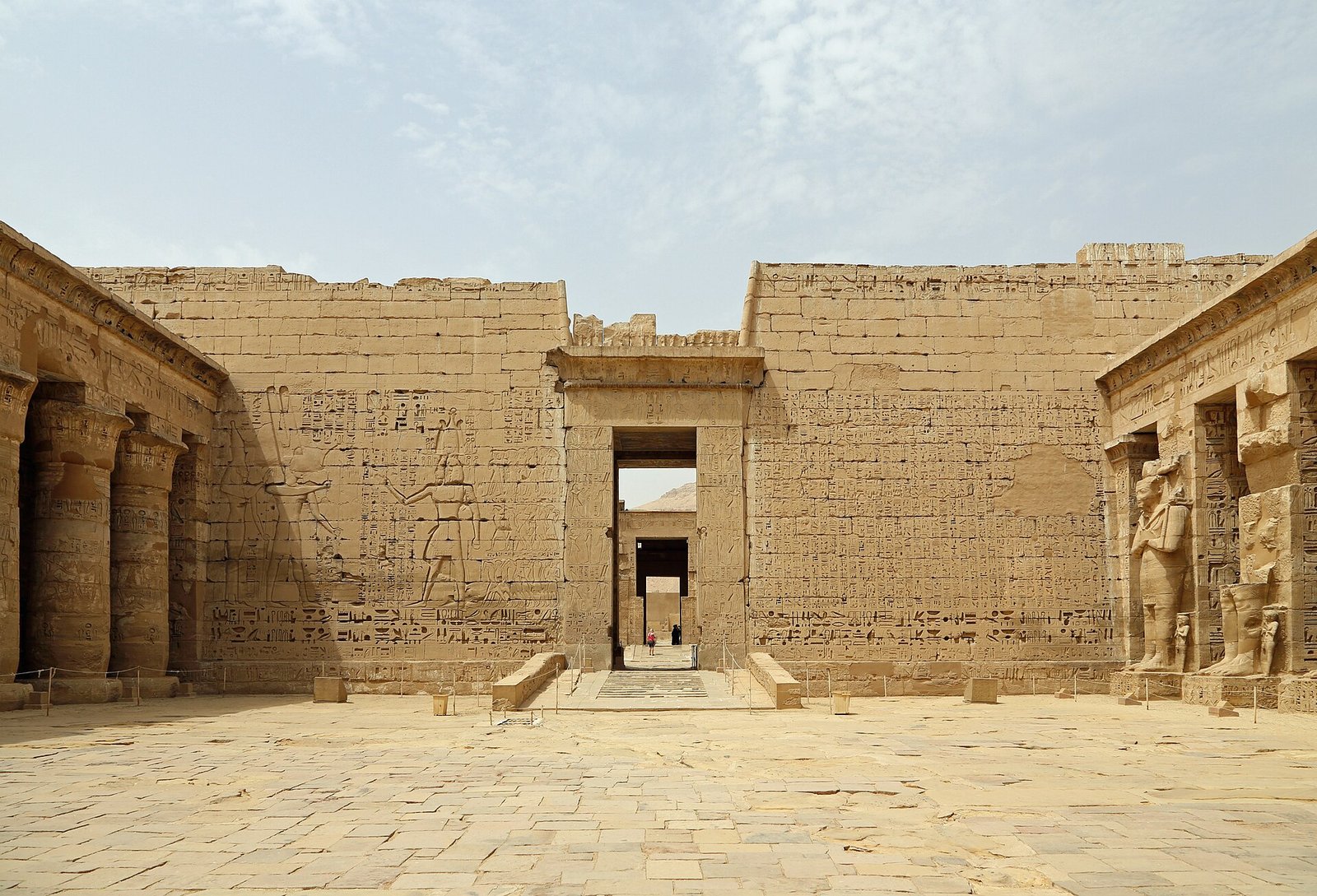
Walk into almost any temple or royal tomb in Egypt and the surfaces are covered. Not decorated, covered: birds, hands, ropes, seated men, water lines, ovals, all of it running in tight rows from the floor to well above head height. Most visitors look at it for a few seconds, decide it is beautiful but closed to them, and move on to the next chamber. It is not closed. You will not learn to read ancient Egyptian on a two week holiday, but the handful of rules below take about ten minutes to absorb, and they change what you see for the rest of the trip.
What hieroglyphs actually are
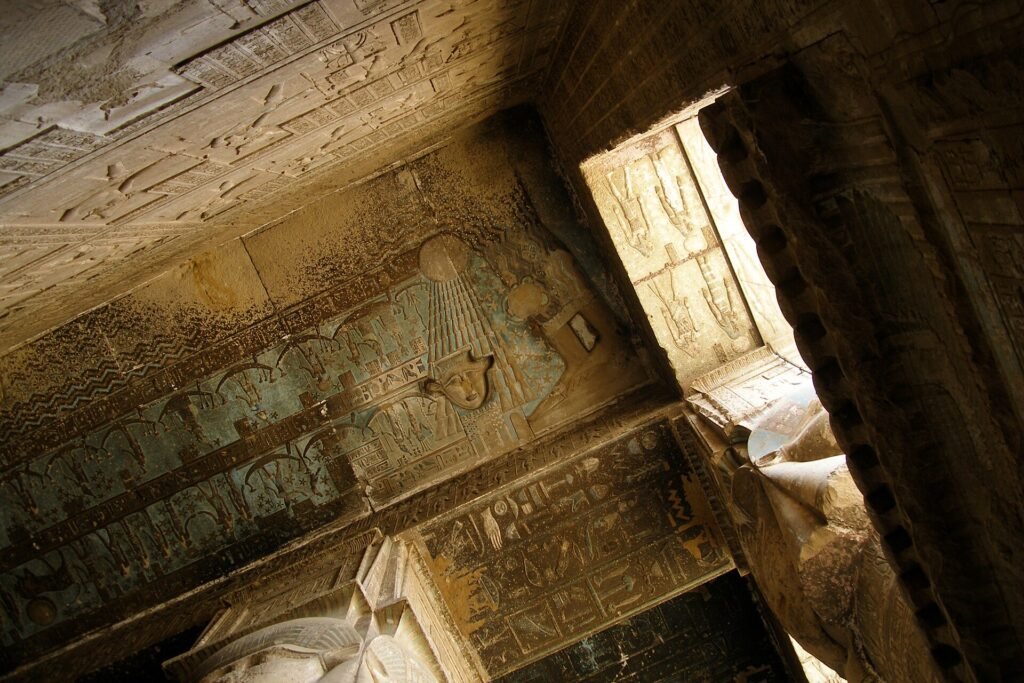
Hieroglyphs were the sacred writing of ancient Egypt, used for more than three thousand years. The word itself comes from Greek and means sacred carving, which is a fair description of where the script mostly appears: on temple walls, in tombs, and on monuments, in religious and official contexts rather than in shopping lists.
It is one of the oldest writing systems in the world. It was in use from around 3200 BCE until the first centuries of the common era, when it fell out of use and its secret was lost. That is a run of more than three millennia, which is longer than the Latin alphabet has existed.
The single most common misunderstanding is worth clearing up before anything else. Hieroglyphs are not drawings, and they are not an ancient comic strip. They are a complete and sophisticated writing system capable of expressing any idea a person might want to record, from a royal decree to a love poem. The pictorial look is a design choice, not a limitation. For everyday business the Egyptians used faster cursive versions of the same language, written with a reed on papyrus, which is why the monumental script stayed so ornate: it was the formal register, and it was carved to last.
How the system works
The difficulty of hieroglyphs is not the number of signs. It is that the same sign can do three different jobs, and you have to work out which job it is doing in each case.
Phonograms, the signs that carry sound
Phonograms represent sounds, the way the letters of an alphabet do, and they combine to spell a word by its pronunciation. Some carry a single consonant, some carry two, some carry three. The owl is the sound m. The mouth is the sound r. The rippled line of water is the sound n. Once you know those three you will start picking them out of inscriptions without meaning to, because they are everywhere.
Ideograms, the signs that mean the thing they show
Ideograms, also called logograms, represent a whole word or idea directly. The sun sign can mean sun, and it can mean day. A pair of legs can mean walking. This is the category most people assume the whole script belongs to, and it is only a slice of it.
Determinatives, the silent signs at the end
Determinatives are not pronounced at all. They sit at the end of a word and tell you which category it belongs to, which sounds like a luxury until you remember that vowels were not written. A great many different words share the same consonantal skeleton, and the determinative is what tells them apart. A pair of walking legs at the end marks a word about movement. A sealed papyrus roll marks an abstract concept. A seated figure marks a person.
Now put the three together. That same sun sign can appear as an ideogram meaning sun, as a phonogram contributing a sound to a longer word, or as a determinative at the end of a word to do with time or light. Working out which of the three functions it is performing in a given line is precisely what kept the script unreadable for centuries.
Which direction do you read them in
Hieroglyphs can run left to right, right to left, or top to bottom in vertical columns. There is a reliable way to tell which, and it is the one piece of this article most worth memorising before you land.
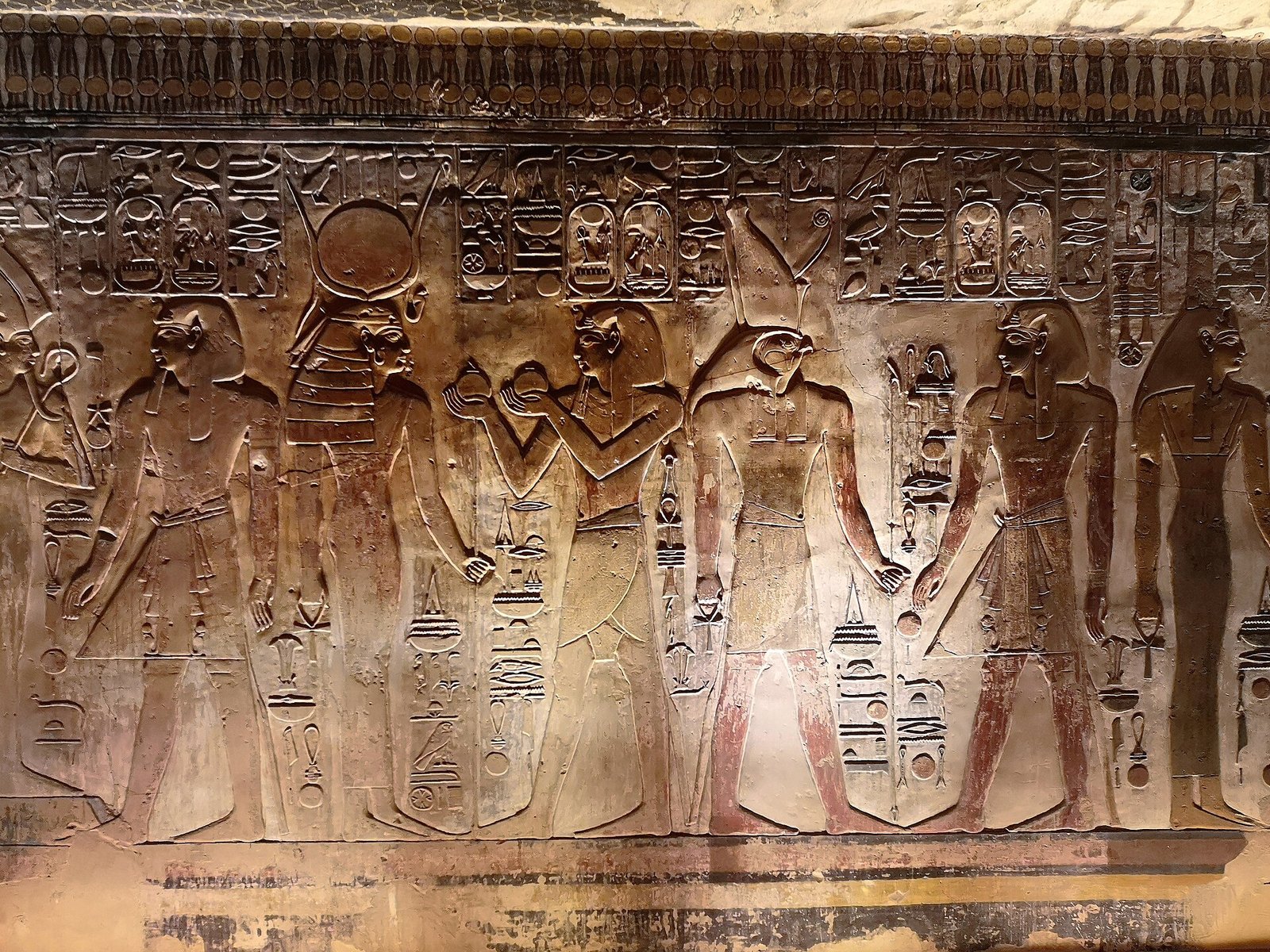
Look at where the people and animals are facing. The figures always face the beginning of the line. So you find the side they are looking towards, start there, and read away from their gaze. If the birds and the human heads face left, the text begins on the left and runs left to right. If they face right, it begins on the right and runs right to left. In vertical columns you always read top to bottom, starting with the column on the side the figures are facing.
That flexibility was not decorative whim. It let the scribes fit text to the symmetry of the building. On temple doorways it is normal to find the same inscription on both jambs, written in opposite directions so the two halves mirror each other. Once you notice that at one gateway you will notice it at every gateway after it.
Other conventions worth knowing
- There are no spaces between words and no punctuation. Nothing on the wall tells you where one word ends.
- Vowels are not written, only the consonantal skeleton. Modern transcriptions insert vowels by convention, which is why the same pharaoh's name is spelled differently by different authors and different guidebooks. Neither spelling is a mistake.
- Signs are grouped into neat rectangular blocks for visual balance rather than being strung out in a continuous line, so a word may read across then down within its own little square.
- The name of a king or a queen sits inside a cartouche, the elongated oval with a bar across its base.
The Rosetta Stone, and how the code was broken
For roughly fourteen centuries nobody on earth could read a word of this. The knowledge died with the last people who held it, and everything written on every wall in Egypt went silent.
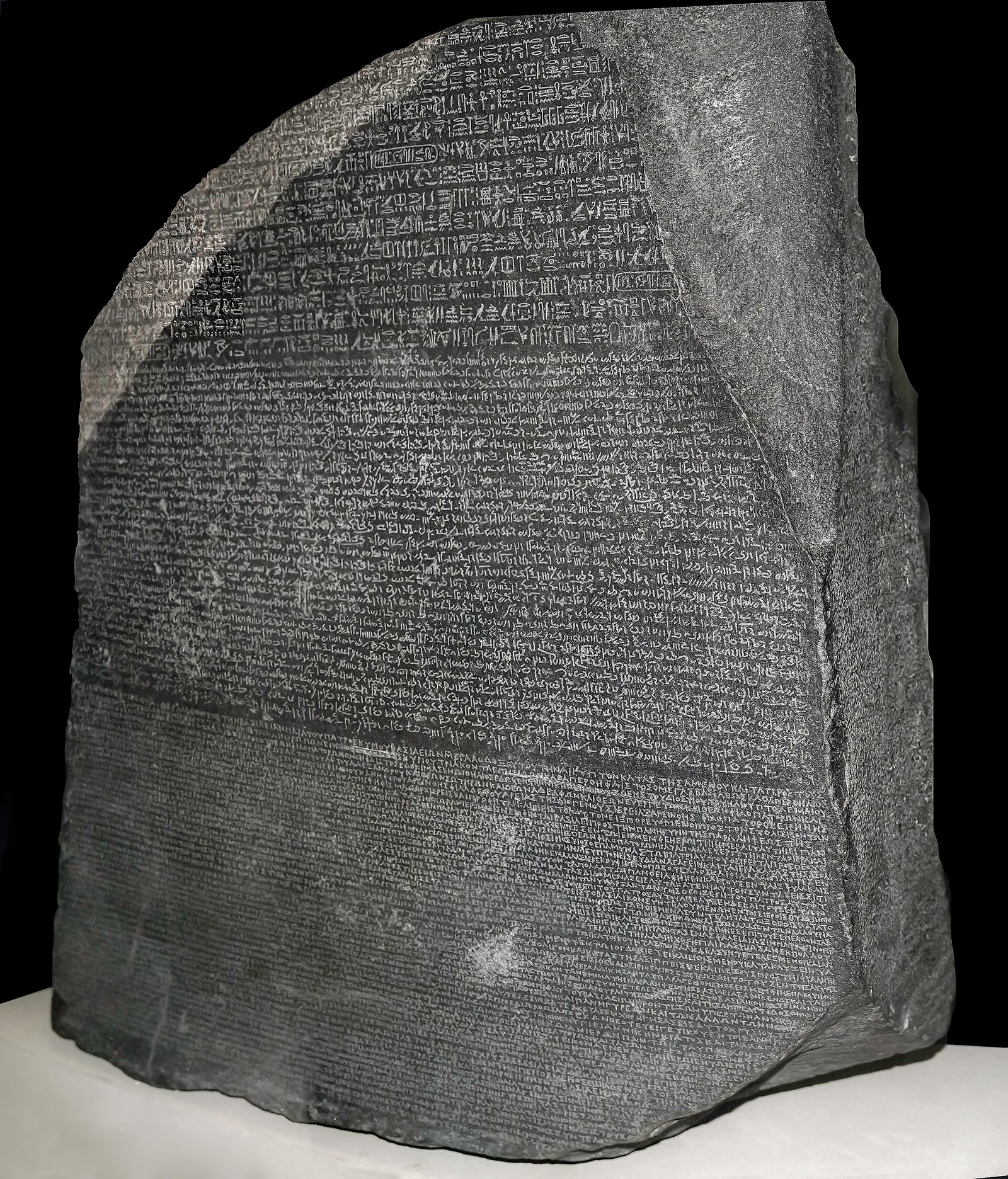
The key that reopened the door was the Rosetta Stone, a slab found in 1799 carrying one and the same decree in three writing systems: hieroglyphic, a more cursive form of Egyptian, and ancient Greek, which scholars could already read. Comparing the three texts, the French linguist Jean-Francois Champollion cracked the code in 1822, after years of work rather than in a flash of insight.
One of his keys was the cartouche. He guessed, correctly, that those signs enclosed in an oval held royal names, which gave him known sounds to anchor against the Greek. That single discovery opened three thousand years of Egyptian history at a stroke and made it possible to read what visitors now stand in front of, including the funerary formulas of the Book of the Dead painted through the royal tombs.
Cartouches, and the souvenir version
Of all the hieroglyphs, cartouches are the ones travelers take home. The oval represents a loop of rope tied at the base, a protective circle drawn around the king's name. In Egyptian jewellers and bazaars you can have one made in silver or gold with your own name spelled out in hieroglyphs, which is about as personal as a souvenir from this country gets. What you pay depends on the metal, the weight and the workshop, so it is worth seeing a few before deciding.
Planning this trip yourself takes hours. We build it for you, and we answer every question before you commit to anything.
How many signs were there, and why the script died
In the classical period the system used somewhere around seven hundred signs in common circulation. That is a lot, but it is a learnable lot, and Egyptian scribes learned it.
In the Ptolemaic and Roman period the count rose to several thousand. Priests multiplied variants and played elaborate graphic games with the script, partly as a way of preserving knowledge that by then belonged to a very small and shrinking elite. This is why the later temples carry the hardest inscriptions in Egypt: if you visit Edfu or Dendera, often on a Nile cruise between Luxor and Aswan, you are looking at the most complex writing the culture ever produced, not the most typical.
It also explains how the whole thing was lost. A script that only a handful of temple priests could still handle has no margin for error. When the last priest able to read it died, there was nobody left. The last dated hieroglyphic inscription was cut at Philae, near Aswan, in 394 CE, and after that came the silence that lasted until Champollion.
What to look for on the walls
You do not need vocabulary to get value out of this. Recognising half a dozen recurring elements is enough to change a visit, and all of them are common enough that you will meet them on your first temple morning.
| What you are looking at | How to spot it | What it tells you |
|---|---|---|
| Cartouche | An elongated oval with a bar at one end, enclosing a group of signs | A royal name. The same cartouche repeated through a temple tells you who built or enlarged it |
| Ankh | A cross with a loop on top | Life. Usually held out by a deity towards the king's face |
| Wadj | A slender papyrus stem sceptre | Prosperity and flourishing |
| Djed | A pillar with several crossbars near the top | Stability. The pillar of Osiris |
| Eye of Horus | A stylised eye with a curl and a teardrop below it | Protection and healing |
| Scarab, khepri | A beetle, often pushing a disc | Rebirth and the morning sun |
| Offering scene | A standing king on one side presenting something to a seated figure | The most repeated composition in all of Egypt. The seated figure is the deity being honored |
The seated figures in those offering scenes are worth a little homework of their own, because the crown, the animal head and the object in the hand identify each one, and recognising the gods is the natural companion skill to reading a cartouche.
The damage is part of the text
On many walls you will see cartouches and faces hacked out with a chisel, cleanly and deliberately, while everything around them is untouched. Some of that is erasure carried out by successors who wanted a particular person removed from the record, and Hatshepsut and Akhenaten are the two cases you are most likely to walk past. Other damage has a different origin. Several temples were taken over by early Christian communities in late antiquity, and at those sites, Dendera and Philae among them, the figures of the gods were defaced on religious grounds rather than dynastic ones. Both kinds are easier to spot than they sound: look for a blank oval, or a scraped out face, in an otherwise complete row of signs. If you want to know which you are standing in front of, that is a question for the guide on the day.
Where to see them in Egypt
Finding authentic hieroglyphs takes no effort at all. They cover the walls of the great temples of Luxor and Aswan and the whole Nile valley, the royal tombs cut into the cliffs of the west bank, and the display cases of museums including the Grand Egyptian Museum outside Cairo.
The densest single day is on the Luxor west bank, where the tomb walls carry both text and painted color, and excursions in Luxor usually pair that with Karnak on the other side of the river. It is genuinely surprising how much a visit to Karnak changes once you can pick out a cartouche. Further south, Philae stands where the script signed off, and it sits on most Aswan excursions alongside the High Dam and the unfinished obelisk. If you get as far as Abu Simbel, the interior walls carry some of the most theatrical royal inscriptions anywhere in the country.
Most of these sites are ticketed individually and the tickets are paid in Egyptian pounds at the gate, so it is worth reading up on monument entrance fees before you plan a heavy temple day.
Reading the walls with someone who can
Everything above is a starting kit, not a translation. The difference between a wall full of signs and a story you remember is usually a licensed Egyptologist guide standing next to you, pointing at the line and telling you what it says, then telling you who erased the name three rows down and why. That is part of how our Egypt tour packages are built, and it is the single upgrade that most changes how a temple day feels.
If you are still shaping the trip, the wider Egypt travel guide covers the practical side: seasons, routing, how long to give the south. We are a local agency based in Egypt and you can book direct on WhatsApp at +201032295513. You arrange your own international flight; everything on the ground here, including domestic hops such as Cairo to Luxor, we handle.
Common questions about Egyptian hieroglyphs
What are Egyptian hieroglyphs?
How do hieroglyphs work?
How do you know which way to read hieroglyphs?
Who deciphered hieroglyphs?
What is an Egyptian cartouche?
Where can you see hieroglyphs in Egypt?
Let us put the trip together
We are a local agency in Egypt. Tell us your dates and what you want to see, and we will come back with a plan, the practical details sorted and someone to ask when you are here.
Part of our guide to
Culture and History 6 guides
This article is part of that pillar. The rest of it:
- ▸Ancient Egyptian Amulets: What the Ankh, the Scarab and the Eye of Horus Actually Did
- ▸Egyptian Gods and How to Recognize Them
- ▸The Egyptian Museum in Tahrir Square: What Is Still There and How to Visit
- ▸The Nile River: From Its Source to the Sea, and How to Sail It
- ▸The Pharaohs of Ancient Egypt: God-Kings of the Nile
- ▸The Ancient Egyptian Calendar: How the 365-Day Year Began
Keep exploring
To finish planning your trip to Egypt
- ▸Akhenaten: The Heretic Pharaoh, Amarna and What Survives
- ▸Eye of Horus Meaning: Myth, Amulet and Where to See It
- ▸Queen Nefertiti: Her Story, the Bust and Where to See Her
- ▸Rosetta Stone: What It Says, Where It Is and What to See
- ▸Movies About Egypt and Documentaries to Watch Before You Go
- ▸Fun Facts About Egypt: True Facts and Where You See Them
- ▸Solar Eclipse Egypt 2027: Luxor, the Path and How to See It
- ▸See all our Egypt tours