The Great Sphinx of Giza is one piece of living rock, and most of what you have heard about it is legend
The Great Sphinx of Giza is one piece of living rock, and most of what you have heard about it is legend
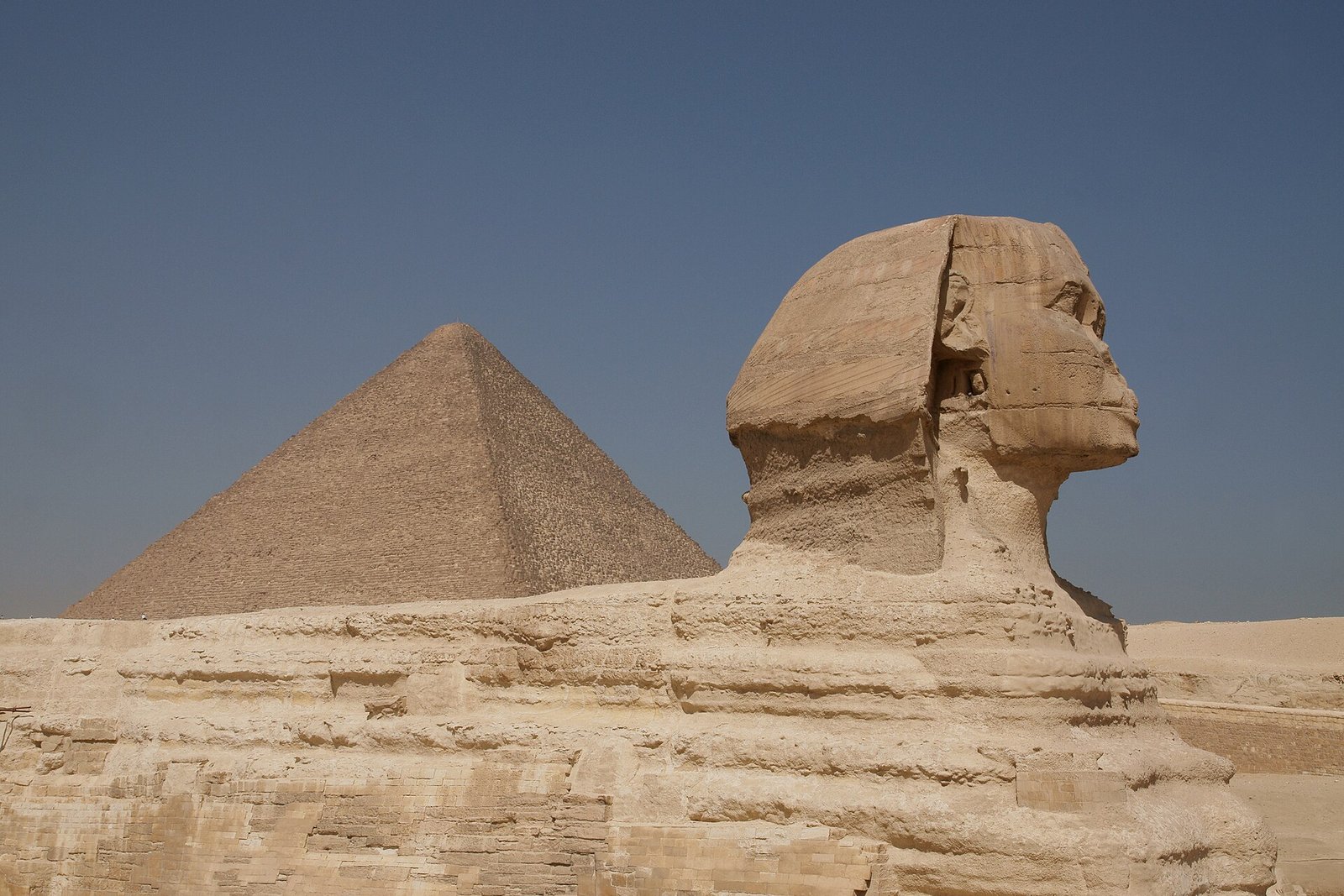
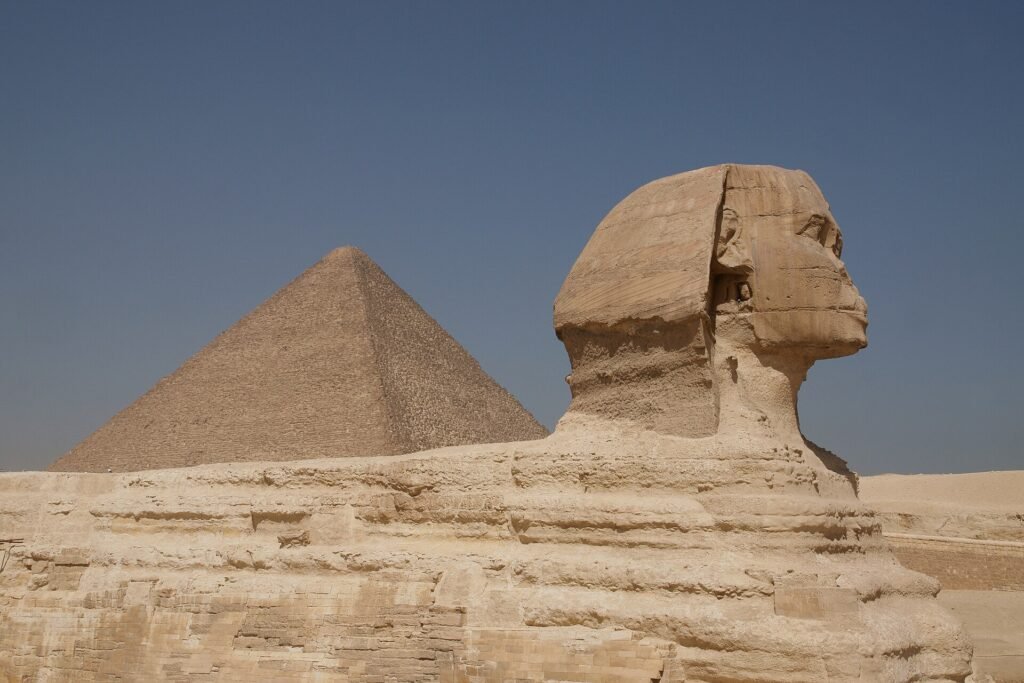
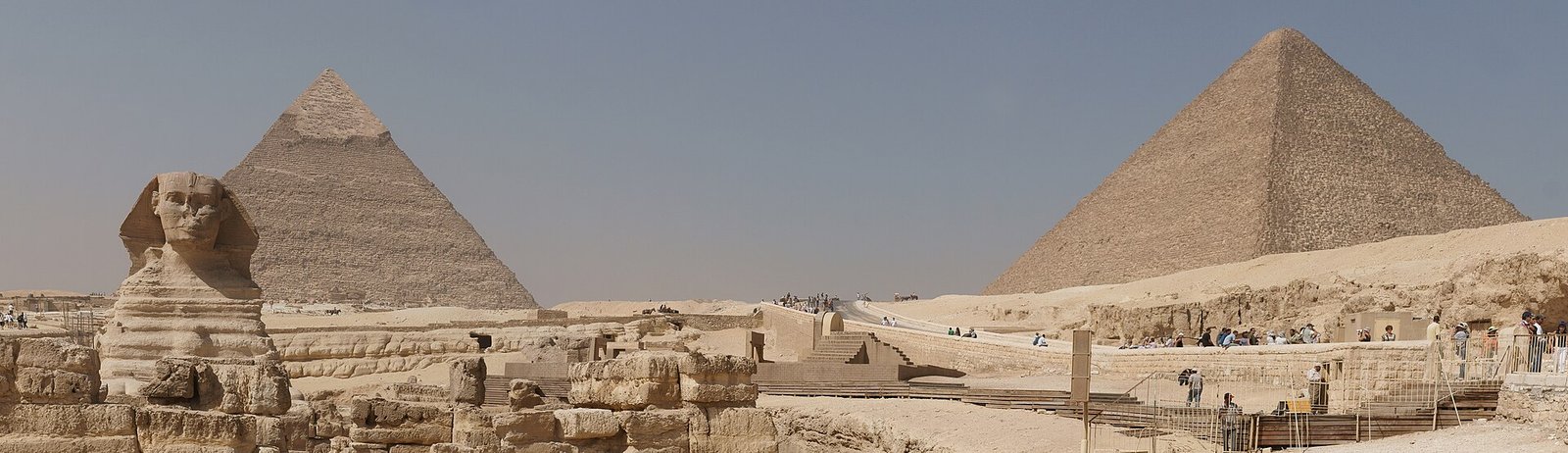
The Great Sphinx of Giza is a reclining lion with a human head, carved from a single outcrop of limestone on the Giza plateau outside Cairo. It is about 240 feet long (73 meters) and 66 feet high (20 meters), faces due east, and is the largest monolithic statue in the world. Most Egyptologists read the face as the pharaoh Khafre, builder of the second pyramid behind it, carved around 2500 BC. Napoleon did not shoot off the nose; it was gone centuries before he arrived. Below is what the stories get wrong, where to stand, and how we fit it into a Giza day.
What the Great Sphinx is, and how big it really is
A sphinx, in Egyptian art, is a lion with the head of a king: the lion for raw power, the face for the ruler who commands it. This one was not built, it was carved. Quarrymen cut a horseshoe-shaped trench into the bedrock, left a block standing in the middle, and sculptors shaped that block into a body and a head. What you see is the hill itself, worked into a statue.
| Measurement | Feet | Meters |
|---|---|---|
| Length, paws to tail | about 240 ft | about 73 m |
| Height, ground to top of head | about 66 ft | about 20 m |
| Width at the rear haunches | about 62 ft | about 19 m |
| Face, across | about 20 ft | about 6 m |
The limestone is not uniform. The head is cut from a hard, fine bed that has kept its detail for more than four thousand years; the body sits in softer layers that flake in horizontal bands, which is why the torso looks like weathered shelving while the face is still a face. It belongs to the same complex as the pyramids of Giza and is always visited with them.
Who carved it: Khafre as the usual reading, and the alternatives
The standard attribution is Khafre, fourth dynasty, around 2500 BC. The case rests on geography and geology, because the statue carries no inscription. The Sphinx sits beside Khafre's causeway, directly in front of his valley temple, and the giant blocks of the Sphinx Temple in front of it were quarried from the trench that freed the body. Quarry and temple belong to one campaign, and that campaign is Khafre's. The face is usually read as his idealized portrait, and you can compare it yourself with the seated diorite Khafre in the Egyptian Museum on Tahrir Square.
The alternatives, which a good guide presents as theories:
- Khufu. Some scholars see Khafre's father in the face and place the Sphinx in the Great Pyramid's original layout.
- Djedefre. A minority view credits Khufu's short-reigning successor, carving it in his father's honor.
- Much older. A geological argument, covered below, reads the weathering as heavy rain long before the fourth dynasty. Most archaeologists reject it because no pottery, tools or settlement at Giza supports a culture that early.
What nobody disputes is that within a thousand years the Egyptians had forgotten who made it. By the New Kingdom they worshipped it as the sun god Horemakhet, and pilgrims left hundreds of small stelae asking for health, children and safe journeys.
The missing nose: Napoleon did not do it
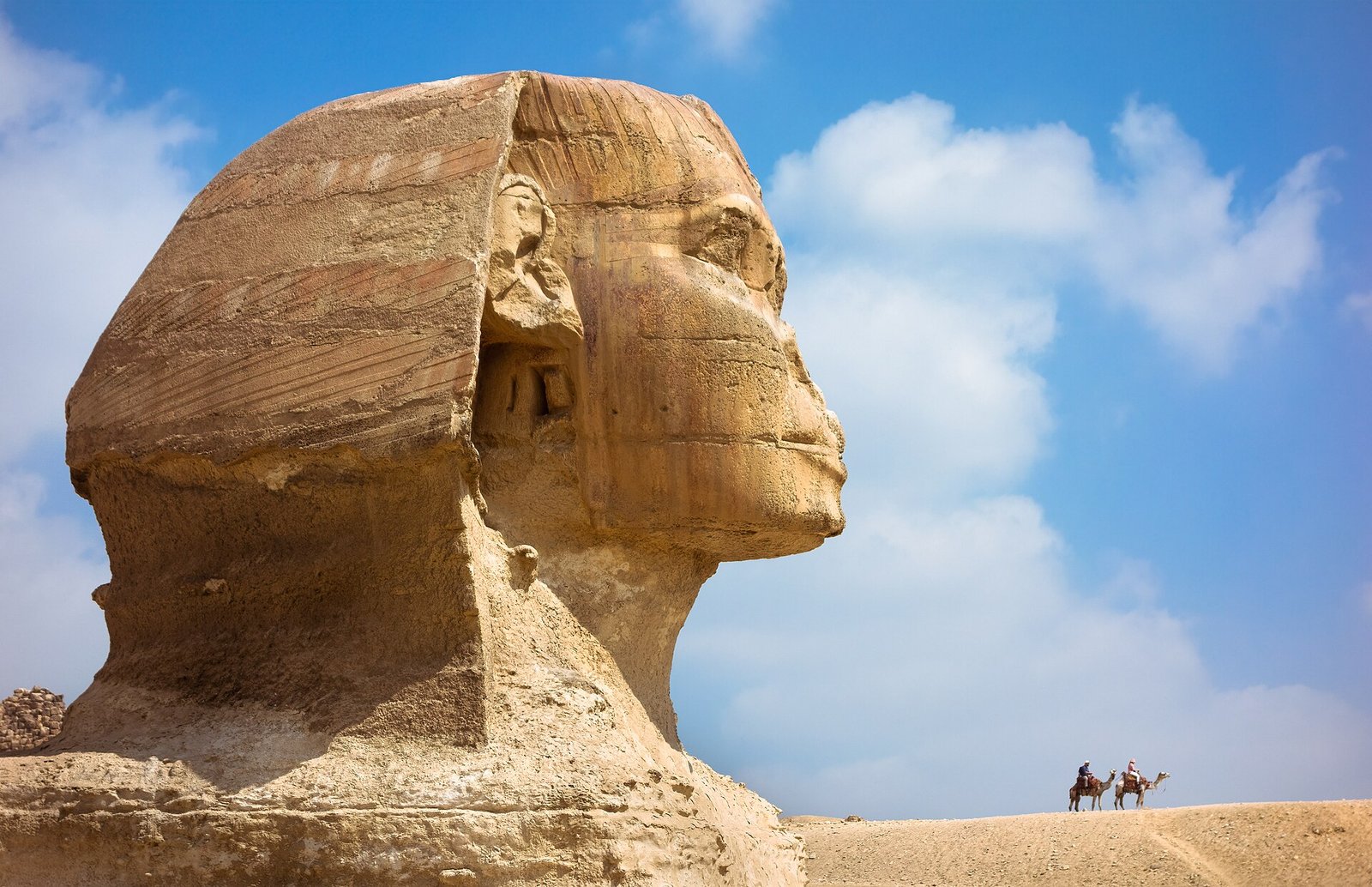
Every visitor asks about the nose, and the popular answer is wrong. The story has French gunners using the face for target practice in 1798. It cannot be true, because the Danish explorer Frederic Louis Norden drew the Sphinx in 1737, sixty years before Napoleon landed, and his engraving already shows the nose gone.
The oldest written account points elsewhere. The fifteenth-century Cairo historian al Maqrizi recorded that in 1378 a Sufi named Muhammad Sa'im al Dahr, angry that local farmers were making offerings to the statue for a good harvest, attacked the face to end the idolatry, and was executed for it. That places the damage four centuries before any French soldier.
The stone agrees with him. Around the nose are long grooves where rods were driven in to lever the block off, first from one side, then the other: deliberate removal by someone standing on the face, not the scatter of cannon fire.
The beard, the paint and the cobra it once wore
The bare sand-colored stone is not what any ancient Egyptian saw. Traces of red pigment survive in sheltered folds of the face, and red is the conventional color for male skin in Egyptian art. The striped nemes headcloth was banded blue and yellow, and the body was very likely painted too. Today's ruin is a faded photograph of a bright polychrome figure.
The Sphinx also wore a false beard, the braided ceremonial kind worn by gods and by statues of kings. It is no longer attached: a large fragment is in the British Museum in London, smaller pieces are in Cairo, and the anchoring scar is visible under the chin. Egyptologists disagree about whether the beard was original or a New Kingdom addition, because the braided divine style fits the later period. Treat it as an open question.
On the forehead sat a uraeus, the rearing royal cobra, of which only the socket remains. Lose the cobra, the beard, the paint and the nose, and what stands in the enclosure is the frame of a statue rather than the statue.
The Dream Stele of Thutmose IV, between the paws
Standing upright between the front paws is a slab of pink granite about twelve feet tall (roughly 3.6 meters), placed there by Thutmose IV around 1400 BC. As a young prince, the text says, Thutmose went hunting in the desert, fell asleep in the shadow of the Sphinx, which by then was buried to the neck in sand, and dreamed that the god spoke: clear away the sand and I will make you king. He did, and he was.
It is elegant propaganda, since Thutmose was probably not the obvious heir. As archaeology, it is priceless, because it proves the Sphinx was already ancient and half lost by the New Kingdom. A damaged line copied in the early nineteenth century also seemed to contain Khafre's name; that part of the stone has since crumbled, so it cannot be checked, but it is one of the few textual threads tying the Sphinx to that king.
You cannot walk between the paws today; bring a zoom lens and your guide will point out the winged sun disc at the top.
The Sphinx Temple and the Valley Temple next door
Most visitors photograph the statue and never look at the two buildings at its feet, which turn it from a lone monument into the centerpiece of a designed approach to Khafre's pyramid.
The Sphinx Temple stands directly in front of the paws, on the east, built from limestone blocks so large that some weigh as much as a loaded truck, all cut from the Sphinx trench. Inside was an open court ringed by square pillars, with a sanctuary at the east end and another at the west, read by many scholars as shrines to the rising and setting sun. It was never finished.
The Valley Temple of Khafre sits just to the south and is the best-preserved Old Kingdom building on the plateau: a limestone core faced with polished red granite from Aswan, with an alabaster floor. The famous diorite Khafre was found here in a pit. You walk through it on the way to the Sphinx, so slow down; those granite walls are the same age as the statue outside.
From the valley temple, Khafre's causeway climbs to his pyramid along the north wall of the Sphinx enclosure. The cavities and shafts under the body are all documented and all the result of ancient and modern probing, not secret chambers.
Erosion, restoration and the age debate, stated plainly
The enclosure walls and the flanks of the body show deep, rounded vertical fissures and undulating horizontal weathering. In the 1990s a geologist argued that this is the signature of prolonged rainfall and that the Sahara has not seen such rain since well before 2500 BC. On that reading the Sphinx would be thousands of years older than Khafre.
The mainstream response comes from other geologists and from the archaeologists who have worked the plateau for decades. The limestone beds vary greatly in hardness, salt crystallization from humid air flakes the softer layers in exactly this way, and runoff from Cairo's rare but violent storms concentrates in the enclosure. Add the temple, the quarry and the pottery, all pointing to one fourth-dynasty campaign, and this is where most of the field stands.
What everyone agrees on is that the statue is fragile. For most of its life it was buried to the neck, and the sand protected it. Since it was fully cleared in the twentieth century it has faced wind, humidity, groundwater and the exhaust of a city of more than twenty million people.
Restoration is nothing new. Thutmose IV cleared the sand and probably added masonry to the paws; the Saite and Roman periods added casing blocks; the 1920s and 1930s cleared the enclosure for good; the 1980s used cement, which trapped moisture and cost a piece of the shoulder; since the 1990s the work has used hand-cut limestone and lime mortar. The blocky masonry on the paws is three and a half thousand years of care.
How close you can get: the enclosure and the viewing platform
You cannot climb the Sphinx, touch it or enter the enclosure. The trench is closed to protect the stone, and the space between the paws is reserved for researchers with permits.
The normal route takes you through the Valley Temple of Khafre and onto a raised stone platform on the south side of the enclosure, roughly at paw level. From there the head is a few dozen yards away, close enough to see the weathering bands on the neck and the cobra socket, with the Pyramid of Khafre rising behind. This is where the kissing-the-Sphinx photographs are taken.
A second, lower viewpoint is on the east, in front of the Sphinx Temple, where you look straight into the face along the axis it has stared down since Khafre. It is the view the Sound and Light Show audience gets after dark.
Entrance arrangements at Giza have changed more than once in recent years, so do not rely on an old blog post; your guide drove the current route that week. Bring a hat; there is no shade at the platform.
The best viewpoints and the best light
The Sphinx faces east, so the sun hits the face in the morning and the face is in shadow by mid-afternoon. That single fact organizes your photography.
| Time of day | Where to stand | What you get |
|---|---|---|
| Early morning | South platform | Front-lit face, warm stone, pyramid behind the head, thin crowds |
| Late morning | East, in front of the Sphinx Temple | Strong frontal light, the full approach, the busiest hour |
| Mid-afternoon | South platform | Face in shadow, body side-lit, the texture of the weathering |
| Last hour before sunset | South platform or the terraces east of the road | Silhouette against an orange sky |
- Do the Sphinx first if you can. Most tours end here around midday, the harshest light and the thickest crowd. We reverse the order for photographers.
- The panoramic viewpoint is for pyramids, not the Sphinx. From the desert overlook the statue is a speck.
- Around the spring and fall equinoxes the sun sets on the Sphinx's shoulder beside the Pyramid of Khafre, almost certainly by design. If your dates are close, ask us to time the afternoon for it.
A telephoto lens earns its place for the face and the stele. Rules on tripods and professional gear change, so read our photography tips and camera rules for Egypt before you pack.
The Sound and Light Show, and where the Sphinx fits in a Giza day
After dark the plateau runs a show in which the Sphinx is the narrator. Seated in the open air in front of the Sphinx Temple, you watch colored light wash over the statue and the three pyramids while a recorded voice tells the story of the plateau. The moment the face lights up out of the darkness is genuinely good. Logistics, seating and languages are in our guide to the Pyramids Sound and Light Show.
In a full day at Giza the Sphinx usually comes last, as the finish to the walk down from the pyramids. A typical order with us:
- Great Pyramid of Khufu, outside and, if you choose, inside.
- Pyramid of Khafre and the panoramic viewpoint, with an optional camel ride at the pyramids.
- Down Khafre's causeway to the valley temple, then the Sphinx platform.
- Lunch, then the Grand Egyptian Museum a short drive away.
- Back for the Sound and Light Show if you want the night version.
For photographers we flip it and start at the Sphinx. The Sphinx and pyramids alone take about three hours; our Giza pyramids tour page lays out the half-day and full-day versions, and Cairo in one day shows how it pairs with the museum and the old city.
What a guide adds, and how Explora Egipto runs the visit
You can see the Sphinx without a guide. You cannot understand it without one. With an Egyptologist beside you, the valley temple becomes the room where Khafre's statues stood and the nose becomes a Sufi from 1378 rather than a French cannon. A guide also handles the things that quietly ruin a Giza morning: the entrance route, the ticket line, the order of stops so you are not on the platform at noon, the hawkers, and the angle for the photograph you actually want.
Explora Egipto is a local agency in Egypt with our own licensed Egyptologist guides and our own air-conditioned vehicles. The Sphinx is part of every Giza visit we run, whether a half day from your Cairo hotel, a day trip from the Red Sea, or the first morning of a longer trip that goes on to Luxor and Aswan. Tell us your dates and how many you are, and we send you the quote.
Frequently asked questions
How big is the Great Sphinx of Giza?
About 240 feet long from the front paws to the tail, 66 feet high and 62 feet wide at the haunches, roughly 73 by 20 by 19 meters. The face alone is about 20 feet across. It is carved from a single outcrop of limestone, which makes it the largest monolithic statue in the world.
Who built the Sphinx and when?
The usual reading is that it was carved for the pharaoh Khafre of the fourth dynasty, around 2500 BC, as part of the complex that includes his pyramid, causeway and valley temple. The face is thought to be his idealized portrait. Some Egyptologists propose Khufu or Djedefre instead, and a minority geological theory argues for a much earlier date. Khafre remains the consensus.
Did Napoleon really shoot off the nose of the Sphinx?
No. Drawings made in 1737, decades before the French campaign, already show the Sphinx without its nose. The historian al Maqrizi recorded that a Sufi named Sa'im al Dahr deliberately damaged the face in 1378 because farmers were making offerings to it. Tool marks around the nose confirm it was pried off on purpose.
What is the Dream Stele?
A granite slab between the front paws, set up by Thutmose IV around 1400 BC. It records that as a prince he slept in the Sphinx's shadow, dreamed that the buried god promised him the throne if he cleared the sand, and did so. It is the first known restoration of the Sphinx. You see it from the platform, not up close.
Can you touch the Sphinx or walk between its paws?
No. The enclosure is closed to protect the stone, and the area between the paws is reserved for researchers with permits. Visitors use a raised platform on the south side, a few dozen yards from the head, and a lower viewpoint in front of the Sphinx Temple to the east. Both are close enough for the classic photographs.
Is the Sphinx included in a pyramids tour, and is the Sound and Light Show worth it?
Every Giza visit we run includes the Sphinx, the Valley Temple of Khafre and the Sphinx Temple; there is no separate trip for it. The Sound and Light Show is a separate evening activity in which the Sphinx narrates the story of the plateau under colored light, worth doing once if you enjoy theater. Ask us for the quote with or without it.
Stand in front of the guardian of Giza with someone who knows its story
Send us your dates, where you are staying and who is traveling, and we come back with a Giza plan built around the Sphinx: the temples at its feet, the right platform at the right hour, the pyramids above and the museum after. No prices on this page, just a quote in your inbox.