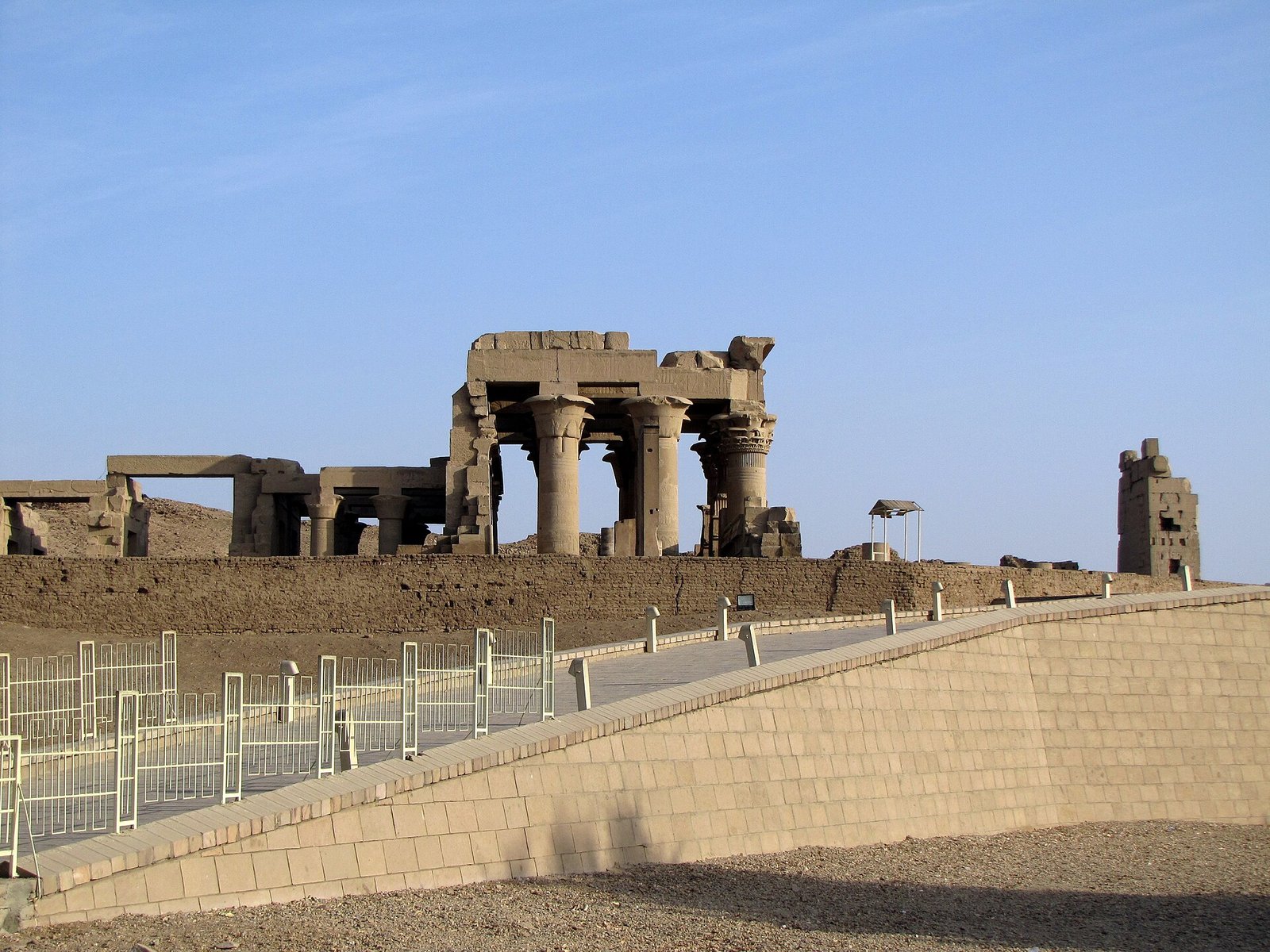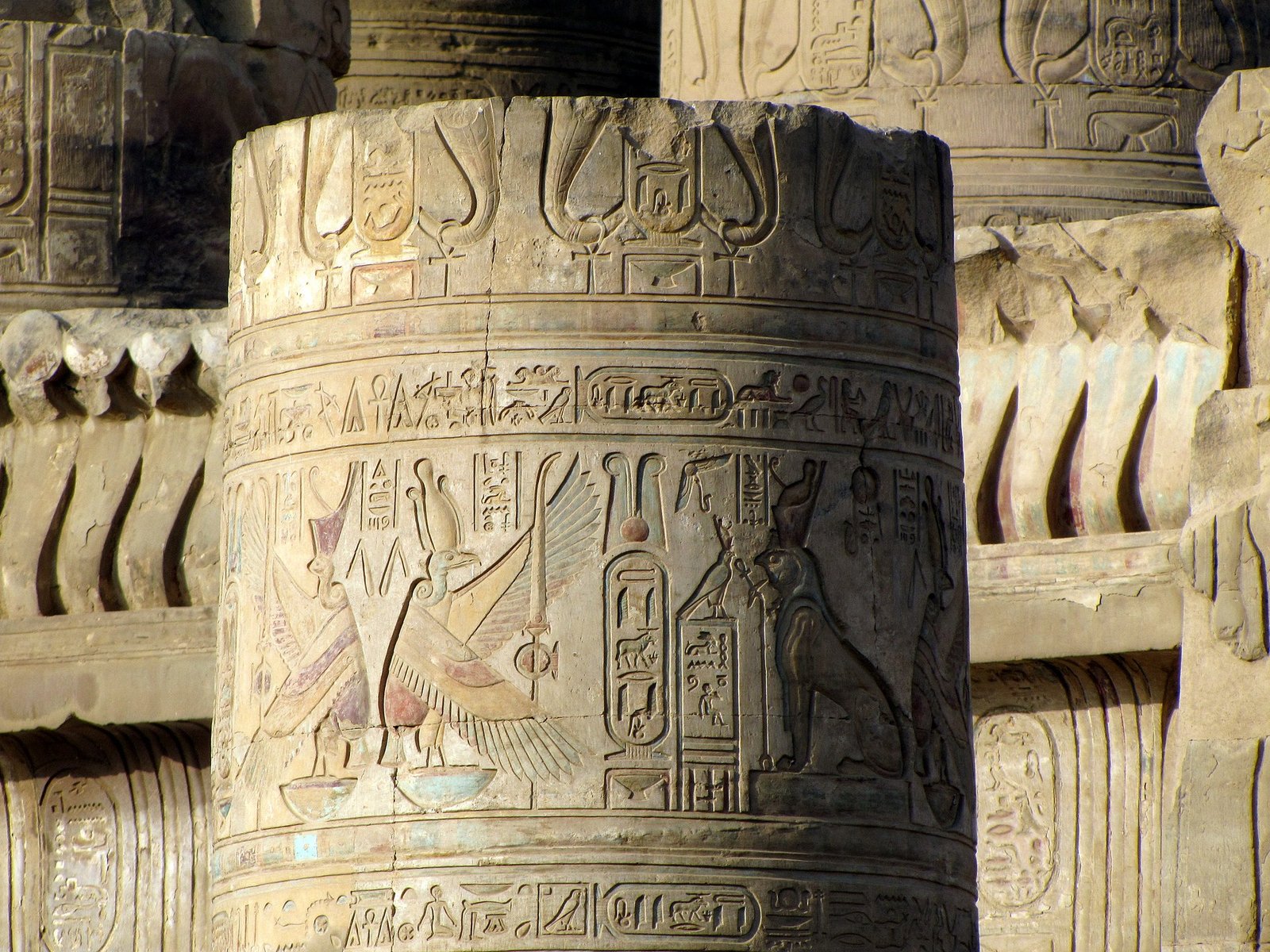
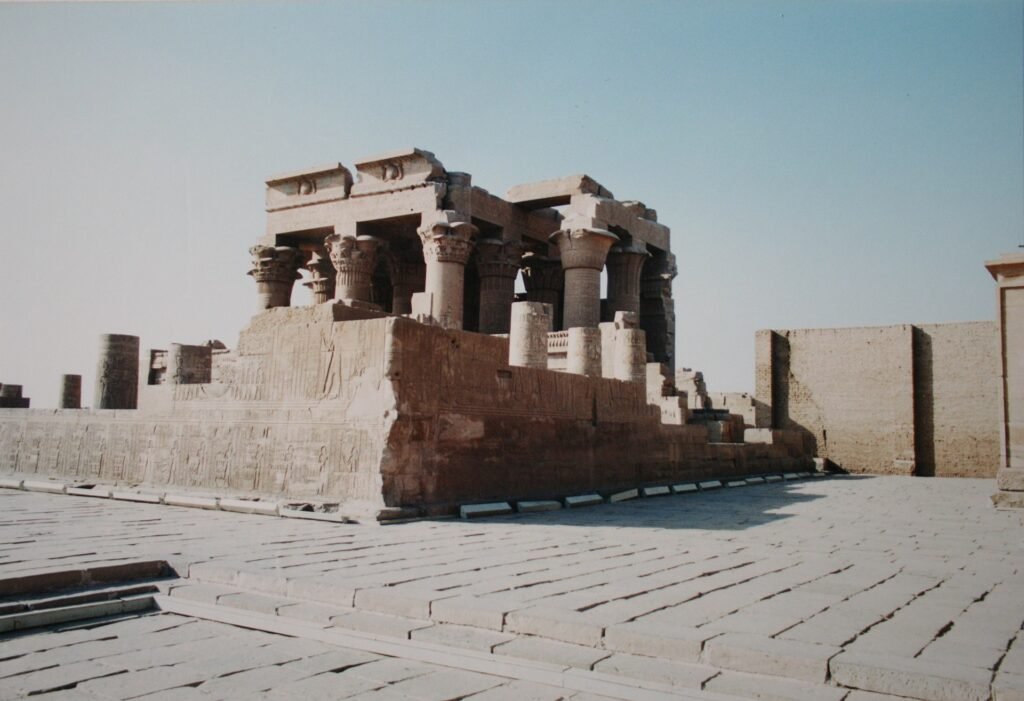
Kom Ombo Temple is the only surviving double temple in Egypt: one half belongs to Sobek, the crocodile god, the other to Haroeris, Horus the Elder, with two gates, two halls and two sanctuaries laid out in mirror image. It stands on the east bank of the Nile about 28 miles north of Aswan, which is why almost everyone sees it from a cruise ship that ties up a two-minute walk from the gate, usually in the golden hour before sunset. The building is Ptolemaic and Roman, and it comes with three things you will not see anywhere else on the river: a relief of surgical instruments, a deep Nilometer well and a museum of mummified crocodiles. Plan 60 to 90 minutes.
Almost every Egyptian temple works the same way: one gate, one axis, a court, a columned hall, then smaller and darker rooms until you reach the single sanctuary where the god lived. Kom Ombo doubles the formula. Stand at the entrance and you see two doorways side by side. Walk through either one and you get your own hall and your own sanctuary, with a twin of each a few yards away.
The right-hand half, the southern half as you face the building from the river, belongs to Sobek. The left-hand half belongs to Haroeris. The dividing line runs straight down the middle through the shared halls, the two axes never cross, and every column, doorway and offering scene has its mirror on the other side.
The reason is not decoration. This stretch of the Nile was full of crocodiles, and the people of Ombos lived with the animal as both a threat and a symbol of the river's power. A temple to Sobek kept the crocodile on their side; a temple to Haroeris, the falcon of the sky, kept the other half of the universe in balance. Building both under one roof, with neither god a step above the other, was a religious statement in sandstone.
Sobek is easy to spot: a man's body, a crocodile's head, often a sun disk and horns on top. He appears again and again on the southern walls receiving offerings from Ptolemaic kings drawn as pharaohs. The Egyptians saw in the crocodile the raw force of the Nile, the animal that surfaced with the flood, brought fertility to the fields and could take a fisherman in one lunge.
Haroeris is Horus the Elder, one of the oldest forms of the falcon god and a different figure from the Horus of Edfu, the child of Isis and Osiris. At Kom Ombo he is a sun god, a warrior and above all a healer. Sick pilgrims came here for centuries hoping to be cured, and that reputation is the background to the medical relief we come to below.
Each god came with a family. Sobek shares his side with Hathor and their son Khonsu; Haroeris with Tasenetnofret, "the good sister", and their son Panebtawy. Six deities in all, shown in every combination on the walls. Ten minutes with our guide to Egyptian gods and how to recognize them before you dock pays off inside.
Compared with Karnak or the Valley of the Kings, Kom Ombo is a young building. It was begun under Ptolemy VI Philometor in the second century BC, continued by Ptolemy VIII and decorated through the reign of Ptolemy XII, the father of Cleopatra, in the first century BC. The Ptolemies, the Greek dynasty that ruled after Alexander the Great, built in the Egyptian style to present themselves as legitimate pharaohs.
The Romans kept going. The forecourt, the outer enclosure and much of the outer decoration belong to the emperors, with Tiberius, Domitian and others shown in full pharaonic dress making offerings to Sobek and Haroeris. Some of the most photographed scenes were cut in the first and second centuries AD, among the last works of pharaonic-style art in Egypt.
The cult is far older. There was a Sobek sanctuary here in the New Kingdom, and reused blocks naming Thutmose III and Hatshepsut have turned up in the foundations. Time has been hard on the building since: earthquakes toppled parts, the Nile ate away the front terrace and the pylon, and later builders carted off stone. What is left is still enough to stop conversation on deck when the ship comes round the bend.
| Fact | Detail |
|---|---|
| Type | Double temple, the only complete one in Egypt |
| Gods | Sobek (south half) and Haroeris, Horus the Elder (north half) |
| Built | Ptolemy VI to Ptolemy XII, second and first centuries BC, with Roman additions |
| Location | East bank of the Nile, about 28 miles north of Aswan and 100 miles south of Luxor |
| Time needed | 60 to 90 minutes including the museum |
Walk to the rear of the temple, into the outer corridor between the inner building and the enclosure wall, and look at the back wall. Carved in a neat row are objects that look uncannily like a surgeon's tray: knives and scalpels, forceps, hooks, probes, a saw, cupping vessels, a pair of scales and what many read as a sponge and bone drills. Two goddesses squat nearby on birthing stools. The scene is Roman, from the reign of Trajan.
Be careful with what you claim about it. Egyptologists still debate whether these are surgical tools, ritual implements or both, and there is no proof that operations were performed here. What is not debated is the link between Haroeris and healing, the sick pilgrims who came, and the fact that Egyptian medicine, known from papyri, used instruments very much like these. It is the most photographed wall in the temple, and you want a guide who can tell the evidence from the legend.
On an inner wall is a long carved calendar listing the festivals of the temple year and the offerings due on each day, laid out in the Egyptian civil calendar of twelve months of thirty days plus five extra days, the system that gave the world the 365-day year. It is a liturgical planner from two thousand years ago, and our explainer on the pharaonic calendar and the origin of the 365-day year makes it far easier to follow.
Toward the northwest corner of the site is a deep circular well with a stone staircase spiraling down inside it. A channel connected it to the river, and the priests read the height of the water on the walls as the flood rose each summer. A high reading meant a good harvest and higher taxes, a low reading a hard year. Every major temple had a Nilometer; this one is among the easiest to understand because you can look straight down the shaft.
Between the two sanctuaries at the very back is a narrow concealed space reached from a passage beneath the floor. The usual explanation is that a priest stood hidden there and spoke as the voice of the god during oracles. True or not, it is one of the best "look at this" moments of the tour, and children love it.
Look up as well: some upper areas still hold their original blues and reds.
Next to the temple, inside the same ticketed site, is the Crocodile Museum, opened in 2012 in a purpose-built, air-conditioned building. It is small and dark on purpose. In the center, under low light, lie a couple of dozen mummified crocodiles found around Kom Ombo, arranged on a sand bed as if still basking. Some are hatchlings barely longer than a hand. The largest are the length of a small car and still wrapped in their linen.
Around them are the objects of the cult: crocodile eggs, gold and ivory inlays once set into the animals' eyes and teeth, wooden coffins shaped for a reptile, stelae and bronze statuettes of Sobek. A display explains how a sacred crocodile was raised in a temple pool and embalmed on its death like a nobleman. Our page on mummification in ancient Egypt covers the process from the drying salts to the wrapping.
It takes about 15 minutes and produces more photographs per minute than the temple itself, especially with families. Flash is not appropriate inside, and at sunset leave the museum for last, because the temple light goes fast and the museum is lit either way.
Book Kom Ombo with an Egyptologist who reads the walls for you
Kom Ombo sits on a low bend of the east bank, and the cruise ships dock a few dozen yards from the entrance. No bus, no traffic, no long walk in the sun: you step off the gangway, cross a strip of stalls and you are inside. That is why every standard Nile cruise between Luxor and Aswan stops here, usually in the late afternoon.
Sunset is the moment. The sandstone goes from pale gold to orange to deep rose as the sun drops behind the west bank, the heat breaks and the floodlights come on while the sky is still blue. Ships sailing downstream from Aswan generally arrive mid to late afternoon. Ships sailing upstream from Luxor may reach it in the morning or after dark, when the floodlit temple is a different but equally good picture. Our page on Nile cruise Luxor to Aswan or Aswan to Luxor goes through the trade-offs.
| How you arrive | Typical time at the temple | What it feels like |
|---|---|---|
| Cruise ship from Aswan | Late afternoon into sunset | The classic stop, golden stone, floodlights at the end |
| Cruise ship from Luxor | Morning, or evening after dark | Quieter by day, dramatic under lights |
| Dahabiya or felucca | Flexible, often a full evening tie-up | Fewer people, time to linger on the terrace |
| By road from Aswan | About an hour each way | No ship needed, easy to pair with Daraw |
In July and August the afternoon still passes 104 F (40 C); in winter the same hour is a pleasant 68 to 75 F (20 to 24 C). There is very little shade inside at any time of year.
Sixty to ninety minutes is right for the temple and the museum together, shorter than Karnak or the Luxor west bank, which is why it fits a sailing afternoon so well. Cruise schedules usually give you an hour and a half on shore.
A guide changes more here than at most temples. Without one, Kom Ombo is two identical halves and a lot of columns, and most people are back on the ship in forty minutes without knowing what they saw. With an Egyptologist, the plan becomes a story about two gods, the medical relief a debate you can follow and the calendar a document you can read.
Kom Ombo and Edfu belong together. Both are Ptolemaic, both are dedicated to a form of Horus, and both sit on the east bank about 37 miles apart. On a standard four-night cruise the ship leaves Kom Ombo after the sunset visit, sails north overnight and ties up at Edfu for the next morning. Some itineraries reverse the pair.
They make a good contrast. Edfu is the best-preserved temple in Egypt, a single-axis giant with pylon, court and roof largely intact, telling the myth of Horus defeating Seth. Kom Ombo is smaller, more damaged, more open to the sky and more unusual in plan. Back to back, one shows what a complete Ptolemaic temple looked like, the other what an architect did to satisfy two gods at once.
| Kom Ombo | Edfu | |
|---|---|---|
| God | Sobek and Haroeris | Horus of Behdet |
| Plan | Double, two parallel axes | Single axis, classic layout |
| Condition | Front lost to the river, open roof | Nearly complete, roofed halls |
| From the dock | A short walk | A short ride from the quay, traditionally by horse carriage |
| Usual timing | Late afternoon and sunset | Early morning |
A few miles south of Kom Ombo, on the road toward Aswan, the village of Daraw holds one of the largest camel markets in Egypt. The animals arrive from Sudan along the old Darb al Arbain, the forty days road across the desert, and are sold to traders who take them north to Cairo. It is loud, dusty, unpolished and one of the most photogenic hours in Upper Egypt.
It is not on the cruise itinerary, because the ship does not wait. It works in two ways. On a road day from Aswan we drive you to Daraw first thing on a market morning, continue to Kom Ombo for the temple and bring you back in the afternoon. Or on a slow sailing, such as a dahabiya Nile cruise that ties up near Kom Ombo for the evening, a car meets the boat and takes you to the market and back.
Market days fall on set mornings each week and change occasionally, so we confirm the current day when we build the itinerary rather than printing one here. Go early. The road day sits naturally inside our Aswan excursions.
We are a local agency in Egypt with our own licensed Egyptologist guides and our own vehicles, and we sail this stretch of the Nile every week of the season. The way we run Kom Ombo is built around the light and the crowd.
The most popular way to see it is our 5-day Nile cruise from Aswan to Luxor, which pairs Kom Ombo at sunset with Edfu the next morning. Tell us your dates, whether you prefer a cruise ship or a dahabiya and whether the camel market interests you, and we build the southern part of your trip around it. No prices are quoted on this page; ask us for the quote.
Because it has two of everything: two entrances, two hypostyle halls and two sanctuaries, arranged along two parallel axes in perfect symmetry. The southern half is dedicated to Sobek, the crocodile god, and the northern half to Haroeris, Horus the Elder. No other temple in Egypt is laid out this way.
Two triads shared the temple. On the south side, Sobek, the crocodile-headed god of the Nile and its fertility, with Hathor and their son Khonsu. On the north side, Haroeris, an ancient falcon form of Horus linked to the sun, war and healing, with Tasenetnofret and their son Panebtawy. Kings and emperors appear on the walls making offerings to all six.
The building you visit is Ptolemaic, begun under Ptolemy VI in the second century BC and decorated through the reign of Ptolemy XII in the first century BC, with the forecourt and outer scenes added by Roman emperors. The cult of Sobek on the site goes back at least to the New Kingdom.
A couple of dozen mummified crocodiles of every size, from hatchlings to animals the length of a small car, laid out on sand under low light, plus crocodile eggs, gold and ivory inlays for the mummies' eyes and teeth, reptile-shaped coffins and statuettes of Sobek. It takes about 15 minutes.
Sixty to ninety minutes covers the temple and the museum without rushing. A guide matters more here than at most sites, because without one the double plan is confusing and the surgical instruments and calendar are just carvings. An Egyptologist walks you down one axis and back up the other and separates evidence from legend at the medical wall. Every Explora Egipto cruise includes one.
Yes, on almost every Nile cruise between Aswan and Luxor. The two temples are both Ptolemaic and about 37 miles apart on the east bank, so the ship visits Kom Ombo in the late afternoon, sails overnight and docks at Edfu for the next morning, or the reverse. Back to back they show a complete single-axis temple and the unique double plan in one day.
Tell us your dates and whether you picture a cruise ship, a dahabiya or a road day from Aswan, and we come back with the sailing that puts you on the Kom Ombo terrace at sunset, an Egyptologist at your side and Edfu and the Crocodile Museum already in the plan. Ask us for the quote.