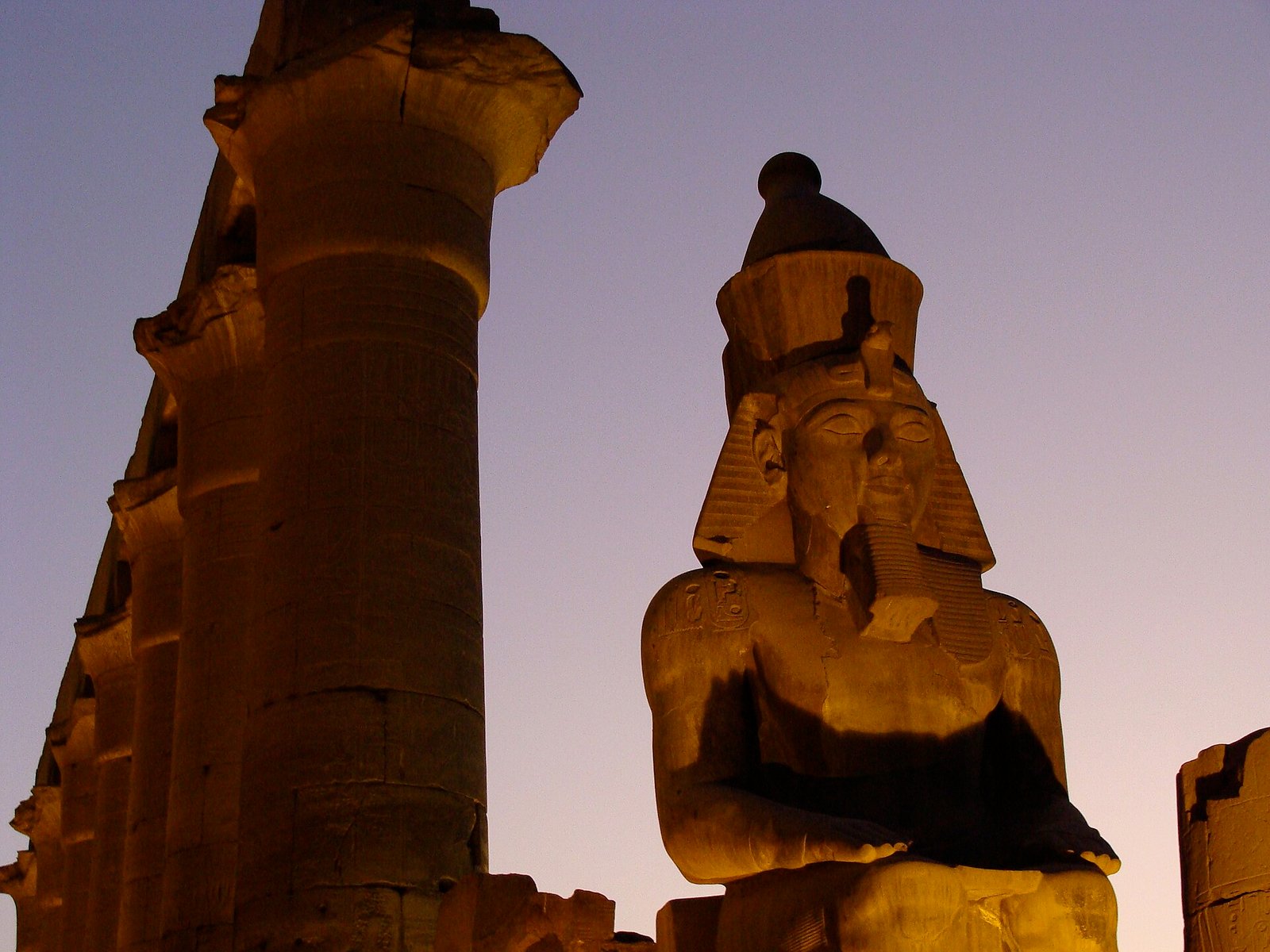
Luxor Temple stands in the middle of the modern city on the east bank of the Nile, a short walk from the corniche and most hotels. Amenhotep III built its heart around 1390 BC and Ramesses II added the pylon, the colossi and two obelisks a century later, one of which now stands in Paris. It is compact, ninety minutes covers it, and it stays open into the evening, when floodlights turn the columns gold. The right plan is Karnak in the morning, the Luxor Museum after lunch and Luxor Temple as the sun goes down, with a guide who can read the Opet festival reliefs.
Most Egyptian temples live in isolation. You drive out, walk through a gate in the desert, and the silence is part of the experience. Luxor Temple is the opposite. It sits in the center of town with cafes on one side, a mosque built into its court, the Nile promenade a block away and horse carriages clattering past the pylon. You leave your hotel, walk five minutes, and there is a granite obelisk of Ramesses II with a traffic light beside it.
That setting is why first-time visitors underrate it. Karnak, three kilometers north, is vast, so people assume Luxor Temple is the smaller sibling you tick off before dinner. In practice it is the more coherent building. Two pharaohs designed almost all of it, the plan runs in a straight line from pylon to sanctuary, and every era after them, Greek, Roman, Christian and Islamic, left something on the walls. It is also the only major temple in Egypt that is genuinely good after dark.
Luxor Temple was never a tomb and never a temple for everyday worship. It was built for one ritual, the annual Opet festival, in which the god Amun traveled from Karnak to Luxor and the pharaoh's divine power was renewed inside the sanctuary. Understand that and the layout makes sense: a processional route with a climax at the far end.
The core was commissioned by Amenhotep III around 1390 BC, at the wealthiest point of the New Kingdom. His are the colonnade of fourteen papyrus columns, the sun court behind it, the hypostyle hall and the sanctuary. He cared about symmetry above everything, and it shows.
A century later Ramesses II added everything you meet first: the pylon carved with the Battle of Kadesh, the first court, the seated colossi and the pair of pink granite obelisks. Where Amenhotep III wanted harmony, Ramesses wanted impact and repetition. Walking from his court into the older colonnade shows how Egyptian taste shifted in a hundred years.
The city was Thebes, capital of the New Kingdom, and its god was Amun. The east bank belonged to the living, the west bank to the dead. Luxor Temple was the southern end of the sacred axis running north to Karnak. Our guide to the Luxor east bank and west bank shows how a two-day visit splits between the sides.
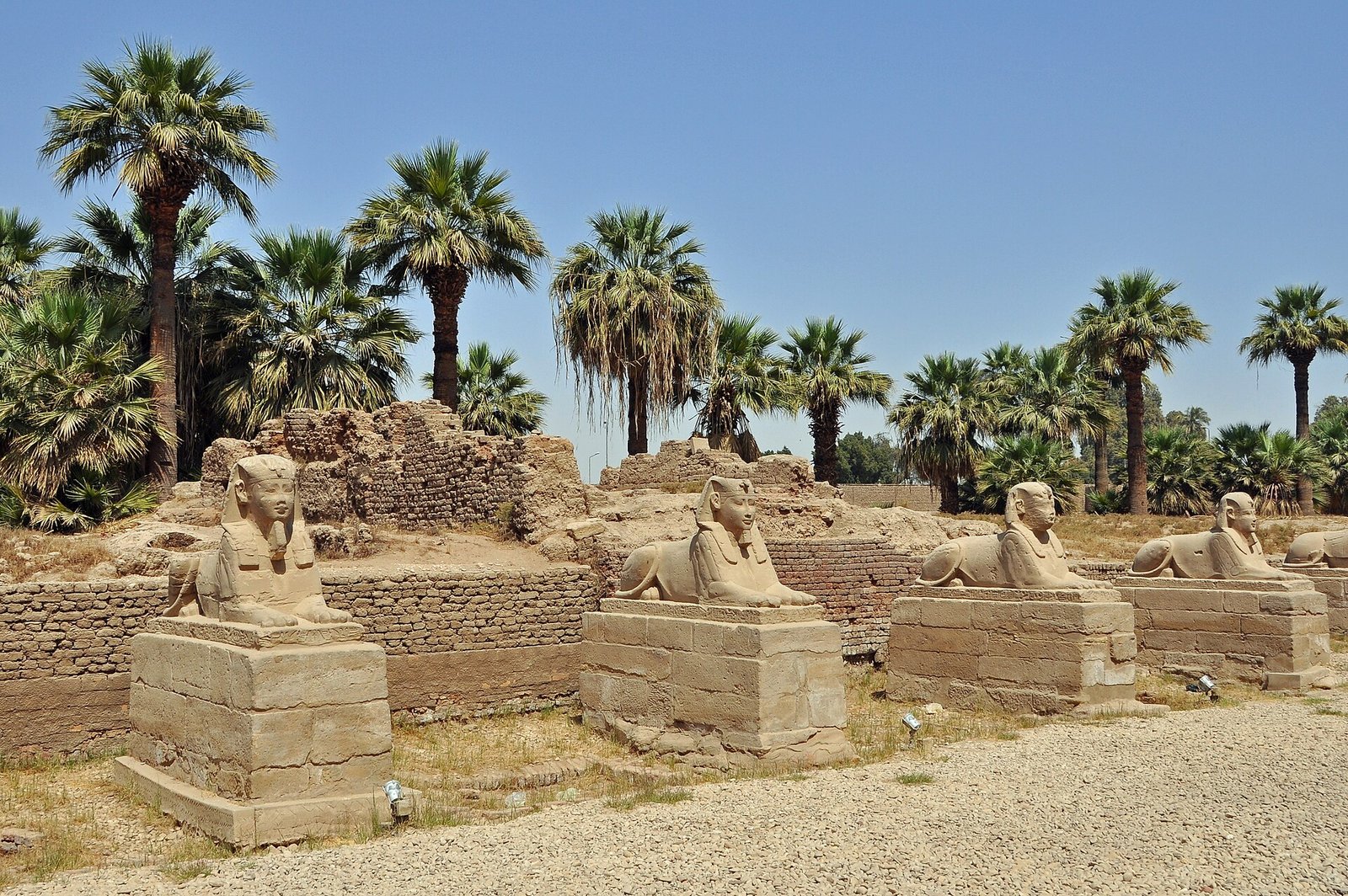
Stand with your back to the pylon and look north. A double row of stone sphinxes runs away in a dead straight line and disappears among the buildings. This is the processional road that connected Luxor Temple to Karnak, roughly 2.7 kilometers, about 1.7 miles, once lined with well over a thousand sphinxes.
For centuries it lay buried under houses, streets and a church. Decades of excavation cleared the full length and it reopened as a single promenade a few years ago, so you can now walk between the two temples on the ancient pavement.
The entrance pylon is the first thing that hits you, a wall of sandstone about 24 meters high, roughly 79 feet, both towers carved in deep sunk relief. The subject is the Battle of Kadesh, the chariot fight against the Hittites that Ramesses II turned into the most advertised victory in Egyptian history, whatever happened on the day.
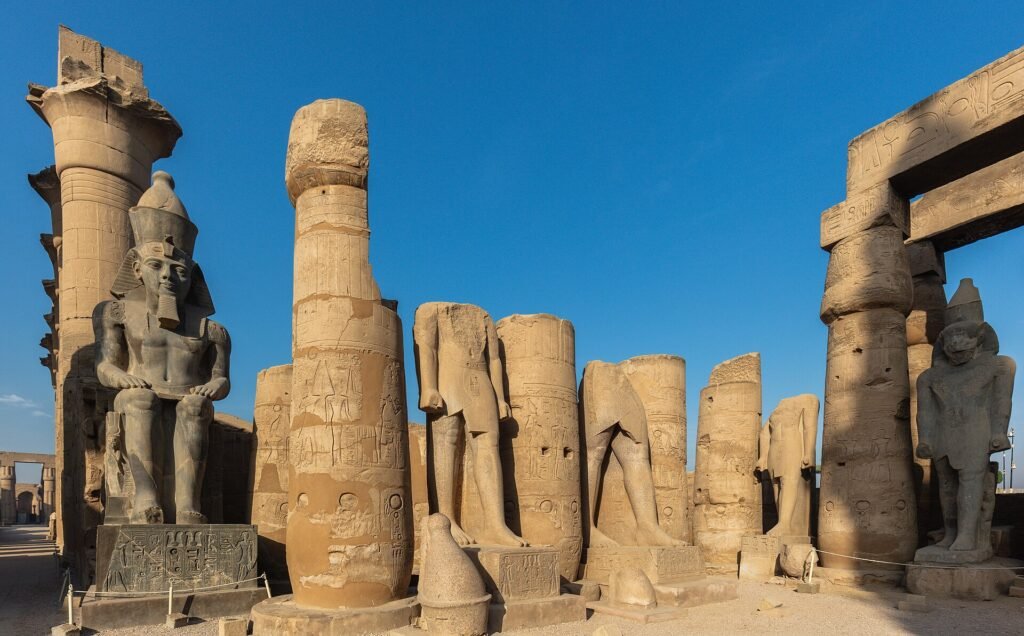
In front of the pylon sit two colossal statues of Ramesses II enthroned, with small figures of his queen beside his legs. Originally six statues stood here, two seated and four standing, and one fallen standing figure has been re-erected in recent years. The seated pair are the most photographed spot in the temple, best in the late afternoon light.
Beside the left tower stands a single obelisk of pink Aswan granite, close to 25 meters tall, around 82 feet, covered in the titles of Ramesses II. There were two. The right-hand one was given to France by Muhammad Ali, ruler of Egypt in the 1830s, shipped down the Nile and across the Mediterranean, and raised in the Place de la Concorde in 1836. The empty pedestal on the right is the most eloquent stone in the temple.
Through the pylon you enter the first court, a broad rectangle ringed by a double row of papyrus-bud columns with standing statues of Ramesses II between them. To the right is a small triple shrine, one chapel each for Amun, Mut and Khonsu, where the sacred boats rested during Opet before entering the temple proper.
Then look up and left. Perched on top of the ancient wall, above the column capitals, is a working mosque with a minaret, the mosque of Abu al Haggag. It honors a thirteenth-century Sufi sheikh who is still Luxor's patron saint, and it was built when the temple lay under many meters of silt and houses. When the court was cleared in the late nineteenth century the mosque was left untouched, so its old street door now hangs high above the pharaonic floor.
The result is one of the strangest sights in Egypt: a congregation praying every day inside a temple decorated for Amun over three thousand years earlier. Every year the town holds the mulid of Abu al Haggag, in which boats are paraded around the temple, a custom many Egyptologists read as a distant echo of the Opet procession. Most visitors walk under the mosque without looking up. Do not be one of them.
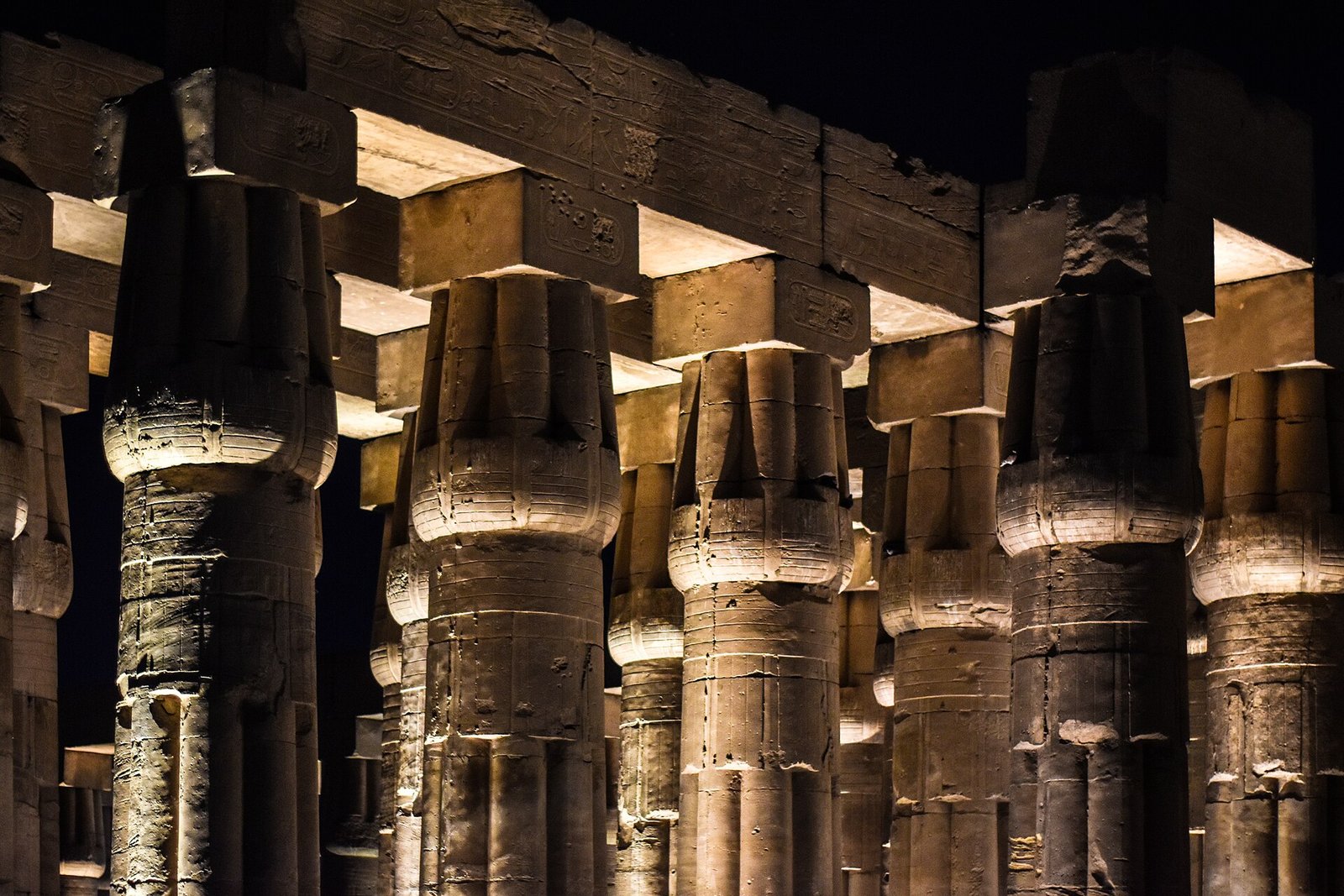
From the Ramesses court a narrow doorway flanked by two more seated colossi leads into the most beautiful space in the temple: the processional colonnade of Amenhotep III. Fourteen columns in two rows, each about 16 meters tall, around 52 feet, with open papyrus capitals, once carried a roof that made this a long, dim, sacred corridor. The roof is gone, so the columns stand against the sky, which is why the floodlighting works so well here.
The walls are the reason to bring a guide. They show the Opet festival in sequence, like a storyboard. The western wall runs from the Karnak end: the sacred boats leaving Karnak, carried to the river, towed upstream, greeted by musicians, dancers, acrobats and butchers preparing cattle for the feast. The eastern wall shows the return, with the king walking in the procession.
The reliefs were begun under Amenhotep III but finished under Tutankhamun, who restored the cult of Amun after Akhenaten abandoned it, then re-inscribed by Horemheb, who put his own name over Tutankhamun's. The scenes are among the liveliest in Egyptian art: acrobats bend over backwards, musicians clap, the cattle wear decorated horns. Look for them low on the wall, at eye level, where most people never look.
The colonnade opens into the sun court of Amenhotep III, a wide peristyle with double rows of columns on three sides. This is also where, in 1989, workers found a cache of buried statues in near-perfect condition, including a red quartzite figure of Amenhotep III on a sledge that is now the centerpiece of the Luxor Museum.
Beyond the court is a hypostyle hall of thirty-two columns, then the antechamber that became the most surprising room in the building. Around AD 300, under Diocletian, the Romans made Luxor Temple the core of a fortress and converted this room into a chapel of the imperial cult. They plastered over the reliefs and painted frescoes of the emperors, with an apse cut into the back wall, and patches of that paint survive. The Arabic name of the town, al-Uqsur, the fortifications, comes from this camp, and so does the word Luxor.
Push on into the inner rooms and you reach the bark shrine, rebuilt inside Amenhotep III's sanctuary by Alexander the Great after he took Egypt in 332 BC. Its walls show Alexander dressed as a pharaoh making offerings to Amun. Beside it is the birth room, where Amun visits the queen and the divine child is shaped on a potter's wheel by the god Khnum. Here, at the very back, is the whole argument of the temple: the king is the son of the god, and the festival proves it each year.
If you take one piece of advice from this page, take this one. Arrive about an hour before sunset. The sandstone goes from pale gold to orange while you walk the pylon and the first court, the heat breaks, and the cruise-ship groups are mostly back on board for dinner. As the light fails the floodlights come on and the temple changes character: columns lit from below, deep shadow between them, the obelisk glowing against a dark blue sky.
Our standing recommendation is to see it twice if you stay overnight: a quiet early-morning pass for the reliefs in daylight, then the floodlit visit after dinner.
Luxor Temple is compact. Sixty minutes gets you through it at a walk. Ninety minutes with a guide covers the Opet reliefs, the Roman chapel and Alexander's shrine properly. That makes it the easiest monument in Luxor to fit around the others, and this is how the east bank falls into a single day:
| Stop | Best time | Time needed | Why in this order |
|---|---|---|---|
| Karnak Temple | Early morning | 2.5 to 3 hours | Huge and exposed; crowds and heat build after ten |
| Luxor Museum | Early afternoon | 1 to 1.5 hours | Air-conditioned, halfway between the temples, holds the statues found under the sun court |
| Avenue of Sphinxes | Late afternoon | 30 to 45 minutes | Walk it southbound and arrive at the pylon as the sun drops |
| Luxor Temple | Dusk into evening | 1 to 1.5 hours | The daylight walk turns into the floodlit visit without leaving the site |
On a Nile cruise the same stops are squeezed into the embarkation or disembarkation day, with the boat moored a few hundred meters from the temple. If it lands at midday, ask us to swap in the evening visit; the boats stay tied up in Luxor overnight. Our page on Luxor to Aswan or Aswan to Luxor explains how the direction changes which day the east bank falls on.
The west bank, with the Valley of the Kings and the temple of Hatshepsut, is a separate morning with its own early start. Two full days in Luxor is the right count, and a hot air balloon over Luxor at dawn on the second morning slots in before the tombs open.
You can visit Luxor Temple alone. It is central, the ticket office is at the entrance and the layout is a straight line. What you will not get alone is the reading. The building is a stack of stories and none of them is labeled. A good Egyptologist guide turns a walk among columns into ninety minutes you will still be describing at home, and this is what ours do here:
Independent visitors tend to leave after the first court. The best rooms are the last ones.
We are a local agency in Egypt with our own licensed Egyptologist guides and vehicles, and the east bank is the day we run most. The shape is always the same:
This evening is built into our Luxor 2-day tour, which pairs it with a full west bank morning, and it opens or closes every Nile cruise we sell between Luxor and Aswan. The wider menu is in our list of Luxor excursions. Entrance fees change and are not quoted here; ask us for the quote.
Mainly two pharaohs of the New Kingdom. Amenhotep III built the core around 1390 BC: the colonnade, the sun court, the hypostyle hall and the sanctuary. Ramesses II added the pylon, the first court, the colossi and the two obelisks about a century later. Tutankhamun and Horemheb finished the colonnade reliefs, Alexander the Great rebuilt the bark shrine, and the Romans added the painted chapel.
In Paris. The temple had two pink granite obelisks in front of the pylon. The right-hand one was given to France by Muhammad Ali in the 1830s, shipped by river and sea, and raised in the Place de la Concorde in 1836. The left-hand one still stands in Luxor beside the pylon, close to 25 meters tall, with the empty twin pedestal a few steps away.
Yes, and for many travelers it becomes the strongest memory of Luxor. The temple is permanently floodlit and stays open later than the other monuments, so you can walk it after dinner with fewer people and no heat. It is not a sound-and-light show, just the lit monument. If you stay overnight, see it once in daylight for the reliefs and once floodlit for the atmosphere.
Between one hour and ninety minutes. It is far more compact than Karnak and the plan runs in a straight line from the pylon to the sanctuary. With a guide reading the Opet reliefs and taking you into the Roman chapel and Alexander's shrine, plan on ninety minutes. If you visit in daylight and again after dark, count two passes of about an hour each.
They are separate temples on the same east bank, joined by the Avenue of Sphinxes. Karnak is enormous, was built and rebuilt over some two thousand years and was the main home of Amun. Luxor Temple is compact, mostly the work of two pharaohs, stands in the center of town and was built for the Opet festival. Karnak needs a morning; Luxor Temple needs an hour at dusk. See both.
The mosque of Abu al Haggag was built in the thirteenth century on what was then the ground, when the temple lay buried under centuries of silt and houses. When the first court was excavated the mosque was left in place, so it now sits on the ancient wall with its old door high above the court. It is still active, and the town's annual festival for the sheikh parades boats around the temple.
Tell us your dates, whether you are on a cruise or staying in town, and how many days you have in Luxor. We come back with the east bank evening built around Luxor Temple at dusk, Karnak and the museum in the right order, and a licensed Egyptologist who can read every wall. No prices on this page, just the quote in your inbox.
Keep exploring