The real Cleopatra history: who the last queen of Egypt was and where you can still find her
The real Cleopatra history: who the last queen of Egypt was and where you can still find her
Cleopatra VII ruled Egypt from Alexandria between 51 and 30 BC, the last monarch of a Macedonian Greek dynasty that had held the country for almost three centuries. She was not the movie seductress but a working head of state who learned Egyptian when none of her family had, kept an indebted kingdom independent by allying with Julius Caesar and then Mark Antony, lost to Octavian at Actium, and died in Alexandria in 30 BC. With her, three thousand years of pharaohs ended. Her city is mostly under water, her tomb has never been found, and the one place in Egypt where you can stand before her carved image is the back wall of the temple of Dendera.
Who Cleopatra was, and why she was Greek and Egyptian at the same time
Start with the fact that surprises most Americans: by documented descent Cleopatra was not Egyptian. She was a Ptolemy, the seventh queen of that name in a family founded by Ptolemy I, one of Alexander the Great's generals. When Alexander died in 323 BC, Ptolemy took Egypt, and his descendants ruled it from Alexandria for the better part of three hundred years.
The Ptolemies were Macedonian Greeks and stayed that way on purpose. They spoke Greek at court, married within the family, and ran Egypt through a Greek-speaking administration laid over the old pharaonic one. To the Nile they were pharaohs; to the Mediterranean, Hellenistic kings.
Cleopatra inherited both faces of that arrangement in 51 BC, at about eighteen, when her father Ptolemy XII died. She was meant to share the throne with her younger brother Ptolemy XIII. What set her apart is that she took the Egyptian half of the job seriously. Our guide to the pharaohs as god kings of the Nile explains why the title mattered so much.
Her languages and education in the Alexandria of the Mouseion
The most reliable thing we know about Cleopatra's mind comes from Plutarch, writing over a century after her death. He says she was the first of her line to learn Egyptian, and that she could speak with Ethiopians, Hebrews, Arabs, Syrians, Medes and Parthians without an interpreter. Padded or not, the point stands: her predecessors had governed Egypt for three centuries without learning to talk to it.
She grew up in the right city for it. Alexandria was the intellectual capital of the Greek world, with the Mouseion, a state-funded research institute, and its Library beside the palace quarter where she lived.
Two things follow for a traveler. The Rosetta Stone, carved in 196 BC under her ancestor Ptolemy V, shows how her Egypt worked: one decree in hieroglyphs, in everyday Egyptian script and in Greek. Our guide to hieroglyphs and how to read them starts from that stone. And the modern Bibliotheca Alexandrina, built as a deliberate answer to the lost Library, is where her intellectual world is explained best.
Caesar, the war with her brother, and the birth of Caesarion
By 48 BC Cleopatra had lost the struggle with her brother's faction and was raising troops on the Syrian border. Then Rome's civil war came to her. Pompey, beaten by Julius Caesar in Greece, fled to Egypt and was murdered on the beach by Ptolemy XIII's men. Caesar arrived days later and was handed Pompey's head.
What happened next is the scene everyone half remembers. Plutarch says Cleopatra had herself smuggled into the palace wrapped in a bedding sack; later retellings turned the sack into a carpet. Caesar backed her claim, Ptolemy's army besieged him in the palace quarter through the winter, and a fire during the fighting damaged part of the city. Whether it reached the Library is still argued about.
Roman reinforcements broke the siege in early 47 BC. Ptolemy XIII drowned in the Nile while fleeing, Cleopatra was restored beside an even younger brother, and later that year she bore a son. Alexandrians called him Caesarion, little Caesar; Caesar never formally acknowledged him and never denied him. She was in Rome as his guest until his assassination in March 44 BC.
Antony, the Donations of Alexandria, and the road to war
Rome split again after Caesar's death, and the east fell to Mark Antony. In 41 BC he summoned Cleopatra to Tarsus to explain which side she had backed. She arrived by river in a gilded barge with purple sails, staged as Aphrodite meeting Dionysus. He wintered in Alexandria, and in 40 BC she bore him twins, Alexander Helios and Cleopatra Selene.
Read the alliance as politics first. Antony needed Egyptian grain, money and ships for his wars in the east. Cleopatra needed a Roman partner who would keep her kingdom off the list of provinces and hand back territory the Ptolemies had lost. A third child, Ptolemy Philadelphus, was born in 36 BC.
The breaking point came in 34 BC with the Donations of Alexandria. At a public ceremony Antony, on a golden throne beside Cleopatra, declared Caesarion the true son of Julius Caesar and distributed eastern kingdoms to her children. Octavian, Caesar's adopted heir, sold it in Rome as proof that Antony meant to move the capital to Egypt. In 32 BC the Senate declared war, carefully, on Cleopatra alone.
Actium, 30 BC, and the end of three thousand years of pharaohs
The war was decided at sea on 2 September 31 BC off Actium in western Greece. Antony and Cleopatra were blockaded and short of supplies. Her squadron broke out and sailed for Egypt, Antony followed, and the rest of his fleet and army gave up over the following days. Plan or collapse, historians still argue; either way Octavian owned the Mediterranean.
In the summer of 30 BC his army reached Alexandria. Antony's remaining forces deserted, and Antony, told falsely that Cleopatra was dead, fell on his sword and died in her arms inside the mausoleum where she had barricaded herself. Octavian entered the city on 1 August.
Cleopatra died a few days later, at thirty-nine, rather than be paraded through Rome in his triumph. The famous version is an asp, an Egyptian cobra, smuggled to her in a basket of figs. That comes from Plutarch, who adds that nobody really knew and that others spoke of a poisoned hairpin. Treat the snake as tradition, not fact.
What is fact is that Octavian had Caesarion killed and made Egypt his personal province. Egypt had been ruled by pharaohs, native or foreign, for roughly three thousand years, and after August 30 BC it never had one again.
The myths: her looks, her ancestry, and who wrote her story
Almost every image of Cleopatra you carry was made by someone with an agenda. Octavian needed the war to look like Rome against a foreign temptress rather than a Roman civil war. Shakespeare and Hollywood needed a tragic heroine.
Was she beautiful?
The only portraits made in her lifetime are coins, and they show a strong hooked nose, a firm chin and a heavy jaw, deliberately close to her father's image, because the point was legitimacy, not prettiness. Plutarch says her beauty was not exceptional and that the pull was in her conversation and her voice. Cassius Dio, later, called her strikingly beautiful.
Was she Black, white, Egyptian, Greek?
The neutral version: her documented ancestry is Macedonian Greek on the paternal side, through a dynasty that married closely within itself. The identity of her mother is not securely recorded, nor is that of one paternal grandmother, and that gap is where the debate lives. No ancient source describes her skin color and no identified remains exist. What is not in doubt is that she was born in Egypt, ruled it, spoke its language and was buried in it.
| What people believe | What the sources support |
|---|---|
| She was Egyptian | Macedonian Greek dynasty, born and raised in Alexandria |
| She was a famous beauty | Coins show a severe face; Plutarch credits her speech and wit |
| She died from an asp bite | A tradition reported by Plutarch, who says nobody knew for certain |
| Caesar and Antony were love stories | Political alliances with children and territory at stake |
To see how the legend was built on screen, our guide to movies and series about Egypt covers the Cleopatra films and what each got wrong.
Alexandria then and now: the sunken palace quarter and the Serapeum
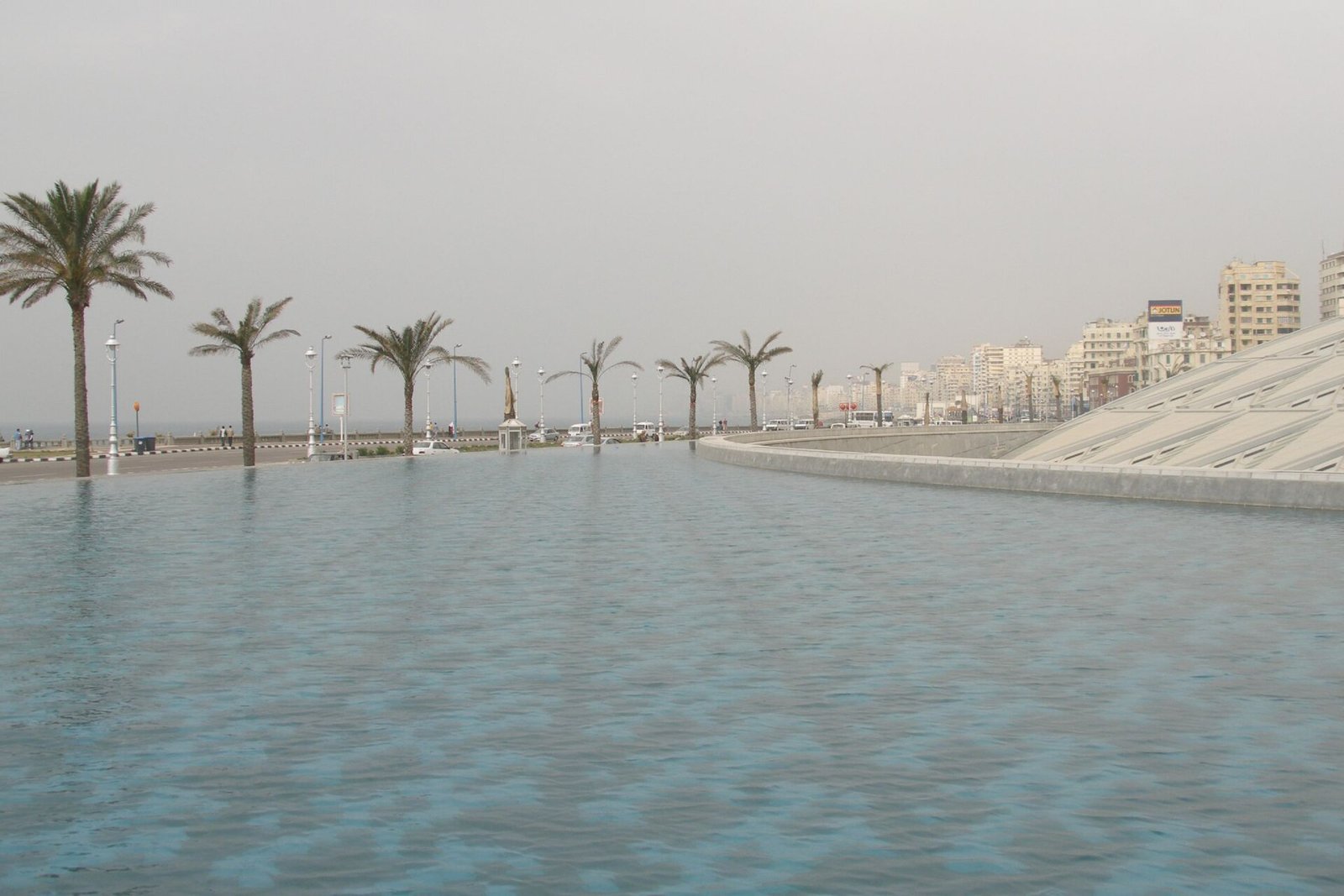
The Alexandria Cleopatra knew was a planned Greek city on a grid, with the lighthouse on Pharos island, a royal quarter of palaces on the Lochias promontory beside the eastern harbor, and the Mouseion and Library close by. She lived, ruled and died in that royal quarter. You cannot walk it, because it is under water.
Earthquakes and a slow sinking of the coastline in the centuries after her death dropped the palace district several meters below the harbor. Since the 1990s underwater archaeologists have mapped columns, sphinxes and statues on the seabed just off the modern corniche. Some recovered pieces are shown in the city's museums.
The one great Ptolemaic religious site you can stand on is the Serapeum, on the hill of the old Egyptian quarter of Rhakotis. It was the temple of Serapis, a god the early Ptolemies created for Greeks and Egyptians to share, and it housed the so-called daughter library. Today you see the platform, underground galleries, two sphinxes and the column locals call Pompey's Pillar, raised for Diocletian three centuries after her.
Taposiris Magna and the search for her tomb
Nobody knows where Cleopatra is buried, and be suspicious of anyone who says otherwise. The ancient sources say she was laid to rest with Antony in the mausoleum she built near the palace in Alexandria. That puts it in the sunken royal quarter or under the modern city, with fifteen centuries of earthquakes and rebuilding on top.
The alternative theory belongs to an excavation at Taposiris Magna, a Ptolemaic temple of Osiris on a ridge about an hour west of Alexandria. The team there proposes that she chose burial outside the city, in a temple of the god whose death and resurrection she linked to Antony and herself. The site has produced coins bearing her image, a long rock-cut tunnel, Greco-Roman burials and statue fragments. It has not produced a tomb or an inscription naming her.
Our position, as a local agency that takes people there, is simple: an atmospheric site with a real scholarly question attached, and unresolved. Alexandria also hides Alexander the Great's tomb, and has never given that one up either.
Dendera: the one place in Egypt where you can see Cleopatra carved in stone
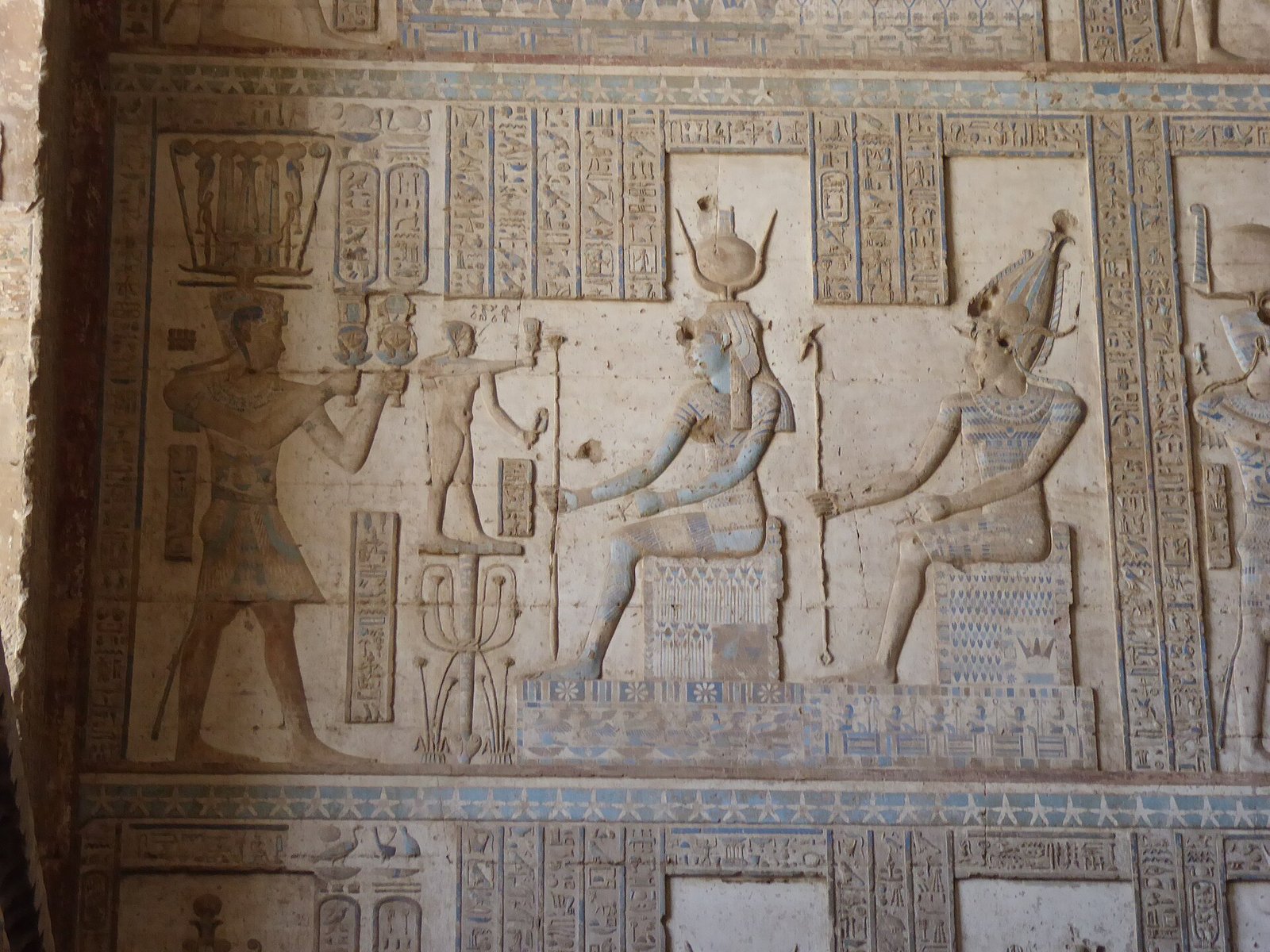
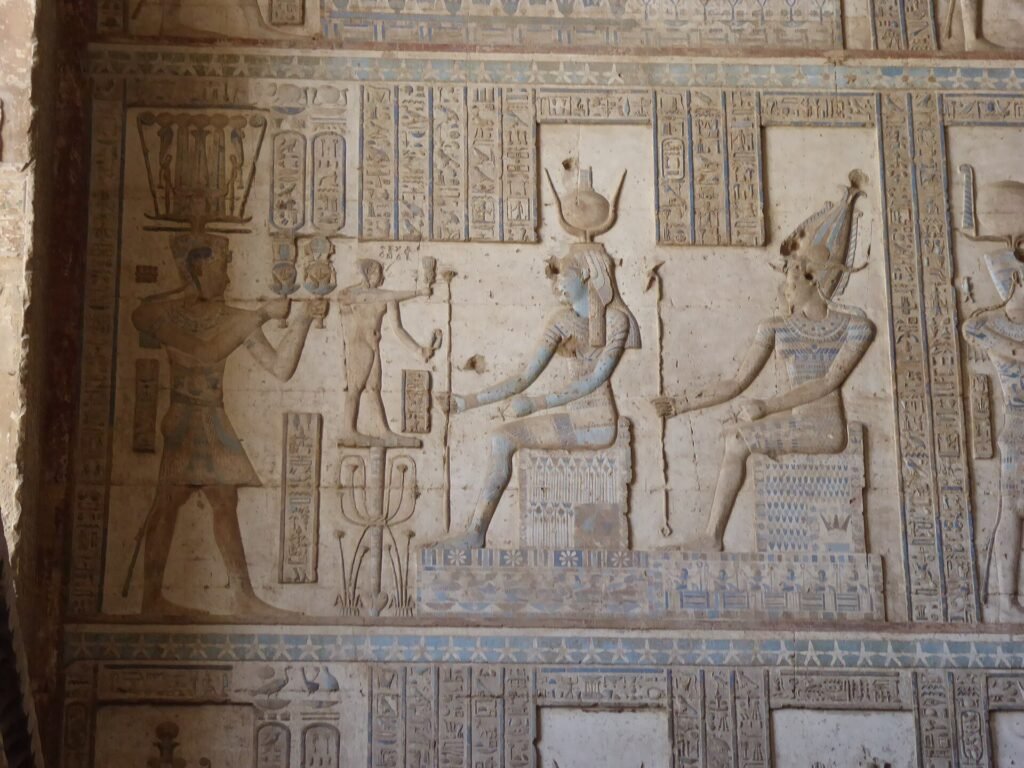
There is exactly one monumental image of Cleopatra VII in Egypt you can walk up to, and it is not in Alexandria. It is on the back wall of the temple of Hathor at Dendera, about an hour and a half north of Luxor by road. Walk around to the rear, look up at the southern wall, and you are facing a relief more than twice your height of Cleopatra and Caesarion offering to Hathor and the other gods.
Look at how she is shown: not as a Greek queen but as an Egyptian one, with the vulture headdress, the sun disk and horns and the tight sheath dress, exactly as queens had been carved for two thousand years. Caesarion stands in front wearing the double crown as pharaoh. That image is part of why the boy was killed weeks after her death.
Dendera rewards the trip on its own, with a painted ceiling cleaned to a deep blue most temples have lost and a copy of the famous zodiac on the roof. Most packages skip it, so it is rarely crowded. It is usually paired with Abydos as a full day from Luxor; our page on excursions from Luxor explains how that day runs.
Her family's temples fill the south. Edfu was completed under her father, Philae carries Ptolemaic reliefs end to end, and Kom Ombo is Ptolemaic too. A Nile cruise between Luxor and Aswan is, whether it says so or not, a tour of her dynasty's architecture.
What to see in Alexandria today if Cleopatra is why you are going
Be realistic. Alexandria is a big, loud, modern port of several million people that wears its ancient past lightly, and nothing from her reign stands intact. What it offers is places where a guide can point at the water and tell you what lies under it.
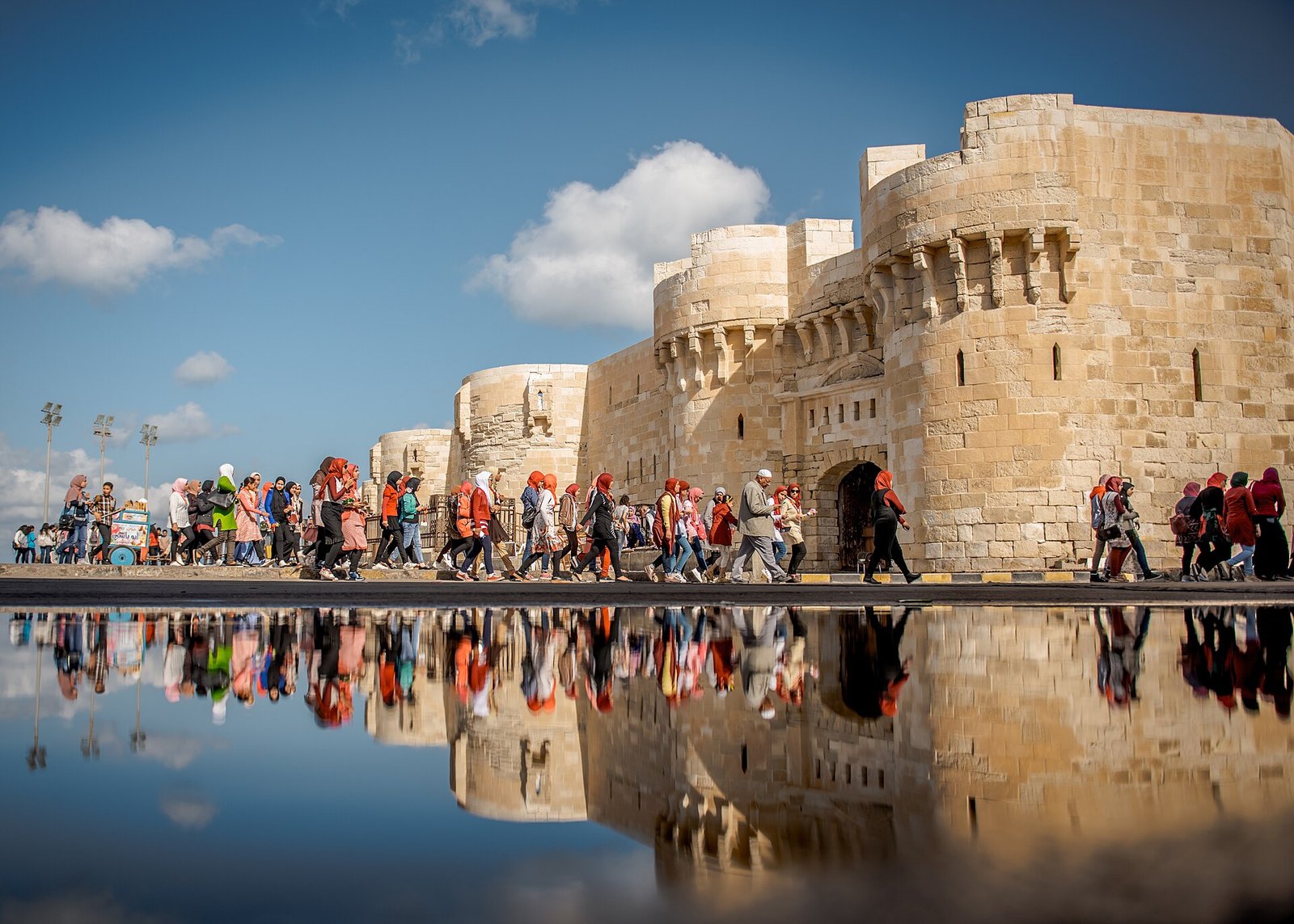
- The eastern harbor corniche. Stand by the fort of Qaitbay, built in the fifteenth century on the foundations of the Pharos lighthouse, and look across the bay. The palace quarter lies beneath the water in front of you.
- The Serapeum and Pompey's Pillar. The Ptolemaic temple platform with its galleries and sphinxes.
- The catacombs of Kom el-Shoqafa. Roman, cut a century or two after her death, but the best surviving fusion of Greek and Egyptian styles, with Anubis dressed as a legionary.
- The museums. The Alexandria National Museum and the antiquities collection inside the Bibliotheca Alexandrina show Ptolemaic statuary and objects raised from the harbor; check the current status of the old Greco-Roman Museum when you plan.
Do it as a full day from Cairo, a little under three hours each way by road, or stay a night on the corniche and add Taposiris Magna the next morning.
How Explora Egipto builds a Cleopatra-themed day
We get this request often enough to have a shape for it. No costumes, no barge with purple sails: a history day run by an Egyptologist guide who knows the Ptolemaic period, in our own vehicle, at a pace that leaves room for the story.
| Option | Base | What it includes | Best for |
|---|---|---|---|
| Alexandria day | Cairo | Qaitbay and the harbor, Serapeum, catacombs, Roman theater, a museum | One free day in Cairo |
| Alexandria overnight | Cairo | The above at an easier pace, plus Taposiris Magna on day two | Readers who care about the tomb question |
| Dendera day | Luxor | Dendera with the Cleopatra relief, usually paired with Abydos | Anyone on a Nile cruise or Luxor stay |
- You tell us your dates, where you start and how deep you want to go. Three lines is enough.
- We reply with an itinerary that slots the Cleopatra sites next to Cairo and Luxor where they belong, and we send you the quote.
For a whole itinerary built around a theme, our custom Egypt tour page explains how we design a private trip from scratch.
Frequently asked questions
Was Cleopatra Egyptian or Greek?
By documented descent she was Macedonian Greek, from the Ptolemaic dynasty founded by one of Alexander the Great's generals, which had ruled Egypt from Alexandria for almost three centuries. She was also born in Egypt, crowned as its pharaoh, and reportedly the first of her line to learn Egyptian. Both descriptions are true.
How did Cleopatra die?
She died in Alexandria in August 30 BC, days after Octavian took the city and Antony killed himself. The asp story comes from Plutarch, writing more than a century later, who admits nobody knew for sure and also mentions a poisoned hairpin. What is certain is that she chose death over a Roman triumph.
Where is Cleopatra's tomb?
It has never been found. Ancient writers place her with Antony in her own mausoleum near the palace in Alexandria, an area now under the harbor or the modern city. The excavation at Taposiris Magna argues for a burial there and has found coins with her portrait and a tunnel, but no tomb. Treat every headline as unconfirmed.
Can you actually see Cleopatra anywhere in Egypt?
Yes, in one place. The rear wall of the temple of Hathor at Dendera, north of Luxor, carries a giant relief of Cleopatra VII and Caesarion offering to the gods in full Egyptian royal style. Coins with her profile are shown in museums in Cairo and Alexandria. Nothing from her reign stands in Alexandria itself.
Is Alexandria worth visiting for the Cleopatra story?
Yes, with the right expectations and a guide who knows the Ptolemaic period. The harbor where her palace sank, the Serapeum, the catacombs and the museum objects raised from the seabed give the story a real landscape. Done as a full day from Cairo or an overnight, it adds a chapter most Egypt trips leave out.
Why does Cleopatra matter so much in Egyptian history?
Because her death closed the longest run of any monarchy in the ancient world. Egypt had been ruled by pharaohs for roughly three thousand years, and after 30 BC it became a province run for Rome. She was also the last ruler to present herself to Egyptians as a living Isis and to fund their temples in the old way.
Follow the last queen of Egypt from the harbor of Alexandria to the wall at Dendera
Tell us your dates and how far you want to take the story, and we come back with a private itinerary that puts Alexandria, Taposiris Magna, Dendera and the Ptolemaic temples of the south in the right order, with an Egyptologist guide who tells the history without the Hollywood. We send you the quote.