The temple of Hatshepsut at Deir el Bahari is the best hour on the Luxor west bank, if you climb it right
The temple of Hatshepsut at Deir el Bahari is the best hour on the Luxor west bank, if you climb it right
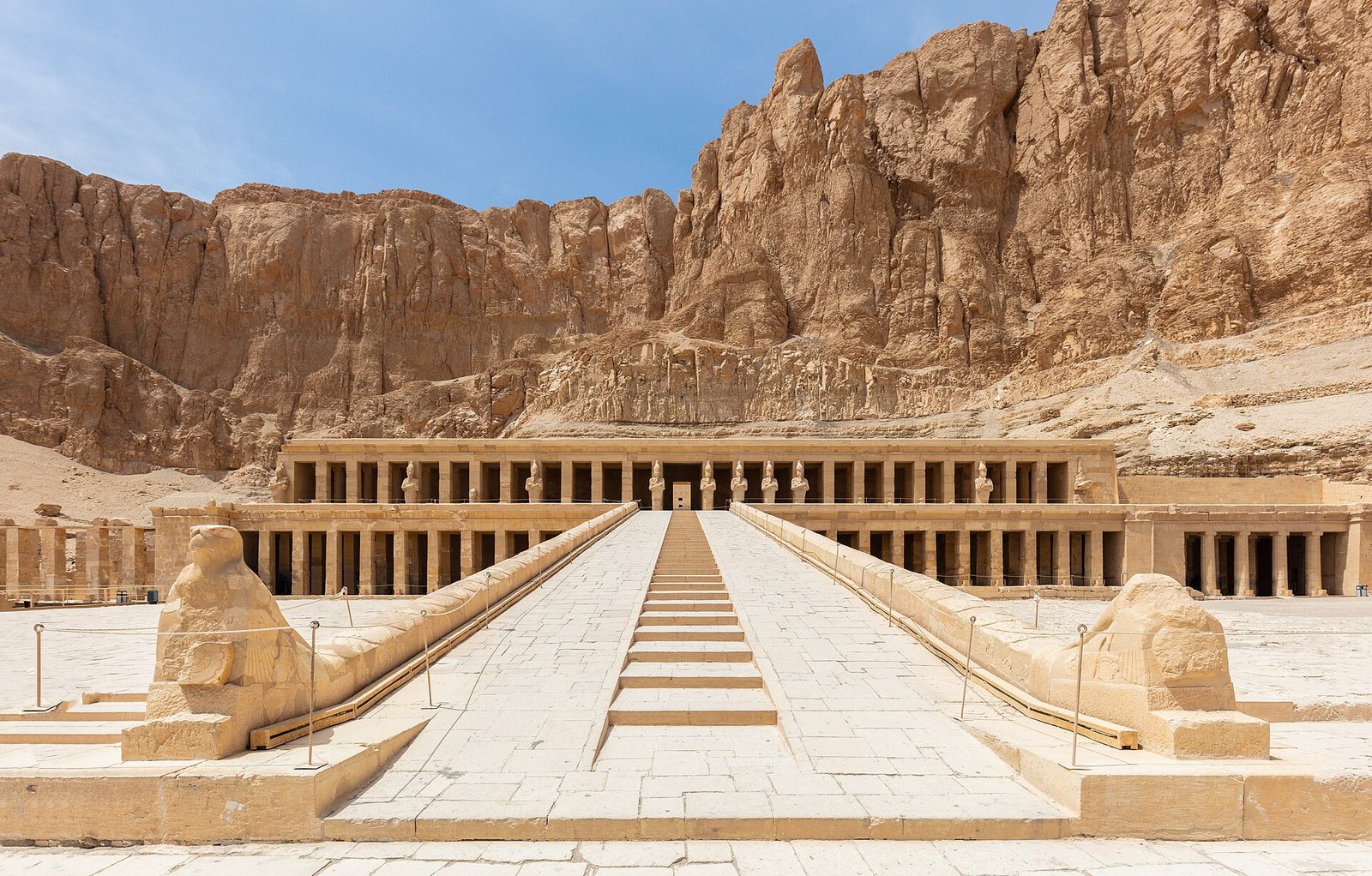
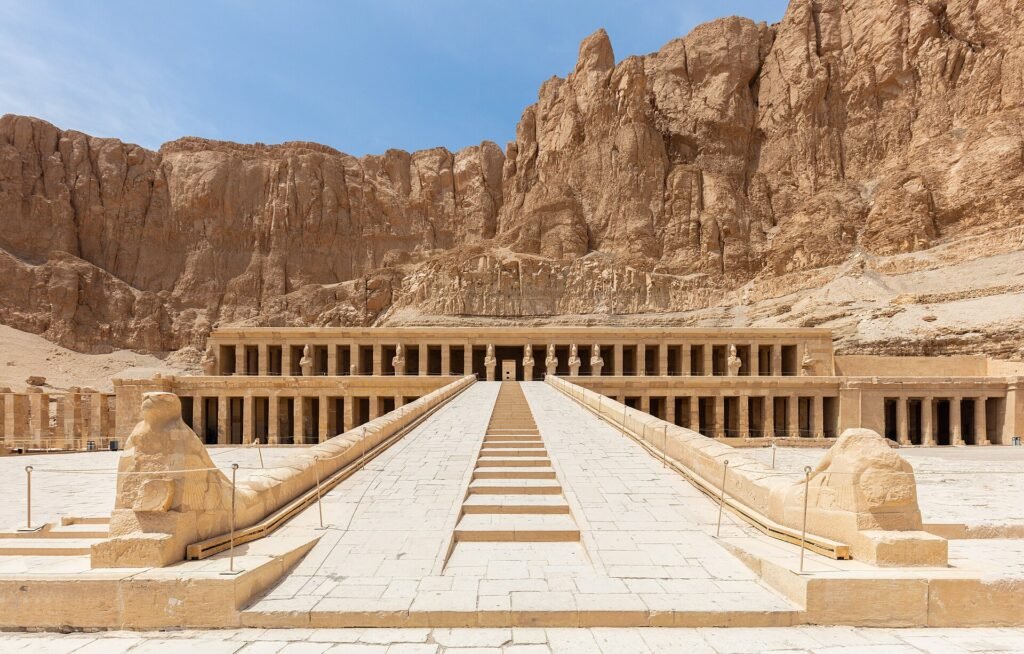
The temple of Hatshepsut sits in a bay of tan cliffs at Deir el Bahari, on the west bank of the Nile opposite Luxor. Three wide terraces climb the hillside on ramps, each fronted by a colonnade, and the whole building reads as if the mountain had been cut to receive it. A short tram ride from the ticket office drops you at the first ramp. Plan 60 to 90 minutes, go at opening or in the last hour before closing, and pair it with the Valley of the Kings, ten minutes away by road. The Punt reliefs and the painted chapel of Anubis are the two things not to miss.
What you are looking at from the bottom of the ramp
The cliff behind the temple is the eastern face of the Theban mountain, the ridge that hides the Valley of the Kings on its far side. The ancient name was Djeser Djeseru, "holy of holies", the memorial temple of the queen who ruled as king in the fifteenth century BC. Her rise, reign and erasure are on our page about Hatshepsut, the queen who ruled as pharaoh. This page is about the building and the visit.
The design is credited to Senenmut, her steward and closest official. Almost every other Egyptian temple is a chain of walled spaces that get darker as you go in. Senenmut turned that inside out: three open terraces against the cliff, joined by central ramps, each fronted by square pillars that repeat the vertical lines of the rock. Mountain and temple read as one object.
The axis points east across the river to Karnak. Once a year, during the Beautiful Festival of the Valley, the barque of Amun left Karnak temple, crossed the Nile and was carried up these ramps to spend the night here. You are walking a processional route, not a set of stairs.
From the ticket office to the first ramp
The ticket office and the parking lot sit at the mouth of the bay, well back from the temple. Between them runs a straight, gently rising causeway with no shade at all, about a third of a mile. You can walk it or take the small open tram. The tram ticket is sold separately beside the main window, and the ride drops you at the base of the lower terrace.
In the cool months, walk in and ride back: the approach on foot is the classic view and the facade grows with every step. From May to September, ride both ways and save your energy for the terraces. With small children or anyone with limited mobility, always ride. The restrooms are at the ticket office end, not the temple.
Off the tram, the whole facade is in front of you. Take the photograph here, ramp centered, before the site fills up.
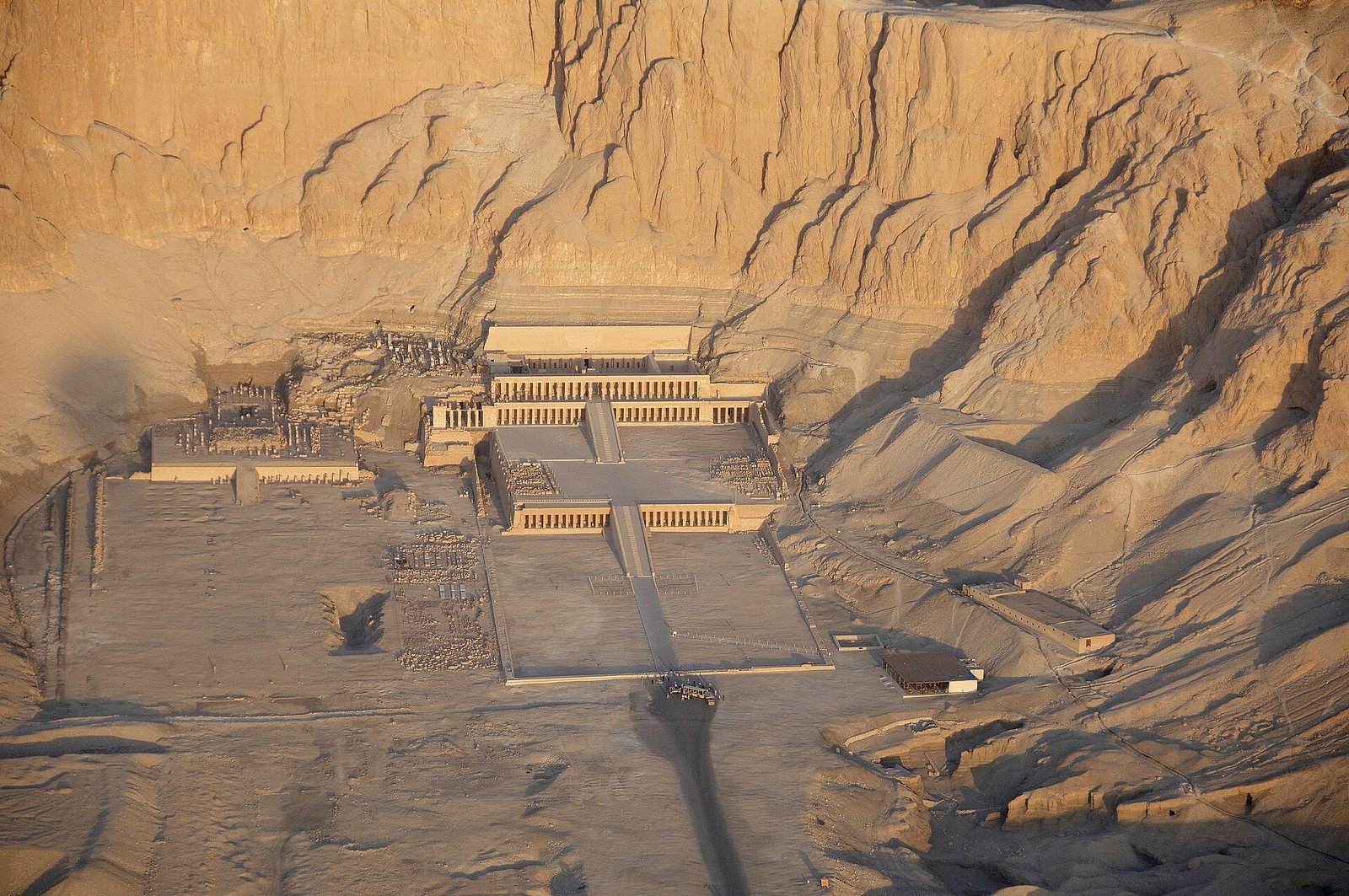
The lower terrace and the obelisks in transit
The lower terrace was once a garden, and the tradition is that some of the trees planted in rows beside the approach were the incense trees brought back from Punt. Today it is an open gravel court that most visitors cross in a minute. Slow down at the back wall.
On the south side of the rear colonnade, to your left as you face the cliff, the reliefs show the transport of Hatshepsut's two great obelisks from the Aswan quarries to Karnak: a pair of enormous barges lashed together, with a fleet of tow boats ahead of them. One of those obelisks still stands at Karnak. On the north side are hunting and offering scenes, much damaged and worth a guide's pointer.
Climb the ramp to the middle terrace slowly; the view back across the plain to the green line of the Nile is already worth a stop.
The middle terrace: Punt on the left, the divine birth on the right
This is the terrace the temple is famous for. Two porticoes flank the central ramp, each with a long illustrated narrative, and together they make Hatshepsut's case for a woman on the throne.
The Punt portico
The south portico records the trading expedition Hatshepsut sent to Punt, a land on the southern Red Sea coast. Read it left to right: five Egyptian ships anchor, the people of Punt live in round houses on stilts among incense trees, the chief Parehu comes forward with his wife Ati, whose heavy figure was carved with a realism unusual in Egyptian art, and the ships are loaded with incense, ebony, gold, ivory, live animals and whole incense trees in baskets slung from poles.
Look at the fish carved beneath the ships; biologists have identified Red Sea species from them. The block with the queen of Punt is in the Egyptian Museum in Cairo, so what you see at that spot is a cast.
The divine birth colonnade
The north portico tells a different story. Amun takes the form of the reigning king and visits Queen Ahmose. The ram-headed god Khnum shapes the future Hatshepsut and her ka on his potter's wheel, and the frog goddess Heket assists at the birth. This was the theological case for a female king, carved where every visiting official would see it.
Many figures of Hatshepsut here were hacked out late in the reign of Thutmose III, and the name of Amun was cut away under Akhenaten and later restored. A guide can show you each layer in the same wall.
The two chapels most groups walk straight past
At either end of the middle terrace, behind the porticoes, are two chapels. Groups on a tight schedule hear the Punt story and go straight up. Do not; these rooms hold the best preserved color in the temple.
The chapel of Hathor, south end
Turn left past the Punt portico into a columned hall whose capitals carry the face of Hathor, with cow's ears and curled wig, above a sistrum. Hathor was the goddess of the Theban necropolis, and here she appears as a cow licking the hand of Hatshepsut and suckling the young king. Red and yellow paint survives on the ceilings and door jambs, and a small rock-cut sanctuary sits at the back.
The chapel of Anubis, north end
Turn right past the birth colonnade into a hall of twelve fluted columns with the freshest paint on the site. The ceiling is a night sky of yellow stars on deep blue. Anubis, the jackal god, receives offerings from Hatshepsut in scenes whose red, blue, green and white survived because the room was roofed and out of the sun. Most people give it three minutes and remember it for years. Give it ten.
Inner rooms open and close with conservation work; ask at the gate.
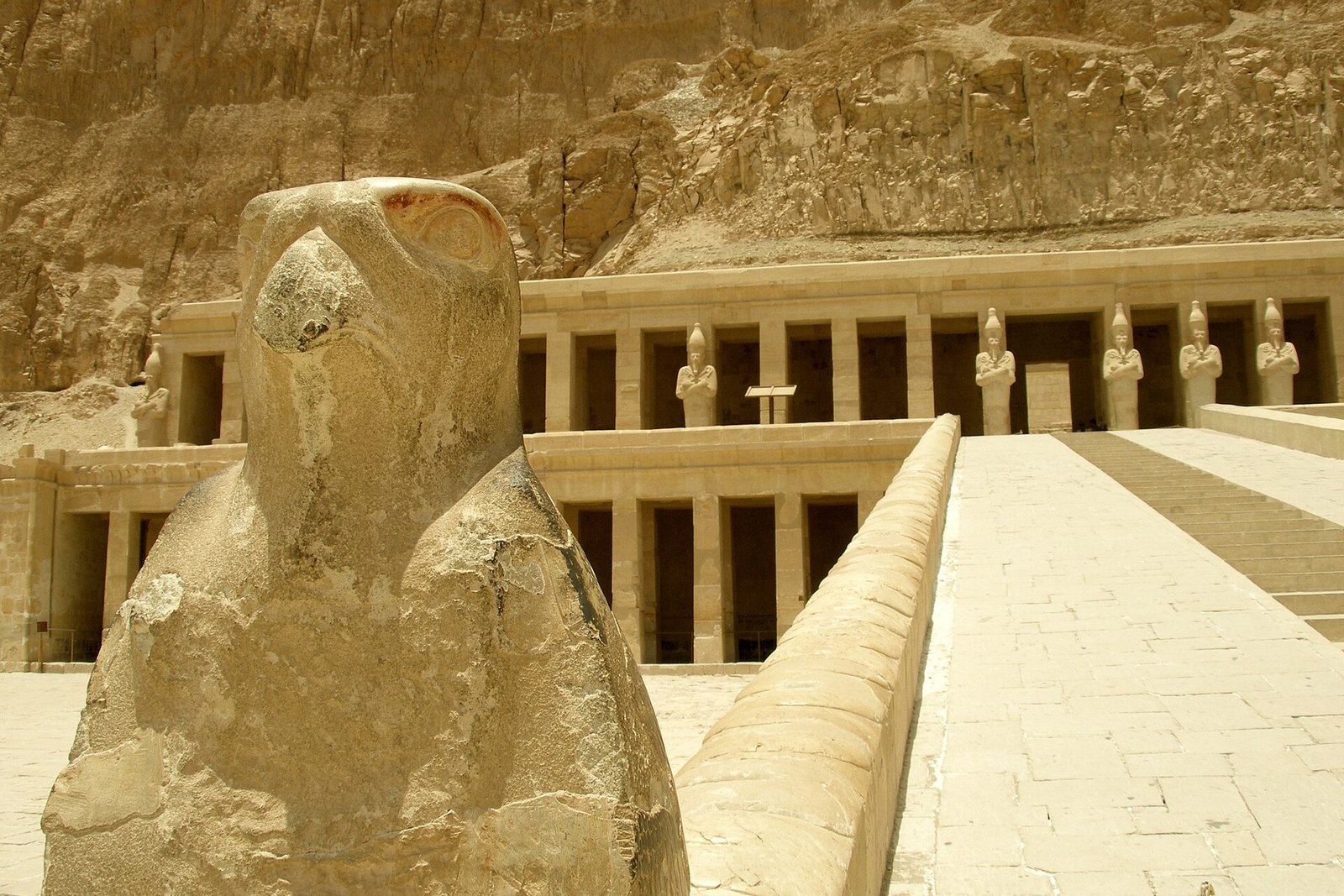
The upper terrace: the Osiride statues and the sanctuary of Amun
The upper ramp brings you to the most photographed row on the site: statues of Hatshepsut standing against the pillars of the portico, wrapped like Osiris, arms crossed with crook and flail, the false beard on the chin. Thutmose III's workmen pulled these down and dumped them in a quarry pit below the temple; what stands today is original fragments pieced together with careful reconstruction.
A granite doorway leads into the festival courtyard, where the barque of Amun rested during the Valley festival. To the north is the solar complex, an open-air altar aligned east to the rising sun; to the south, the chapels of the royal cult for Hatshepsut and her father Thutmose I.
At the back, on the axis, the sanctuary of Amun is cut straight into the cliff: dim rooms one behind the other, still visited by sick pilgrims a thousand years after Hatshepsut died. The guards will sometimes light the reliefs for you with a mirror, the old way.
Then turn around. From the upper terrace, looking east over the ramps to the fields and the river, you understand at a glance why Senenmut chose this bay and no other.
Ask us to plan Deir el Bahari and the Valley of the Kings together
The ruin next door: the temple of Mentuhotep II
South of Hatshepsut's temple, in the same bay, lie the remains of an older and far more ruined building. It belongs to Mentuhotep II, who reunited Egypt around 2050 BC and founded the Middle Kingdom, five centuries before Hatshepsut. It also rose in terraces, around a solid central block that early excavators took for a pyramid. Senenmut studied it, borrowed the terrace idea and built bigger.
The royal cache above the bay
A few hundred yards away, high in the southern cliffs, is the shaft where in 1881 the antiquities service found more than fifty royal mummies, among them Seti I, Ramesses II and Thutmose III. Priests at the end of the New Kingdom had gathered them from their robbed tombs, rewrapped them and hidden them together. Those kings now rest in the National Museum of Egyptian Civilization in Cairo. The shaft itself is not visitable.
Why the temple looks so complete: the Polish reconstruction
The temple you walk through is partly a reconstruction, which is worth knowing. After Thutmose III defaced it, the building was quarried for stone, buried by rockfall and finally occupied by a Coptic monastery on the upper terrace. Deir el Bahari means "the northern monastery"; the monks are the reason the name survives.
Excavation began in the 1890s, and the Metropolitan Museum of Art's expedition recovered the smashed statues from the quarry pits in the 1920s. Since 1961 a Polish-Egyptian mission from the University of Warsaw has rebuilt the upper terrace, re-erected the Osiride statues and reassembled thousands of decorated blocks.
The method is anastylosis: original blocks return to their original positions, gaps are filled with plain new stone that never pretends to be old, and nothing is carved fresh. When a wall looks patchy, that is the honesty of the restoration.
Heat, shade and the best hour of the day
This is the hottest major site in Luxor. The bay of cliffs faces east, catches the sun the moment it clears the far bank, and reflects it back off pale limestone from three sides. There is no shade on the causeway or the ramps; only the porticoes and the chapels give relief.
| Season | Typical range at the temple | What it means for you |
|---|---|---|
| November to February | Mornings 50 to 60 F (10 to 15 C), afternoons around 75 F (24 C) | Comfortable at any hour. Walk the causeway. The only issue is the mid-morning crowd. |
| March, April, October | Mornings 65 to 70 F (18 to 21 C), afternoons 90 to 95 F (32 to 35 C) | Go at opening or after 3 pm. Midday is uncomfortable on the terraces. |
| May to September | Mornings already 80 F (27 C), afternoons 104 to 113 F (40 to 45 C) | Opening hour only, tram both ways, back in the vehicle by 10 am. |
The light follows the same logic. The temple faces east, so at opening the facade is lit evenly while the cliff behind is still in shadow. That is the postcard. By late morning the facade flattens and the glare is fierce. In the last hour before closing the cliff turns gold and the terraces fall into soft shade: the second best moment and far emptier. Check current opening hours locally.
Bring a brimmed hat, a liter of water each, sunscreen, and closed shoes for the smooth stone ramps.
How long it takes, and how to pair it with the Valley of the Kings and the Colossi
Give the temple 60 to 90 minutes including the tram. That covers all three terraces, both chapels and the sanctuary without rushing; photographers should allow two hours.
The temple is the middle piece of the classic west bank morning. The Valley of the Kings is ten minutes away by road on the far side of the same mountain, and the Colossi of Memnon stand beside the road you drive in on. Our standard order:
- Valley of the Kings at opening. The tombs are underground and cool, and the crowds build fast. Three tombs, about two hours.
- Deir el Bahari by mid-morning. You arrive as the first big groups leave. Ninety minutes.
- The Colossi of Memnon on the way back. A fifteen minute roadside stop.
- Medinet Habu or the Ramesseum if you have the appetite. Both are close and quieter.
In winter we sometimes flip the first two, because the opening light on the facade is the best of the day and heat is not a factor. In summer the order above is the only sensible one. Lunch is back across the river and Karnak fills the afternoon; our page on the Luxor east bank and west bank shows how the two sides fit into one or two days, and the wider list is in what to see in Luxor.
What a guide adds, and how Explora Egipto slots it in
You can visit Deir el Bahari on your own and enjoy the view. What you miss is the reading. The Punt reliefs are a story with a beginning, a middle and an end; without someone tracing it wall by wall it looks like a row of boats. The birth colonnade means nothing unless you know why Hatshepsut needed it.
A guide also knows which chapel rooms are open and when to leave so you are not in line at noon. This is how we run it at Explora Egipto:
- A private vehicle and an Egyptologist guide for the whole west bank morning, with the order set by season and interest.
- Site and tram tickets bought before you arrive, so you walk straight in.
- Time inside the Hathor and Anubis chapels built into the schedule rather than skipped.
- Extra stops on request: the Tombs of the Nobles, Deir el Medina, or a sunrise balloon that drifts over the temple.
- The morning folded into your Nile cruise, hotel stay or longer itinerary; our Luxor excursions page shows how it can be packaged.
Tell us your dates and how many days you have in Luxor, and we send you the plan and the quote.
Frequently asked questions
Where is the temple of Hatshepsut and how do you get there?
At Deir el Bahari, on the west bank of the Nile opposite Luxor, in a bay of cliffs below the Theban mountain. From a Luxor hotel or cruise ship you cross the river by bridge or ferry, then drive about twenty minutes. Almost everyone sees it on a guided west bank morning with the Valley of the Kings.
How long do you need at the temple of Hatshepsut?
Sixty to ninety minutes is right for most people, including the tram ride. That covers the three terraces, the Punt and divine birth reliefs, both side chapels and the sanctuary. To photograph the facade in good light and read the Punt story scene by scene, plan two hours. In summer keep it under an hour and go at opening.
What is the best time of day to visit Deir el Bahari?
Opening time. The temple faces east, so the facade is evenly lit for about ninety minutes after sunrise while the cliff behind stays in shadow, and the air is at its coolest. The last hour before closing is the second best choice, with gold light and far fewer people. Avoid 11 am to 3 pm from April through October.
Is there a tram at the temple of Hatshepsut?
Yes. A small open tram runs between the ticket office and the base of the lower terrace along a shadeless causeway of about a third of a mile; its ticket is sold separately beside the main window. In the cool months walk in for the view and ride back; in summer, or with children or limited mobility, ride both ways.
Can you see the Punt reliefs and the painted chapels?
Yes, they are on the middle terrace and included in the site ticket. The Punt expedition fills the south portico and the divine birth scenes the north. The chapel of Hathor is beyond the Punt portico and the chapel of Anubis, with the best surviving color, beyond the birth colonnade. Some inner rooms close for conservation; ask at the gate.
Should I see the Valley of the Kings before or after Hatshepsut's temple?
From April to October, the Valley first. The tombs are underground and cool, and Deir el Bahari's terraces are the hottest spot in Luxor by late morning. From November to March heat is not a problem, and starting at Hatshepsut's temple at opening gives you the best light before the Valley. The two sites are ten minutes apart and belong in the same morning.
Climb the terraces with someone who can read the walls
Tell us your dates, where you are staying in Luxor or which cruise you are on, and who is traveling. We come back with a west bank morning built around the temple of Hatshepsut, an Egyptologist guide who knows which chapels are open, and the rest of your Egypt trip around it. Ask us for the quote.