A Giza pyramids tour is a half day if you do it right, and a whole day if you want it to be
A Giza pyramids tour is a half day if you do it right, and a whole day if you want it to be
A good Giza pyramids tour is a guided visit of the plateau with a licensed Egyptologist, a private vehicle from your Cairo hotel and the tickets already in hand. In four to five hours you walk the three pyramids of Khufu, Khafre and Menkaure, go inside one of them, climb to the panorama point where all three line up, and finish at the Sphinx and the valley temple in front of it. The two decisions that matter most are the hour you enter and whether you go private or with a small group. Add Saqqara and Memphis or the Grand Egyptian Museum and it becomes a full day. Below is how the tour unfolds and where people waste their morning.
What a guided Giza pyramids tour actually covers
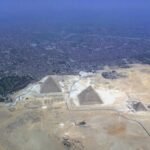
The plateau is about a mile and a half across, from the Great Pyramid at the north end to the Sphinx at the bottom of the causeway, which is why a proper tour includes a vehicle between the stops.
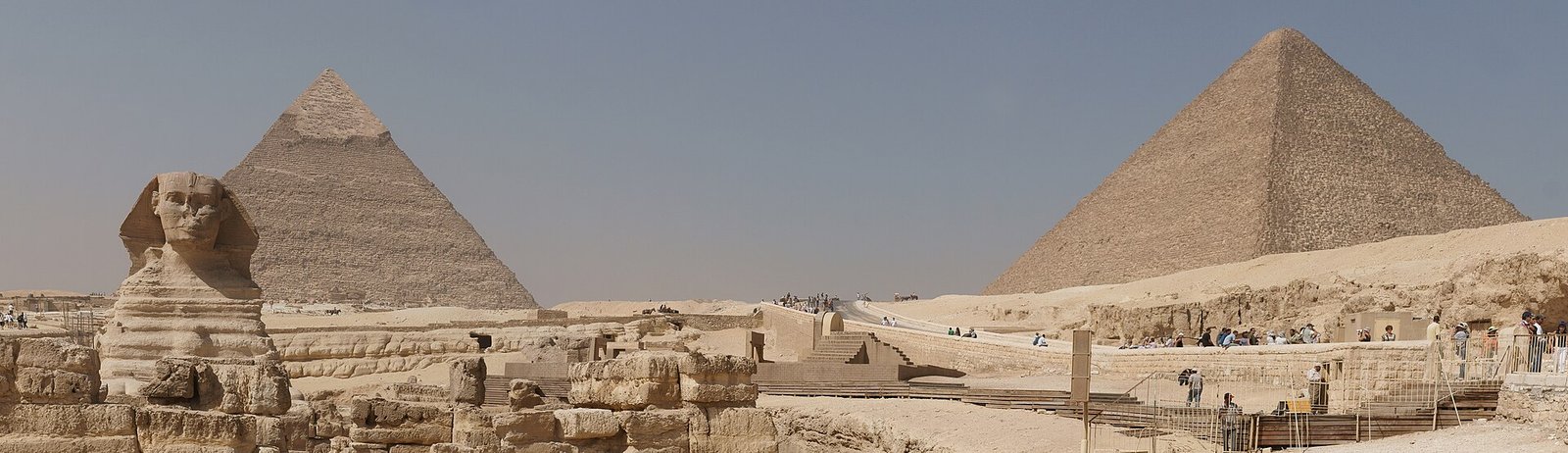
A standard guided visit covers, in this order: the Great Pyramid of Khufu, the pyramid of Khafre with its surviving cap of casing stones, the smaller pyramid of Menkaure with the three queens' pyramids beside it, the panorama viewpoint, and then the Sphinx with the valley temple next to it. Going inside one pyramid is an extra ticket that your guide arranges at the gate.
This page is about the tour experience: timing, order, extras, hassle and how to plan the day. For the monument itself, the history of each king and the measurements, read our guide to the pyramids of Giza first.
The three pyramids, and what a good guide does at each
Khufu. You start at the base of the Great Pyramid, on the north face where the entrance is. The point of standing here is scale: each block at the bottom is about chest height on an adult, and the pyramid rose to roughly 481 feet (146 meters) when it still had its smooth limestone casing. A good guide explains the quarrying and hauling here, then lets you walk the corner and photograph the edge running up into the sky.
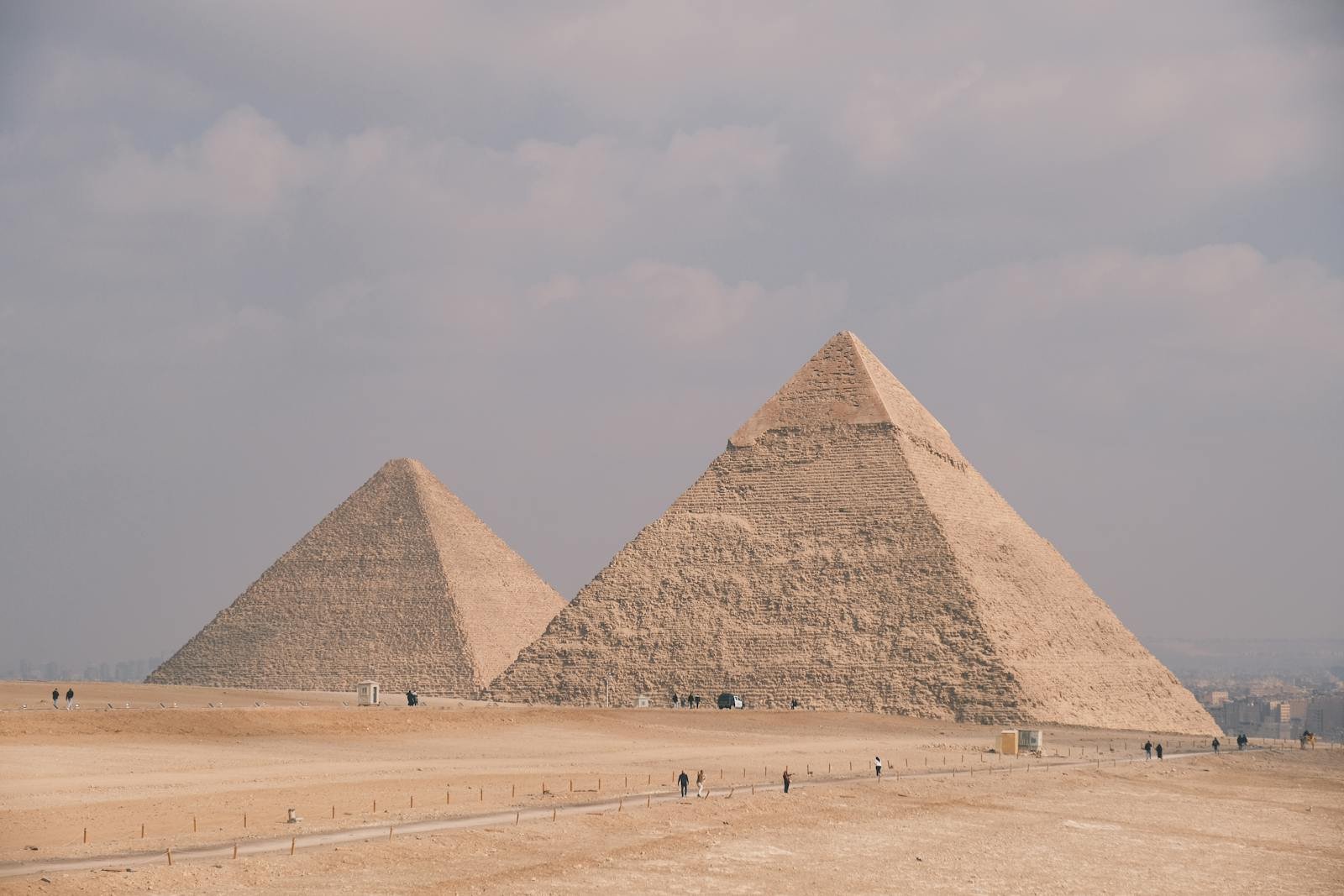
Khafre. The middle pyramid looks taller because it sits on higher ground. Look at the top: the cap of pale casing stones is the last patch of the finish that once covered all three. Your guide should point out the causeway running down to the Sphinx, which explains why the Sphinx is where it is.
Menkaure. The smallest of the three, with granite on its lowest courses and a long gash on the north face left by a medieval attempt to pull it down. The queens' pyramids beside it make the best close-up photos on the plateau, and this is the least crowded corner.
Going inside a pyramid: Khufu or Khafre, and whether it is worth it
You can enter the Great Pyramid of Khufu or the pyramid of Khafre on a separate ticket, and sometimes Menkaure when it is open in rotation. Which ones are open changes with restoration work, so we confirm on the day. There is nothing inside except stone and air. That is exactly why people go in.
Khufu. You climb the Ascending Passage bent almost double, then straighten up in the Grand Gallery, a corbelled corridor that rises to the King's Chamber, a granite room with an empty sarcophagus. It is hot, close and steep, and it is the more memorable of the two by a wide margin. Allow thirty to forty minutes.
Khafre. A single descending passage leads to one burial chamber. Shorter, usually no line, and the same feeling of being under millions of tons of rock, without the Grand Gallery.
- Skip it if you are claustrophobic, have bad knees or a bad back, or struggle with heat. The passages are about four feet high for long stretches.
- Guides do not go in with you. Your Egyptologist explains the layout at the entrance and waits outside.
Our honest advice: if you are fit and it is your first time, go into Khufu. If the line is long or the heat is bad, Khafre gives you most of the experience in a third of the time.
The Sphinx, the valley temple and the panorama point
Most tours leave the Sphinx for the last ten minutes, and that is the most common mistake on the plateau. Give it its own half hour. You approach through the valley temple of Khafre, a hall of enormous granite pillars and alabaster floors, and come out on the viewing terrace that faces the Sphinx directly.
The Sphinx is about 240 feet (73 meters) long and 66 feet (20 meters) high, carved from a single outcrop of the plateau bedrock. A guide who knows the site shows you the erosion channels on the body, explains why the face is thought to be Khafre and what the missing beard looked like.
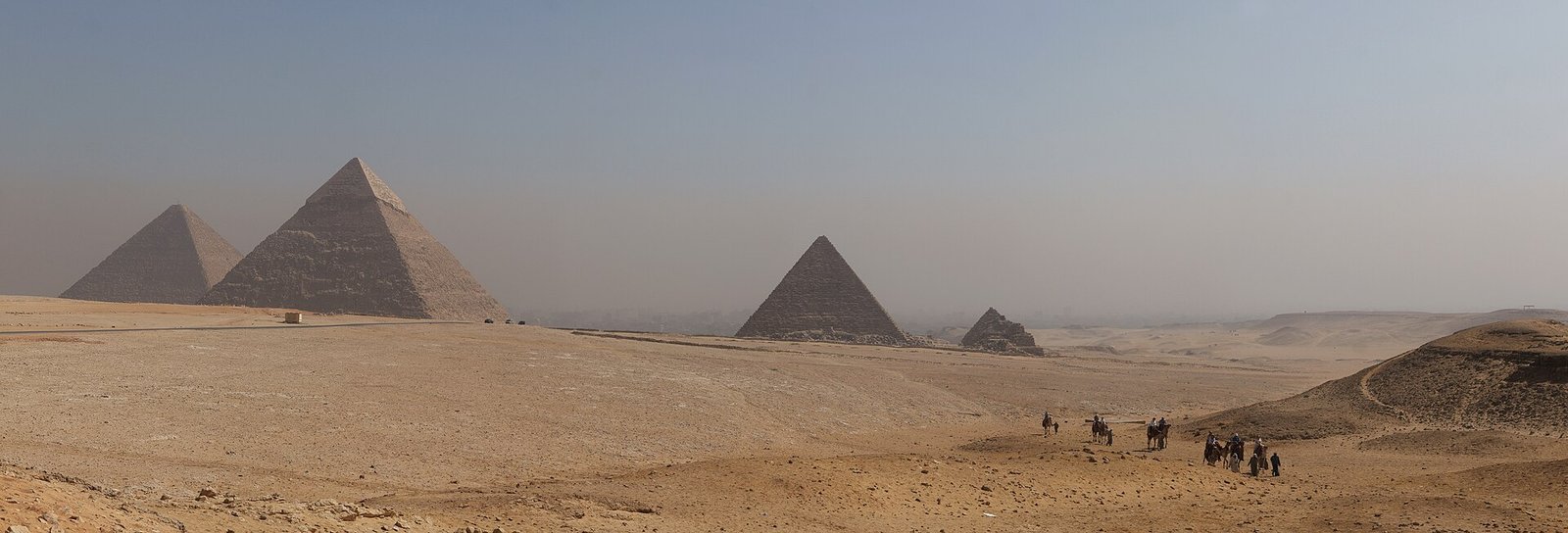
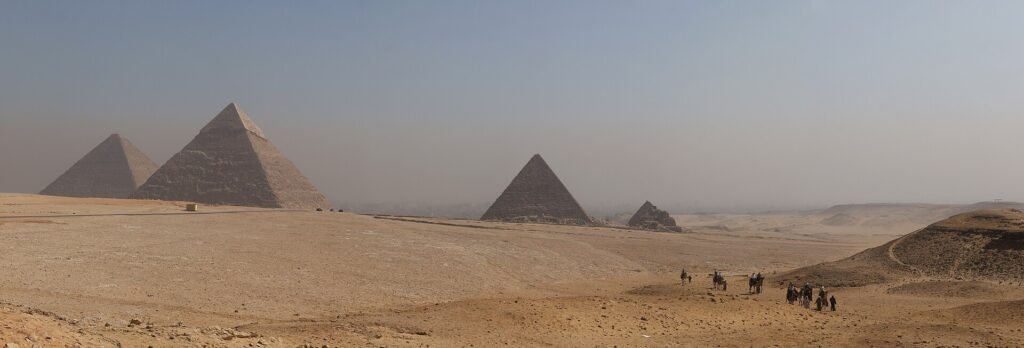
The panorama point is the raised ground south of Menkaure. It is the only spot inside the enclosure where the three pyramids line up in one frame, and it is where the camel handlers wait. Go up while the sun is still to the side, not overhead. At noon the landscape flattens and the photos are worse.
Camel rides, the honest version
A short camel ride at the panorama point is fun, the photo is genuinely good, and it is also the number one source of arguments on the plateau. The problems are always the same: an agreed amount that changes once you are on the animal, and a handler who leads you far from your group and asks for more to bring you back.
The fix is not to avoid camels. It is to let your guide arrange it. Our guides work with the same handlers every week, agree the whole thing before you mount, including the dismount, and stay in sight for the ride. Ask for twenty minutes, which gets you along the ridge with the three pyramids behind you and back.
- Do not hand over your phone for the photo unless your guide is the one taking it.
- If an animal looks thin or has open sores, say so and pick another. Your guide will back you.
- Horse carts are easier for anyone with hip or back problems, and there is no obligation to ride at all.
Timing decides the tour: first entry, afternoon light, heat and season
Of every choice you make about Giza, the hour you enter changes the experience more than anything else, more than private versus group and more than which extras you add.
First entry. The gate opens early in the morning (check the current hour, it shifts with the season). The plateau is close to empty, the light comes in low and gives the stones their volume, and there are almost no vendors yet, because the vendors arrive with the buses.
Mid morning. The tour buses arrive together and the area around Khufu fills up. This is the slot most people end up in and the weakest of the three.
Late afternoon. The crowds thin, the heat drops and the light turns warm again. The drawback is the closing time. It works well after a morning at the Grand Egyptian Museum.
| Season | Plateau conditions | How we plan it |
|---|---|---|
| October to April | Mornings around 50 to 65 F (10 to 18 C), pleasant afternoons, some wind and dust | First entry, full circuit, inside Khufu comfortably |
| May and September | Hot by late morning, around 90 F (32 C) | First entry, vehicle between stops, done by early afternoon |
| June to August | Highs of 95 to 104 F (35 to 40 C) on open sand, no shade | Strict first entry, short walks, Khafre instead of Khufu inside, museum after lunch |
If your tour is private, you set the hour, and that alone is the strongest argument for going private at this site. If you join a group, ask what time it enters before you book, not after.
Private or small group, and what a licensed Egyptologist adds
In Egypt a tour guide is a licensed profession. The people we send to Giza studied Egyptology or tourism guidance at university, passed the state license and have spent years on this plateau. That matters here more than at most sites, because the pyramids have no signage worth reading and the meaning of the place is in the explanation.
What a licensed guide adds, concretely: the sequence that avoids the crowds, the history told at the right stop rather than in the van, the ticket line handled, the vendors kept off you, the camel arranged, and answers to the questions you did not know you had.
| Private tour | Small group | |
|---|---|---|
| Start time | You choose, first entry recommended | Fixed by the group, ask before booking |
| Pace | Yours, stop where you like | The group's, with set photo breaks |
| Guide | Exclusive, all your questions | Shared with a few other travelers |
| Extras | Inside a pyramid, camel, museum, added on the spot | Usually pre-set, harder to add |
Both come with an Egyptologist, an air-conditioned vehicle and the general ticket. For Giza we lean toward private because of the start time.
Half day or full day: Saqqara, Memphis and the Grand Egyptian Museum
Giza alone is a half day, four to five hours door to door from a hotel in central Cairo or Giza. That is the right length if you want the afternoon for Islamic Cairo or a rest. With a full day you can add one of two things.
Saqqara and Memphis. The classic pairing and the one we recommend on a first visit. Saqqara has the Step Pyramid of Djoser, the oldest stone pyramid in Egypt, plus the pyramid of Teti with its carved interior and the mastaba tombs with the finest daily-life reliefs in the country. Memphis, the old capital, is a short stop for the fallen colossus of Ramses II and the alabaster sphinx. Together they show you where Giza came from.
The Grand Egyptian Museum. Twenty minutes from the plateau. Morning at the pyramids, lunch, then the afternoon with the Tutankhamun galleries and the Khufu solar boat, which was moved here from its old shed beside the Great Pyramid. Our Grand Egyptian Museum guide explains how to plan that visit.
See how these fit a longer stay in our Cairo in 3 days plan, or browse the rest of our Cairo excursions to build the other days.
Hassle on the plateau, and how your guide shields you
Giza is safe. What it is not is quiet. Between the gate and the Sphinx you will be offered scarves, headdresses, photos, horse rides, camel rides and "official" guides, sometimes all at once. None of it is dangerous. All of it is tiring alone, and it is the main reason people leave the pyramids worn out instead of amazed.
The classic moves, so you recognize them: someone puts a headdress on you "as a gift" and then asks for money; someone says the entrance is closed and offers to take you "the other way"; someone takes your photo with your own phone and will not give it back until paid.
With a guide, almost all of this evaporates. Vendors recognize a licensed Egyptologist and move on to the next group. If one does not, your guide handles it in Arabic in one sentence. You can still buy something if you want to, and your guide will tell you what a fair amount is. Otherwise say "la shukran" once, smile, and keep walking.
The only tips to think about are for the camel handler and for your guide and driver at the end. Our tipping guide has the details.
What to wear and bring for the pyramids
You are on open sand and rock for four hours with no shade beyond the pyramids' own shadows, and the ground is uneven everywhere. Dress for a desert walk, not a museum.
- Closed shoes with grip. Sneakers or light hiking shoes. Sandals fill with sand and the passage inside Khufu is smooth and steep.
- Hat, sunglasses, sunscreen. Even in January the sun is strong at midday.
- Light long clothing. Long pants and a loose shirt beat shorts for sun and dust. Our what to wear in Egypt guide has the full list.
- A layer for winter mornings. First entry in December or January can be cold and windy at the panorama point.
- Water, small bills for tips, a scarf for dust, a power bank and your passport for the ticket gate.
- Camera or phone only. Tripods and drones need a permit. Leave the big bag in the vehicle.
If you plan to go inside a pyramid, wear something you do not mind getting dusty. It is a crawl, not a walk.
How Explora Egipto runs the Giza pyramids tour
We are a local agency in Egypt with our own licensed Egyptologist guides and our own vehicles, so the person who plans your day is in Cairo and the person who meets you in the lobby works for us, not for a subcontractor.
- Pickup. Guide and driver meet you at your Cairo or Giza hotel early enough to be at the gate for first entry, in a private air-conditioned vehicle.
- Tickets. The general entry ticket is arranged in advance. Interior tickets and the camel are handled by your guide on the spot, only if you want them. Ticket categories change from time to time, so see our monument entrance fees page for the current structure. We confirm everything in your quote.
- The circuit. Khufu, interior, Khafre and Menkaure, panorama point, Sphinx and valley temple, with the vehicle moving you between stops.
- The afternoon. Back to the hotel, or on to Saqqara and Memphis, the Grand Egyptian Museum or Islamic Cairo. The sound and light show at the pyramids can be added the same evening.
Tell us your dates, how many of you there are, private or shared, and Giza alone or a full day. We come back with the plan and the quote on WhatsApp, everything listed so there are no surprises at the gate.
Frequently asked questions
How long does a Giza pyramids tour take?
Plan on four to five hours door to door from a central Cairo hotel, including the drive, the three pyramids, going inside one, the panorama point and the Sphinx. Add Saqqara and Memphis or the Grand Egyptian Museum and it becomes eight to nine hours with lunch.
Can you go inside the Great Pyramid on the tour?
Yes. Entering Khufu, Khafre or, when it is open, Menkaure is a separate ticket your guide arranges at the gate. The Khufu passage is steep, low and hot, with the Grand Gallery and the King's Chamber at the top. Khafre is shorter and quieter. Skip it if you are claustrophobic or have knee problems.
Is it better to do the pyramids tour private or in a group?
Private if you can, mainly because you choose the start time and first entry is what makes the visit. A small group shares the guide and vehicle with a few other travelers and suits solo travelers or tighter budgets. Both include a licensed Egyptologist and the general ticket.
What is the best time of day to visit the pyramids of Giza?
The moment the gate opens. The plateau is nearly empty, the light is low and sideways, the heat has not built and the vendors have not arrived. Mid morning is the busiest window. Late afternoon is good again for light but the closing hour limits you. In summer, first entry is not a preference, it is the plan.
Should I ride a camel at the pyramids?
If you want the photo, yes, for about twenty minutes at the panorama point and only through your guide, who agrees the whole ride including the dismount before you get on and stays in sight. Ridden that way it is a highlight. Arranged with a stranger at the gate it is the most common complaint at Giza.
Can I combine the Giza tour with Saqqara, Memphis or the Grand Egyptian Museum?
Yes, and it is the best use of a full day in Cairo. Giza in the morning at first entry, lunch, then either Saqqara and Memphis for the Step Pyramid and the tombs, or the Grand Egyptian Museum for Tutankhamun and the solar boat. Tell us which appeals and we build the day around it.
See the pyramids at the hour they are empty
Send us your Cairo dates, how many are traveling and whether you want Giza alone or a full day with Saqqara or the museum. We answer on WhatsApp with the plan, the guide, the pickup time and the quote, all in writing before you land.