Photography in Egypt: The Rules, the Tickets and the Light
Photography in Egypt: The Rules, the Tickets and the Light
You can photograph almost anywhere in Egypt, and there are a handful of places where you absolutely cannot: military installations, government buildings, police stations, soldiers, airports and infrastructure such as bridges and dams. At many sites and museums photography is a separate ticket rather than part of the entrance, flash is banned in painted tombs, and photographing people means asking first. Sunrise and sunset are when the monuments look their best.
Where you must never point a camera
Egypt is generous with photographers almost everywhere, and then completely inflexible in a handful of places. Military installations, government buildings, police stations, soldiers, airports and sensitive infrastructure such as bridges and dams are off limits. That is not a guideline anyone will let slide. It applies to a phone held at waist height as much as it applies to a camera with a long lens, and it applies whether or not you intended to include the checkpoint in the frame.
In practice this matters most on the road. Desert transfers, the drive out to Abu Simbel, the approach to any airport and the crossings over the Nile all pass through places where a guard may be watching. If someone objects, the usual outcome is that you are asked to show the images and delete them on the spot. Handing over the phone politely and deleting without argument ends it there. Arguing about whether the rule is reasonable does not.
Everywhere else, and that means the temples, the tombs, the museums, the markets, the river and the desert, photography is welcome and nobody will bother you. When you are unsure, the shortest route to an answer is to point at the camera and raise your eyebrows at the nearest guard. If the answer is no, it will be immediate and obvious.
The camera ticket, and why your entrance fee is not the whole story
This is the part that catches most first-time visitors. At a number of sites, museums and tombs, taking photographs is not covered by the standard entrance ticket. There is a separate camera ticket, bought at the same window, and the guard inside will ask to see it. Some of the painted tombs in the Valley of the Kings work this way, and so do certain museum halls.
Whether a phone counts as a camera has changed more than once, and it varies between sites and sometimes between seasons, so treat it as a question to ask at the ticket window rather than something to assume. The safest habit is to buy the ticket if you have any intention of shooting, since the amount involved is small next to what you already paid to be standing there. Budget for it the same way you budget for the entrance fees themselves, and check what your ticket covers before you walk through the gate rather than after.
Flash is a separate matter. In painted interiors it is banned outright, because repeated flash degrades pigments that have held their color for three thousand years. Turn it off at the hotel on the first morning and leave it off. Guards watch for it, and a flash going off in a tomb will get you removed faster than almost anything else you can do.
Photographing people without causing offence
Ask first, every time, and particularly before photographing a woman. You do not need the language for it. Lifting the camera slightly, catching the person's eye and giving a questioning smile is understood everywhere in Egypt, and most people say yes cheerfully. Some will say no, and that is the end of it.
Expect a request for a small tip in return, especially from vendors, camel handlers, boatmen and anyone posing beside a monument. Baksheesh is not a scam and it is not aimed at you personally. It is simply how small services are paid for here, and a photograph counts as one. Keep small notes in an accessible pocket, separate from your main money, and the whole exchange takes four seconds. If you would rather not pay, do not take the shot. Understanding how tipping works before you arrive removes most of the friction from the trip, not just the photographic part of it.
Children are the exception worth thinking about. They will often ask to be photographed and then ask for money, and a crowd forms quickly. Show them the picture on the screen, which is usually what they actually wanted, and move on.
Drones and tripods
Do not bring a drone. Their use in Egypt is heavily restricted, bringing one into the country without a specific permit is generally prohibited, and that permit is extremely difficult to obtain as a private traveler. Confiscation at airport customs is common, and you may not get the drone back on the way out. If you have a genuine professional need, that is a permit application made well in advance through official channels, not something to improvise at the gate.
Tripods sit in a gray zone. Some monuments allow them, some do not, and some treat them as professional equipment requiring the same kind of permit. Inside the tombs the answer is simply no, both because of the rules and because there is no floor space for one. A small beanbag, a folding table-top support or a clamp will get you through most low-light situations without triggering anyone's attention.
The light decides everything
Egyptian stone is sandy beige and the sky is usually cloudless. At midday that combination gives you flat, hard, colourless images with black shadows in the wrong places, and it is also when the heat is worst. Two hours after sunrise and two hours before sunset, the same wall turns gold and the low sun rakes across the carved reliefs so that every incised line reads. It is the single largest improvement available to you, and it costs nothing but an early alarm.
Early is also when the sites are empty. Coach groups arrive mid-morning, so the difference between arriving at opening and arriving at ten o'clock is the difference between a temple corridor with nobody in it and a temple corridor with sixty people in it.
| Where | Best light | Why |
|---|---|---|
| Giza plateau panorama | Early morning or late afternoon | Clear air and thin crowds early, warm side light on the pyramids late |
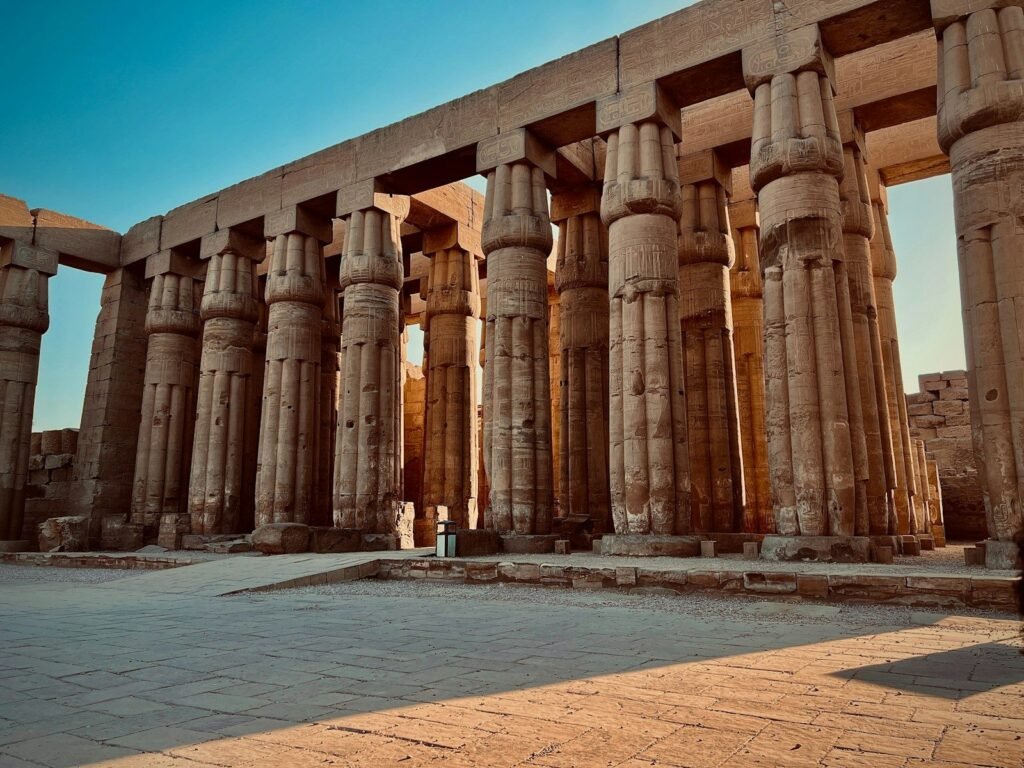
| Karnak hypostyle hall | First hour after opening | Low sun throws shafts between the columns and the hall is briefly quiet |
| Abu Simbel facade | Sunrise | The temple faces east, so the colossi are lit rather than in shadow |
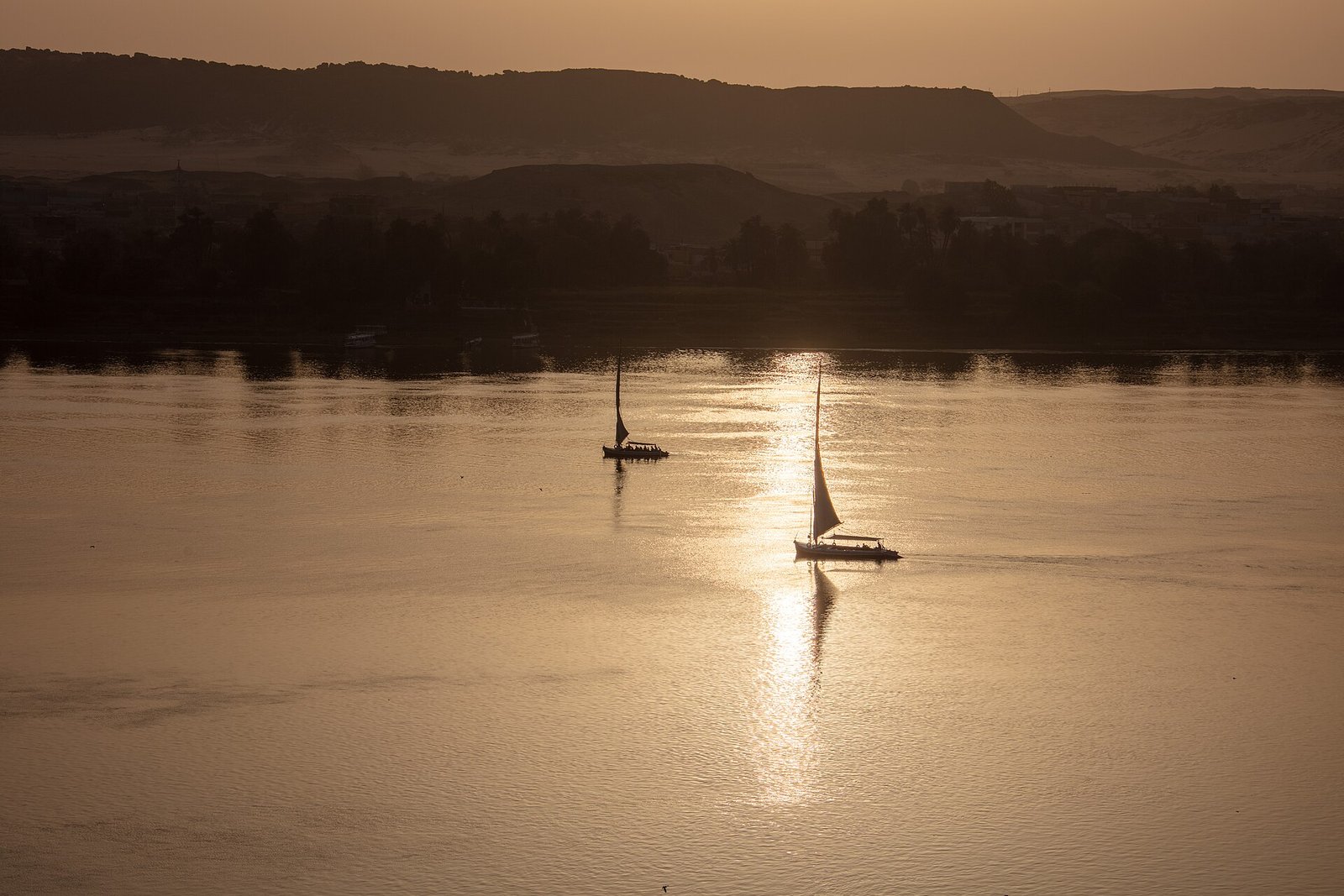
| Felucca on the Nile at Aswan | The hour before sunset | Sails backlit against the water, with the desert edge going pink behind |
| Tomb interiors | Any time | Artificially lit, so the outside light is irrelevant and only the crowd matters |
Seasons change how much of that golden window you actually get. Winter days are short and the light stays usable for longer; summer gives you a brutal middle of the day and a very brief good hour at each end. It is worth reading up on when to travel before fixing dates, because the photographic answer and the comfort answer point the same way.
Inside the tombs, the hardest photography of the trip
The painted tombs are where most people come home disappointed. The conditions are genuinely difficult: low light, a corridor barely wide enough for two people, no tripod, no flash, and in several tombs the finest reliefs sit behind glass or a barrier. Nothing about it is forgiving, and the automatic settings on both phones and cameras handle it badly.
Raise the sensitivity and stop worrying about it
Push the ISO higher than feels comfortable. A slightly grainy photograph of a painted ceiling is worth having. A blurred one is not, and blur is what you get when the camera tries to protect image quality by dropping the shutter speed. Modern sensors and phone processing handle high sensitivity far better than most people assume.
Lean on something and breathe out
With no tripod allowed, your body is the tripod. Brace a shoulder against the door frame, rest the camera on the handrail, and release the shutter as you finish exhaling rather than while holding your breath. It buys you two or three stops, which is often the whole difference.
Deal with the glass properly
Where reliefs are behind glass, bring the lens almost touching the surface and shoot straight on rather than at an angle. That removes nearly all reflections. The rest usually comes from you, because pale clothing bounces the tomb lighting straight back into the glass. It is a small argument for darker layers on tomb days, which sits oddly alongside the usual advice on what to wear in the heat, but a dark scarf over a white shirt for thirty seconds solves it.
Shoot detail, not the room
In a two-meter-wide corridor, the wide shot almost never works. There is no vantage point, the ceiling cuts you off, and the result reads as a confusing brown tunnel. A single figure, a hand holding an offering, a column of hieroglyphs with the original blue still in it: those carry the place far better. Knowing who the figures are also changes what you choose to frame, because you start photographing a scene rather than a texture.
Planning this trip yourself takes hours. We build it for you, and we answer every question before you commit to anything.
What to actually carry
You do not need professional equipment. Current phones produce excellent results in Egyptian daylight, they are comfortable to carry all day, and they are far less conspicuous when you are moving through a busy site. If you prefer a camera, a wide angle earns its place on temple architecture and a modest telephoto pulls out the carved details you cannot get close to.
- Spare batteries and more cards than you think. Heat drains batteries noticeably faster than at home, and you will shoot several times your usual volume.
- A power bank. On a full day between Luxor's west and east banks there is nowhere to charge, and your phone is also your map, your torch inside the tombs and your translation tool.
- A microfibre cloth. Lenses pick up fine dust within minutes at any archaeological site.
- A sealed plastic bag. The cheapest camera protection there is, and the only thing that reliably keeps sand out of a phone on a windy day.
If you are heading to the coast afterwards, a waterproof phone case turns a snorkeling stop on the Red Sea into a genuinely different set of pictures, and it costs almost nothing to pack.
Dust and heat, not water
The threat to your equipment in Egypt is not rain. It is extremely fine sand, which gets into zoom barrels, lens mounts and charging ports and does not come out. Keep the camera in a bag when you are not shooting, never change lenses in the open when there is any wind, and clean the front element with a cloth rather than a sleeve.
Heat does the rest of the damage. A camera left on a dashboard or a phone left screen-up in direct sun will overheat and shut down, usually just as something worth photographing happens. On a cruise deck, a hat over the camera bag is enough. In a vehicle, keep it in the footwell shade rather than on the seat.
The frames everyone takes, and the ones almost nobody does
Start with the classics, because they are classics for a reason: the three pyramids together from the high point of the Giza plateau, the facade of Abu Simbel with its four seated colossi, a felucca under full sail on the Nile at Aswan as the light goes, and the forest of columns in the hypostyle hall at Karnak. Each of these has one good position and one good hour, and getting there at the right time is most of the work. A sunrise balloon flight over Luxor adds a perspective on the west bank that nothing on the ground can match, and if you are going as far south as visiting Abu Simbel, plan the arrival for early light rather than midday.
Then look for the pictures that are not already on a million memory cards.
- The reverse view. Stand on a temple's upper terrace and photograph the valley instead of the building. It explains why anyone chose that spot in the first place, which the front elevation never does.
- Human scale. A person standing at the foot of a column or a colossus tells the viewer how large it is. Photographed alone against the sky, the same monument looks strangely small.
- Evidence of the work. Masons' marks, tool scars, the joint between two blocks, a patch of original paint surviving on a ceiling. These are the pictures that make people ask how it was built.
- The surroundings. The guard on his chair, the cat asleep in the shade of a sphinx, the scaffolding of a restoration, the tea seller at the gate. This is what separates your photographs from a catalog.
One discipline worth adopting: at each new site, leave the camera in the bag for the first few minutes and just look. You will photograph better afterwards, because you will have found the picture instead of reacting to the first thing you saw.
Backing up while you are still traveling
This is the step almost nobody takes and the one people regret most, because a lost card or a stolen phone takes the entire trip with it. The system does not need to be sophisticated.
- Use two smaller memory cards rather than one large one, swap at the midpoint of the trip, and keep them in different bags.
- Upload to the cloud on hotel wifi at night. Connectivity on a Nile cruise is unpredictable, so treat the nights on land as your real backup windows.
- Copy to a laptop, tablet or small drive if you are carrying one.
- Cull each evening. Deleting the obvious failures frees space, shortens the upload and makes the eventual edit far quicker.
Ten minutes before bed covers it, and it is the difference between losing a day and losing the holiday.
Building the trip around the light
Most of what makes Egyptian photographs good is scheduling rather than equipment: being at Karnak when it opens, on the west bank before the coaches, on the water at Aswan in the last hour of sun. That is easier when the itinerary is written around those hours instead of around a standard coach timetable, and when the guide at your shoulder already knows which gate wants a separate camera ticket and which wall is worth waiting ten minutes for. Our tailor-made Egypt packages are built directly with a local team in Egypt, with day excursions from US$120 and private guiding throughout, and the sunrise starts are put in on purpose. If you want the itinerary shaped around light rather than convenience, message us on WhatsApp at +201032295513 and tell us what you want to photograph.
Common questions about photography in Egypt
What may you not photograph in Egypt?
Do you pay to take photographs at Egyptian monuments?
Can you use flash in Egyptian tombs?
Can you photograph people in Egypt?
Can you take a drone to Egypt?
What is the best time of day to photograph in Egypt?
Let us put the trip together
We are a local agency in Egypt. Tell us your dates and what you want to see, and we will come back with a plan, the practical details sorted and someone to ask when you are here.
Part of our guide to
Practical Guide 11 guides
This article is part of that pillar. The rest of it:
- ▸Arabic Phrases for Travel in Egypt
- ▸Cairo Airport: What Happens When You Land, and How to Leave
- ▸Can You Drink the Water in Egypt?
- ▸Exchanging Money in Egypt: Where to Change Cash and How Much at a Time
- ▸Haggling in Egypt: How to Bargain Without Overpaying
- ▸High Season, Low Season and Shoulder Season in Egypt
- ▸How Much Does a Trip to Egypt Cost? A Real 2026 Breakdown
- ▸Food Prices in Egypt: What Meals Really Cost
- ▸How Much Money to Bring to Egypt: The Cash You Actually Need
- ▸Is Cairo Safe? The Real Risks and How to Get Around
- ▸Internet and SIM Cards in Egypt: A Traveler's Guide to Staying Connected
Keep exploring
To finish planning your trip to Egypt
- ▸Domestic Flights in Egypt: Routes, Times and How to Book
- ▸How Much Money to Bring to Egypt: The Cash You Actually Need
- ▸Cairo Airport: What Happens When You Land, and How to Leave
- ▸Vaccines for Egypt: What Travelers Actually Need
- ▸Uber and Careem in Cairo: How Ride Apps Really Work
- ▸Internet and SIM Cards in Egypt: A Traveler's Guide to Staying Connected
- ▸Solar Eclipse Egypt 2027: Luxor, the Path and How to See It
- ▸See all our Egypt tours