Cairo in 2 days works when you split the city by traffic, not by monument
Cairo in 2 days works when you split the city by traffic, not by monument
Two days in Cairo is enough for the pyramids, the museum and the old city, provided you split the days by geography rather than by wish list. Day 1 stays on the west side of the river: the Giza plateau at opening, Saqqara before lunch, the Grand Egyptian Museum or the Tahrir museum in the air-conditioned afternoon, and dinner on the Nile. Day 2 stays in the historic center and runs from the quiet churches of Coptic Cairo up through the Citadel, the Sultan Hassan mosque and Al Muizz street to Khan el Khalili as the lights come on. That order means you cross the city once instead of four times, which in Cairo is the difference between seeing everything and spending an afternoon in a car.
Why two days is the right number for a first visit to Cairo
Cairo has three layers: the pharaonic one of Giza, Saqqara and the museums, the medieval one of the Citadel, the mosques and the bazaar, and the Christian one of Coptic Cairo. With one day you pick two and sprint between them; that compressed version is in our guide to Cairo in one day. With two days you stop choosing between layers and start choosing the order.
The second day keeps each day on its own side of the river, lets you go inside monuments instead of photographing them from the parking lot, and gives you both evenings, which is when Cairo is at its best.
Two days is also the last point where the plan is still tight. A third day adds Dahshur, the second museum and a slow afternoon, covered in the guide to Cairo in 3 days. This page is about making two days work, not stretching them.
The traffic geography that makes the order work
The limiting factor in Cairo is traffic, not distance. The Giza plateau and the Grand Egyptian Museum sit minutes apart on the western edge of the city, and Saqqara is a straight run south on the same bank. The Citadel, Sultan Hassan, Al Muizz street, Khan el Khalili and Coptic Cairo are all on the east bank, lined up north to south through the old city. Two blocks, one river between them.
Crossing between the blocks at rush hour can take well over an hour each way, and that crossing is what breaks most two-day plans. The classic mistake is the Citadel on the same day as the pyramids, because both are famous, and the middle of the day lost on a bridge.
Direction matters too. Leaving Zamalek or Downtown at seven toward Giza runs against the inbound flow. Coming back at five runs into the worst of it. So finish day 1 on the Giza side, in the museum and then at dinner on the river, and cross back once the roads have cleared.
| Block | What is in it | Why it groups |
|---|---|---|
| West bank, day 1 | Giza plateau, Grand Egyptian Museum, Saqqara, Memphis, the dinner cruise docks | Same side of the Nile, one road south, no bridges until the evening |
| East bank, day 2 | Coptic Cairo, the Citadel, Sultan Hassan, Ibn Tulun, Al Muizz street, Khan el Khalili, the Tahrir museum | A north-south line through the old city, short hops and walking |
Day 1: Giza at opening, Saqqara, the museum and dinner on the Nile
The Giza plateau in the first hour
Be at the gate when it opens. The plateau at opening and at eleven are two different places: low warm light, no tour buses, the sand between the pyramids nearly empty. In summer it is also the only comfortable window, because by early afternoon the plateau is regularly above 95°F (35°C) with no shade.
The loop that works is the Great Pyramid up close, the panoramic point for the three-in-a-line photo, then down to the Sphinx. Going inside a pyramid is a separate ticket and a low, steep, humid passage; if the Great Pyramid line is long, Khafre or Menkaure give the same experience faster. A short camel ride at the panorama point is fine, a long one eats the morning.
Saqqara before lunch
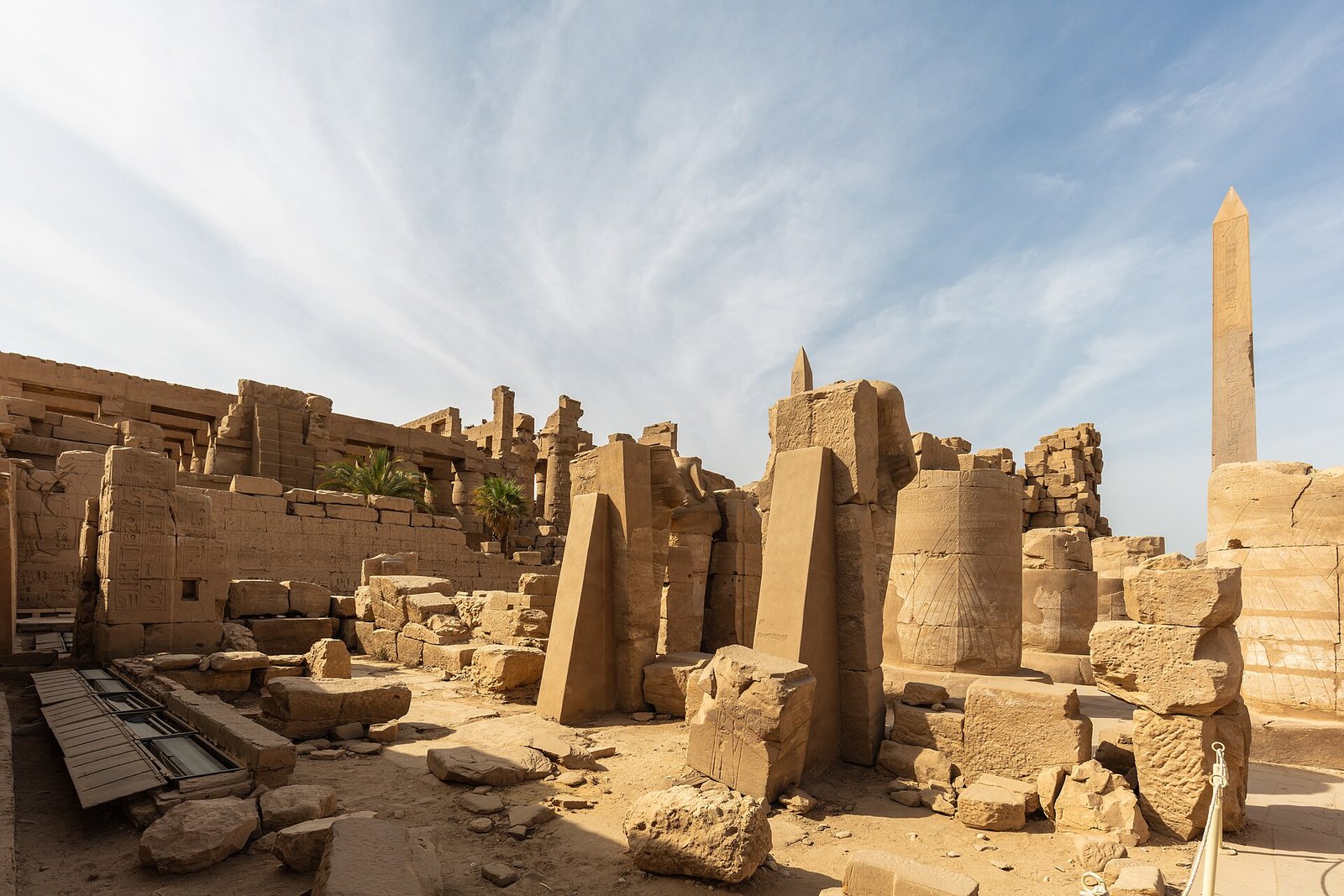
Saqqara is forty minutes to an hour south on the same bank, and for many travelers it is the best two hours of the day. The Step Pyramid of Djoser is the oldest large stone building on earth, the pyramids of Unas and Teti have burial chambers carved with the Pyramid Texts, the mastaba tombs show fishing, baking and cattle in painted relief, and the Serapeum is a corridor of giant granite bull sarcophagi nobody expects. Memphis, with its colossal fallen Ramesses II, is a thirty-minute stop on the way back. Eat something quick rather than sitting down to a long lunch.
The museum in the afternoon
The Grand Egyptian Museum is minutes from the plateau and is the natural afternoon: cool halls, the grand staircase lined with statues, the complete Tutankhamun collection. Two hours is a fair visit, three if you read every label. The alternative is the old museum on Tahrir Square, a hundred-year-old building with the charm of the original collection; we weigh the two in Grand Egyptian Museum or Egyptian Museum Tahrir. For a strict two-day plan, the Grand Egyptian Museum keeps you out of the traffic.
Dinner on the Nile
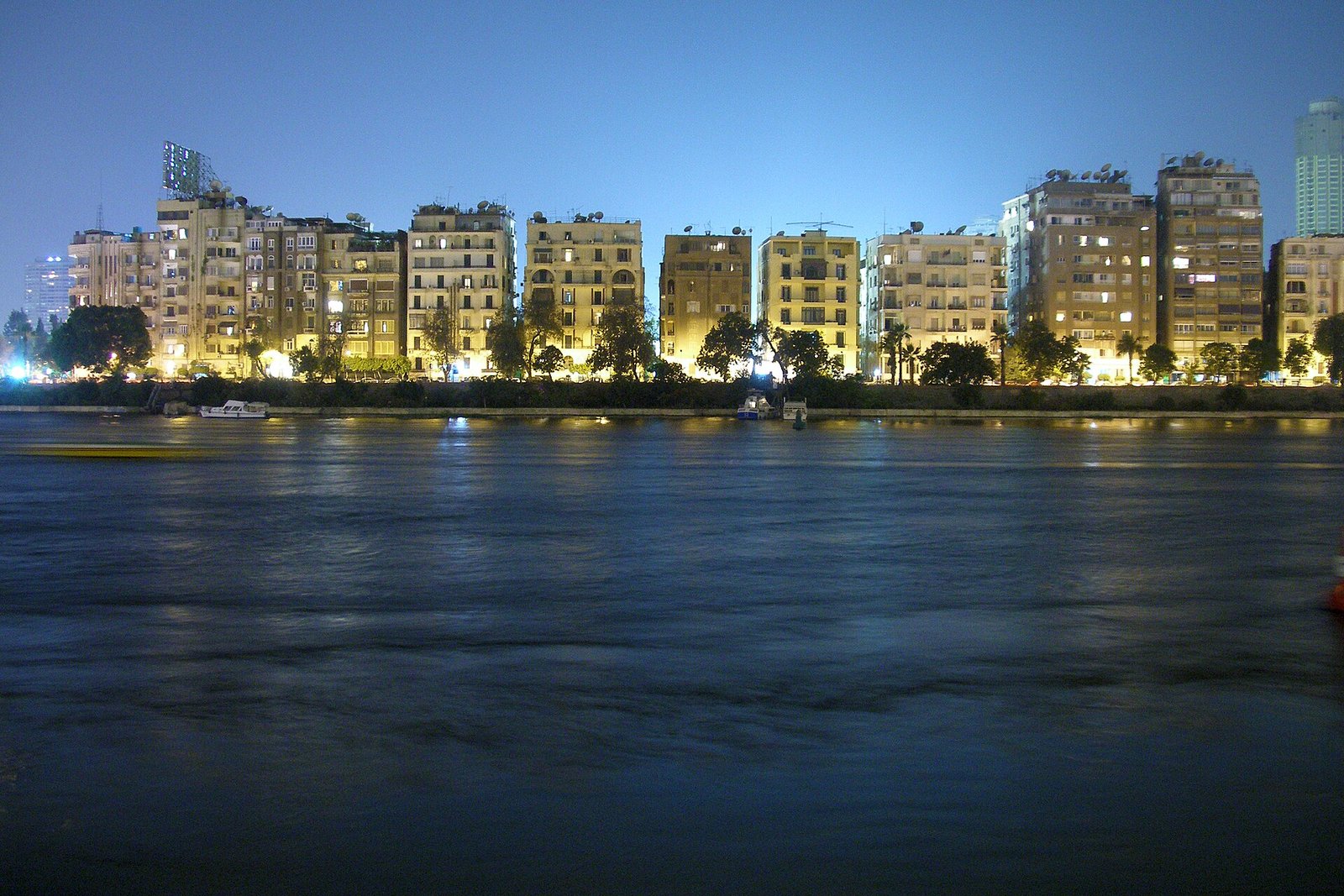
Finish with the river. A Nile dinner cruise in Cairo boards in the early evening, sails for a couple of hours with dinner and a show, and lands you back after the roads have emptied, exactly the timing the geography wants. A quieter riverside restaurant on the Giza side does the same job. Either way, do not spend the sunset hour in a car.
Day 2: Coptic Cairo, the Citadel, Sultan Hassan, Al Muizz street and Khan el Khalili
Start in Coptic Cairo while it is quiet
The order that works runs south to north and starts in the Christian quarter. Early in the morning the lanes inside the old Roman fortress are almost silent, and the Hanging Church, the crypt under Abu Serga where the Holy Family is said to have sheltered, the Ben Ezra synagogue and the Coptic Museum take under two hours. The full walkthrough is in our guide to Coptic Cairo.
The Citadel and the Sultan Hassan mosque
From Old Cairo it is a short drive up to the fortress Saladin began above the city. The alabaster mosque of Mohamed Ali is the postcard, and the terrace beside it is where, on a clear morning, you see the whole city with the pyramids on the horizon. Tickets and layout are in the Citadel of Saladin.
At the foot of the Citadel two mosques face each other. Sultan Hassan is the one to enter: a fourteenth-century mosque and madrasa with a portal the height of a building, a bare stone courtyard that silences people, and four vaulted halls for the four schools of law. It is the finest Mamluk interior in Cairo and most groups skip it. Al Rifai opposite takes ten minutes.
Al Muizz street on foot
After a quick lunch near Al Azhar, walk Al Muizz street south to north: the Qalawun complex, the row of Mamluk facades at Bayn al Qasrayn, the carved mosque of Al Aqmar, the merchant house of Bayt al Suhaymi, and side streets still selling copper and spices. About ninety minutes with a guide; the wider quarter is in our guide to Islamic Cairo.
Khan el Khalili as the lights come on
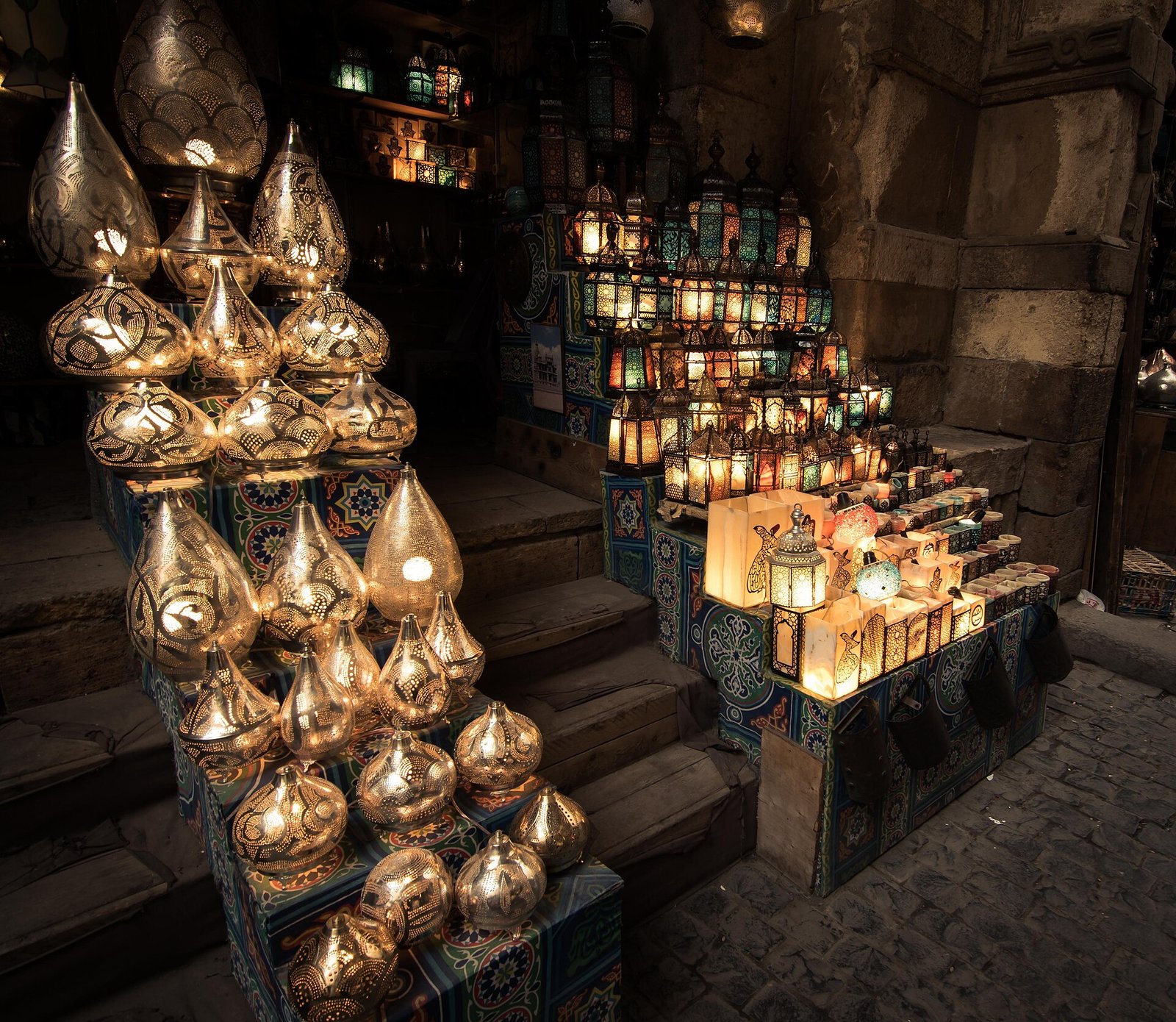
End at the bazaar, and end late. Khan el Khalili is a morning disappointment and an evening triumph: many shops open late, the cafes fill after sunset, and the lanterns only make sense once it is dark. Sit for a mint tea, buy the brass tray you have been circling, and let the day close on its own.
Two variants: museum lovers and bazaar lovers
Two kinds of traveler should bend the standard plan, and both changes stay inside the blocks.
| Element | Standard plan | Museum lover | Bazaar and street lover |
|---|---|---|---|
| Day 1 morning | Giza at opening, then Saqqara | Giza at opening, Saqqara cut to the Step Pyramid and one tomb | Giza at opening, then Saqqara |
| Day 1 afternoon | Grand Egyptian Museum, two to three hours | Grand Egyptian Museum until closing | Grand Egyptian Museum, ninety minutes for Tutankhamun and the staircase |
| Day 2 morning | Coptic Cairo, then the Citadel | Tahrir museum at opening, then Coptic Cairo, then the Citadel | Coptic Cairo, then the Citadel and Sultan Hassan |
| Day 2 afternoon | Sultan Hassan, Al Muizz street, Khan el Khalili | Sultan Hassan, a short Al Muizz walk, Khan el Khalili | Ibn Tulun, the tentmakers street at Bab Zuweila, all of Al Muizz, a long evening in Khan el Khalili |
The museum lover pays for the second museum with a shorter Saqqara and a shorter walk. The bazaar lover trades museum time for the covered tentmakers street south of Bab Zuweila and for the mosque of Ibn Tulun, the oldest intact mosque in the city, with its vast empty courtyard and spiral minaret.
Where to stay for two days, by area
The hotel decision is really a traffic decision. We do not name hotels because they change hands, but the areas are stable and each favors a different day.
| Area | Works for | Trade-off |
|---|---|---|
| Giza, pyramid view | Day 1 minutes away, the pyramids from your window, the sound and light show without a drive | Far from everything on day 2, thin evenings outside the hotel |
| Zamalek | A quiet island in the river, good restaurants, roughly equal distance to both blocks | Fewer big Nile-view hotels, more boutique and mid-size |
| Garden City and the Downtown corniche | The large Nile hotels, walking distance to Tahrir, next to the dinner cruise docks | Downtown noise, and the morning run to Giza starts in the thick of the city |
| Heliopolis and New Cairo | Late arrivals and early domestic flights, near the airport | Far from both blocks; a first or last night only |
| Islamic Cairo boutique | Day 2 entirely on foot, the old city at night | A long drive to Giza on day 1, very limited choice |
Our default for two nights is Zamalek or the corniche, with the Giza pyramid-view category as the romantic alternative if day 1 matters more than day 2. If you land late the night before, a first night near the airport is a fair compromise.
The evenings: what to do after the sights
The first evening belongs to the river. If you are staying on the Giza side, the sound and light show at the pyramids is the other option, a seat in front of the Sphinx with the monuments lit in sequence, before a late dinner.
The second evening belongs to the old city. Sunset first from Al Azhar Park, on a hill above the old walls, where the skyline of minarets with the Citadel behind it is the best urban photograph of the trip. Then Khan el Khalili after dark, tea and shisha by the Al Hussein mosque, and, on the nights it runs, the whirling dervish performance in the restored caravanserai near Al Azhar. Check on the day whether it is on.
What two days cannot include, and why to let it go
These are the things people try to force in and regret.
- Alexandria. Two and a half to three hours each way. A full day that belongs to a longer stay.
- Dahshur. The Bent and Red pyramids are only twenty minutes past Saqqara, but they displace the museum. They are the first thing a third day adds.
- The second museum. Unless you take the museum lover variant, choose one. The royal mummies at the National Museum of Egyptian Civilization, next to Coptic Cairo, are the same temptation: ninety minutes that come out of Al Muizz street.
What does fit, if the day runs early, is the mosque of Ibn Tulun, thirty minutes and unlike anything else in the city. The complete list, for choosing what a longer stay adds, is in what to see in Cairo.
The four timing mistakes that cost half a day
Almost all the time we see lost comes from the same four decisions.
- Starting late on day 1. Every hour after opening at Giza adds heat, buses and hawkers, and pushes Saqqara into the hottest part of the day.
- A long sit-down lunch. It burns the useful middle of the day. Eat quickly at noon and have the real meal in the evening.
- The bazaar in the morning. Half the shops are shut and the atmosphere is not there. Put it at the end of day 2.
- Crossing back from Giza at five. The single longest drive in the plan. Stay on the west bank until the roads clear.
Two calendar notes. On Fridays the mosque interiors close to visitors around the midday prayer, so Sultan Hassan moves earlier or later. And many shops in Khan el Khalili traditionally close on Sundays; if day 2 lands on a Sunday, flip the days.
How Explora Egipto runs the two days
We are a local agency in Egypt with our own Egyptologist guides and vehicles, and a two-day Cairo program is the thing we run most often. The shape is the one above, adjusted to your hotel, your arrival time and whether you are a museum person or a bazaar person. Your guide meets you at the hotel with the driver, the tickets are arranged, and the guide reorders the afternoon on the spot if a site is unexpectedly closed.
The dinner cruise is booked in advance, and day 2 ends in the bazaar with your guide there for the haggling. Most travelers continue to Luxor or Aswan by domestic flight for a Nile cruise, and we book that connection in the same plan. Tell us your dates and your hotel and ask us for the quote.
Frequently asked questions
Is 2 days enough for Cairo?
Yes, for a first visit it is the right amount. Two days cover the Giza plateau, Saqqara, one major museum, the Citadel, Sultan Hassan, Al Muizz street, Khan el Khalili and Coptic Cairo, with both evenings free. What they do not cover is Alexandria, Dahshur, the second museum or a slow afternoon, which is what a third day adds.
Should I see the pyramids on day 1 or day 2?
Day 1. You are freshest and most likely to be up early, and if the morning turns hazy or a sandstorm blows through, you still have day 2 to swap. The west-bank day also ends on the river, the better first-night finish. The only case for flipping is a Sunday, when many bazaar shops close, or a Friday, when mosque interiors shut around the midday prayer.
Can I fit Saqqara and the Grand Egyptian Museum in the same day as Giza?
Yes, and it is the point of the west-bank day. Giza at opening for three hours, a forty-minute drive south to Saqqara for two hours, a quick lunch, and the museum from mid-afternoon. It works because all three sit on the same side of the river, so the drives are short. What does not fit on that day is Dahshur, which displaces the museum, or anything in the historic center.
Grand Egyptian Museum or the Tahrir museum for a two-day visit?
For a strict two-day plan, the Grand Egyptian Museum, because it is minutes from the plateau and holds the complete Tutankhamun collection. The Tahrir museum is a beautiful old building with the charm of the original collection, and it sits in the center, so it belongs to day 2 if at all. Museum lovers take both, at the cost of a shorter Saqqara and a shorter walk.
Can I do Cairo in 2 days on my own with ride-hailing apps?
You can, and Uber and Careem both work in Cairo. What you lose is the traffic reading, the ticket lines, the order of the sites and the explanations, and on a two-day plan those hours are the whole margin. Giza and Saqqara in particular reward a guide who knows which tombs are open that week. If you go solo, keep each day inside its block and start at opening.
What should I wear for the mosques and churches on day 2?
Shoulders and knees covered for everyone, and women should carry a light scarf for the mosque interiors. Shoes come off at the door of every mosque, so wear something easy to slip off and bring socks, because the stone courtyards get hot. Coptic Cairo and the Citadel expect the same standard. Comfortable shoes matter most: day 2 is a walking day on old paving.
Two days in Cairo, planned around the traffic instead of against it
Tell us your dates, where you are staying and whether you lean toward museums or the bazaar, and we come back with the two days laid out hour by hour, the guide and driver assigned, the tickets arranged and the evening on the Nile booked. No prices on this page, just a quote in your inbox.