What to buy in Egypt, the souvenirs worth carrying home and the ones to leave on the shelf
What to buy in Egypt, the souvenirs worth carrying home and the ones to leave on the shelf
The souvenirs from Egypt that still look good a year later are a short list: hand-painted papyrus that is actually papyrus, Egyptian cotton from a shop that can name the mill, spices and hibiscus from the Aswan souk, a pierced brass lantern, Luxor alabaster that glows against the light, a silver cartouche with your name in hieroglyphs, perfume oil, a galabeya, dates and halawa. What you leave behind matters as much: antiquities are illegal to export, and ivory, coral, shells and dried seahorses are stopped at the border. Here is what to buy, where each thing is best, how to haggle, and how to get it home to the United States in one piece.
The short list: what is actually worth carrying home
Every stall from the Pyramids to Abu Simbel sells the same resin pyramids, so decide what you want before the first vendor reaches you. This is the list that gets used, worn, eaten or framed at home.
- Papyrus painted by hand, bought at a workshop.
- Egyptian cotton from a proper shop.
- Spices and hibiscus from Aswan, the best value in the country.
- Brass and copper lanterns from behind Khan el Khalili.
- Alabaster from the Luxor west bank workshops.
- A cartouche with your name in hieroglyphs.
- Perfume oils in a blown glass bottle.
- Galabeyas and scarves, worn once on the cruise and forever at home.
- Dates and halawa, the edible souvenirs that survive the trip.
- Nubian crafts from Aswan: beadwork, baskets, painted plates.
Each has a good version and a mass-produced version, often on the same shelf.
Papyrus: the real sheet versus banana leaf
Papyrus is the classic Egyptian souvenir and the one most often faked. The plant is cut into strips, laid in two crossed layers, pressed and dried, then painted with scenes copied from tomb walls. A bad one is a sheet of banana leaf with a print stamped on it, sold by the bundle at every temple gate.
How to tell them apart
- Hold it up to the light. Real papyrus shows an irregular grid of crossed fibers. Banana leaf looks even and slightly waxy.
- Roll a corner gently. Papyrus springs back with no crease. Banana leaf cracks or leaves a pale fold mark.
- Look at the painting. Hand-painted work shows brush strokes and small differences between two sheets of the same scene. Prints are identical.
- Ask to see the plant. A real workshop keeps a stalk and a press on the counter.
Buy at a papyrus institute or workshop in Cairo or Luxor, where the painters work in the back. Most will paint your name in hieroglyphs inside a cartouche while you wait, and our guide to reading hieroglyphs lets you check the spelling before you pay.
Egyptian cotton, galabeyas and scarves
Egyptian cotton is real and one of the best in the world, a long-staple fiber grown in the Delta that spins into a smooth, strong thread. The problem is the label, which is used loosely: a sheet set hanging from a hook in a market alley is not long-staple Egyptian cotton, whatever the tag says.
Buy it in a dedicated cotton shop or a hotel arcade store that names the mill and prints the thread count. The fabric should feel cool and dense, with a tight weave against the light. We cover mills, labels and what to ask for in our page on buying Egyptian cotton in Egypt.
Galabeyas and scarves
The galabeya is the long loose robe Egyptians wear at home. Nile cruise boats hold a galabeya night, and most travelers buy one for that evening and then discover it is the most comfortable thing they own. Men's are plain cotton in white, beige or blue; women's come embroidered at the neck and cuffs, often in the bright Nubian colors sold in Aswan. Check that the seams are stitched and the fabric is cotton, not a shiny polyester blend.
Cotton and linen scarves from the souks are light, useful on the trip for the sun and for covering shoulders in mosques, and easy to give away at home.
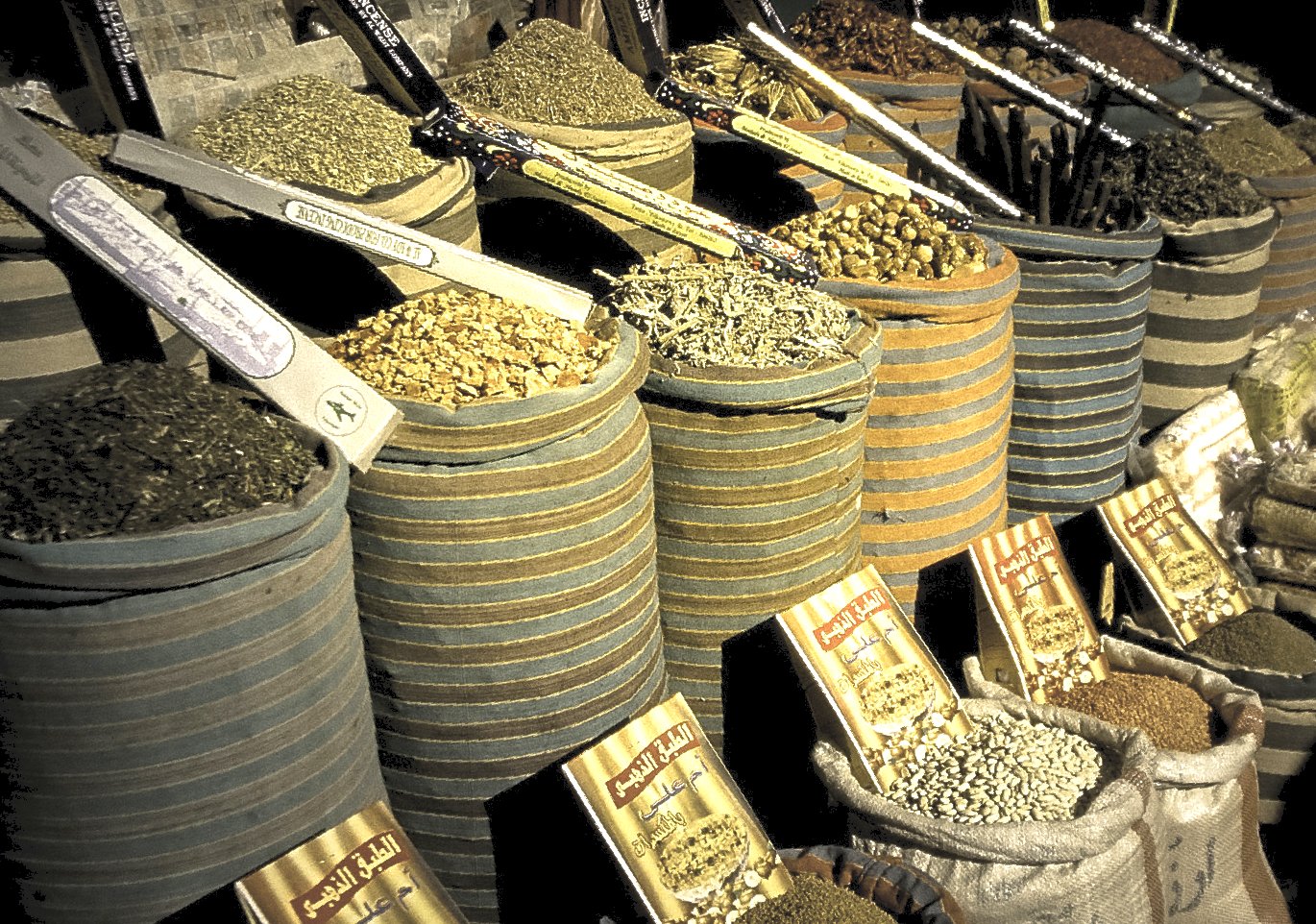
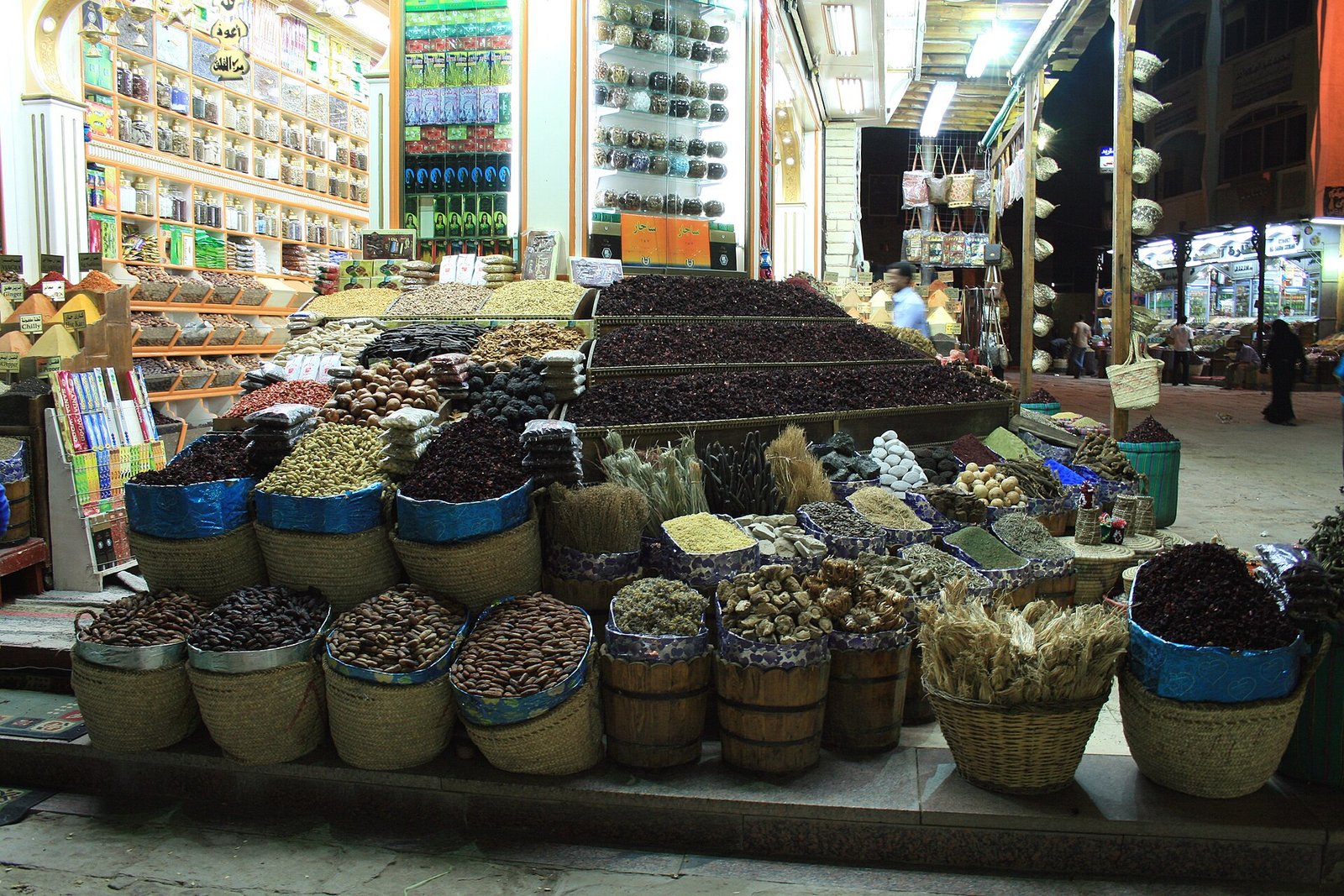
Spices, hibiscus, dates and halawa
The edible souvenirs are the ones people thank you for.
- Hibiscus (karkade). Dried deep red petals brewed into the drink every hotel offers on arrival. Buy whole petals, not powder, and buy them in Aswan.
- Cumin, coriander, dukkah. Egyptian cumin is sharper than what US supermarkets sell. Dukkah is the crushed nut, seed and spice mix eaten with bread and olive oil, and every seller has a house blend.
- Safflower, sold as saffron. The orange threads piled high in every market are a pleasant coloring herb, not saffron.
- Dates. Egypt grows dozens of varieties. Boxed dates from a supermarket or a date shop travel best.
- Halawa. The dense sesame sweet, plain or with pistachio, sold in tubs. It keeps for weeks without a fridge.
Ask the seller to vacuum seal anything strongly scented, or your suitcase will smell of cumin for months. To taste these in context first, see our guide to Egyptian food worth trying.
Brass and copper lanterns, trays and inlaid boxes
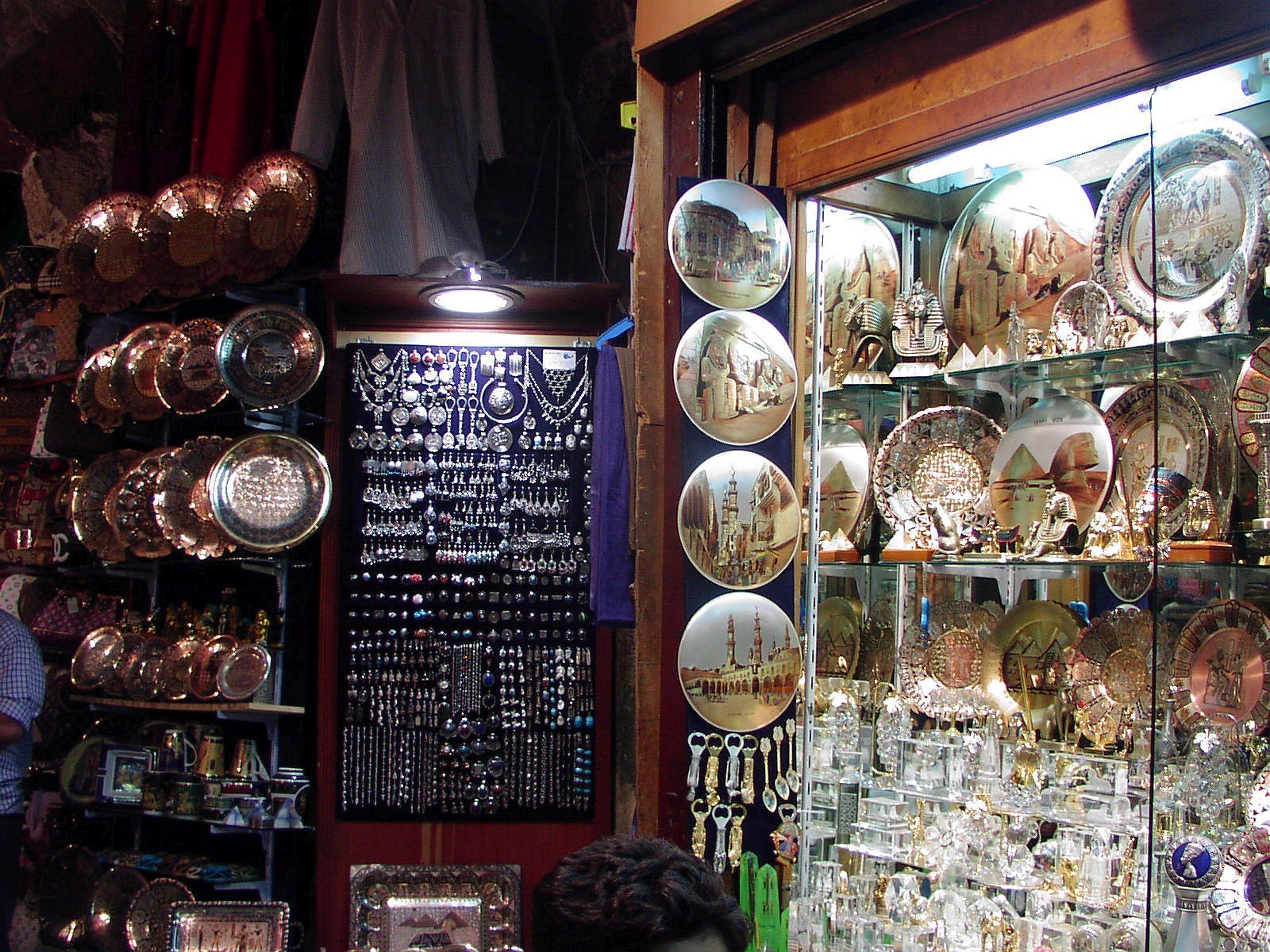
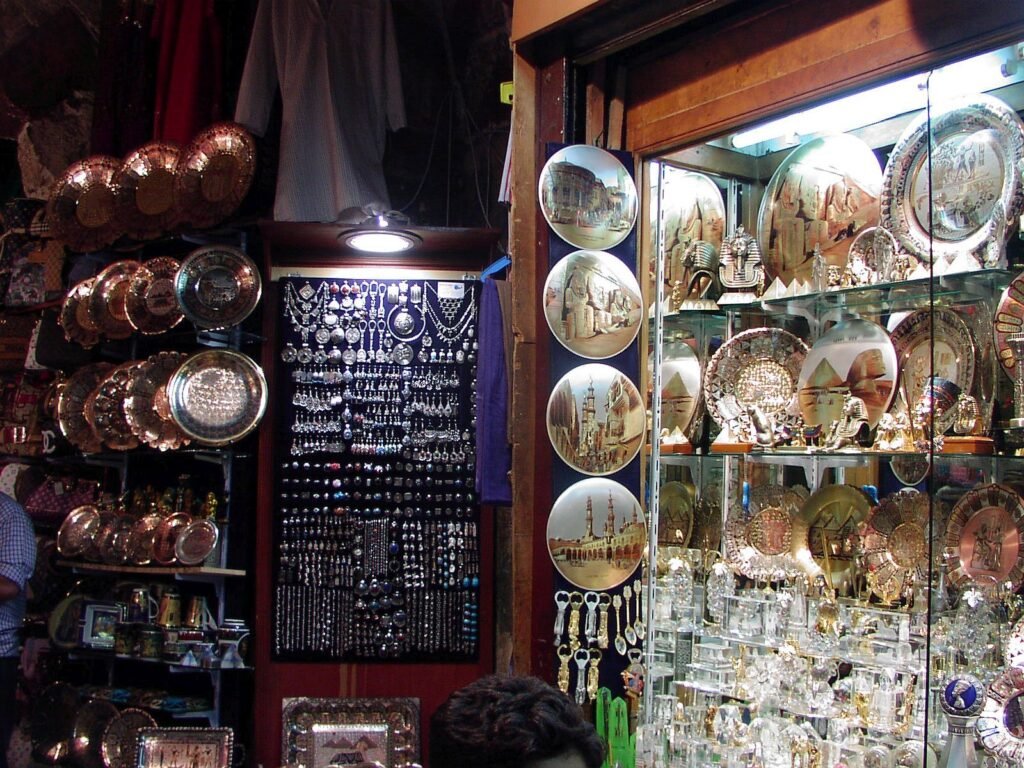
The metalworkers' lanes on the edge of Khan el Khalili are still full of hammering. This is where the pierced brass lanterns come from, along with copper trays and tea sets.
A hand-pierced lantern shows small irregularities in the pattern and an uneven solder line. A machine-stamped one is perfect, lighter and usually imported. Both are fine; just do not pay a hand-work price for a stamped piece. The colored glass is the fragile part, so have the seller pad each panel and carry the lantern on board.
The same lanes sell boxes and backgammon boards inlaid with mother of pearl. Real inlay is shell set into the wood, each piece slightly different in color; the imitation is a printed sticker under varnish, and a fingernail finds the edge on one and not the other. A guided walk through Islamic Cairo usually passes these workshops.
Alabaster, cartouches and perfume oils
Alabaster from Luxor
Egyptian alabaster is a soft translucent stone carved along the Nile since the Old Kingdom, and the family workshops on the Luxor west bank, on the road to the Valley of the Kings, still turn it by hand. Hold the piece up to the light: real alabaster glows softly, shows veins running through the stone, and is cool and heavy in the hand. The imitation is molded resin, which stays opaque, feels warm and weighs too little.
Cartouche jewelry
A cartouche is the oval around a royal name in the inscriptions, and jewelers across Egypt will engrave your name in hieroglyphs on a silver or gold pendant, usually ready the next morning. Order from a jeweler with a fixed shop, ask to see the hallmark, and check the spelling against a chart before they engrave. Plated pieces are sold as silver in the alleys. For a symbol rather than a name, our page on the ankh, scarab and Eye of Horus explains what each one meant.
Perfume oils
Egyptian perfume shops sell concentrated alcohol-free oils, in lotus, jasmine, musk, amber and blends named after queens, in hand-blown glass bottles worth buying on their own. Know that "pure essence" is a sales phrase; most oils are diluted in a carrier, which is fine at a market rate. Smell it on your skin, wait five minutes, and buy a small bottle first.
Nubian crafts in Aswan
Aswan feels like a different country from Cairo, and its crafts show it. The Nubian villages on the west bank and the islands sell the brightly painted plates, beaded necklaces, woven palm baskets and stitched cloth dolls you see on every Nubian house wall. The colors are strong, the prices are gentle, and buying from the family workshop puts the money where it should go.
The best pieces are the striped palm-frond baskets, which pack flat, and the beadwork, done by the women of the village and sold from the doorways. The painted plates are decorative, not food-safe. A visit usually pairs a boat ride with tea in a Nubian home, as described on our page about the Nubian village near Aswan.
The Aswan souk itself, a covered street parallel to the Corniche, is far more relaxed than Cairo, and vendors serve Aswan families first, which is why the quality holds up.
What to leave on the shelf: antiquities, ivory, coral, shells and seahorses
Some things sold to tourists cannot leave Egypt, or cannot enter the United States, and buying them ranges from a waste of money to a serious legal problem.
- Antiquities. Exporting a genuine antiquity is a crime, and airport scanners and customs officers look for them. Anything a vendor whispers is "real, from a tomb" is either a reproduction sold with a lie or a crime in a bag. Reproductions are legal and openly sold as such; keep the receipt and, for larger pieces, ask the shop for a note stating it is modern.
- Ivory. Trade in elephant ivory is banned under international rules and US law, and it is seized on arrival. When in doubt, do not buy.
- Coral and shells. Red Sea coral, coral jewelry and large shells from Hurghada and Sharm el Sheikh stalls are protected and illegal to export, and buying them feeds the destruction of the reefs people cross the world to see. This includes dead coral picked off the beach.
- Dried seahorses, starfish and puffer fish. Sold as curiosities on the coast, protected, and stopped by customs.
The principle: anything made from a wild animal or an ancient object needs paperwork a market stall cannot give you, so leave it.
Where to buy each thing
Place matters as much as product. Each market has a specialty, and the same lantern bought in the wrong place is a worse lantern at a higher price.
| Souvenir | Best place to buy | What to know |
|---|---|---|
| Papyrus | Papyrus workshop, Cairo or Luxor | Watch the demonstration, take it rolled in a tube |
| Egyptian cotton | Cotton shops and hotel arcades, Cairo | Mill on the label, never a market stall |
| Spices and hibiscus | Aswan souk, then Khan el Khalili | Whole petals, ask for vacuum sealing |
| Brass and copper | Metalworkers' lanes, Khan el Khalili | Hand-pierced is slightly irregular, carry glass on board |
| Alabaster | West bank workshops, Luxor | Holds light, cool and heavy, resin stays opaque |
| Cartouche jewelry | Jewelers with a fixed shop | See the hallmark, check the spelling, collect next day |
| Perfume oils | Perfume shops, Cairo and Luxor | Test on skin, buy small |
| Galabeyas and scarves | Luxor souk, Aswan souk, Khan el Khalili | Cotton not polyester, stitched seams |
| Dates and halawa | Supermarkets, last day in Cairo | Travel well in checked bags |
| Nubian crafts | Nubian villages, Aswan | Baskets and beadwork pack flat |
| Museum reproductions | Grand Egyptian Museum and NMEC shops | Fixed prices, no haggling, labeled replicas |
The airport is fine for a last box of dates, but it has the smallest range and the highest prices in the country, so do not leave the real shopping for departure day.
Haggling basics in one minute
Haggling is expected in the bazaars and souks and unwelcome in museum shops, supermarkets and any store with printed tags. Where it applies, the rhythm is the same:
- Walk past the first three stalls that sell what you want, so you know the range.
- Ask the price, look mildly disappointed, and offer well under it. Nobody is offended.
- Meet in the middle over two or three friendly exchanges. Smile the whole time; it is a conversation, not a fight.
- If the number will not move, thank the seller and walk away slowly. The final offer often follows you out the door.
- Once you say yes, the sale is done. Do not renegotiate after the item is wrapped.
Carry small bills so you can pay the agreed figure exactly. The longer version, with the phrases to use and the tricks to expect, is in our guide to haggling in Egypt.
Getting it home: packing and US customs in general terms
Packing
- Papyrus travels rolled in a rigid tube, never flat in a suitcase. Workshops give you the tube if you ask.
- Lanterns, blown glass and alabaster are the items that arrive broken most often. Carry them on board, wrapped in clothing.
- Perfume oils go in checked luggage because of the cabin liquid limits, each bottle sealed in a bag inside a shoe. The stoppers are not airtight.
- Keep receipts for anything of value and any reproduction that might look old to a scanner.
Customs, in general words
Coming into the United States you fill out a declaration, and you should declare everything edible. Commercially packaged dried spices, hibiscus, boxed dates, halawa and sealed tea are generally allowed as personal goods; fresh fruit, seeds for planting and meat products are not. Textiles, jewelry, brass, glass, alabaster and papyrus are ordinary goods within your personal exemption, which changes from time to time, so check the current CBP guidance before you travel. Anything made from ivory, coral, shell or seahorse is stopped regardless of value, and antiquities are stopped and reported.
How a guided shopping stop works with Explora Egipto
You can shop on your own in Egypt and many people enjoy it. What our guides change is the ratio of good purchases to regretted ones. On a shopping stop this is what happens:
- The right market on the right day. Spices in Aswan, alabaster in Luxor, brass and cotton in Cairo, with the heavy items bought last.
- Workshops rather than stalls. The guide takes you into the alabaster family workshop, the papyrus studio and the metalworker's lane. Nobody is paid a commission to bring you in.
- A second pair of eyes. The guide checks the cartouche spelling, holds the alabaster to the light and tells you when a "pure oil" is a diluted one.
- The negotiation, if you want help. Some travelers love haggling and the guide steps back. Others hate it and the guide handles it, in Arabic, at a local rate.
- Logistics. Purchases ride in the vehicle and the last morning in Cairo stays free for dates and halawa.
The shopping stop is part of every custom Egypt tour we plan. Tell us what you hope to bring home and we place it on the route.
Frequently asked questions
What is the best souvenir to buy in Egypt?
For most travelers it is a hand-painted papyrus from a real workshop, because it is light, unmistakably Egyptian and looks good framed. For something personal, a silver cartouche with your name in hieroglyphs. For daily use, Egyptian cotton sheets from a proper shop. For the best value, hibiscus and dukkah from the Aswan souk.
How can I tell real papyrus from fake papyrus?
Hold it up to the light and look for an irregular grid of crossed plant fibers; banana leaf looks even and waxy. Roll a corner gently: real papyrus springs back with no crease, the fake cracks or leaves a white line. Hand-painted work shows brush strokes, while prints are identical. Buy at a workshop where you see the plant pressed.
Can I take antiquities or old-looking items out of Egypt?
Genuine antiquities cannot be exported, and the airport checks for them. Modern reproductions are legal and openly sold in museum shops and bazaars. Keep the receipt, and for anything large or convincingly aged, ask the shop for a note stating it is a reproduction. If a vendor claims a piece is truly ancient, walk away.
Can I bring Egyptian spices, dates and hibiscus into the United States?
In general terms yes. Dried, commercially packaged spices, hibiscus petals, boxed dates, halawa and sealed tea are treated as personal food items and are normally allowed, as long as you declare them on the customs form. Fresh fruit, seeds for planting and meat products are not. Rules change, so check the current US Customs and Border Protection guidance before you travel.
Where is the best place to shop in Egypt?
Khan el Khalili in Cairo has the widest choice, especially in the side lanes for brass, cotton and spices. The Luxor souk is smaller and calmer and is the place for alabaster and scarves. The Aswan souk is the best in the country for spices and hibiscus. Museum shops sell reproductions at fixed prices.
Should I buy Egyptian cotton in the market?
No. Real long-staple Egyptian cotton comes from specialist shops and hotel arcade stores that name the mill and print the thread count. Market stall sheets labeled Egyptian cotton are almost always a blend or a short-staple cotton with a printed tag. The good fabric feels cool, dense and smooth, with a tight weave.
Bring home the Egypt that was made by hand
Tell us your dates, who is traveling and what you would love to carry home, and we send you an itinerary with the right markets and workshops placed along the route and a guide who checks every purchase with you. No prices on this page, just a quote in your inbox.