
Dendera and Abydos are two of the best-preserved temples in Egypt, north of Luxor and off the classic circuit. Dendera, dedicated to the goddess Hathor, has astronomical ceilings in their original color and the famous zodiac; Abydos holds the temple of Seti I, with the finest reliefs in the country and the king list. They are visited together on a full-day trip from Luxor of about ten hours.
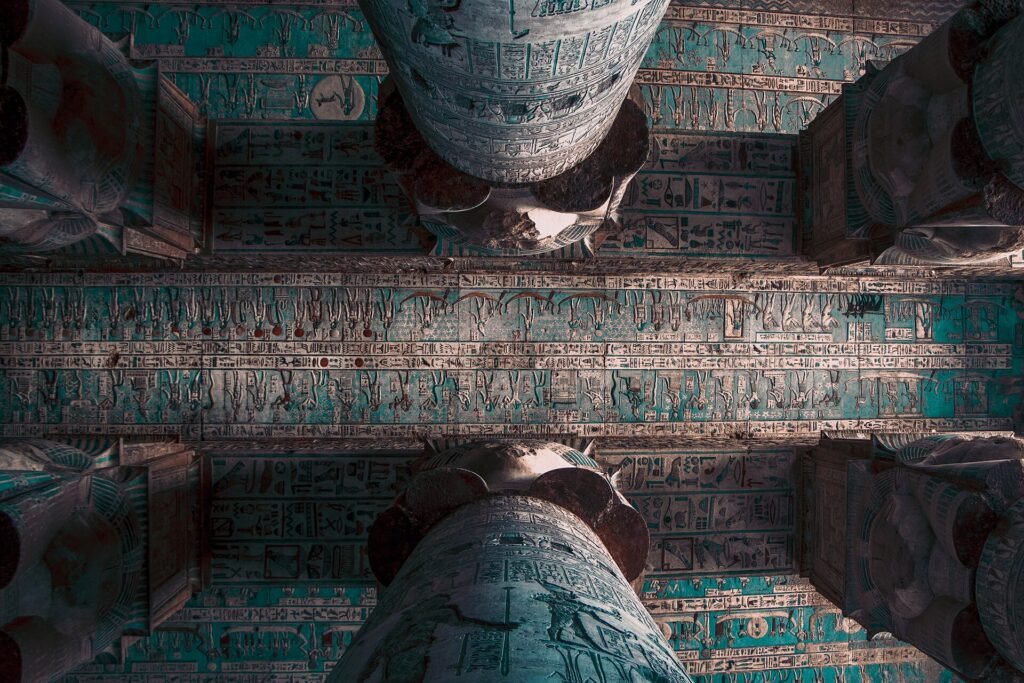
Most travelers who reach Luxor spend their time at Karnak, Luxor Temple and the Valley of the Kings, and rightly so: they are essential. But a few hours north by road, following the Nile, are two temples that many Egyptologists name among their favorites and that see a fraction of the crowds. Walking into Dendera's hypostyle hall and looking up at its blue ceiling, or moving quietly through the painted chapels of Abydos, is as close as you will get to seeing ancient Egypt the way its priests did.
This guide covers what makes each temple special, what not to miss inside, how the day trip from Luxor works and who it is really worth a day of your trip for.
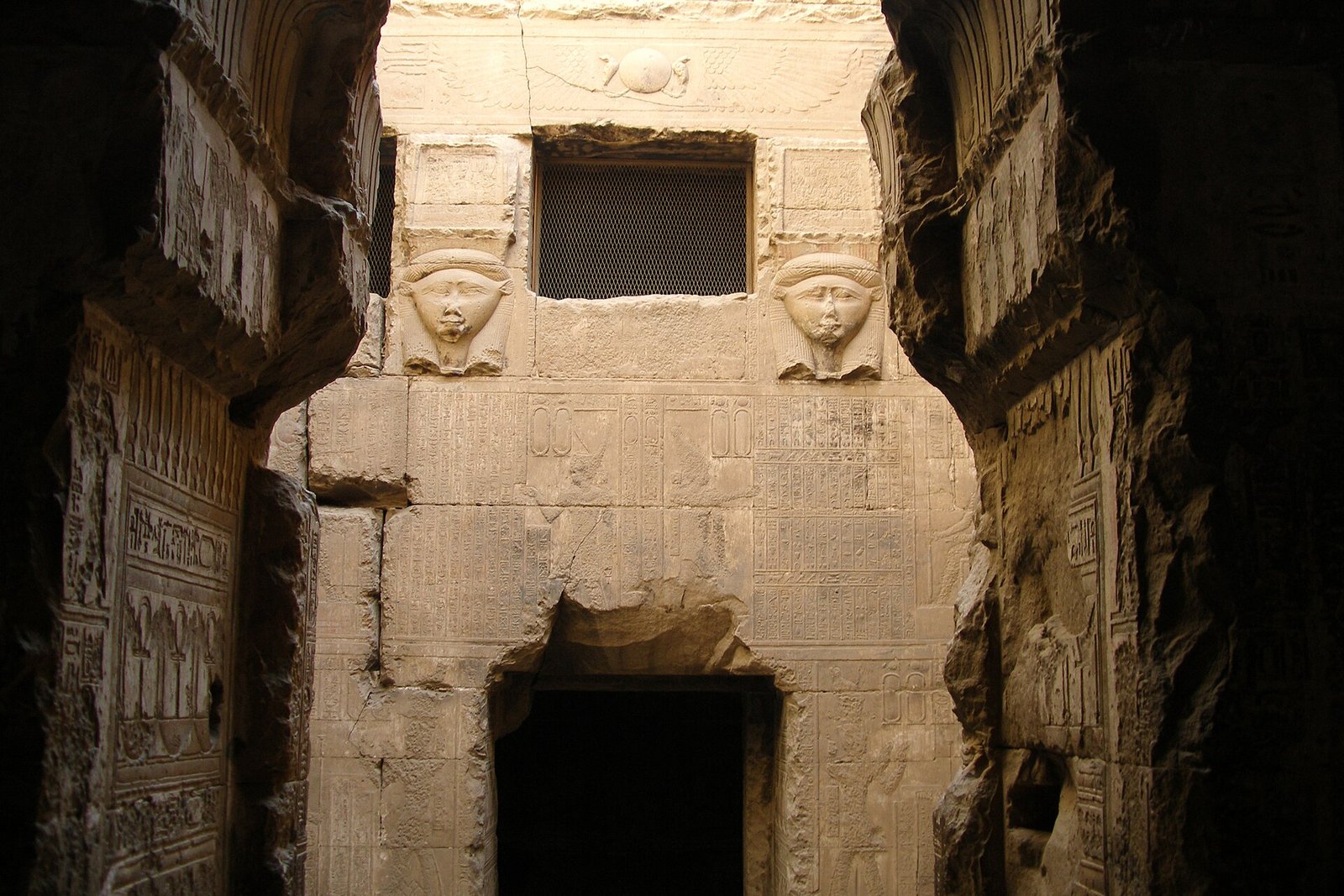
Dendera stands on the west bank of the Nile opposite the town of Qena, about 45 miles north of Luxor. For millennia it was the great sanctuary of Hathor, goddess of joy, music, love and motherhood, shown with a woman's face and cow's ears. The site is very old, but the temple you see today is late: building started in the 1st century BC under the last Ptolemies and was finished by Roman emperors. That is why it is nearly complete, roof, staircases and chapels still in place.
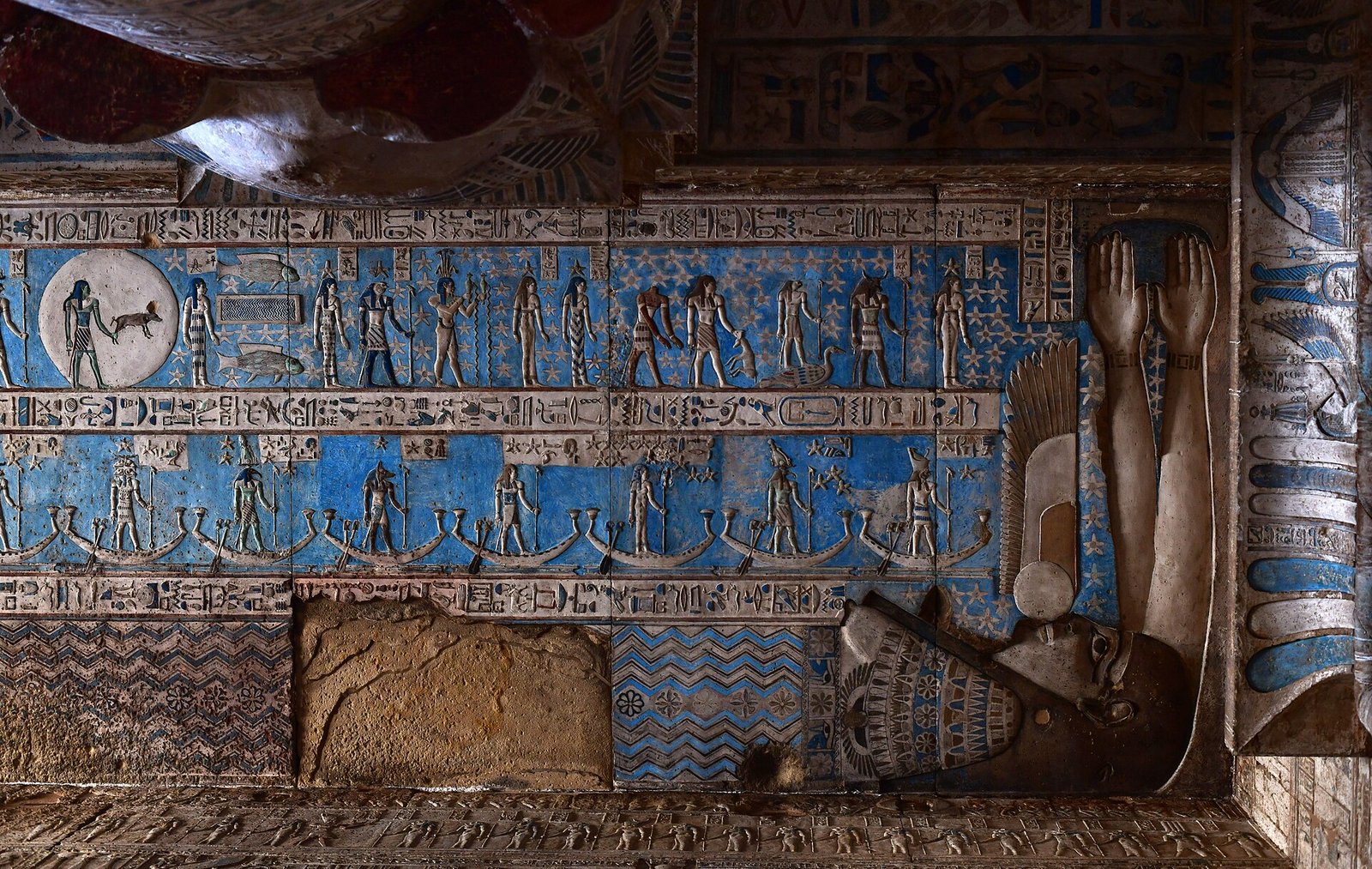
The first thing that strikes you is the great entrance hall, with twenty-four columns crowned by Hathor's face. What stops people in their tracks, though, is the ceiling: a sky painted in deep blue, crossed by the sky goddess Nut, who swallows the sun every evening and gives birth to it every morning, along with the hours of day and night, the constellations and the decans, the star groups Egyptians used to tell time. Since its cleaning, the color has a brightness very few temples keep. For how the Egyptians measured the year, see the pharaonic calendar.
In one of the rooftop chapels dedicated to Osiris was the famous circular Dendera zodiac, one of the most complete maps of the sky from antiquity, with the zodiac signs the Egyptians borrowed from Greek and Babylonian astronomy blended with their own constellations. The original was removed in the 19th century and is now in the Louvre in Paris; a faithful cast sits in its place. Climbing to the roof by the staircases carved with the priests' procession, who carried the goddess's statue up to meet the new year's sun, is part of the visit.
On the temple's rear exterior wall is one of the few reliefs of Cleopatra VII: she appears with her son Caesarion, Julius Caesar's child, making offerings to the gods. She is carved in traditional Egyptian style, as just another pharaonic queen, not with the Greek features of her coins, which says a lot about how the Ptolemies wanted their Egyptian subjects to see them.
Beneath the temple are narrow crypts where sacred objects were stored, with remarkably preserved reliefs. One scene is often presented online as an ancient light bulb. Egyptologists read it differently, and with the help of the texts beside it: a lotus flower from which a snake emerges, an image from the creation myth. It is well worth seeing with a guide who can read the inscriptions with you.
Abydos lies further north, about 105 miles from Luxor on the edge of the Western Desert. It was one of the holiest places in Egypt: the country's first kings were buried here more than five thousand years ago, and this was believed to be the tomb of Osiris, god of the dead. For centuries Egyptians made pilgrimages to Abydos and wanted to leave their mark near the god, with a stela, a chapel or at least their name. The story of Osiris is in Egyptian mythology.
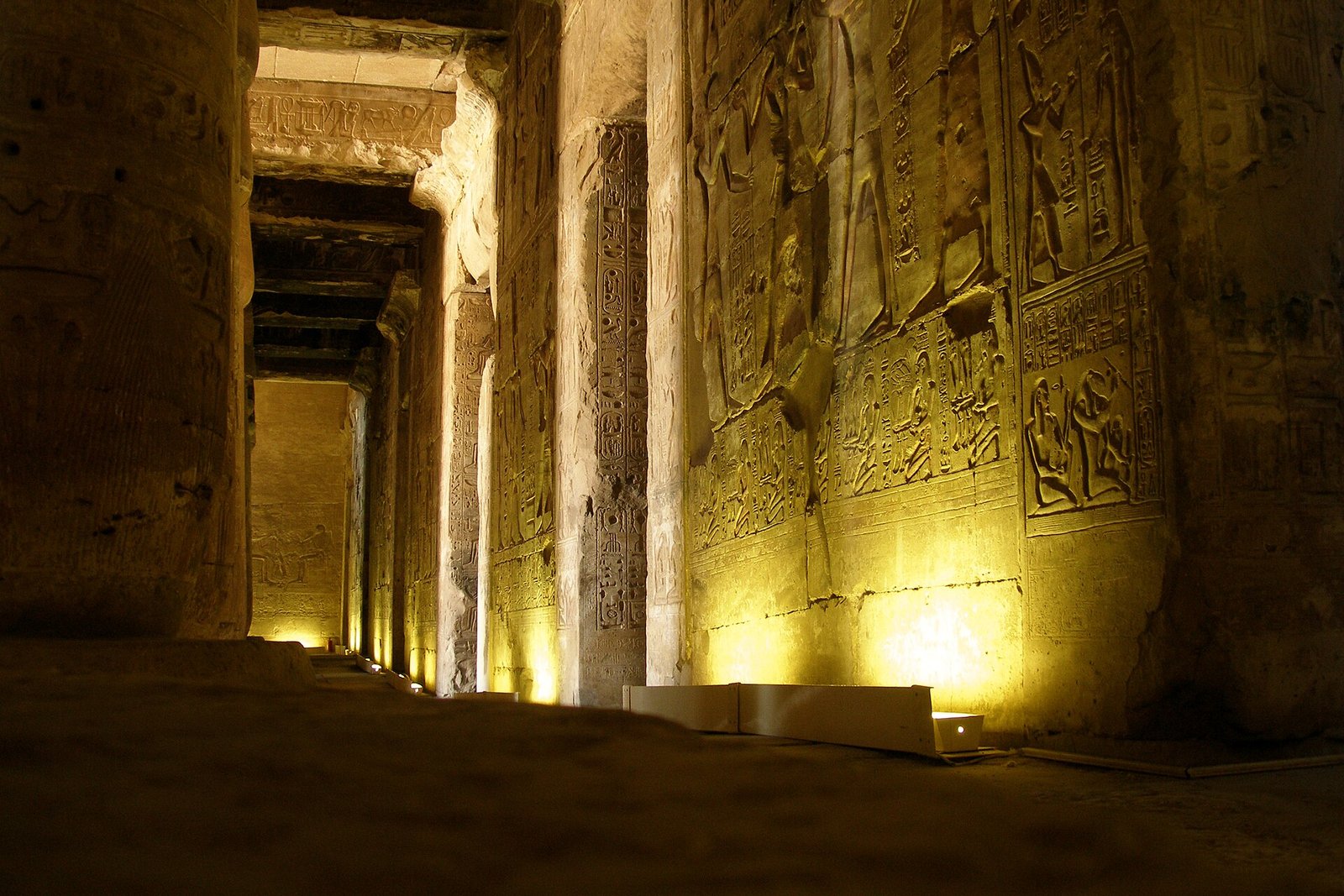
The jewel of Abydos is the temple built by Seti I, father of Ramesses II, around 1290 BC. It is unlike any other: instead of one sanctuary it has seven chapels side by side, for Osiris, Isis, Horus, Amun, Ra-Horakhty, Ptah and the deified king himself. Its raised reliefs, carved in fine limestone and many still painted, are considered the most delicate in Egypt. If you have just seen the great temples of Luxor, you will notice the difference in quality immediately.
In one corridor, Seti I and the young Ramesses make offerings before a list of seventy-six cartouches: the kings who came before them, from Menes, who unified Egypt, down to Seti himself. It is one of the most important sources for putting Egyptian history in order, with telling gaps: the rulers Seti considered illegitimate, such as Hatshepsut, Akhenaten and Tutankhamun, are left out. The full succession is in the pharaohs of Egypt.
On a beam in the hypostyle hall is an inscription that went viral because some signs look like a helicopter or a submarine. The explanation has long been known: Seti I's titles were carved first, then filled with plaster and recarved with those of Ramesses II. Over the centuries the plaster fell away and the two overlapping texts produced those shapes. It is a good lesson in reading hieroglyphs in context.
Behind the temple is a puzzling structure sunk below ground level: the Osireion, a kind of cenotaph for Osiris built with massive granite pillars, evoking the primeval mound surrounded by water. Today it is usually partly flooded by groundwater, which only adds to the atmosphere.
A story many travelers enjoy: in the 20th century an Englishwoman named Dorothy Eady, known as Omm Sety, lived in Abydos, convinced she had been a priestess in this temple in a past life. She worked for years alongside the archaeologists on site, who valued her knowledge of the temple, and she is buried at Abydos.
The usual way to visit is a private full-day trip from Luxor with a car, driver and Egyptologist guide. You leave early and go to Abydos first, the farther of the two, to arrive before the heat and the few groups; then you head back south and stop at Dendera in the afternoon, when the light is softer. With the drive and both visits it takes about ten hours, including a lunch stop on the way.
We build it into your Luxor program alongside the other options in Luxor excursions. If you are still deciding what to see in the city, start with what to see in Luxor.
It is not a question of choosing one over the other, but of knowing what each adds. Karnak overwhelms with its scale and two thousand years of additions; Luxor Temple with its axis and its night lighting. Dendera offers something they cannot: an almost complete temple, roof and color included, where it is easy to picture how it worked inside. Abydos has the finest relief carving in Egypt and a sense of sacred place that has never faded. That is why both are in our pick of the 10 must-see temples in Egypt, and why they suit an off-the-beaten-path Egypt trip so well.
To place both temples in the full story of the country, from the Old Kingdom to the Romans, read our guide to ancient Egypt; to recognize Hathor, Osiris and the other deities on their walls, see how to recognize the Egyptian gods.
North of Luxor in the Nile Valley. Dendera faces the town of Qena, about 45 miles from Luxor, and Abydos is about 105 miles away on the edge of the Western Desert. They are visited together on a full-day trip from Luxor.
About ten hours in total, with the drive, both visits and a lunch stop. The usual plan is to leave early, see Abydos first and keep Dendera for the afternoon.
A circular relief of the sky showing the zodiac signs and Egyptian constellations, carved on the ceiling of a rooftop chapel of the Hathor temple. The original has been in the Louvre since the 19th century; a cast is in its original place at Dendera.
A relief in the temple of Seti I with seventy-six royal cartouches, from Menes to Seti I, before which the king and his son Ramesses make offerings. It is a key source for Egyptian chronology, though it omits rulers considered illegitimate, such as Hatshepsut and Akhenaten.
Yes. On the temple's rear exterior wall, Cleopatra VII appears with her son Caesarion making offerings to the gods, carved in traditional Egyptian style. It is one of the few images of the queen preserved on a temple.
Very much, especially if you have seen the Luxor highlights or prefer quiet temples. Dendera has the best-preserved color in Egypt and Abydos the finest reliefs. It is a long day, but for history lovers it is often one of the best of the trip.
All our itineraries are on Egypt tour packages.
Keep exploring