The mysteries of the Sphinx, question by question, with what the evidence actually says
The mysteries of the Sphinx, question by question, with what the evidence actually says
The mysteries of the Sphinx sort into three piles once you look at the evidence. Settled: it was carved around 2500 BC in the reign of Khafre, it faces due east on purpose, and its nose was chiseled off centuries before Napoleon was born. Genuinely open: whose face it is, whether the beard was original, when it was painted, and what the Old Kingdom called it. Fringe: a lost civilization carving it ten thousand years ago, and a Hall of Records under the paws. Surveys have found cavities, and every one is a dead end. Below, each question gets its current best answer, fringe is labeled fringe, and you get the guide's method for telling them apart on site.
Who built the Sphinx, and whose face is it?
The mainstream answer is Khafre, builder of the second pyramid, and the reasoning is physical. The Sphinx sits at the foot of Khafre's causeway. The Sphinx Temple in front of it and Khafre's Valley Temple beside it are built from huge limestone blocks whose geological layers match the layers of the ditch dug around the statue. The rock removed to shape the lion was stacked next door to build its temple, tying both to one campaign. The statue carries no inscription, which is why the question stays alive.
Two minority views exist inside Egyptology: that Khufu, Khafre's father, commissioned it, or that Djedefre, who reigned briefly between them, carved it in his father's honor. Both sit in the same generation, so the argument is about which king in one family.
The face is harder. In the 1990s a police forensic artist compared the profile with the famous diorite statue of Khafre and concluded the faces do not match. Egyptologists reply that royal portraits were idealized and that two workshops carving different stone at different scales would never produce identical features. Honest status: the builder is very probably Khafre; whether the face is his portrait is unproven.
How old is the Sphinx? The water-erosion argument against the geology
The alternative case
A geologist and a writer proposed in the early 1990s that the enclosure walls show rounded, vertical, rippled weathering of the kind rain runoff leaves on rock, not the flat horizontal profile cut by wind-blown sand. Since the last truly wet period in this part of the Sahara ended long before 2500 BC, they argued the ditch, and so the statue, must be thousands of years older, with 7000 BC or earlier suggested.
The mainstream reply
- The rock is layered. The plateau limestone alternates hard and soft beds. Soft beds retreat, hard beds stand proud, and you get a rippled profile without a drop of rain.
- Salt does the damage. Ground water rises into the porous stone, evaporates, and salt crystals flake the surface off.
- It did rain, later. Downpours have hit Giza throughout historical times, and the statue spent most of its life buried in damp sand, which weathers stone fast.
- Nobody was there to carve it. A monument this size needs quarries, gangs, food surplus and administration. There is no trace of any of that at Giza before the pyramid age.
A middle position from another geologist accepts some runoff weathering but dates it only a few generations earlier, to the dawn of the pyramid age. So: the ten-thousand-year date is fringe, and the exact reign is open.
Is there a Hall of Records under the Sphinx?
The legend comes from the American psychic Edgar Cayce, who said in trance readings in the 1930s that survivors of Atlantis had buried their records beneath the right paw. No ancient Egyptian text mentions anything of the kind. But the story funded expeditions, so you should know what they found.
Surveys since the late 1970s, using resistivity, seismic refraction, ground-penetrating radar and boreholes, detected anomalies, which is what you expect in fractured limestone with a high water table. Where drilled, they proved to be natural fissures or solid rock.
Three real passages do exist in the body:
- The rump passage. A narrow shaft at the tail end, found in the 1920s clearance, reopened and mapped in 1980. A dead end, probably a treasure hunter's probe or an ancient test cut.
- The hole behind the head. Drilled by a nineteenth-century explorer looking for a chamber. He found rock.
- The north-side fissure. A natural crack, later filled.
Under Khafre's causeway nearby sits a genuine deep shaft with a water-filled sarcophagus, nicknamed the tomb of Osiris. It is not under the Sphinx. The cavities are real; the records are not. For what has genuinely come out of the ground lately, see our list of recent archaeological discoveries in Egypt.
The nose, the beard and the original colors
Start with the myth. Napoleon's soldiers did not shoot off the nose. A Danish traveler sketched the Sphinx in 1737, six decades before the French expedition, and his drawing already shows a noseless face.
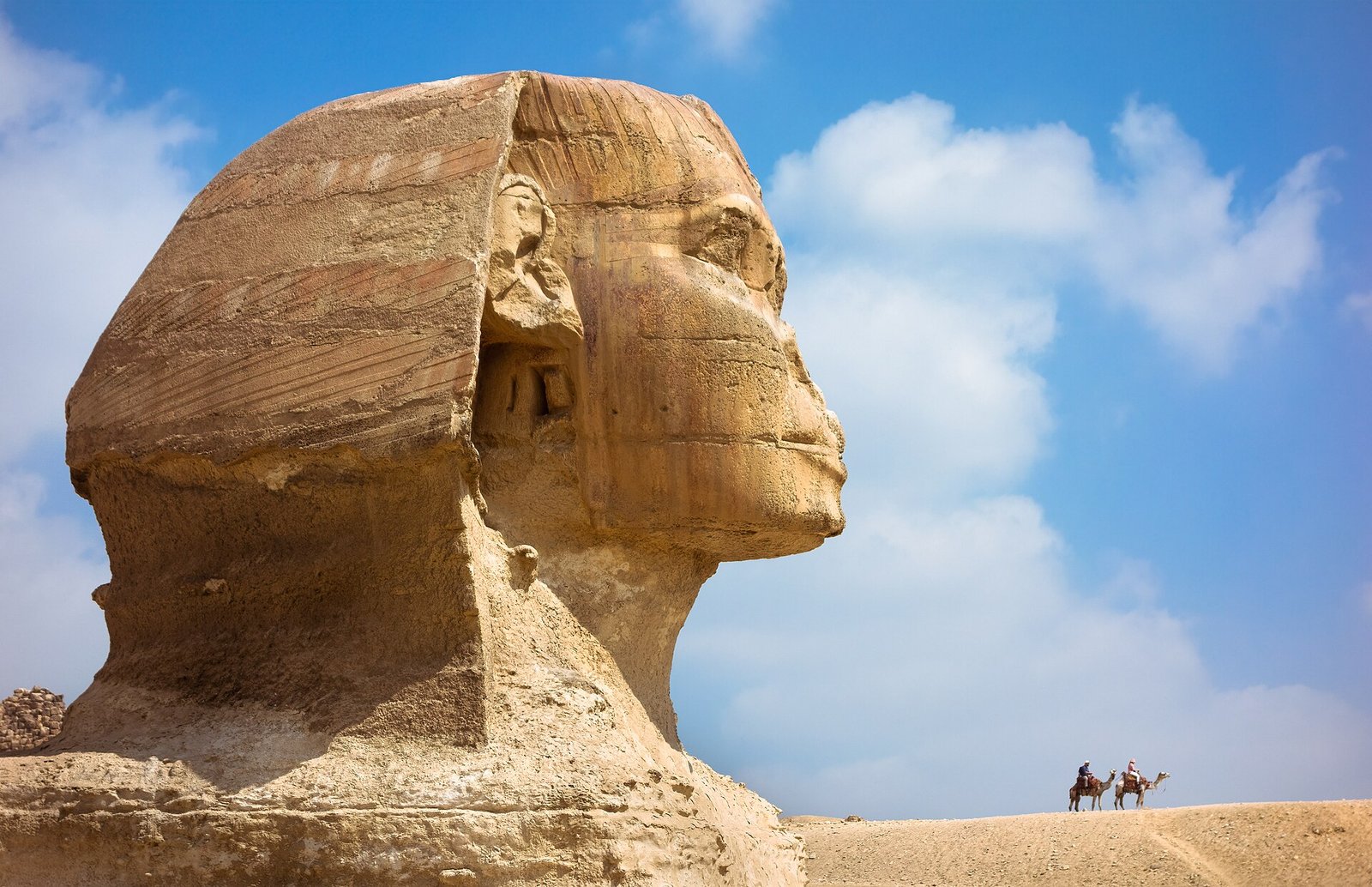
The best documented account is from the fifteenth-century Cairo historian al-Maqrizi, who wrote that a zealot named Muhammad Sa'im al-Dahr attacked the face in 1378, angry that farmers were leaving offerings to the statue for good harvests, and was executed for it. The physical evidence fits deliberate work: long marks on the nose bed show rods or chisels were hammered in and the nose, about a yard wide, was pried off. What you see today is the scar.
The beard is a separate story. Fragments of a long, plaited, ceremonial beard were found between the paws in 1817; one large piece is in the British Museum, others in Cairo. The plaited style belongs to a god, not a living king, so most Egyptologists think it was added when the Sphinx was reinterpreted as the god Horemakhet in the New Kingdom, a thousand years after the carving. A minority think it was original. Open question.
And it was painted. Traces of red ochre survive by the ear and along the cheek, the standard color for male skin in Egyptian art, and the stripes of the nemes headcloth carried yellow and blue. When the paint was applied is unsettled: the flakes are too small to date, and most specialists lean toward the New Kingdom restoration while assuming the original was painted too, because every Old Kingdom statue we have was. To calibrate your eye, spend an hour with the painted statues in the Grand Egyptian Museum the day before Giza.
The Dream Stele and the sand that kept burying it
Between the paws stands a slab of red granite about twelve feet tall, placed by Thutmose IV around 1400 BC. It tells how the prince fell asleep in the shadow of the head, which was all that showed above the sand, and how the god promised him the throne in a dream if he cleared the body. He did, and he became king. It is the oldest explicit document about the Sphinx, and it already describes a ruin needing rescue a thousand years after the carving.
The stele also matters to the age debate. One badly eroded line once held a royal name beginning with the sign for Khaf, copied in the 1820s before the surface flaked away. Mainstream Egyptologists read it as Khafre; skeptics note the context is lost. Both sides quote the same missing line, which tells you how thin the textual record is.
The sand explains a great deal. The Sphinx sits in a hollow below plateau level, and the wind refills it within decades of any clearance. So it was dug out again and again: by Thutmose IV, in the Late Period, by the Romans, by explorers in 1817, 1853 and 1886, and finally in a full clearance in the 1920s and 1930s. Burial protected the body for most of its life, and the repair blocks on the flanks come from every one of those campaigns, so much of the visible body is ancient masonry, not original rock.
Does the Sphinx line up with the equinox?
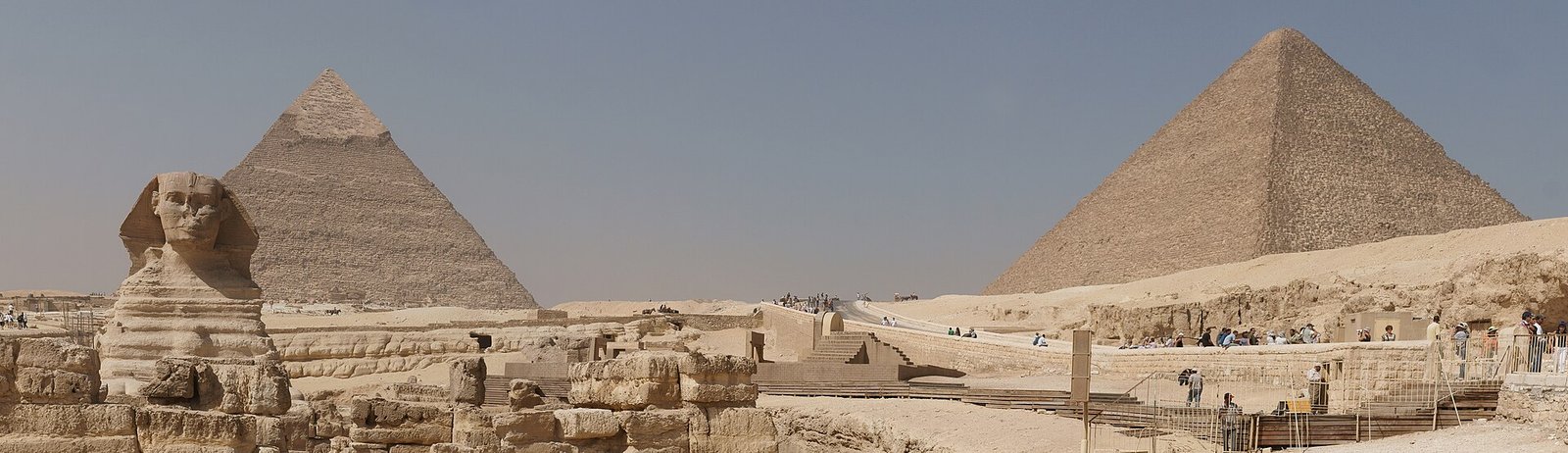
It faces due east to within a fraction of a degree, and that is deliberate. On the equinoxes, around March 21 and September 23, the sun rises directly before its gaze. Its temple has two sanctuaries, east and west, framing sunrise and sunset.
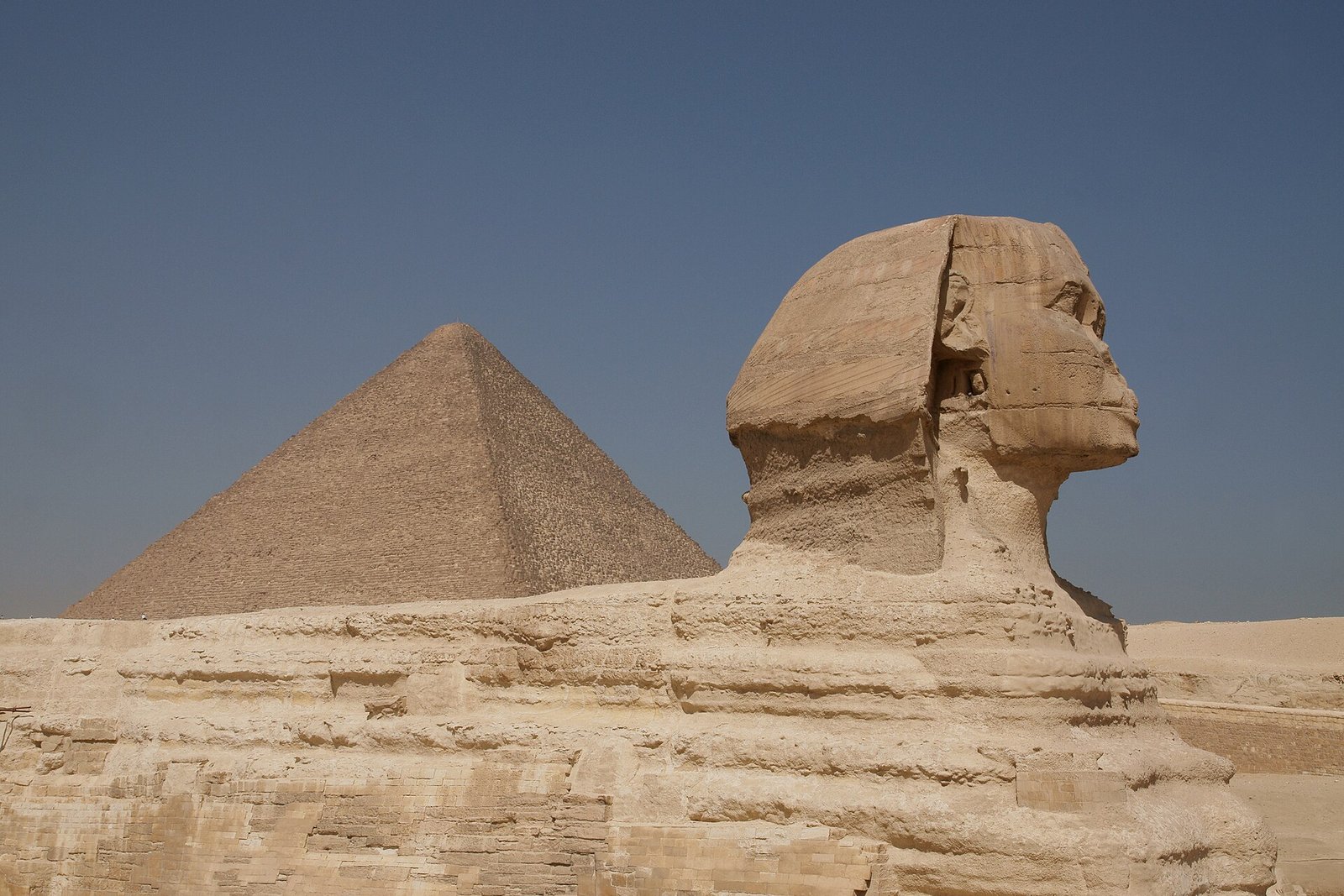
The striking alignment is at sunset. Stand in the Sphinx Temple on the equinox and the sun goes down on the south shoulder of Khafre's pyramid, so the Sphinx and the pyramid share one silhouette. At the summer solstice, from the same spot, the sun sets midway between the Great Pyramid and Khafre's, reproducing the hieroglyph for horizon, a disc between two hills. The New Kingdom name Horemakhet means Horus in the Horizon, and it is hard to call that a coincidence.
None of it requires mystery. The Egyptians were careful surveyors whose religion revolved around the sun's daily rebirth, and the pyramids are aligned to the cardinal points with the same precision; our page on how the pyramids were built covers the method. A solar alignment is a real feature of the site, not evidence of anything lost.
The Inventory Stela: the text that says Khufu found the Sphinx
This small limestone slab, found in 1858 in a temple of Isis east of the Great Pyramid, is the most quoted document in alternative Sphinx literature. It claims to be a decree of Khufu saying he found the temple of Isis beside the house of the Sphinx and restored the statue. Read literally, that puts the Sphinx before Khufu.
Egyptologists do not read it literally. The language, the titles and the list of divine statues belong to the twenty-sixth dynasty, roughly two thousand years after Khufu. The temple where it was found is the converted chapel of a queen's pyramid, and its late-era priests had every reason to claim the greatest pyramid builder as their founder. It is pious antiquarianism, a community writing itself a prestigious backstory.
So the stela is real and ancient, and it is not an eyewitness account from 2500 BC. When a documentary shows it without mentioning when it was carved, you are watching the fringe version.
What has the Sphinx been called across the ages?
Nobody knows what Khafre called it; no Old Kingdom text names the statue. The names arrive in layers:
- Horemakhet, Horus in the Horizon, from the New Kingdom, when the statue was reinterpreted as a form of the sun god and given a temple, a cult and the beard. Greek visitors wrote it Harmachis.
- Hauron, a Canaanite god's name, used by foreign settlers nearby in the New Kingdom.
- Sphinx, a Greek word for the riddling monster of the Oedipus story, applied by Greeks to Egyptian lion-bodied statues. A derivation from the Egyptian shesep ankh, living image, is disputed.
- Abu al-Hawl, Father of Dread, the Arabic name Egyptians use today.
Herodotus never mentions the Sphinx, almost certainly because it was buried to the neck when he visited. To place Horemakhet among the gods you will meet on the trip, see how to recognize the Egyptian gods.
Every mystery ranked: settled, open or fringe
| Question | Current best answer | Status |
|---|---|---|
| Who built it? | Khafre, around 2500 BC. Khufu or Djedefre are minority views in the same generation. | Settled to a generation |
| Whose face is it? | Probably an idealized Khafre. The forensic mismatch is real but inconclusive. | Open |
| Thousands of years older? | No. Layered limestone, salt and later rain explain the enclosure. | Fringe |
| A Hall of Records? | No. Three known passages, all dead ends; every drilled anomaly was rock. | Fringe |
| Who broke the nose? | Chiseled off deliberately, most likely in 1378. Not Napoleon. | Settled |
| Was the beard original? | Probably a New Kingdom addition; some argue original. | Open |
| Was it painted? | Yes: red face, yellow and blue headcloth. Date of the paint unresolved. | Settled, date open |
| Does it align with the sun? | Yes: due east, equinox sunrise ahead, solstice sunset in the horizon sign. | Settled |
| Does the Inventory Stela prove it predates Khufu? | No. A Late Period text two millennia after Khufu. | Fringe reading |
| Its Old Kingdom name? | Unknown. Horemakhet is New Kingdom; Sphinx is Greek; Abu al-Hawl is Arabic. | Open |
How a guide separates fact from fringe while you stand there
Everything above is visible from the enclosure terrace, in this order.
- Read the rock first. From the south side you see three limestone beds: hard base, soft middle, harder head. That explains the erosion, the small head, and why the face outlasted the body.
- Match the blocks. In the Sphinx Temple, look at the size and layering of the core blocks. They came out of this ditch. That is the Khafre argument in stone.
- Count the repairs. The small blocks on the paws and flanks are restoration from at least four eras. What looks like decay is mostly ancient maintenance.
- Find the pigment and read the stele. The red under the ear is still there with a long lens, and the Dream Stele is between the paws. Its story makes the sand, the burial and the New Kingdom cult fall into place.
- Then take the theories one at a time. We do not mock the water-erosion idea; we walk you to the enclosure wall, show the rippled profile, then the salt crust and the bedding planes that produce it. You decide with your own eyes.
How Explora Egipto builds the Sphinx into your Giza day
We give the Sphinx its own slot, never the last ten minutes after the pyramids. Our order is the Great Pyramid in the cool of the morning, the Panorama viewpoint for the wide shot, then the Valley Temple and the enclosure while the sun is still in front of the face. At midday the face goes flat; by late afternoon it is backlit, which is why so many photos come out dark. Our guide to the Pyramids of Giza has the full sequence.
Tickets, distances and photo positions live on our Great Sphinx of Giza visiting guide; this page is the argument, that one is the logistics. A private Giza pyramids tour with an Egyptologist is the format we recommend, and the evening sound and light show tells the Dream Stele story with the Sphinx as narrator.
Frequently asked questions
What are the biggest unsolved mysteries of the Sphinx?
The genuinely open ones are whose face it carries, whether the plaited beard was original, when the surviving paint was applied, and what the Old Kingdom called it. The builder is settled to Khafre's generation. The dramatic mysteries, a ten-thousand-year age and a Hall of Records under the paws, are fringe claims that surveys and geology have not supported.
Is the Sphinx really older than the pyramids?
Almost certainly not. The water-erosion argument rests on the rounded weathering of the enclosure walls, but layered limestone, salt crystallization from the high water table, later rainstorms and centuries of burial in damp sand produce the same profile. The temple in front is built from blocks quarried out of the Sphinx ditch, tying it to Khafre's reign.
Are there secret chambers under the Sphinx?
There are three known passages: a dead-end shaft at the rump, a nineteenth-century drill hole behind the head and a natural fissure on the north side. All have been opened and mapped. Surveys since the 1970s have detected anomalies, and where drilled they proved to be fissures or solid rock. The Hall of Records is a twentieth-century psychic's prophecy, not an ancient tradition.
Did Napoleon's army break off the Sphinx's nose?
No. Sketches from 1737 show the face already without a nose, decades before the French expedition. The historian al-Maqrizi records that a zealot named Muhammad Sa'im al-Dahr mutilated the face in 1378, offended by farmers making offerings there. Tool marks on the nose bed show it was pried off deliberately. Napoleon's scholars measured and drew it with care.
Why does the Sphinx face east?
Because the sun rises there. The Sphinx faces due east so that on the equinoxes the sun comes up directly before its gaze, and its temple has sanctuaries for sunrise and sunset. From the temple on the summer solstice the sun sets between the two great pyramids, forming the hieroglyph for horizon, which matches its New Kingdom name Horemakhet, Horus in the Horizon.
Can you get close enough to see the pigment and the Dream Stele?
Yes. The enclosure terrace runs alongside the body and ends in front of the paws, close enough to read the outline of the Dream Stele and, with a long lens or binoculars, to pick out the red ochre on the cheek. Go in the morning when the face is lit from the front, and give it its own hour.
Stand in the enclosure and judge the evidence yourself
Tell us your dates and how deep you want to go, and we build a Giza day around the Sphinx with an Egyptologist who has read both sides of the argument, the enclosure in the right light, and the museum the day before. Write to us on WhatsApp and we send you the quote.