The Dahshur pyramids are where Egypt learned to build a true pyramid, and you can go inside
The Dahshur pyramids are where Egypt learned to build a true pyramid, and you can go inside
The Dahshur pyramids sit about 25 miles south of downtown Cairo, past Saqqara, and they belong to one king, Sneferu, the father of Khufu who built the Great Pyramid. The Bent Pyramid changes angle halfway up because the builders realized the slope was too steep, and it still wears most of its smooth white limestone casing, which no pyramid at Giza does. The Red Pyramid next to it is the first true, straight-sided pyramid ever finished, and you can crawl down its long passage and stand in three corbelled chambers, usually alone. Dahshur was a military zone for decades, so it never made the standard circuit. That is exactly why it is worth your day.
Why Dahshur matters: Sneferu's laboratory
Giza was the graduation project. The homework was done at Dahshur. Sneferu founded the Fourth Dynasty around 2600 BC and spent his reign trying to turn the stepped tomb of Djoser at Saqqara into a smooth, four-sided pyramid. He built at Meidum first, then moved his workforce north to Dahshur and tried twice more.
The result is a royal cemetery with two enormous experiments a mile apart. One went wrong in an instructive way. The other worked, and his son copied its proportions at Giza. Sneferu probably moved more stone than any other king in Egyptian history, because he kept starting over.
You are looking at the moment the engineers figured it out. Read the site in order, Saqqara, then the Bent Pyramid, then the Red Pyramid, and the whole idea of the pyramids of Giza explains itself before you get there.
The Bent Pyramid, and why the angle changes
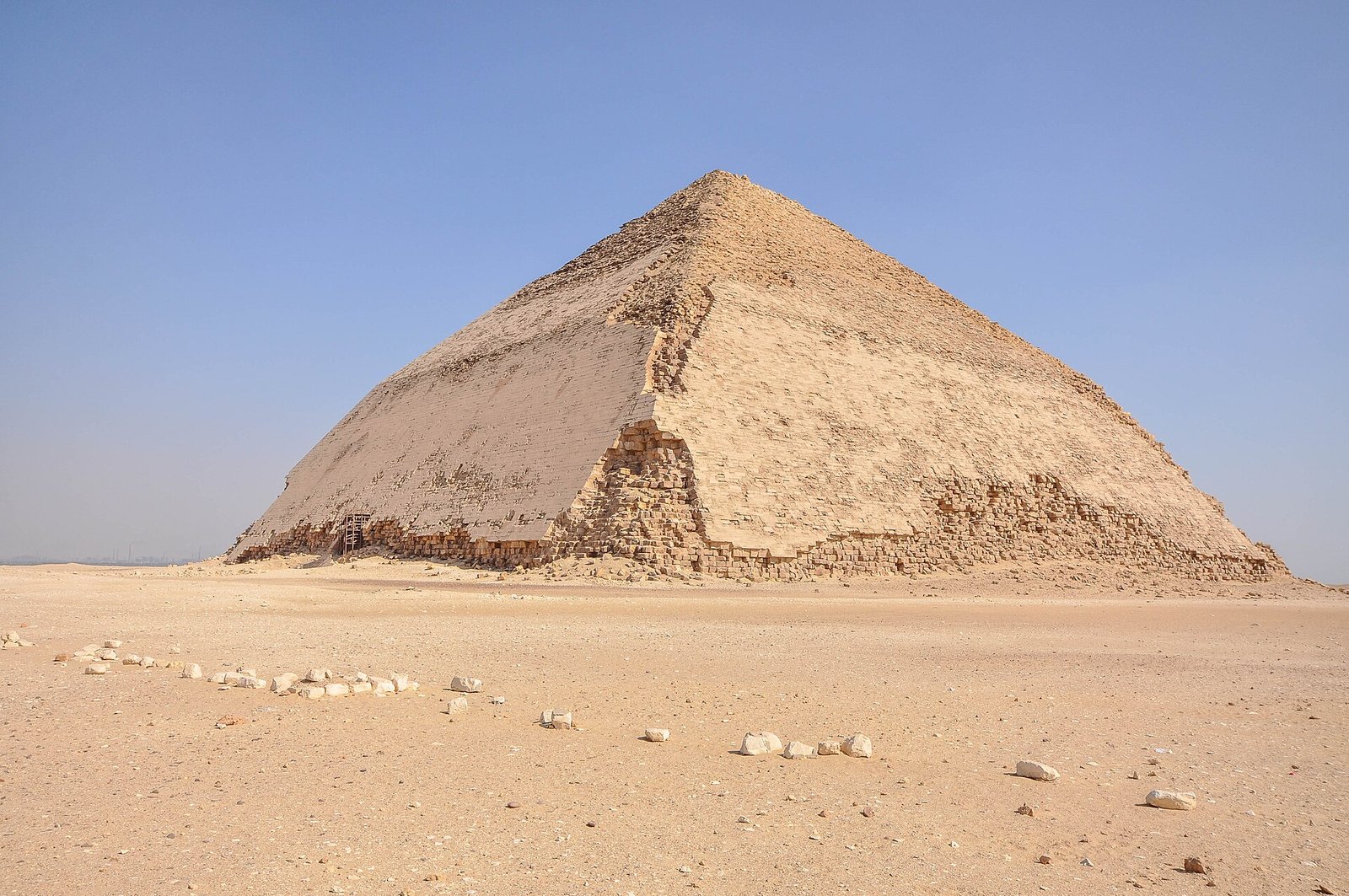
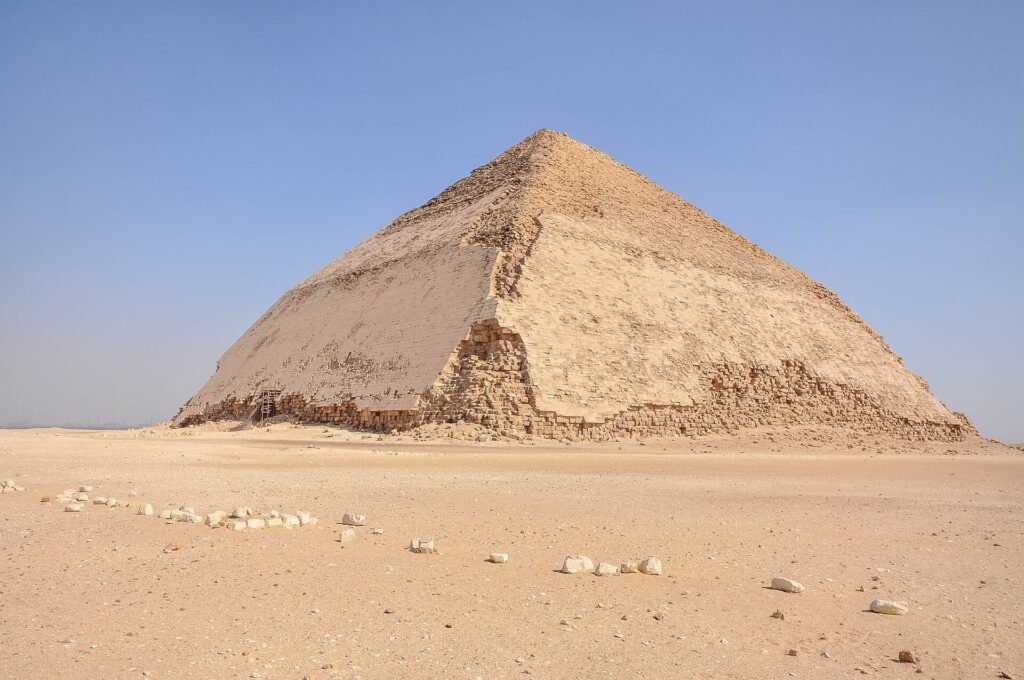
The Bent Pyramid is the one you see first from the access road, and even from a mile away it looks wrong. The lower half rises at a steep slope of roughly 54 degrees. About 150 feet up, the faces suddenly flatten to about 43 degrees and continue to the top at that gentler pitch.
The accepted explanation is structural. The core sat on desert clay that could not carry the weight, and the internal passages began to crack while the pyramid was still going up. The builders widened the base, then reduced the angle of the upper section to take load off the structure. Cedar beams were wedged inside the chambers to brace walls that were already moving, and you can still see them.
The Bent Pyramid is also the only pyramid in Egypt with two separate entrances, north and west, each leading to its own set of chambers. Nobody knows for certain why. A satellite pyramid stands to the south. The interior was opened to visitors in recent years after a long closure, so ask us what is accessible in the week you travel.
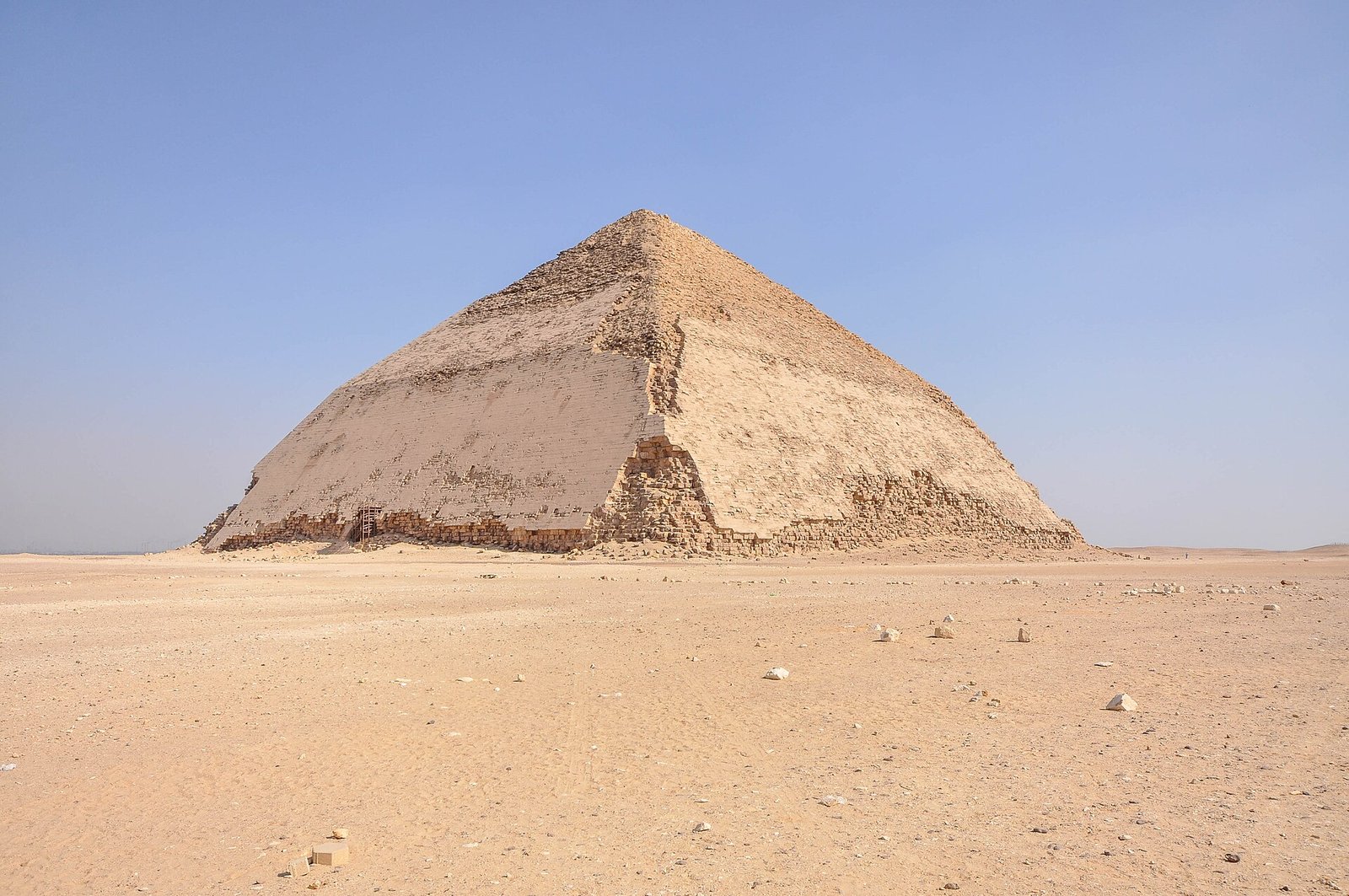
The casing: what a finished pyramid actually looked like
This is the detail people miss in photos and never forget in person. The Bent Pyramid keeps most of its original outer casing, fine white limestone from the Tura quarries across the Nile, polished smooth and fitted so tightly you cannot slide a card between the blocks. At Giza that skin was stripped for building stone centuries ago, which is why the Great Pyramid looks like a staircase. At Dahshur you see the intended finish on broad stretches of every face.
Stand close and notice something else. The casing blocks were laid tilted inward, leaning against the core, rather than in flat courses. It is an older technique the Egyptians abandoned right after this pyramid, and it may have added to the instability. Walk to the Red Pyramid and the blocks lie level. Two engineering systems, side by side, in the open air.
The Red Pyramid: the first true pyramid
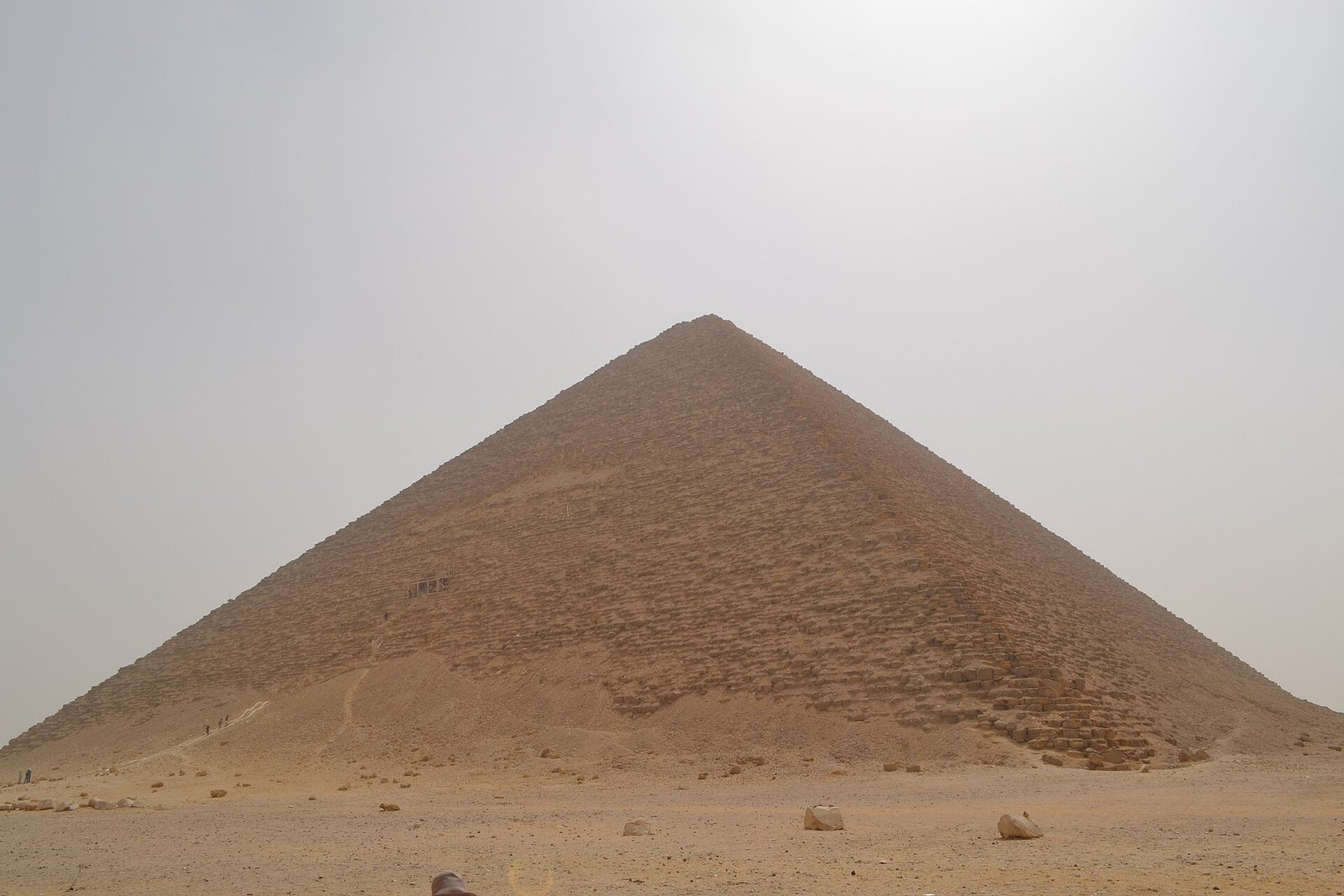
About a mile north, Sneferu tried again and got it right. The Red Pyramid rises at the same gentle 43 degrees the Bent Pyramid finished with, this time from the ground up, and it is the first smooth-sided pyramid ever completed. It stands around 340 feet tall on a base roughly 720 feet on each side, the third largest pyramid in Egypt by volume, behind only Khufu and Khafre at Giza.
The name comes from the rusty local limestone of the core, exposed once the white Tura casing was stripped. Fragments of that casing lie around the base, along with a reconstructed capstone, the pyramidion, found in pieces nearby and reassembled at ground level so you can see the shape up close.
Khufu's builders took his father's successful angle, steepened it slightly to about 52 degrees, and added height. The Red Pyramid is the proof of concept. Without it, Giza does not happen.
Going inside the Red Pyramid, step by step
The Red Pyramid is the best pyramid interior in Egypt you can enter without a line. Here is exactly what happens, so you can decide whether it is for you.
- The climb. The entrance is on the north face, about 90 feet up. An outdoor staircase built over the stone gets you there in ten minutes, with a fine view over the desert from the top.
- The descent. A passage about 200 feet long drops into the pyramid at a steep angle. It is roughly four feet high, so you go down bent double, holding a rail, with wooden slats underfoot for grip. Take it slowly.
- The first two chambers. At the bottom the passage levels out into a tall room with a corbelled ceiling, each course of stone stepping inward until the walls meet far above your head. A short corridor leads to a second, almost identical chamber.
- The burial chamber. A modern wooden staircase climbs to a high opening, and beyond it lies the third chamber, the largest, with a corbelled vault rising about 50 feet. The floor was torn up long ago by treasure hunters.
- The climb back. The same 200 feet, uphill. Most people find it harder than the descent.
The smell, the air and who should stay outside
Two honest warnings. The air inside is hot, still and very dry, and it carries a sharp ammonia smell from generations of bats that roosted in the chambers. The first breath at the bottom is a surprise. There is no ventilation and no phone signal. If you are claustrophobic, or your knees or lower back complain on stairs, stay outside without any guilt. The exterior is the main event anyway.
For everyone else, the reward is standing in a vaulted stone room sealed roughly 4,600 years ago, with nobody else in it. That happens almost every day at Dahshur. It never happens at Giza.
The Black Pyramid and the Middle Kingdom field
Look east from the Red Pyramid, toward the palm groves, and you see a dark, slumped mound that looks more like a hill than a monument. That is the Black Pyramid of Amenemhat III, built roughly 800 years after Sneferu, in the Middle Kingdom. It explains why Dahshur looks so different from Giza.
By the Twelfth Dynasty, kings had stopped building in solid stone. The Black Pyramid had a mud brick core and a limestone skin. When later generations stripped the skin for reuse, the brick was left open to rain and wind and melted into the shape you see today. It also stood too close to the valley floor, on ground that could not carry it, and the chambers cracked before the king could use them. Amenemhat III was buried at Hawara in the Fayum instead.
Two survivors are worth knowing about. Its granite capstone, carved with the king's names and a pair of eyes facing the rising sun, was found nearly intact and is displayed in Cairo. And the tombs of royal women around the Middle Kingdom pyramids here produced some of the finest jewelry ever recovered from ancient Egypt, also in Cairo. Our guide on which Cairo museum to choose tells you where to see them. Seeing the capstone after the shapeless mound it came from is one of the best lessons in Egypt about what time does to architecture.
Why Dahshur is so empty compared with Giza
Dahshur is less than half an hour from Saqqara and about an hour and a quarter from central Cairo in normal traffic. It has two of the three most important pyramids in the country. And on most mornings you can count the other visitors on your fingers. There are three reasons.
- It was a military zone. For most of the second half of the twentieth century Dahshur sat inside a restricted army area, closed to the public. It only opened to tourism in the mid 1990s. The classic Cairo itineraries were written long before that, and many operators still run them by habit.
- There are no services. No cafe, almost no shade, a small ticket office, minimal signs. You arrive with your own water, hat and plan.
- Nobody is selling anything. No camel line, no papyrus shop, no one walking beside you offering a photo. For travelers who have just done Giza in high season, that alone is the reason to come.
The result is probably the only place in Egypt where you can stand in front of a complete pyramid with no one in the frame and no one in your ear. Pair it with the Sphinx and the Giza plateau on another day and you get both versions: the famous one and the quiet one.
How Dahshur combines with Saqqara and Memphis
Nobody goes to Dahshur alone. It is the last stop on a day that starts at Memphis, the ancient capital, continues at Saqqara with the Step Pyramid of Djoser, and finishes among Sneferu's pyramids. The three sites lie along the same desert edge, a short drive apart.
| Stop | What you see | Time on site | Why it comes in this order |
|---|---|---|---|
| Memphis (Mit Rahina) | The fallen colossus of Ramesses II, the alabaster sphinx, an open air museum in a palm grove | About 45 minutes | The city the pyramids were built to overlook |
| Saqqara | The Step Pyramid of Djoser, the Imhotep Museum, decorated Old Kingdom tombs | 2 to 3 hours | The first pyramid, stepped, and daily life carved in relief |
| Dahshur | The Bent Pyramid, the Red Pyramid inside and out, the Black Pyramid in the distance | 1.5 to 2 hours | The step becomes a slope, the slope fails, then succeeds. Giza is the next chapter |
Do Dahshur last, not first. Some drivers reverse the order to beat the sun. Resist that. If you arrive at the Bent Pyramid already knowing what Djoser's step pyramid looks like, the change of angle reads as a sentence in a story rather than an oddity. We build this as one of our Cairo excursions with a private vehicle, so the order is yours.
Can you add Giza to the same day? Physically yes, and plenty of operators sell it that way. We do not recommend it. Giza deserves a fresh morning and Dahshur an unhurried afternoon. If Cairo is short, see how we split it in two days in Cairo.
Best light, timing and what to bring
The Red Pyramid earns its name in the late afternoon, when the low sun turns the core stone a deep rust and the casing on the Bent Pyramid goes warm and gold. That is the window for photos, and another reason to end the day here. Early morning is the coolest and emptiest, with clean blue light.
From October through April the desert is comfortable, with midday highs around 70 to 80 F (21 to 27 C). In summer expect 95 to 105 F (35 to 40 C) on open sand with almost no shade, so start early and do the interior first while your legs are fresh. Inside the pyramid it is warm year round.
- Closed shoes with grip. The passage slats are polished by decades of soles.
- More water than you think, and a hat. There is nowhere to buy either on site.
- A small flashlight or your phone light. The interior is lit, but the corbels are best seen with your own beam.
- Something to tie back long hair before the descent. The ceiling is close.
- Small notes for the guardians who open the pyramid, the same courtesy as at every site in Egypt.
What a guide adds at Dahshur
Dahshur has almost no interpretation on site. No panel explains the change of angle, no sign points out the Black Pyramid or says why the casing blocks lean inward. Without someone who knows the site, most visitors walk around two big pyramids, take the same photo and leave in forty minutes.
With an Egyptologist guide, the field turns into a lecture you can walk through. Ours will stand you at the base of the Bent Pyramid and show you the exact course where the angle changes, point out the tilted casing blocks and the level ones at the Red Pyramid, and walk you to the reconstructed pyramidion. Inside the Red Pyramid the guide goes down with you, and having someone who has done it a hundred times makes the descent feel routine instead of daunting.
How Explora Egipto builds the Dahshur day
We are a local agency based in Egypt, with our own guides and vehicles, and we have run this route more times than we can count. The standard version is a private full day from your Cairo hotel: pickup after breakfast, Memphis first, then Saqqara with time inside a decorated tomb, lunch near the palm groves, and Dahshur through the afternoon with the Red Pyramid interior at the end. Back in Cairo by early evening.
If you would rather have Dahshur in the morning for the cool air, we flip the order. If someone in your group will skip the interior, the guide splits the party so nobody waits in the sun. On a longer trip this day slots between a first Giza pyramids tour and the flight south to Luxor.
Tell us your dates, your hotel and how many of you are traveling, and we send you the quote with the day already shaped around what you want to see.
Frequently asked questions
Can you go inside the Dahshur pyramids?
Yes. The Red Pyramid is normally open: you climb an exterior staircase to a doorway on the north face, then descend a long, low passage to three corbelled chambers. The Bent Pyramid has been opened to visitors in recent years after decades of closure, though access can change without notice. Ask us what is open in the week you travel and we confirm before you go.
Is the Red Pyramid better than going inside the Great Pyramid?
For most people, yes. The Red Pyramid interior is larger, with three high chambers instead of one, and you usually have it to yourself, while the Great Pyramid means a line and a crowded passage. If you can only do one interior on your trip, choose the Red Pyramid and spend your Giza time outside admiring the scale.
How far is Dahshur from Cairo and how long do you need?
Dahshur is about 25 miles south of downtown Cairo, roughly an hour and a quarter by road depending on traffic, and about 20 minutes beyond Saqqara. Plan 90 minutes to two hours on site if you go inside the Red Pyramid. Combined with Memphis and Saqqara it is a full day of eight to nine hours from hotel to hotel.
Why is the Bent Pyramid bent?
The builders started at a steep angle of about 54 degrees on ground that could not carry the weight. Cracks appeared in the chambers during construction, so they reduced the slope of the upper part to about 43 degrees to lighten the load. The result is the distinctive kink about two thirds of the way up. Sneferu then built the Red Pyramid at the gentler angle from the start.
Is Dahshur suitable for children and older travelers?
The exterior is easy for everyone: flat sand, short walks from the vehicle, a guide who adapts the pace. The interior of the Red Pyramid is the demanding part, with a long bent-over descent and the same climb back. Fit kids from about eight up usually love it. Anyone with knee, back or heart concerns, or claustrophobia, should enjoy the outside and skip the passage.
Should I visit Dahshur or just see Giza?
Do both, on different days if you can. Giza gives you the scale, the Sphinx and the icon everyone recognizes. Dahshur gives you the story of how that icon was invented, an intact casing you cannot see at Giza, a pyramid interior without crowds and nobody selling anything. If your Cairo time is very short, Giza wins, but travelers who add Dahshur almost always call it a highlight.
See the pyramid being invented, with nobody else around
Tell us your dates, your hotel and who is traveling, and we come back with a Dahshur, Saqqara and Memphis day built around your pace, a guide who goes down the passage with you, and the rest of your Egypt trip shaped around it. No prices on this page, just a quote in your inbox.