
The Eye of Horus meaning is healing and protection, and the story behind it is better than the amulet
The Eye of Horus meaning is healing and protection, and the story behind it is better than the amulet
The Eye of Horus, called the wedjat in Egyptian, means wholeness, healing and protection. The name translates as the whole one or the sound one. It comes from the myth in which the falcon god Horus loses an eye fighting his uncle Seth for the throne of Egypt, and the eye is healed and given back to him. Because a broken thing was made whole, the sign became the most common protective amulet in the country, worn by the living against sickness and envy, and tucked into mummy wrappings to guard the dead. It is not the Eye of Ra, it is not the eye on the dollar bill, and the famous fraction story is now doubted.
What the Eye of Horus is, and what wedjat means
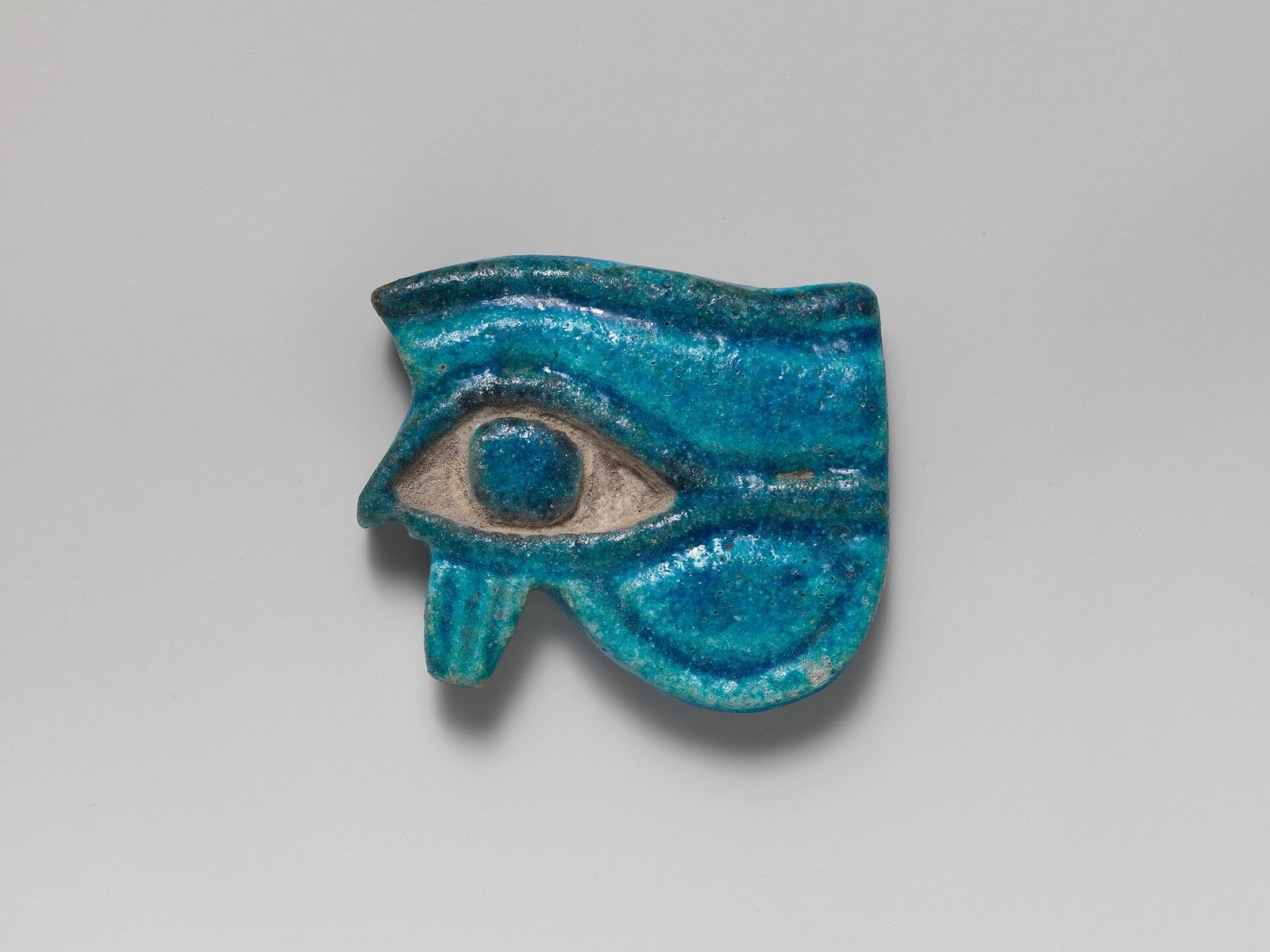
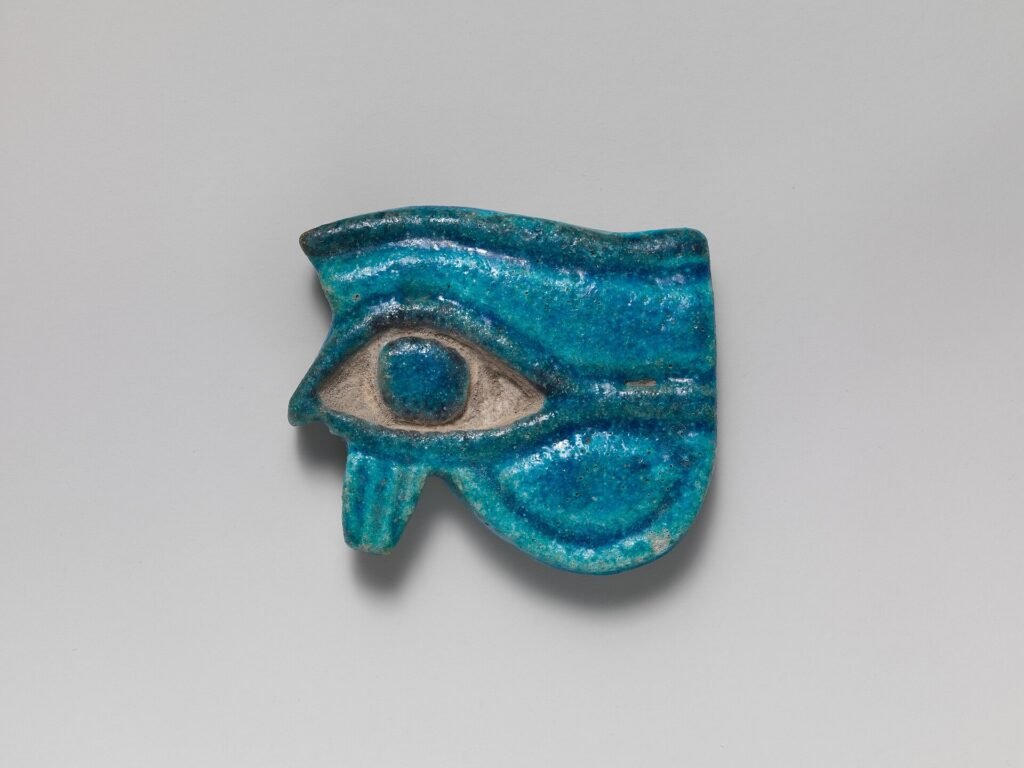
Look at any Eye of Horus and you will see five strokes: a stylized human eye, an eyebrow above it, a curved line dropping from the outer corner, a second line ending in a spiral under the inner corner, and the pupil. The two lines below are not decoration. They copy the dark cheek markings of a falcon, the bird of Horus, so the symbol is a human eye dressed as a bird of prey.
The Egyptians called it the wedjat, also spelled udjat. The word means the whole one, the sound one, the one that has been restored. That is the entire meaning in a single term: not power, not vision, but wholeness after damage. The same root gives the name of Wadjet, the cobra goddess who rears up on the royal crown.
The sign worked as a hieroglyph, as a temple image and as an amulet made in the tens of thousands. To see how it sits alongside the ankh and the scarab, our guide to the amulets of ancient Egypt covers the whole family.
The myth: Horus, Seth, and the eye that was made whole
Horus was the son of Osiris and Isis. When Seth murdered Osiris and took the throne, Isis raised the boy in secret in the Delta marshes until he could claim it. The contest between Horus and Seth is the longest quarrel in Egyptian myth, and the eye is its central wound.
In the fight, Seth tears out or damages the eye of Horus. In the version most people know, Thoth, the ibis-headed god of writing and reckoning, gathers the pieces and restores it. In another telling, on a papyrus of the Ramesside period, Hathor heals the blinded Horus with the milk of a gazelle. The Egyptians were comfortable with more than one version of a story.
What happens next is the part jewelry shops leave out. Horus offers the healed eye to his dead father Osiris, and the gift revives Osiris in the underworld. That is why every offering placed on a temple altar, bread, wine, incense, meat, could be called the Eye of Horus in the ritual texts. To give the eye was to give life back.
The wounded eye is usually understood as the left eye, the moon, which shrinks and is made whole again every month. The right eye is the sun. That lunar reading is why the wedjat is tied to healing rather than raw strength. For the family tree behind all of this, start with our guide to Egyptian mythology.
Eye of Horus versus Eye of Ra: left and right, protection and power
This is the question a guide hears most in the Edfu courtyard. They are two different ideas sharing a shape. The Eye of Horus is the wounded and healed eye of a young god. The Eye of Ra is a goddess: a fierce female force the sun god sends out to punish his enemies, identified with Sekhmet, Hathor, Wadjet or Bastet depending on the temple and the century.
In the myth of the destruction of mankind, Ra sends his Eye, Hathor turned Sekhmet, to slaughter the humans who plotted against him, and only stops her by flooding the fields with beer dyed red. The Eye of Ra protects the king by attacking. The Eye of Horus protects the wearer by being whole.
| Feature | Eye of Horus (wedjat) | Eye of Ra |
|---|---|---|
| Which eye | Left, the moon | Right, the sun |
| Core meaning | Healing, wholeness, protection, offering | Power, punishment, the king's defense |
| Who it belongs to | Horus, son of Osiris | Ra, and the goddesses who act as his Eye |
| Mood | Restored after injury, calm | Dangerous, needs to be pacified |
| Where you meet it | Amulets, mummy wrappings, coffins, offering scenes | The uraeus cobra on the crown, Sekhmet statues, sun disks |
One caution. The Egyptians did not police the left and right rule the way modern charts do. Amulets survive facing both ways, often in pairs, and no direction is cursed whatever a vendor says. Our guide to the Egyptian gods and how to recognize them shows which goddess is playing the Eye of Ra in any relief.
The amulet: in the mummy wrappings and over the incision
The wedjat was the single most popular amulet in Egypt from the Old Kingdom to the Roman period. Most were pressed from faience, a glazed quartz paste fired to a blue or turquoise green that imitated lapis lazuli and turquoise, stones of the sky and of new life. Finer ones were cut from carnelian, real lapis, glass, gold and steatite. Many small ones have a suspension loop and genuine wear: people wore these in life, on a cord or on a ring.
In the tomb the amulet had a specific job. Embalmers laid wedjat eyes between the layers of linen at set points of the body, and the Book of the Dead includes a spell for bringing the wedjat to the deceased. On royal and wealthy mummies of the New Kingdom and later, the cut the embalmers made on the left flank to remove the organs was covered with a plate of wax, bronze or gold stamped with the eye. The healed eye of Horus sealed the one wound the embalmers themselves had made.
The fractions story, and why Egyptologists now doubt it
You will read almost everywhere that the six parts of the eye stand for six fractions used to measure grain: one half, one quarter, one eighth, one sixteenth, one thirty-second and one sixty-fourth. Add them up and you are one sixty-fourth short of a whole eye, and the story says Thoth supplied the missing piece by magic. It is elegant and printed on a thousand posters.
Here is what the evidence shows. Egyptian scribes really used a set of signs for halving the hekat, the standard grain measure, running from one half down to one sixty-fourth. The idea that those signs are the dismembered eye was proposed by a German Egyptologist in the early twentieth century and accepted for decades. When the hieratic originals were reexamined more recently, the signs did not match the strokes of the eye as neatly as the theory needed, and no Egyptian text ever states the connection.
So the fractions are real, the eye is real, and the link between them is a modern theory most specialists now treat as unproven. Enjoy the poster, but do not repeat it as fact on your Nile cruise. The Egyptians did tie the eye to reckoning, through Thoth, the god of counting, who restores it. That connection is in the texts. The pie chart is not.
Eyes on boats, coffins and temple walls
Once you know the shape you will see it everywhere on the trip.
On coffins. The rectangular wooden coffins of the Middle Kingdom carry a pair of wedjat eyes painted on the east side, at the head end. The dead lay on the left side facing east, and the eyes were a window to watch the sunrise and the offerings brought to the tomb.
On boats. The sacred barks that carried a god's statue in procession, carved on the walls at Karnak and Edfu on priests' shoulders, have eyes on the prow. So did working Nile boats, and the habit of painting an eye on a bow so the boat can see its way survives on fishing boats across the Mediterranean.
On temple walls. In the Ptolemaic temples of Edfu, Dendera and Philae, the king holds out a wedjat eye to the god as an offering, because the eye stands for every offering. On the inner face of the enclosure wall at Edfu the whole quarrel is carved: Horus in his boat harpooning Seth in the form of a hippopotamus, scene after scene. That is this page in stone, and the reason we give the temple of Horus at Edfu more time than the cruise schedule does.
The Eye of Horus today: jewelry, tattoos and the Rx myth
Few ancient symbols are this alive. It is on silver pendants in every bazaar, on Cairo doorways to turn away envy, on truck mudguards, and on the forearms of many travelers we meet at the airport. The meaning has barely changed in three thousand years: keep me whole, keep harm away.
Tattoos are not a modern twist. The mummy of a woman from the workers' village of Deir el-Medina, near the Valley of the Kings, carries wedjat eyes tattooed on her neck and shoulders among dozens of other sacred images. If you are planning one, make sure the cheek line and the spiral are clean, because they are what make it a wedjat rather than a generic eye.
Three modern claims deserve a straight answer:
- The Rx symbol on prescriptions comes from the Eye of Horus. Folk etymology. Pharmacy historians trace Rx to the Latin word recipe, meaning take, with a stroke through the R. There is no chain of evidence between an Egyptian amulet and a European apothecary's shorthand.
- It is the eye on the back of the US one dollar bill. No. That is the Eye of Providence, an eighteenth-century Christian and Masonic motif of an eye inside a triangle.
- It is a diagram of the pineal gland. The comparison lives on the internet and nowhere in an Egyptian source.
Where to see real wedjat eyes on your trip
Cairo
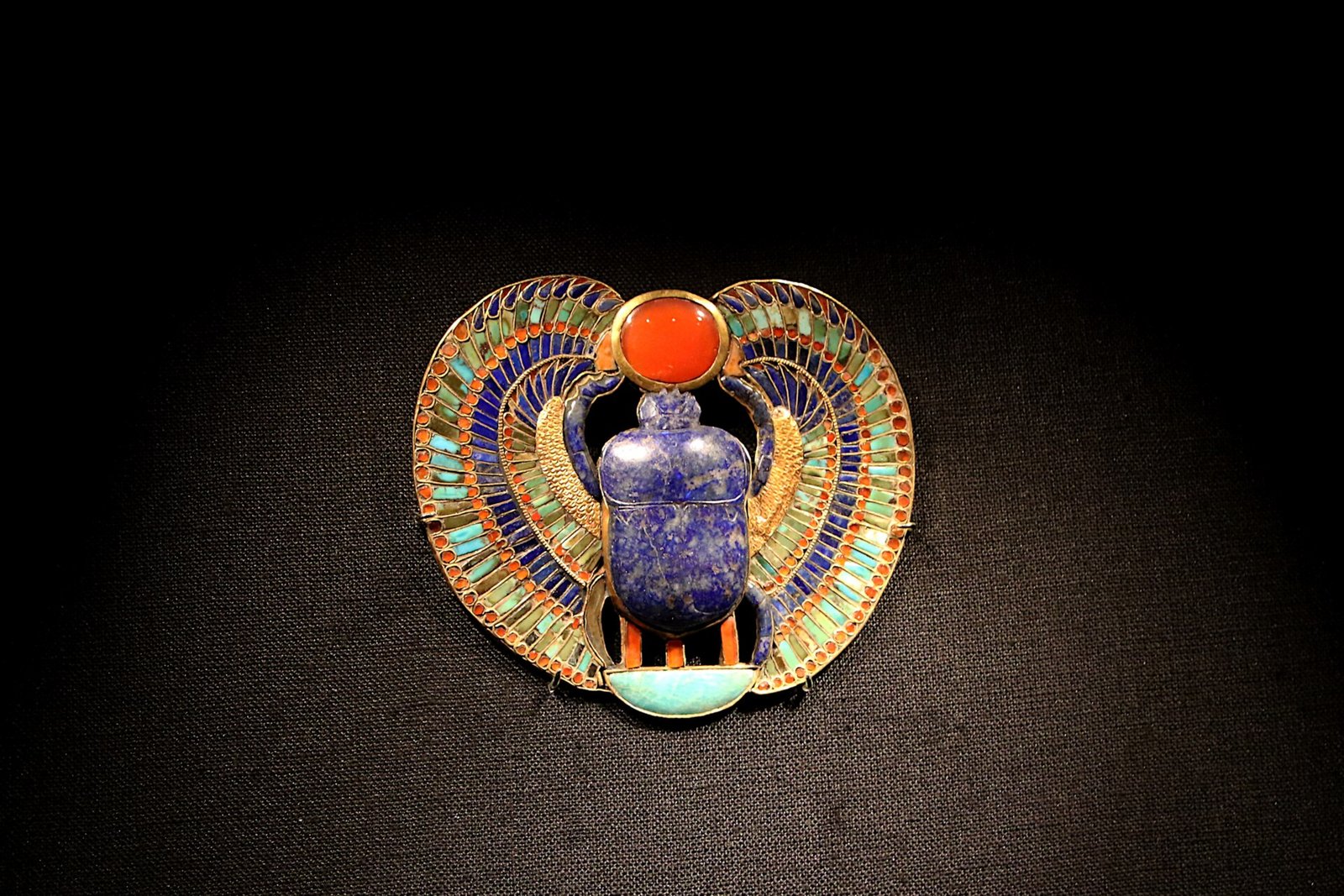
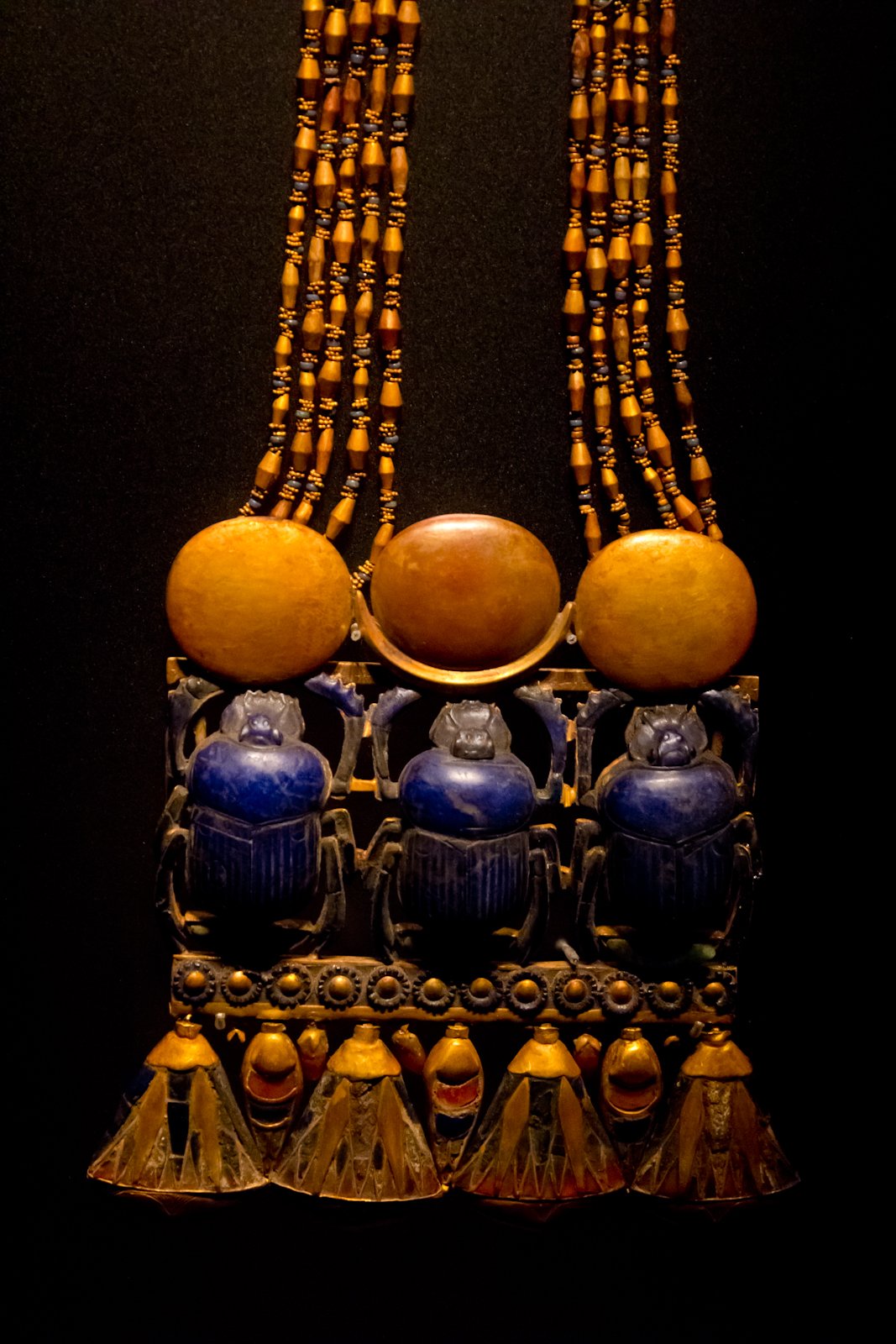
The Grand Egyptian Museum at Giza holds the Tutankhamun collection, including the gold and inlaid pectorals and bracelets from the king's mummy with the wedjat flanked by the vulture and the cobra. The older Egyptian Museum on Tahrir Square keeps the cases of everyday faience amulets and the Middle Kingdom coffins with the painted eye panel. Between the two you see both ends of the social scale.
Luxor
The Luxor Museum is worth an hour for its jewelry and coffin fragments. On the west bank the tombs of the nobles and the workers' tombs at Deir el-Medina show the eye in its original colors, and the Valley of the Kings shows it in the royal texts on the walls.
Between Luxor and Aswan
Edfu is the main event: the largest temple dedicated to Horus and the wall where his fight with Seth is carved. Kom Ombo, shared between the crocodile god Sobek and Horus the Elder, has the famous relief of surgical instruments on its back wall, the natural place to talk about the eye and healing. At Philae, near Aswan, the offering scenes include the presentation of the wedjat. Ask for Edfu in the morning, before the cruise crowds.
Buying one: a real amulet versus a tourist keychain
You cannot buy an ancient wedjat, and you should walk away from anyone who says otherwise. Selling or exporting antiquities is illegal in Egypt, and anything offered as old on a street is either fake or a serious problem at the airport. What you can buy is a well-made modern piece, and there is a real gap between the good ones and the rest.
| Check | Well-made piece | Tourist keychain |
|---|---|---|
| Weight | Sits heavy for its size, solid silver or fired faience | Light, hollow, resin or plated pot metal |
| The spiral | Crisp, clearly separate from the cheek line | Blurred into a blob |
| The back | Finished and smooth, sometimes engraved | Flat, rough, or with a visible mold seam |
| Silver | Stamped 800 or 925 with the Egyptian assay mark | No stamp, or a stamp that rubs off |
| Faience | Glassy glaze, uneven blue, slight weight | Painted plaster, chalky feel, chips at the loop |
| Where it is sold | Silversmith's bench or a Luxor faience workshop | A rack of fifty identical pieces by the temple gate |
Turn it over before you pay. The ancient pieces were finished on the back even though nobody would see it, and good modern makers still do the same. In Cairo the silversmiths of Khan el Khalili will make a wedjat to your size while you drink tea, and on the Luxor west bank a few faience workshops let you watch the paste being molded and glazed. For the wider list, see our guide on what to buy in Egypt.
How Explora Egipto builds the Eye of Horus into your trip
We are a local agency in Egypt with our own Egyptologist guides and vehicles, and because guests ask about the symbols so often, we plan for them.
- Cairo first. The amulet cases at Tahrir and the Tutankhamun galleries at the Grand Egyptian Museum, with the myth explained before you reach the pectorals.
- Edfu properly. On the Nile cruise we walk you along the enclosure wall where Horus harpoons Seth, with time the cruise timetable does not give.
- Kom Ombo and Philae. The surgical relief and the offering scenes, read out loud.
- A real workshop. A silversmith or a west bank faience maker, not the stall with the bus outside, and we stay out of the transaction.
Domestic flights between Cairo and Luxor or Aswan, the cruise cabin, the hotels and every entrance are handled by us. Tell us your dates and we send you the quote.
Frequently asked questions
What does the Eye of Horus mean?
It means wholeness, healing and protection. The Egyptian name, wedjat, translates as the whole one or the sound one, because in the myth the eye of Horus was damaged by Seth and then restored. Egyptians wore it in life against sickness and envy, and placed it in mummy wrappings to keep the dead intact. It also stood for the offering itself, since Horus gave the healed eye to Osiris.
Is the Eye of Horus the left eye or the right eye?
By convention the Eye of Horus is the left eye, associated with the moon, which wanes and is made whole again each month like the wounded eye in the myth. The right eye is the sun, usually called the Eye of Ra. In practice ancient amulets survive facing both ways, often in pairs, and no direction was treated as unlucky.
What is the difference between the Eye of Horus and the Eye of Ra?
The Eye of Horus is a healed wound and stands for protection, health and offering. The Eye of Ra is a goddess, the fierce daughter the sun god sends against his enemies, identified with Sekhmet, Hathor or Wadjet. One guards you by being whole, the other guards the king by attacking. Artists usually showed the Eye of Ra as a cobra or a lioness, not as an eye.
Is the fraction story about the Eye of Horus true?
Partly. Egyptian scribes really used signs for one half, one quarter and down to one sixty-fourth of the grain measure. The claim that those signs are the six pieces of the eye was a modern theory from the early twentieth century, and when the original hieratic documents were reexamined the match did not hold up. The fractions are real, the eye is real, the diagram connecting them is not ancient.
Does the Rx pharmacy symbol come from the Eye of Horus?
No. That is a popular story with no evidence behind it. The Rx on prescriptions is generally traced to the Latin word recipe, meaning take, written as an R with a stroke through the leg. The pairing of a healed eye and a healing symbol sounds right, which is why the claim spreads, but no historical chain links the two.
Where can I buy a real Eye of Horus amulet in Egypt?
A real one today means a well-made modern piece, never an antiquity, which is illegal to sell or export. Go to a silversmith in Khan el Khalili in Cairo for stamped silver made to your size, or to a faience workshop on the Luxor west bank for a fired blue-green pendant. Check the weight, the spiral and the back. Your guide can take you to a workshop instead of a stall.
See the eye on the wall where the story was carved
Tell us your dates and how much time you want for the temples and the museums, and we come back with a plan built around a real Egyptologist, the enclosure wall at Edfu in the quiet of the morning, the Tutankhamun galleries in Cairo, and a workshop where the wedjat you carry home was made properly. Just a quote in your inbox.