Abu Simbel Sun Festival: 22 October and 22 February
Abu Simbel Sun Festival: 22 October and 22 February
Twice a year, at first light, a beam of sun enters the doorway of the great temple of Ramesses II at Abu Simbel, travels roughly 60 meters through the hypostyle hall and the vestibule, and lands on the figures carved into the back wall of the sanctuary. It holds for about 18 to 20 minutes. Then it slides off the stone and that chamber goes back to darkness until the next of the two dates.
That is the Sun Festival, and it is the reason people set an alarm for 3:00 in the morning. The next two occurrences are 22 October 2026 and 22 February 2027.
The dates and the timing
The alignment falls on 22 February and 22 October every year. The two mornings are not evenly spaced: four months separate October from February, and eight months separate February from October. Those are not equinoxes and they are nowhere near them. The equinox alignments people talk about at other Egyptian sites are a separate phenomenon; Abu Simbel is a custom calculation aimed at two particular mornings.
| Date | What tradition links it to | When it happens | How long it lasts |
|---|---|---|---|
| 22 October 2026 | Traditionally associated with the coronation of Ramesses II | At sunrise. Egypt is still on daylight saving time on this date, so the clock reading is later than in February | About 18 to 20 minutes |
| 22 February 2027 | Traditionally associated with his birth | At sunrise, in the region of 06:20 to 06:30 local time | About 18 to 20 minutes |
Two caveats on those times. Sunrise at Abu Simbel drifts by a few minutes from one year to the next, and the October date sits inside Egypt's daylight saving period, which runs until the last Thursday of the month, so the hour you read on a clock in October is later than the February one even though the sun is doing exactly the same thing. Treat the figures as a guide and have the gate opening time confirmed locally the evening before. Anyone quoting you a precise arrival time months ahead is guessing.
The birth and coronation labels deserve the same care. They are the traditional explanation, repeated in almost every guidebook, and they may well be right, but no surviving ancient text ties either date to either event, and sources disagree about which date belongs to which. It is a good story rather than a documented fact.
What happens inside the temple
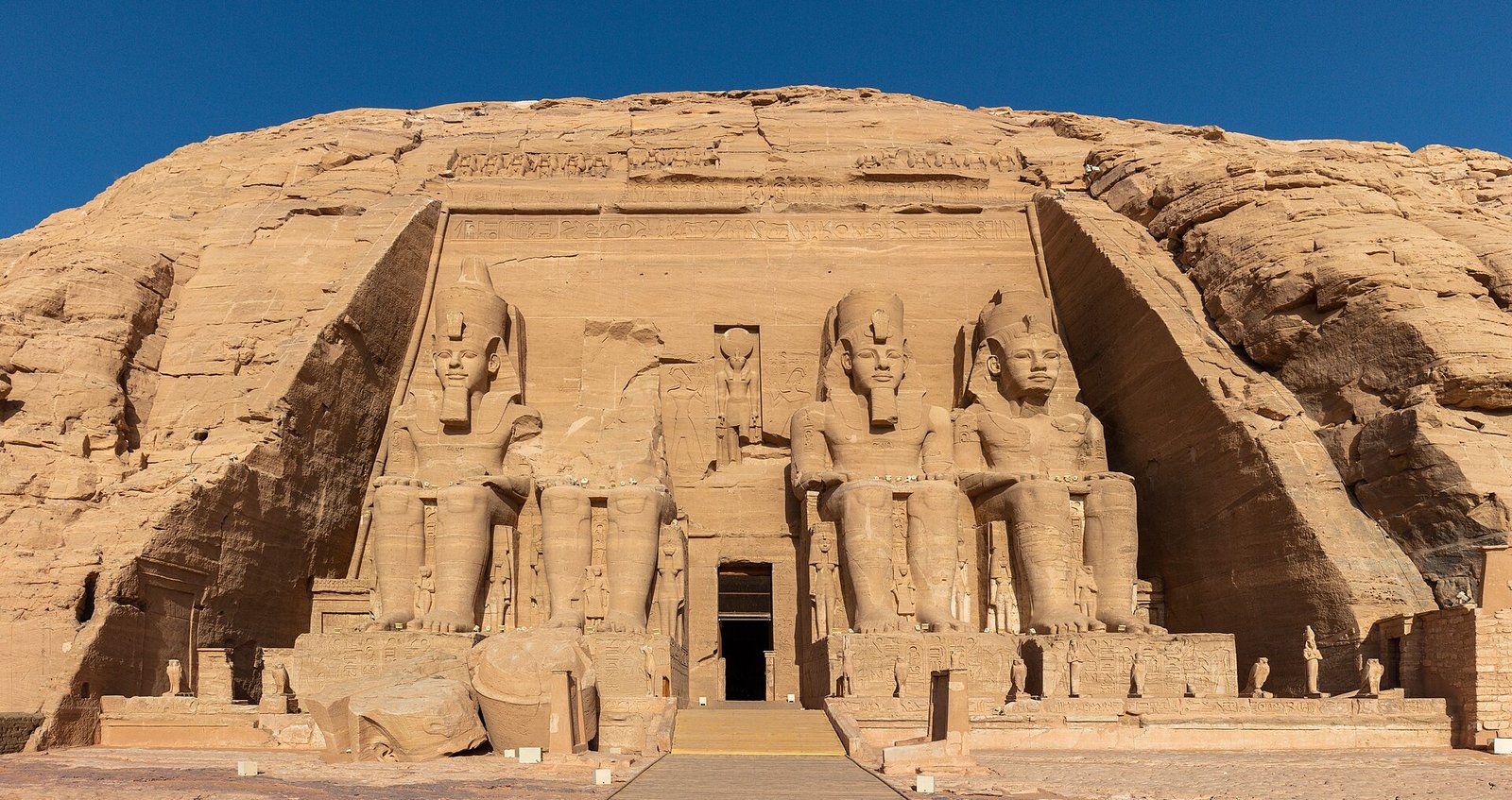
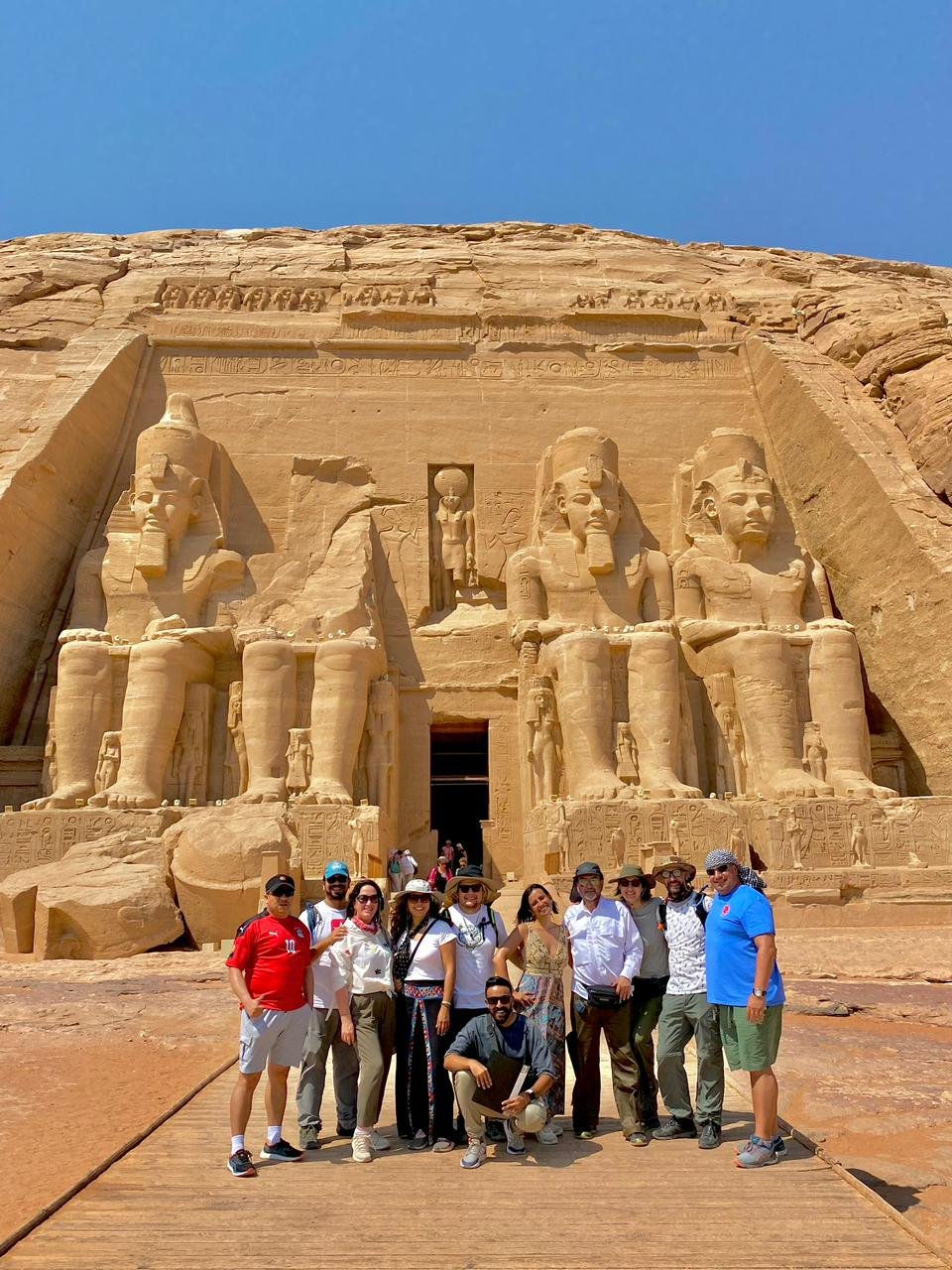
Ramesses II had the great temple cut into the rock of a sandstone hill in the thirteenth century BC. The facade is four seated colossi of the pharaoh, twenty meters tall, facing the water. Almost every photograph stops there, but the facade is not where the engineering is. The achievement is the axis behind it, which runs about 60 meters into the hillside and ends in a small chamber: the sanctuary.
Four seated statues are carved into the sanctuary's back wall. Left to right they are Ptah, the god of Memphis, tied to the underworld; Amun-Ra, king of the gods; Ramesses II himself in divine form; and Ra-Horakhty, the solar god. The iconography stops being confusing once you know what to look for, so a few minutes on recognizing Egyptian gods before you travel pays off in the two minutes you get in front of them.
The statue that stays dark
On the two festival mornings the beam reaches three of those four figures. Ra-Horakhty, Amun-Ra and the deified Ramesses are lit. Ptah is not. He stays in shadow. Ptah's associations are with the underworld and with darkness, which is why the placement is generally read as deliberate rather than accidental. Thirty-three centuries later that is still the detail that stops visitors. Orienting a building to the sun is difficult. Orienting it so that one specific figure in a row of four is excluded, on two chosen mornings and no others, is a different order of problem.
Why the alignment survived being moved
The most improbable thing about the Sun Festival is not that it was designed. It is that it still works, because the temple you walk into today is not standing where it was built.
The rescue operation
In the 1960s the Aswan High Dam was going to create Lake Nasser and put Abu Simbel underneath it. Between 1964 and 1968 UNESCO coordinated an international operation to prevent that. Both temples were cut into more than a thousand large numbered blocks and rebuilt 65 meters higher and roughly 200 meters further inland, inside concrete domes shaped to imitate the original hill.
Moving the stone was the manageable part. Setting it back down at an orientation exact enough that the solar alignment still functioned was not, and it still functions. Every sunrise crowd standing at that doorway today is there because of that piece of work.
You will also read that the move pushed the dates by a day, from 21 February and 21 October to the 22nd of each. It is repeated almost everywhere, and it is disputed: some Egyptologists argue the original dates were never the 21st, and that a shift of a couple of hundred meters cannot move a solar date by a full day. Since you will meet both versions in print, plan around the dates the site works to now, which are 22 February and 22 October.
The temple next door
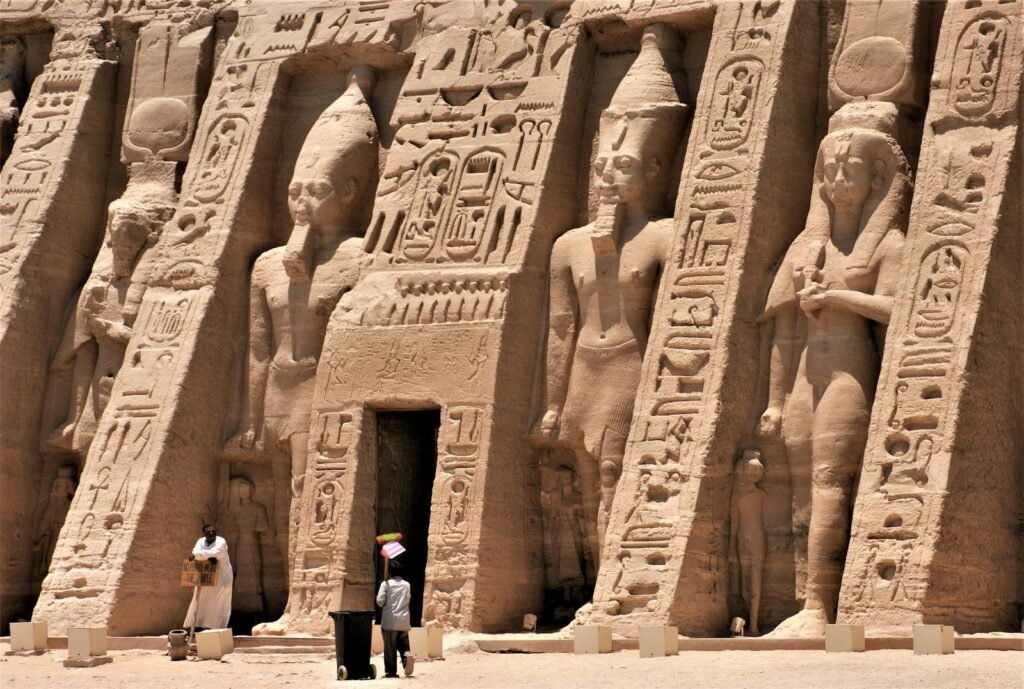
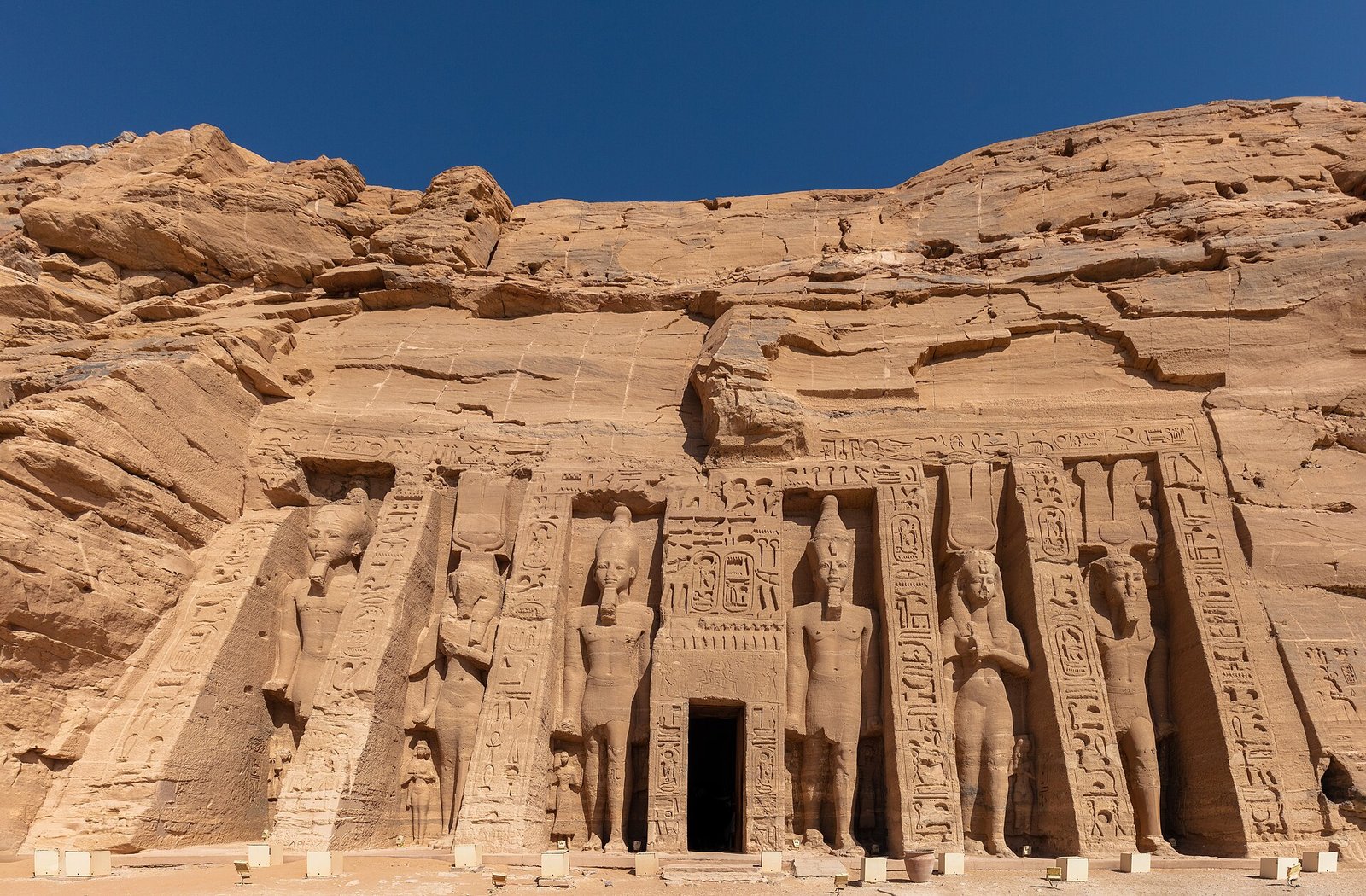
Beside the great temple stands a smaller one that Ramesses dedicated to Nefertari, his principal wife, and to the goddess Hathor. Its facade is one of the very rare cases in Egyptian art where the queen appears at the same scale as the pharaoh. Go into both. Nefertari's temple is usually far quieter, which matters more than usual on a morning when several hundred people are waiting for the same doorway next door.
Getting there for sunrise
Abu Simbel sits about 280 kilometers southwest of Aswan, close to the border with Sudan, reached by a single desert road. Convoy rules on that road have changed over the years, so have the current arrangement confirmed when you book. On a festival morning almost every vehicle leaves inside the same short window in any case, which produces a convoy in everything but name.
The constraint is simple. You have to be inside the temple before the sun clears the horizon, so you either sleep in Abu Simbel or leave Aswan in the middle of the night.
Sleeping in Abu Simbel
The village has only a handful of hotels, all of them minutes from the gate. You wake, walk over, and are inside without a three hour drive behind you. It is the comfortable option for the festival and it is also the first thing to sell out, often months ahead, because the total number of beds is small and every operator in the south wants them for the same two nights.
Leaving Aswan before dawn
The alternative is to stay in Aswan and set off between 3:00 and 4:00 in the morning for three to three and a half hours across the desert. It is the cheaper route, it keeps your hotel base fixed, and it is how most people do it. Aswan is the natural base in any case, since the same city is the starting point for Philae, the High Dam and the other day trips from Aswan. Day excursions in Egypt start from US$120 per person, and on the festival dates capacity is genuinely limited rather than rhetorically limited.
Flying in
Abu Simbel has an airport, and short domestic hops from Aswan run for most of the year. It is a good way to see the temples on an ordinary day and a good way to arrive the afternoon before the festival, but the schedules generally put you on the ground after sunrise, so it does not solve the festival morning by itself. We arrange domestic Egyptian flights inside a program; your international flights stay in your own hands.
Planning this trip yourself takes hours. We build it for you, and we answer every question before you commit to anything.
The morning itself
The most common misunderstanding is that the festival is a ticketed event separate from the temple. It is not. You go in on the standard temple ticket, at an hour when the site is normally closed. Outside the temple there is a crowd, music and in some years dancing or performances before and after the alignment. Inside, the sanctuary is a small room and the queue moves through it briskly. A few things worth knowing before you stand in it:
- The desert is genuinely cold before dawn and hot within a couple of hours of it, so bring a layer you can take off. Our notes on what to pack cover the rest of the year, but this is the morning that catches people out.
- Have the camera ready before you reach the sanctuary door. You get a couple of minutes in front of the statues, not a browsing session, and fumbling with settings costs you the thing you came for.
- Carry water. There is very little shade once the sun is up and the drive back is long.
Building a trip around the date
February and October are two of the best months in Egypt anyway, which is convenient: the festival lands squarely inside the season most people would choose for other reasons. If you are still deciding when to come, the wider picture is in our guide to the best months to travel.
The most common shape of trip is Cairo and the pyramids first, then a domestic flight south, then four or five days sailing between the temples on a Nile cruise that takes in Karnak, Edfu, Kom Ombo and Philae, finishing in Aswan, which is exactly where the road to Abu Simbel begins. Cruises start from US$755 and classic seven to ten day tours from US$1,348. That structure covers the essentials in eight to ten days without sprinting, and if you want to reason it through properly we have written about how long to spend in the country.
One piece of scheduling advice from running this every season: reach Aswan a day or two before the festival rather than the night before. Philae at sunset and a felucca on the Nile are a far better preparation for a 3:00 start than a late arrival and four hours of sleep, and the spare day absorbs a delayed domestic flight without costing you the alignment.
If your dates do not line up
Missing 22 February or 22 October costs you the beam and nothing else. The colossi are still twenty meters tall, the sanctuary is still there, and sunrise over Lake Nasser from the terrace in front of the temples is one of the better hours anyone spends in Egypt. The only difference is that the light stops in the hall instead of reaching the back wall. On an ordinary morning you get a fraction of the crowd and no queue behind you. You go on the festival dates for the engineering.
Planning it with a local team
We are a local agency based in Egypt with licensed Egyptologist guides working in the south of the country every season, which is why we can tell you what time the gate actually opens rather than what a schedule says it should. For the festival dates the hotel beds in Abu Simbel and the early departures from Aswan go first, so the earlier the conversation starts the more choice you have.
Message us on WhatsApp at +201032295513 with your dates and how long you have in Egypt, and we will tell you honestly whether the festival fits your trip or whether an ordinary morning at Abu Simbel serves you better.
Common questions about the Abu Simbel sun festival
What happens at the Abu Simbel sun festival?
When is the Abu Simbel sun festival?
Which statues does the sunlight reach?
How did the alignment survive the temple being moved?
How do you get to Abu Simbel for sunrise?
What if your dates do not line up with the festival?
Let us put the trip together
We are a local agency in Egypt. Tell us your dates and what you want to see, and we will come back with a plan, the practical details sorted and someone to ask when you are here.
Part of our guide to
Destinations and Monuments 6 guides
This article is part of that pillar. The rest of it:
- ▸Abu Simbel: Tickets, Timing and Getting There
- ▸Grand Egyptian Museum: Tickets, Opening Hours and a Complete Visiting Guide for 2026
- ▸Climbing Mount Sinai at Sunrise: the Night Ascent, the Summit and St Catherine's Monastery
- ▸The National Museum of Egyptian Civilization and Its Royal Mummies
- ▸The Sinai Peninsula: Where Egypt Crosses Into Asia
- ▸Valley of the Kings: Tickets, Tombs and How to Visit in 2026
Keep exploring
To finish planning your trip to Egypt
- ▸Egypt Oasis Route: Western Desert Oases Loop from Cairo
- ▸Memphis and Saqqara Day Trip from Cairo: What to See
- ▸Grand Egyptian Museum or Egyptian Museum: Which to Visit
- ▸Minya and Middle Egypt Tour: Amarna and Beni Hasan
- ▸Hurghada or Sharm El Sheikh, which Red Sea resort should you choose
- ▸Valley of the Queens, Luxor: Nefertari Tomb and Tickets
- ▸Time Difference Egypt USA: What Time Is It in Egypt Now
- ▸See all our Egypt tours