Is Cairo Safe? The Real Risks and How to Get Around
Is Cairo Safe? The Real Risks and How to Get Around
Cairo is safe for visitors. Serious crime against travelers is uncommon, there is a heavy tourist police presence at the pyramids, the museums and the main bazaars, and the overwhelming majority of people who come here go home without a single incident. The genuine risks are duller than the ones most people arrive worrying about: the traffic is the one thing in Cairo likely to hurt you, and persistent sellers and small scams are the main irritation.
The short answer
Cairo is safe for visitors. Serious crime against travelers is uncommon, there is a heavy tourist police presence at the pyramids, the museums and the main bazaars, and the overwhelming majority of people who come here go home without a single incident. What Cairo does do is overwhelm you, and first-time visitors often file that feeling under danger. The two are not the same thing.
The genuine risks are duller than the ones most people arrive worrying about. The first is the traffic, which is the only thing in Cairo likely to actually hurt you. The second is not really a risk at all but a tax on your patience: persistent vendors and small scams around Giza and Khan el-Khalili, which grind people down over a day and then get described afterwards as the city feeling unsafe. Deal with those two and Cairo is a place you walk around in daylight with the same ordinary care you would use in any large capital.
The traffic is the real danger
Cars do not reliably stop at crossings, traffic lights are treated as a suggestion in many places, and lane markings are decorative. There are very few regulated crossings on the roads you will actually use, and the standard visitor instinct, waiting at the kerb for a gap, does not work. The road never empties. People stand there for five minutes, then dart across at the worst possible moment, which is exactly the behavior that causes accidents.
How to cross a street in Cairo
Copy the locals, because their method is genuinely the safe one. You walk at a firm, constant pace, you do not run, you do not stop suddenly, you do not step backwards, and you look at the drivers. Cairene drivers are calculating your trajectory and adjusting theirs around you. That system works as long as you are predictable. Unpredictable movement is what gets people hit.
The easiest way to learn it is to cross the first few times glued to a group of Egyptians who are already crossing, using them as a shield. Everybody does this and nobody thinks it is strange. With children, hold hands and walk on the side the cars are coming from, so you are between the child and the traffic. On the big multi-lane avenues, look for the footbridges. They exist on the main axes and they are worth the detour.
Getting around without fighting the traffic
Use ride-hailing apps or cars arranged by your hotel. Both give you a fixed price and a record of the trip, which removes the whole negotiation problem before it starts. If you do take a street taxi, agree the fare out loud before you get in, because most drivers will not run the meter for you.
The metro is cheap and it is the fastest way to cross the center at rush hour, and it has women-only carriages marked on the platform. What it will not do is take you to the pyramids or the Grand Egyptian Museum, both of which still need a car. Road accidents are the realistic reason to have decent travel insurance for Egypt, far more than anything involving crime.
The scams and the sales pressure
The number one complaint from visitors to Cairo is not fear. It is the exhaustion of being approached constantly, mostly at the Giza plateau and inside Khan el-Khalili. None of it is aggressive. It is just relentless, and it is worth knowing the four standard routines before you meet them.
The free gift
Someone presses an object into your hand, a scarf, a small carved figure, a headdress tied on for a photo, and calls it a gift or a welcome present. Money is demanded once you are holding it. Do not accept anything you did not ask for, and keep your hands occupied when somebody is walking towards you holding something out.
The camel or horse ride
At the pyramids you will be pushed hard towards a ride. The price quoted at the start is not the price you end up paying, and the classic version of this is charging you extra to get back down. If you want to do it, agree the route, the duration and the total in writing before you sit on the animal, or book it as part of an organized visit. Otherwise say no and keep walking.
The taxi with no meter
Plenty of drivers will not use the meter, and the fare then gets invented on arrival, usually outside your hotel where you feel obliged to settle it quietly. An app fixes this permanently. If you are hailing off the street, name your price before the doors close.
It is closed today
A friendly stranger tells you the mosque, the museum or the bazaar you are heading for is shut, closed for a holiday, closed for prayers, and offers to take you somewhere better instead. Somewhere better is a relative's shop. Check for yourself at the entrance, every time.
Tipping is not one of these
Small tips, baksheesh, are a normal part of daily life in Egypt and not a scam, which confuses a lot of visitors who have just spent an hour refusing things. Someone who carries a bag, watches a car, points out a good photo angle or opens a gate expects a few notes, and small change in your pocket makes the whole day smoother. Reading up on how tipping works here before you arrive removes most of the awkwardness, because the difficulty is rarely the amount, it is not knowing whether the moment calls for one at all.
The defense against the rest of it is the same in every case: a firm, friendly no, no eye contact prolonged into a conversation you do not want, and prices agreed in advance. Say the no once, repeat it once, then stop responding. Arguing is what extends the encounter.
The parts of Cairo you will actually be in
Cairo is enormous and visitors use a small, well-policed fraction of it. The pyramids are not out in the desert somewhere either, they sit at the edge of the built-up city, which surprises people on the drive out. These are the areas that make up almost any itinerary:
- Giza and the pyramids plateau. Controlled access, police and tourist police throughout, and the heaviest sales pressure in the country. Safe, and tiring.
- Downtown, or Wust el-Balad. The dense modern center around Tahrir and Talaat Harb. Loud, crowded, busy until very late, and normal to walk in.
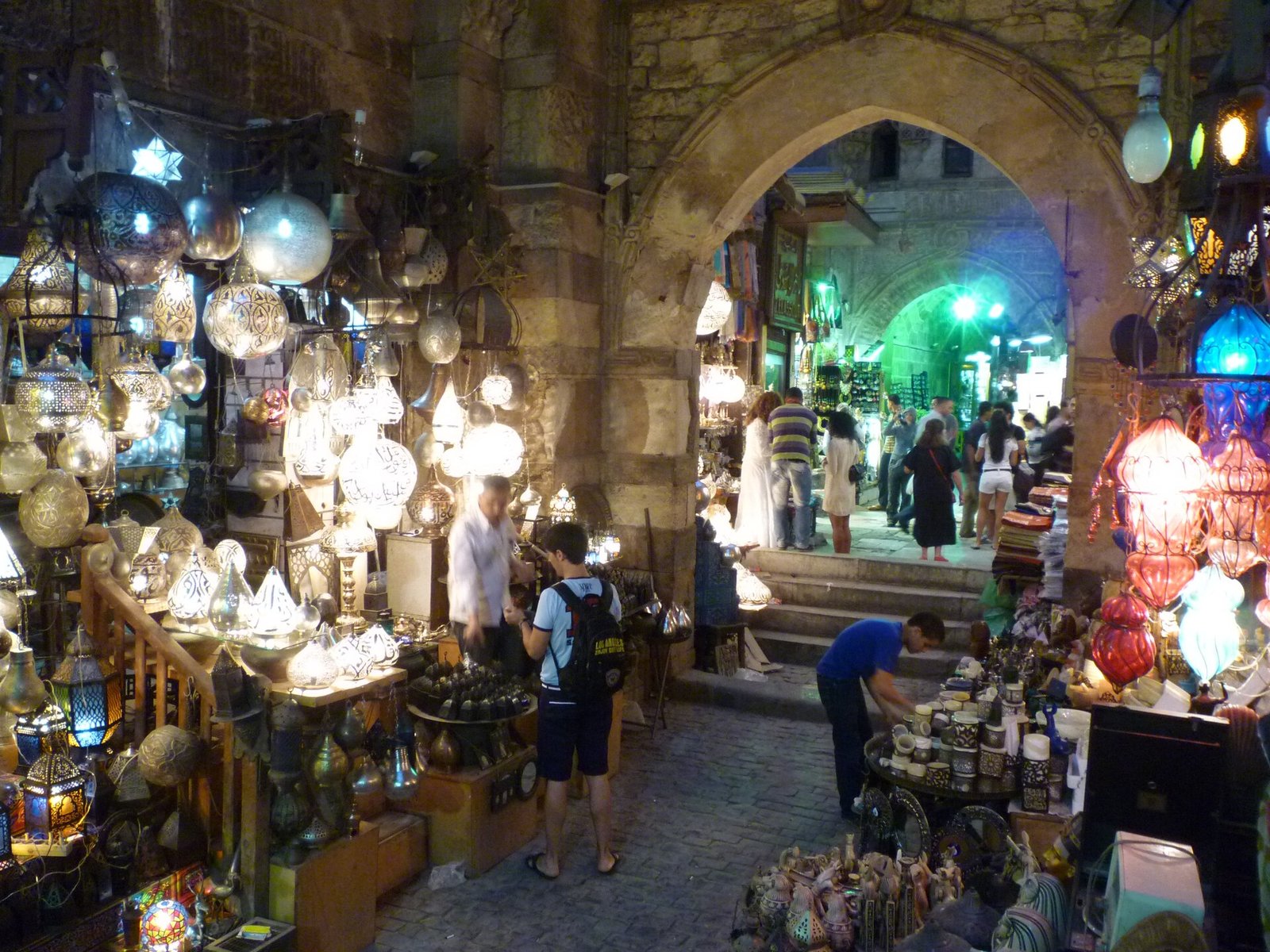
- Khan el-Khalili and Islamic Cairo. The medieval quarter and the main bazaar. Heavily patrolled, and the other place the touts concentrate. Fine on foot by day and popular in the evening.
- Coptic Cairo, around Mar Girgis. A small, quiet, walled and guarded enclave of churches. Probably the calmest hour you will spend in the city.
- Zamalek and Garden City. Leafy central districts holding much of the international hotel stock, the embassies and the restaurants. Comfortable to walk at any hour.
- Maadi, Heliopolis and New Cairo. Residential, green and quiet, and where a lot of longer-stay visitors end up. Far from the sights, so budget for the drive.
The logic underneath that list is simple. Monument zones and museum districts have permanent police presence and access control. Wealthy residential districts are calm and walkable around the clock. The modern center and the commercial streets are dense and noisy with people out late, which functions as passive safety. The peripheral and informal districts on the edges of the city are on no tourist route at all, and there is no reason to go into one without somebody local who knows it. What Cairo does not really have, in the visitor's experience of it, is the violent street crime that worries people in other big capitals. What it has is commercial insistence and traffic.
Cairo after dark
Cairo genuinely functions at night, and that works in your favor. The central and commercial streets stay full until very late, with families out, shops open and cafes at full volume. In summer, social life moves wholesale into the evening because the daytime heat makes anything else unpleasant, which is one reason the shoulder months matter so much when you are deciding when to visit. A crowded street at midnight is a safe street.
The precautions are the ones you would take in any metropolis. Use a ride-hailing app rather than flagging down an unmarked car, keep your phone and your money out of sight in crowds, stay alert in very congested spots where pockets get picked, and do not wander into empty side alleys just to see where they go.
Planning this trip yourself takes hours. We build it for you, and we answer every question before you commit to anything.
Traveling alone as a woman
The honest version is that the problem is attention rather than crime. Staring, comments and the occasional attempt to walk alongside you are common enough that a solo woman should expect them, while physical incidents are rare. The busy central districts and the residential neighborhoods are noticeably more comfortable after dark than quiet secondary streets, and plenty of women switch to cars entirely after a certain hour, which is a sensible call and not an overreaction.
Two practical things help. The first is dressing on the conservative side, covering shoulders and knees, which cuts the attention considerably and is expected inside mosques anyway, so the specifics of what to wear are worth sorting before you pack. The second is the women-only metro carriage, which exists precisely because crowded transport is where harassment happens. Beyond that, a flat no and no further engagement ends nearly every approach.
Terrorism and what the travel advisories mean
This is the risk people ask about most and understand least. Attacks in Egypt have historically been concentrated well away from the standard tourist circuit, and the sites visitors actually use are guarded to a degree that surprises first-timers, with vehicle checks on the approach roads, metal detectors at hotel entrances and bag scanners at the museums. Read your own government's travel advice before you book, because it will name the regions it tells you to stay out of, North Sinai above all, and none of them sit on the Cairo, Luxor and Aswan route. The countrywide wording those advisories use is rarely describing anything that touches a visitor doing the classic itinerary, and it reads better alongside the wider picture of safety in Egypt overall.
What a guide actually changes
The advice to see Cairo with a guide gets repeated constantly and almost always for the wrong reason. It is not about physical protection. It is about friction. Without one, every transfer, every ticket window and every commercial approach becomes a small transaction you have to manage, and it is the accumulation of those over eight hours that produces the hassled, worn-out feeling people later describe as the city being unsafe.
A guide also removes the uncertainty: what is open today, which ticket covers what, which gate you go in by, how long the drive really takes at four in the afternoon. In a city with this traffic, that information converts straight into hours of actual sightseeing. And it gives you somebody who speaks Arabic standing next to you, which settles an awkward moment in about ten seconds instead of twenty minutes.
For one loose day, you can manage perfectly well on your own. For a first visit of several days with several transfers, the difference in comfort is large, and guided days in Cairo with a driver included start from US$120. If Cairo is one stop in a longer trip, it usually makes more sense to fold it into one of the multi-day Egypt itineraries, so the transfers and the domestic flights are handled as a single piece and you are not solving each one at the kerb. We are a local agency based in Egypt, and you can ask us anything on WhatsApp at +201032295513, including the questions where the honest answer is that you do not need us for that part.
What visitors say when they get back
The overwhelming majority of people cross Cairo without any incident whatsoever, and what they report afterwards is not fear. It is intensity. The city is loud, dense and tiring, and that sensation gets routinely mistaken for insecurity. They are different things. Once the traffic is respected rather than feared, the transfers are handled and you have had a couple of days to adjust, Cairo stops overwhelming you and starts fascinating you, and for most people that switch happens somewhere around the second day. If you are still assembling the trip around it, the rest of the practical detail sits in our Egypt travel guide.
Common questions about safety in Cairo
Is Cairo safe for tourists?
What is the biggest danger in Cairo?
Are there many scams in Cairo?
Is Cairo safe at night?
Is it better to visit Cairo with a guide?
Is there a terrorism risk in Cairo?
Let us put the trip together
We are a local agency in Egypt. Tell us your dates and what you want to see, and we will come back with a plan, the practical details sorted and someone to ask when you are here.
Part of our guide to
Practical Guide 11 guides
This article is part of that pillar. The rest of it:
- ▸Arabic Phrases for Travel in Egypt
- ▸Cairo Airport: What Happens When You Land, and How to Leave
- ▸Can You Drink the Water in Egypt?
- ▸Exchanging Money in Egypt: Where to Change Cash and How Much at a Time
- ▸Haggling in Egypt: How to Bargain Without Overpaying
- ▸High Season, Low Season and Shoulder Season in Egypt
- ▸How Much Does a Trip to Egypt Cost? A Real 2026 Breakdown
- ▸Food Prices in Egypt: What Meals Really Cost
- ▸How Much Money to Bring to Egypt: The Cash You Actually Need
- ▸Photography in Egypt: The Rules, the Tickets and the Light
- ▸Internet and SIM Cards in Egypt: A Traveler's Guide to Staying Connected
Keep exploring
To finish planning your trip to Egypt
- ▸Arabic Phrases for Travel in Egypt
- ▸What to Pack for Egypt
- ▸Egypt With Kids: A Practical Guide for Families
- ▸Mistakes to Avoid in Egypt: 15 Travel Mistakes and Fixes
- ▸What Men Should Wear in Egypt
- ▸Egypt Travel Checklist: Passport, Visa, Packing and Timeline
- ▸Real vs Fake Papyrus: How to Tell Real Papyrus in Egypt
- ▸See all our Egypt tours