
Food Prices in Egypt: What Meals Really Cost
Food Prices in Egypt: What Meals Really Cost
Food is the smallest line in an Egypt budget. Street food costs a dollar or two, a main course in a local restaurant runs about five to ten dollars, and a tourist or hotel restaurant can reach fifteen or twenty. On a cruise or a package most meals are already included, so most travelers come home with cash they never got round to spending.
Food is the smallest line in an Egypt budget
Nearly everything else you spend money on in Egypt is decided before you leave. A day excursion starts from US$120, a Nile cruise from US$755, a classic seven to ten day tour from US$1,348, and the international flight you arrange yourself sits on top of all that. Food is the one cost you meet in real time, one meal at a time, and it is small enough that most travelers come home with cash they never got round to spending.
What does vary is the spread. A counter in central Cairo and a terrace facing the pyramids will sell you much the same plate of grilled chicken for wildly different money, and the difference is the address, not the chicken. Knowing which of those rooms you are standing in is the entire skill, and it takes about ten seconds to learn.
What a meal costs, by where you eat it
Three tiers cover almost every meal you will eat in the country.
| Where you eat | Typical order | What you are paying for |
|---|---|---|
| Street counter or cart | Koshary, ful and taameya, shawarma | One dish cooked in volume, eaten standing or carried away, with no table and no service to pay for |
| Local sit-down restaurant | Main course with sides, sometimes a starter | A kitchen running a full menu, waiters, and rent on an ordinary working street |
| Tourist or hotel restaurant | Similar food, better view, full table service | The address itself: the view, the air conditioning, the linen and staff who speak your language |
What the tiers cost on any given day is not something to carry in your head before you arrive. You pay in Egyptian pounds, so the sum in your own currency moves with the exchange rate, and menu prices move with it too. The order of the tiers is the part that is stable and useful: the street counter is a fraction of the local restaurant, the local restaurant is a fraction of the terrace with a view, and all three are inexpensive by the standards of almost anywhere travelers fly in from. Most places post a menu at the door, so read two or three on your first walk through a neighborhood and you will have current numbers of your own, which beats any figure written down months earlier.
Street food, and why it is often the best plate of the day
Egyptian street food is mostly vegetarian, built on pulses and bread, and filling in a way that settles the question of lunch for several hours. It is also the food the country is genuinely proud of.
Koshary
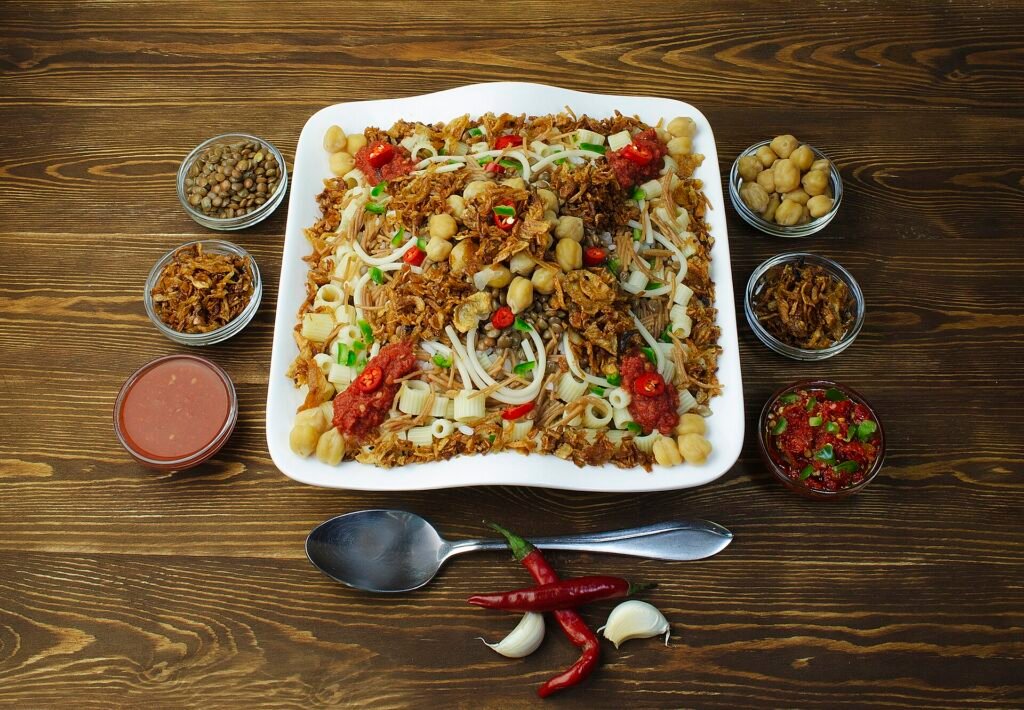
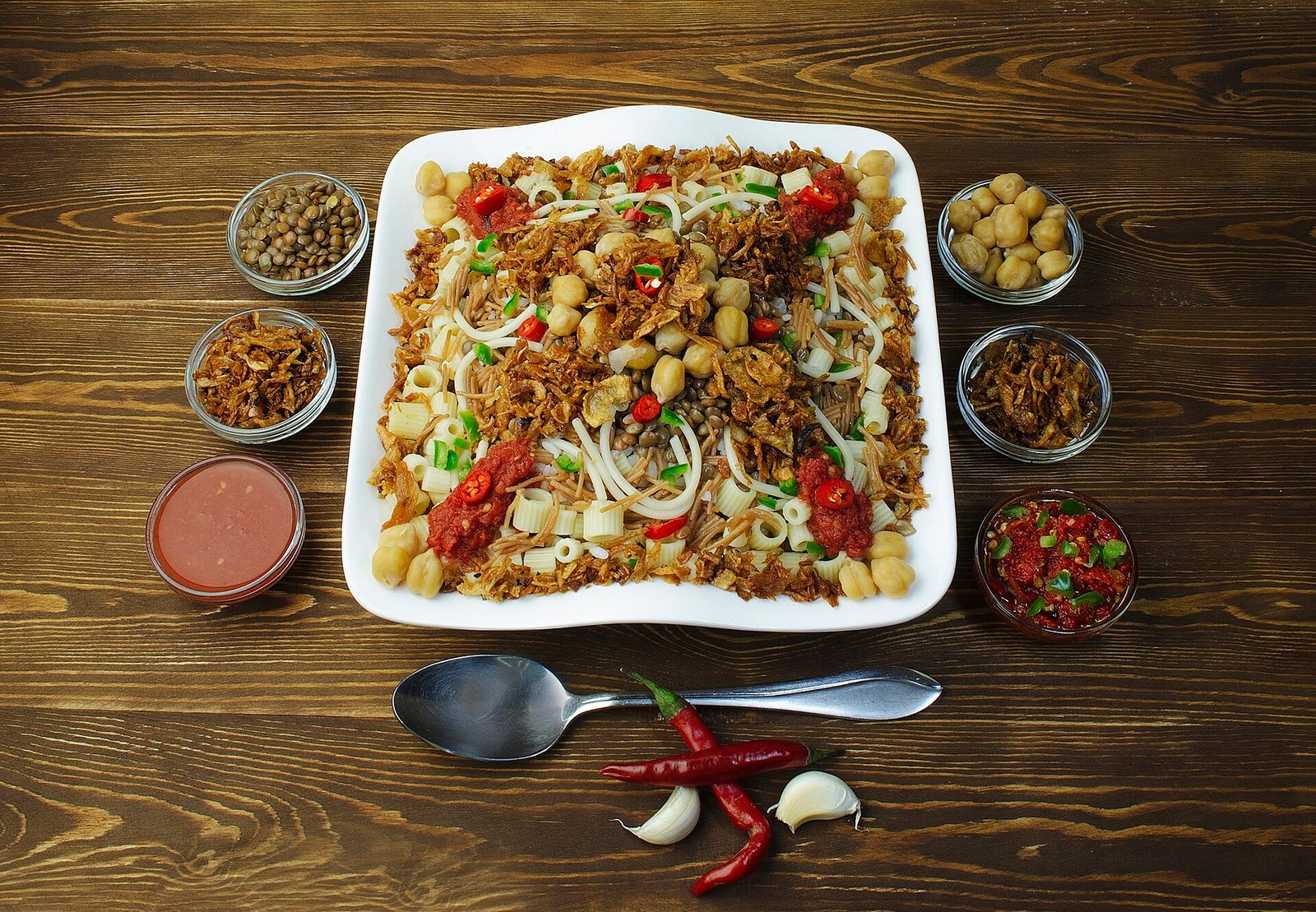
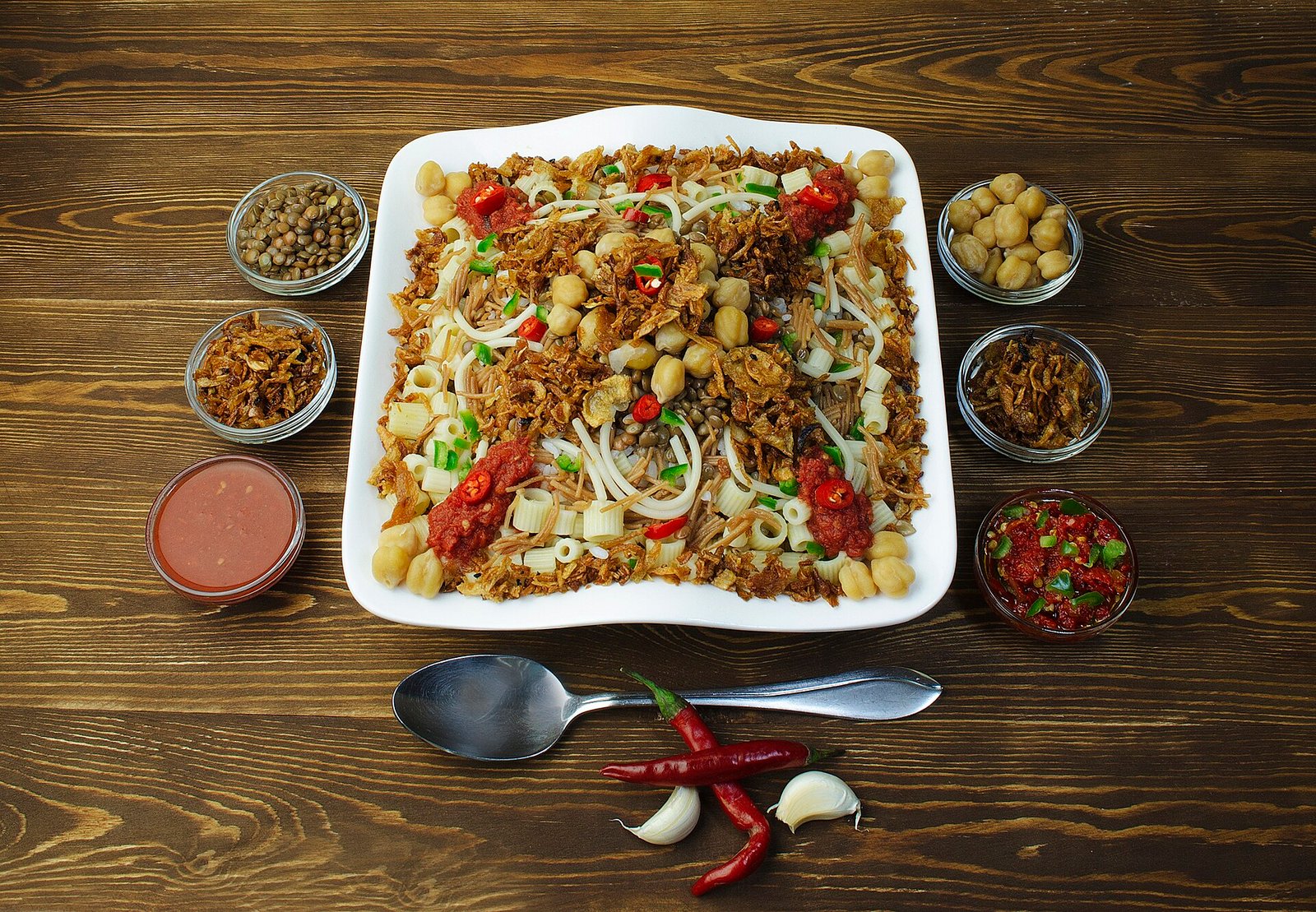
The national dish, and the one to eat first. Rice, short pasta, brown lentils and chickpeas in a bowl, buried under tomato sauce and fried onion, with garlic vinegar and chilli sauce on the table so you can adjust it yourself. The shops that sell it usually sell nothing else, which is why they are good at it. A large bowl is one of the cheapest things you can buy in Egypt, and it defeats most people.
Ful and taameya
Breakfast, and a very good one. Ful is slow-cooked broad beans mashed with oil, lemon and cumin. Taameya is the Egyptian falafel, made from broad beans instead of chickpeas, which leaves it green inside and lighter than the version sold elsewhere. Both go into pita with salad and tahini at street-counter prices, and one sandwich is enough to carry you through a morning of temples.
Shawarma and the charcoal grill
Spiced meat carved off a vertical spit into bread, priced like the rest of the street counter, and the obvious answer when you get back late and the hotel kitchen has closed. Near the shawarma window there is usually a charcoal grill doing kofta and chicken, often sold by weight, which is a step up in price and a considerable step up in dinner.
Local restaurants, where the cooking gets more ambitious
The step up from the street buys a table, a bilingual menu and a kitchen doing more than one thing. This is the tier where tagine appears, the stew cooked and served in its own clay pot, alongside charcoal brochettes, grilled chicken or fish, and molokhia, the green jute-leaf soup Egyptians grow up on and visitors either adopt immediately or never order twice. A main course arrives with rice, bread and small salads, sometimes a starter as well, for what a coffee and a pastry costs at home.
Tourist restaurants, where you pay for the view
In this tier the money stops going into the food. It buys the terrace over the Nile, the table with the pyramids in the frame, air conditioning, linen and staff who speak your language. One or two of those meals belong in any trip, and the sunset ones earn their price. Just be clear about what you are buying, because the same grilled fish costs a fraction of it three streets back.
How to read a place in ten seconds
Three circuits run side by side in every Egyptian city, selling broadly similar food at wildly different prices.
- The street circuit. Small rooms specialising in one or two dishes, a counter you can see into, a menu in Arabic or no menu at all, and constant movement. Cheapest by a distance, and frequently the best food of the trip.
- The local sit-down circuit. Tables, waiters, a menu in Arabic and English, a clientele that is mostly Egyptian. Middle price, far more choice.
- The tourist circuit. Beside the monuments and along the hotel strips, menus in five languages, photographs of every dish, somebody at the door inviting you in. The most expensive, and rarely the best.
The decor tells you nothing, and neither does the language of the menu. The signal that works is who is eating inside. A room full of local people at one in the afternoon is simultaneously the cheapest option and the safest one, because a full room means fast turnover and fresh stock.
On a cruise or a package, most of this is already paid
Here is the part that settles nerves. A Nile cruise runs on full board: breakfast, lunch and dinner on the boat, usually a generous buffet, with nothing to settle at the table. Most tour packages include hotel breakfast throughout and full board for the cruise nights, so for a good stretch of the trip your food spending is close to zero and what remains is entirely discretionary. A drink between meals, tea on a terrace, something sweet from a market stall, one dinner ashore because you wanted a night off the boat.
Read the inclusions properly before you book, because the pattern is consistent.
- Usually included. Hotel breakfast every morning, and full board on the nights you sleep aboard.
- Usually not included. Drinks, including drinks at meals that are otherwise included, which is the surprise that catches most people. Meals on city days, unless the itinerary says so in writing. Anything ordered outside buffet hours.
- Worth confirming. Exactly how many lunches and how many dinners, and whether the cruise board opens with dinner on the day you board or with the following day. One meal either way separates two itineraries that look identical on paper, and it is the sharpest question to ask when comparing cruise boats.
One piece of advice applies even on full board: get off the boat and eat somewhere local at least a couple of times. The buffet is perfectly good, and it is also the same buffet on every boat.
Five things that quietly push a bill up
None of these is a scam. They are ordinary practice, and together they explain the gap between the number you expected and the number printed at the bottom.
- Things you did not order. Bread, salads, pickles and dips land on the table the moment you sit down. In some places they are included, in others they are charged. Asking as they arrive is completely normal and settles it before it matters.
- Bottled water. Brought by default, charged separately, and occasionally arriving as a large bottle nobody specified.
- Service charge and tax. A service charge and a tax on the total are both common, itemised at the foot of the bill. That is why the dishes never add up to the number you pay.
- The tip, which sits on top of the service charge. That charge does not reliably reach the people who served you, so cash still changes hands at the end.
- Drinks. In the tourist circuit the margin on drinks is much higher than on food. Three rounds of soft drinks can quietly outweigh the main courses.
Knowing those five is the difference between a bill that surprises you and a bill you can predict.
Planning this trip yourself takes hours. We build it for you, and we answer every question before you commit to anything.
Drinks, bottled water and alcohol
Tea and Egyptian coffee cost very little anywhere, including on the tourist terraces, and they remain the cheapest way to buy an hour of shade and a chair. Soft drinks and bottled water are cheap in shops and noticeably dearer in restaurants and hotels, so buy water by the pack in a supermarket rather than from the minibar. You will drink far more of it than you expect. Tap water is not drunk in Egypt, and the detail is worth understanding before you arrive, including whether tap water is safe for brushing teeth and for ice. Alcohol is the exception to the cheap rule: it is expensive, heavily taxed and not sold everywhere, so treat a wine list as a bonus rather than an assumption.
Tipping, and why you want small notes
Tipping runs through daily life in Egypt rather than being confined to restaurants, and the individual amounts are small. Leave something for the waiter even when a service charge already appears on the bill. The practical part is currency management: break a large note early, keep a stack of small Egyptian ones somewhere you can reach without opening your wallet in public, and top it up when it runs low. That one habit covers tipping in Egypt across restaurants, drivers, housekeeping and the man who appears to help with your bags. Tips are handed over in Egyptian pounds, and several small notes are worth more to you than one large one.
Eating everything without wrecking your stomach
Street food can be perfectly safe, and the conditions are not complicated.
- Turnover above all. A counter with a constant queue is serving food that came out minutes ago. A quiet place at one in the afternoon has had the same pans sitting since morning.
- Cooked in front of you and served hot. The grill, the oven and the pan working while you wait are the safest thing on the street.
- Go carefully for the first two days with raw food, with salads outside places you trust, and with ice from a street cart, while your system adjusts.
- Fruit you peel yourself is always a good option.
- Check the seal on bottled water before you open it, every time.
Being too strict carries a real cost, because the food is one of the best parts of the country and the vast majority of travelers eat everything without incident. The same measured approach applies to the wider question of how safe Egypt is: caution where it earns its keep, and no more than that.
Ramadan changes the shape of the eating day
If your dates fall during Ramadan, eating works differently for a month. Many local places close through daylight hours and reopen for iftar at sunset, when the streets empty for half an hour and then fill again. Hotels and tourist restaurants serve normally throughout, so nobody goes hungry, but the cheap counter you were counting on may be shut at noon and packed at eight in the evening. An iftar table is a genuine occasion and worth arranging once. The dates shift roughly eleven days earlier each year, so check them against when you travel before you fix an itinerary.
Working out your own daily food budget
Build the figure yourself instead of carrying someone else's. Decide roughly how many meals you expect to take from street counters, how many in local sit-down restaurants and how many on a terrace with a view, then price that mix against the menus you walk past in your first day. The answer holds for the rest of the trip, because the same three circuits run in every Egyptian city and your habits will not change much once you find them. On cruise days and package days the whole line collapses to almost nothing, because the meals are already behind you. Set that against entrance fees at the monuments, which are paid in Egyptian pounds and are usually the larger of your two daily costs on the ground, and food stops being something worth planning around at all.
If you would rather take the question off the table completely, full board on the boat plus breakfast in the hotels does most of the work, and the rest becomes pocket money. We build the ground program from inside Egypt, including the domestic hop between Cairo and Luxor, while you arrange your own international flight. Message us on WhatsApp at +201032295513 and we will tell you exactly which meals your itinerary already covers.
Common questions about food costs in Egypt
How much does it cost to eat in Egypt per day?
How much does a meal cost in Egypt?
Are meals included on a Nile cruise?
Is street food safe in Egypt?
Which Egyptian dishes should you try?
Do you tip in restaurants in Egypt?
Let us put the trip together
We are a local agency in Egypt. Tell us your dates and what you want to see, and we will come back with a plan, the practical details sorted and someone to ask when you are here.
Part of our guide to
Practical Guide 11 guides
This article is part of that pillar. The rest of it:
- ▸Arabic Phrases for Travel in Egypt
- ▸Cairo Airport: What Happens When You Land, and How to Leave
- ▸Can You Drink the Water in Egypt?
- ▸Exchanging Money in Egypt: Where to Change Cash and How Much at a Time
- ▸Haggling in Egypt: How to Bargain Without Overpaying
- ▸High Season, Low Season and Shoulder Season in Egypt
- ▸How Much Does a Trip to Egypt Cost? A Real 2026 Breakdown
- ▸How Much Money to Bring to Egypt: The Cash You Actually Need
- ▸Is Cairo Safe? The Real Risks and How to Get Around
- ▸Photography in Egypt: The Rules, the Tickets and the Light
- ▸Internet and SIM Cards in Egypt: A Traveler's Guide to Staying Connected
Keep exploring
To finish planning your trip to Egypt
- ▸Is Cairo Safe? The Real Risks and How to Get Around
- ▸Domestic Flights in Egypt: Routes, Times and How to Book
- ▸What to Buy in Egypt: Best Souvenirs and What to Avoid
- ▸Accessible Egypt: Wheelchair Travel Guide by a Local Agency
- ▸Uber and Careem in Cairo: How Ride Apps Really Work
- ▸Exchanging Money in Egypt: Where to Change Cash and How Much at a Time
- ▸Real vs Fake Papyrus: How to Tell Real Papyrus in Egypt
- ▸See all our Egypt tours