The Citadel of Saladin in Cairo is where Egypt was ruled from for 700 years, and the view still explains why
The Citadel of Saladin in Cairo is where Egypt was ruled from for 700 years, and the view still explains why
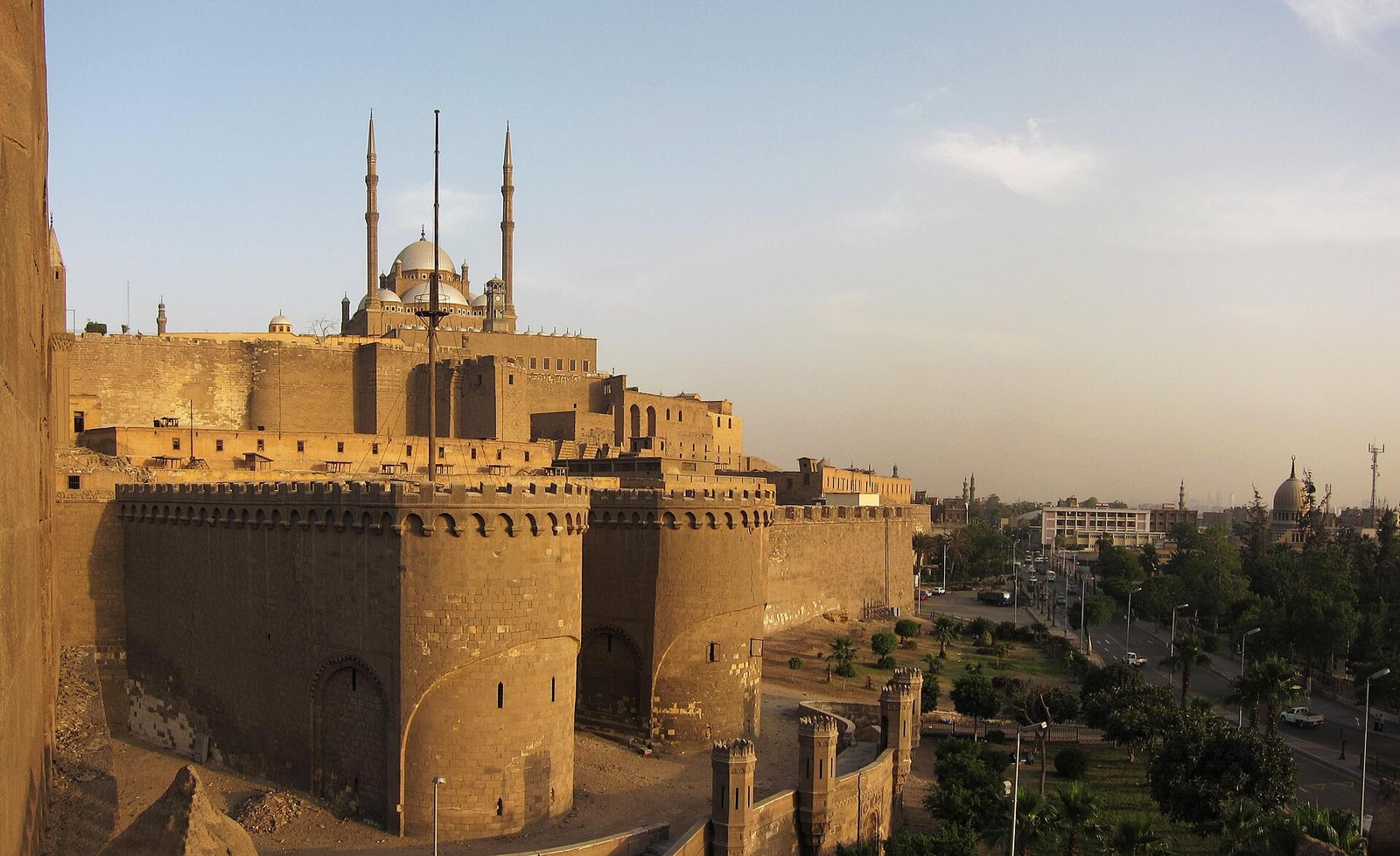
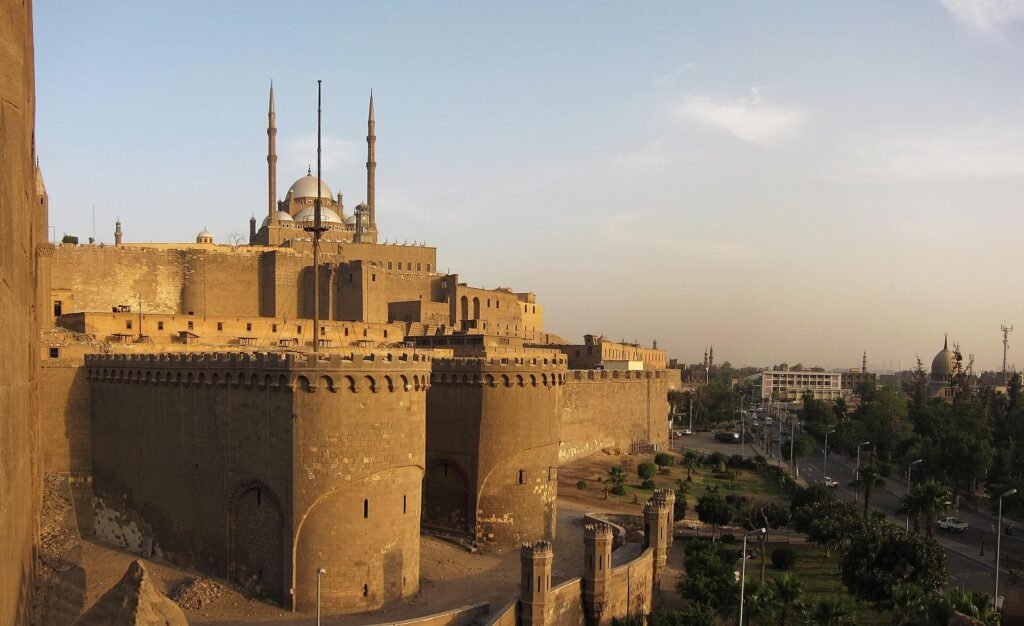
The Citadel of Saladin, or simply the Cairo Citadel, is the walled fortress on a spur of the Mokattam hills on the east side of the city. Saladin started it in the twelfth century to hold off the Crusaders, and every ruler of Egypt governed from inside its walls until the 1870s. What you see today is mostly later: the Ottoman-style Mosque of Muhammad Ali with its alabaster walls and twin pencil minarets, the Mamluk mosque of Al Nasir Muhammad, the Gawhara Palace and a few museums. The terrace looks over every minaret in Islamic Cairo and, on a clear day, to the pyramids. Plan two hours, cover shoulders and knees, and pair it with the giant mosques directly below.
What the Citadel of Saladin is, and why it sits where it does
Stand on the terrace and the logic of the site is obvious. The Citadel occupies a rocky shoulder of the Mokattam hills, high enough to watch every approach to the city and far enough from the river that a besieging army could not cut it off. Saladin, the Kurdish general who ended the Fatimid caliphate and spent the rest of his life fighting the Crusaders, ordered the fortress in the 1170s. He never lived in it. His nephew Al Kamil finished the walls and moved the court up the hill, and from then on the Citadel was Egypt.
The Ayyubids ruled from here, then the Mamluk sultans, then the Ottoman governors, then Muhammad Ali and his dynasty, until Khedive Ismail built Abdeen Palace downtown in the 1870s. Seven hundred years of rulers means seven hundred years of demolition and rebuilding, which is why almost nothing you walk through today is Saladin's own work. From his period you get stretches of outer wall, a few towers and the well cut into the rock; the rest is Mamluk, Ottoman and nineteenth century.
Anyone expecting a Crusader castle with a keep will be looking for the wrong thing. What you get instead is an open-air lesson in seven centuries of Islamic architecture on one hill, split into a northern military enclosure with the towers and museums and a southern residential one with the great mosque and the palace, and listed as World Heritage with the medieval city below.
The Mosque of Muhammad Ali, the alabaster mosque on the skyline
The building that defines the Cairo skyline is the newest important thing inside the walls. Muhammad Ali Pasha, the Albanian officer who seized Egypt in the early 1800s and founded the dynasty that lasted until 1952, began his mosque in 1830 on the site of the Mamluk palaces he had leveled. It was finished after his death, and his tomb sits behind a bronze grille to the right as you walk in.
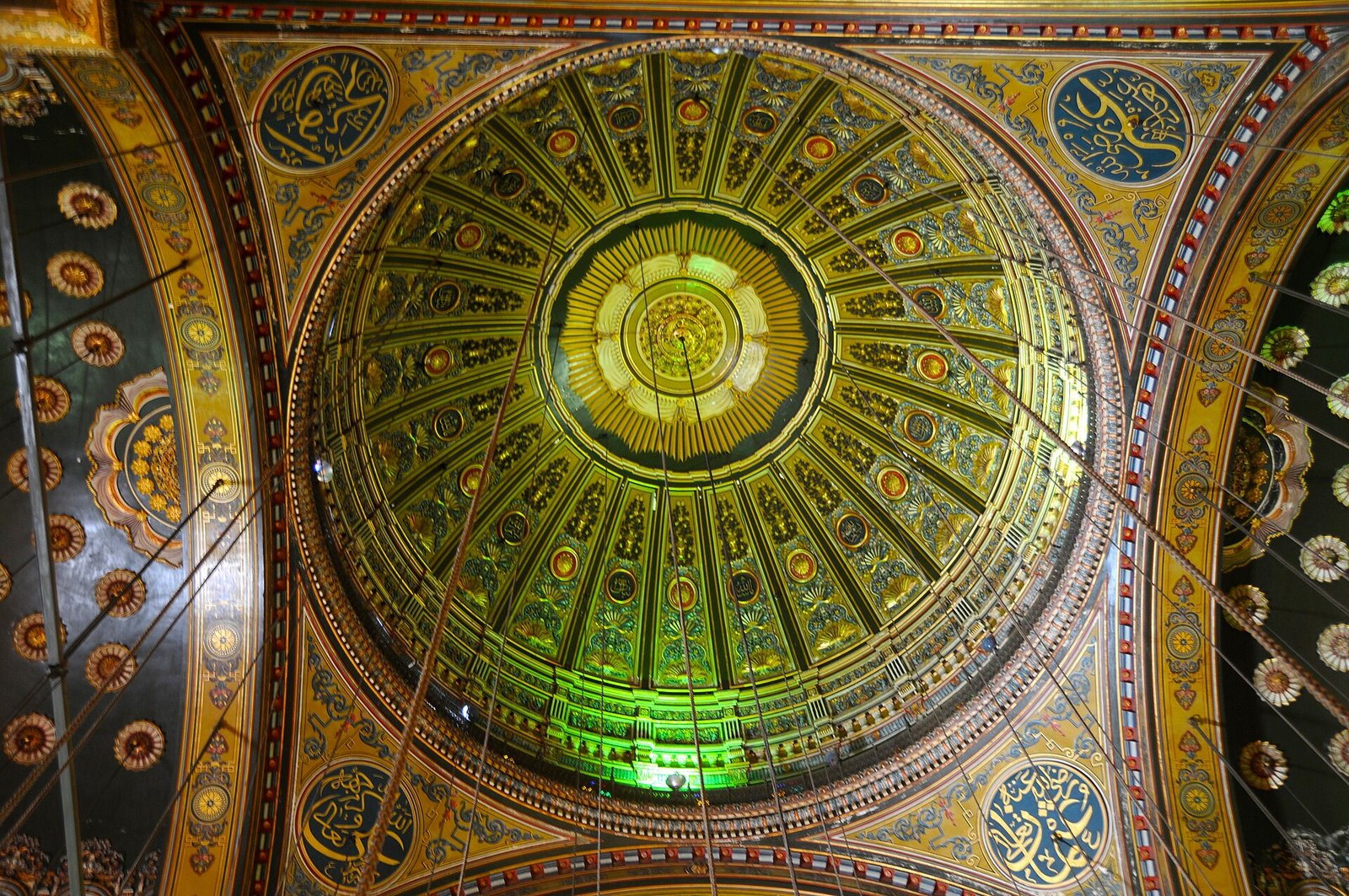
The design is deliberately not Egyptian. Muhammad Ali wanted a mosque that looked like the imperial mosques of Istanbul, so his architect copied the Ottoman formula: one big central dome, four half domes around it, and two pencil-thin minarets rising well above eighty meters. The courtyard and lower walls are faced with alabaster quarried near Beni Suef, hence the nickname Alabaster Mosque. Inside, the scale hits you first: a painted and gilded dome, a huge ring of glass lamps with a French crystal chandelier in the middle, and two pulpits, the original gilded wooden minbar and a smaller alabaster one added later.
In the courtyard, opposite the ablution fountain, stands an iron clock tower that looks like it wandered in from a French railway station. In a sense it did. King Louis Philippe sent the clock in the mid 1840s as a thank-you for the obelisk Muhammad Ali had given France, the one from Luxor Temple that now stands in the Place de la Concorde. The clock arrived damaged and has mostly not worked since. Every guide delivers the same line: France got three thousand years of granite and Egypt got a broken clock.
One honest note: this is a nineteenth-century building in nineteenth-century taste, grand rather than refined. Medieval Islamic art, carved stone and complex geometry live in the mosques down in the city and in the Museum of Islamic Art. Come here for the setting, the scale and the view.
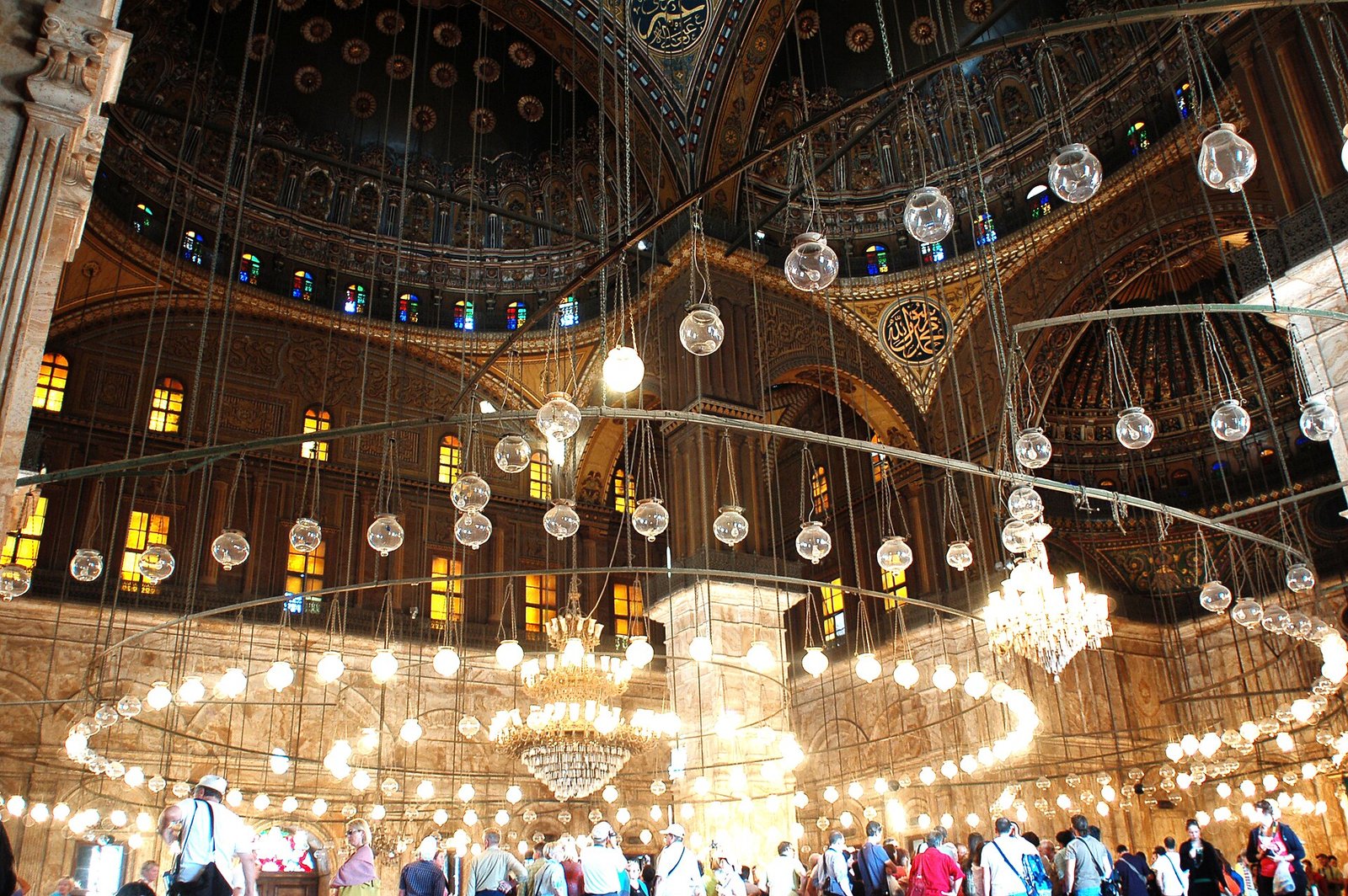
The Mosque of Al Nasir Muhammad, the older and better building
Walk out of the big mosque, cross the open ground, and the plainer building with the two odd minarets is the one architects come to see. Sultan Al Nasir Muhammad built it in 1318 and enlarged it in 1335 as the official mosque of the Citadel. It is the only Mamluk building left inside the walls, because Muhammad Ali cleared the rest.
Two things make it special. First, the minarets: their upper sections are covered in green glazed tiles in a Persian manner, almost certainly by craftsmen from Tabriz, and you will not see that anywhere else in Cairo. Second, the courtyard, whose columns were salvaged from older buildings all over Egypt. Look at the capitals: some are Roman, some Byzantine, and a few are pharaonic, with papyrus forms still visible under the Islamic arches.
The Ottomans stripped the marble panels and shipped them to Istanbul, so the walls are bare stone, which lets you see the proportions. See this mosque first and the Muhammad Ali mosque second and the visit becomes a comparison you can feel in ten minutes, Mamluk Cairo on one side and imperial Istanbul on the other.
The Gawhara Palace and the museums inside the walls
Beyond the mosques there is a scatter of palaces and museums. None takes more than half an hour, and which ones are open changes with restoration work, so treat this as a menu.
| Site | What it is | Worth it if |
|---|---|---|
| Gawhara Palace | Muhammad Ali's audience palace of 1814, with a throne room, painted ceilings and period furniture | You want to see how the Pasha received ambassadors |
| National Military Museum | In the Harem Palace, the old family residence; uniforms, weapons and dioramas | Someone loves military history, or you want air conditioning |
| Police Museum | On the site of the old prison; the terrace beside it is one of the best viewpoints | You are heading to the terrace anyway |
| Joseph's Well | Saladin's well, cut nearly ninety meters through rock | It happens to be open, which is rare |
The well deserves a word even if you cannot go down. A fortress on a rock has one weakness, water, and Saladin's engineers solved it by boring to the water table, with a spiral ramp for the oxen. That is why the Citadel could survive a siege without the Nile. With three days in Cairo the palace and one museum fit nicely; on a one-day visit, skip them for the terrace and the mosques below.
The terrace view over Cairo, and how to read it
The terrace on the western edge is one of the great city views of the world, and most people take one photo and leave. Give it ten minutes and a little method.
Directly below you, two enormous mosques stand almost wall to wall. The one on the left with the massive plain walls is Sultan Hassan, the masterpiece of Mamluk Cairo, finished in the 1360s. The one on the right with the more decorated facade is Al Rifai, a nineteenth-century royal mausoleum where the last king of Egypt and the last Shah of Iran are buried. Beyond them the medieval city spreads out in a sea of minarets; the spiral one to the right belongs to Ibn Tulun, the oldest mosque in the city.
Then look for the pyramids. On a clear day they sit on the southwestern horizon, small gray triangles above the haze line, and seeing them from a medieval fortress fifteen miles away is a moment. The key word is clear: dust and traffic haze hide them most days, and it depends on the air, not the hour. Behind you is the Mokattam ridge, the quarry that supplied stone for the city and, long before that, the white casing of the pyramids you are trying to spot.
The Citadel is a fixed stop on our Cairo excursions, and on a clear day we build the morning around this terrace.
The Massacre of the Mamluks, told where it happened
No visit is complete without the story of the morning in March 1811 that ended five and a half centuries of Mamluk power, and it happened in the narrow lane leading down to the Bab al Azab gate on the western wall.
The Mamluks were a military caste of former slave soldiers who had ruled Egypt as sultans and then, under the Ottomans, as a thorn in every governor's side. Muhammad Ali invited every Mamluk bey to the Citadel for a ceremony marking his son's departure on a campaign to Arabia. Several hundred came in full dress, on horseback. When the procession left, they were led down the walled passage to Bab al Azab. The gate at the bottom was shut behind the last rider, troops on the walls opened fire, and the Mamluks, trapped in a lane too narrow to turn a horse, were killed almost to a man.
Tradition holds that one bey escaped by jumping his horse over the wall, a story every Cairene knows and every historian doubts. The lane is still there, and so is the gate with its twin round towers. When a guide walks you down it, the geometry does the storytelling. With the beys gone, Muhammad Ali had no rivals, and the mosque on the hill was his victory monument.
How long to plan, and the best time of day
Ninety minutes covers both mosques and the terrace at a relaxed pace. Two hours lets you add the Gawhara Palace or one museum and the walk down toward Bab al Azab. Three hours means you went into the military museum; there is no reason to stay longer.
- First thing in the morning. The air is clearest, so this is your best shot at the pyramids, and the mosque is quiet. The trade-off is flat light.
- Late afternoon. The stone turns gold, the heat drops and the city below starts lighting its minarets. Haze is usually thicker. Photographers pick this one.
- Midday in summer. Avoid it. The courtyard has no shade and the paving reflects heat; readings above 95 F (35 C) on the stone are normal from June to September.
Fridays around the noon prayer are busy and the prayer hall may close to visitors for a stretch. Confirm current opening times before you go, since they shift with the seasons and with Ramadan. Inside the walls there are slopes, steps and uneven cobbles, so wear closed shoes and bring a hat and water. If mobility is a concern, tell us; the terrace and the main mosque are close to the vehicle drop.
Dress code and mosque etiquette
Both mosques are consecrated and one is in daily use, so the rules are those of any mosque in Egypt. They are not complicated.
- Cover shoulders and knees, men and women alike. Long pants or a skirt below the knee and a shirt with sleeves.
- Women cover their hair inside the prayer hall. Bring a light scarf; attendants usually have loaner wraps, but your own is cleaner and quicker.
- Shoes off at the mosque entrance. There are racks, or carry them in a bag. Socks help on the hot marble in summer and the cold marble in winter.
- Keep your voice down and never walk in front of anyone praying.
- Photos are allowed without flash and without pointing the lens at worshippers. Drones are not permitted anywhere in the Citadel.
For what works in Egypt's heat and in its mosques, see our guide on what to wear in Egypt. The short version is loose, light, long, and a scarf in the bag.
Combining the Citadel with Sultan Hassan, Al Rifai and Islamic Cairo
Sultan Hassan and Al Rifai, directly below
Five minutes by car from the Citadel gate, these two mosques face each other across a narrow street and are visited together. Sultan Hassan is the one to spend time in: a fourteenth-century mosque and madrasa on a scale that still stuns, with a courtyard the size of a plaza and a vaulted hall for each of the four schools of law. Al Rifai is the royal mausoleum, worth twenty minutes. Citadel first, then these two, means you look down on them and then walk inside them.
Al Muizz street and Khan el Khalili
The classic afternoon. The walk along Al Muizz street through Islamic Cairo passes the finest Mamluk facades in the city and ends at the Khan el Khalili bazaar. Citadel in the morning, Sultan Hassan on the way down, lunch near Al Azhar, then Al Muizz until sunset. That is the full Islamic Cairo day and one of the best days in Egypt.
Coptic Cairo, if you want both faiths in one day
Some travelers pair the Citadel with the churches and synagogue of Coptic Cairo, a short drive south. It works, but it crowds out Al Muizz. With one day in Cairo and the pyramids also on the list, Citadel plus Sultan Hassan plus the bazaar is the realistic combination.
What a guide adds, and how Explora Egipto slots it in
Here a guide changes the experience rather than just easing it. Without one, you see a big mosque, a plain mosque and a view. With one, you see seven centuries of rulers, the trap at Bab al Azab, the pharaonic columns in the Mamluk courtyard, and why Muhammad Ali built Istanbul on a hill in Cairo. Signage is thin.
Explora Egipto is a local agency in Cairo with its own licensed guides and vehicles. For the Citadel that means:
- A private, air-conditioned vehicle with a driver who knows which gate is open that day, saving a long walk around the walls.
- A licensed guide who knows the Islamic period, not a pharaonic specialist reading from a card.
- Entrance tickets handled in advance.
- The route ordered for the light and the air.
In our Egypt tour packages the Citadel is built into the Islamic Cairo day of every Cairo itinerary, usually with Sultan Hassan and Al Muizz street, and it can be added to any custom program. Tell us your dates and we send you the quote.
Frequently asked questions
Is the Citadel of Saladin worth visiting?
Yes, and for most first-time visitors it is the best single introduction to Islamic Cairo. You get the city's most famous mosque, its only surviving Mamluk mosque inside the walls, a medieval fortress and the finest panoramic view in Cairo, all in about two hours, and the natural start of a day that runs down to Sultan Hassan and Al Muizz street.
Can you see the pyramids from the Citadel?
On a clear day, yes. From the terrace on the western edge they appear as small triangles on the southwestern horizon, above the haze line. Clear days are the exception because of dust and traffic, and it depends on the air rather than the hour. Winter mornings after a windy night give the best odds.
Why is it called the Alabaster Mosque?
The Mosque of Muhammad Ali is faced with alabaster, a translucent, creamy stone quarried near Beni Suef in Middle Egypt. It covers the courtyard and the lower walls, and in low light it takes on a warm glow. Many drivers only know the mosque by that nickname, so use either name when asking directions.
Can non-Muslims and tourists enter the Mosque of Muhammad Ali?
Yes. Both mosques are open to visitors of any faith. You remove your shoes, cover shoulders and knees, women cover their hair inside the prayer hall, and you avoid walking in front of anyone praying. Access may pause around the Friday noon prayer, so plan the visit for another slot.
How long does a visit to the Cairo Citadel take?
Ninety minutes for the two main mosques and the terrace, two hours if you add the Gawhara Palace or one museum, up to three with the National Military Museum. Add two to three hours if you continue to Sultan Hassan and Al Rifai below and then Al Muizz street, the full Islamic Cairo day.
What happened at the Massacre of the Mamluks?
In March 1811 Muhammad Ali invited the Mamluk beys to a ceremony at the Citadel, then had them trapped in the narrow lane down to Bab al Azab gate and shot from the walls. Several hundred died and Mamluk power in Egypt ended that morning. The lane and the gate survive, and a guide can walk you along the exact route.
See Cairo from the rock the sultans chose
Tell us your dates, how many days you have in Cairo and what else is on your list. We build the Islamic Cairo day around the Citadel, with a private guide, our own vehicle and the terrace timed for clear air, and send you the quote.