The Alabaster Mosque in Cairo is the Mosque of Muhammad Ali, and here is how to see it properly
The Alabaster Mosque in Cairo is the Mosque of Muhammad Ali, and here is how to see it properly
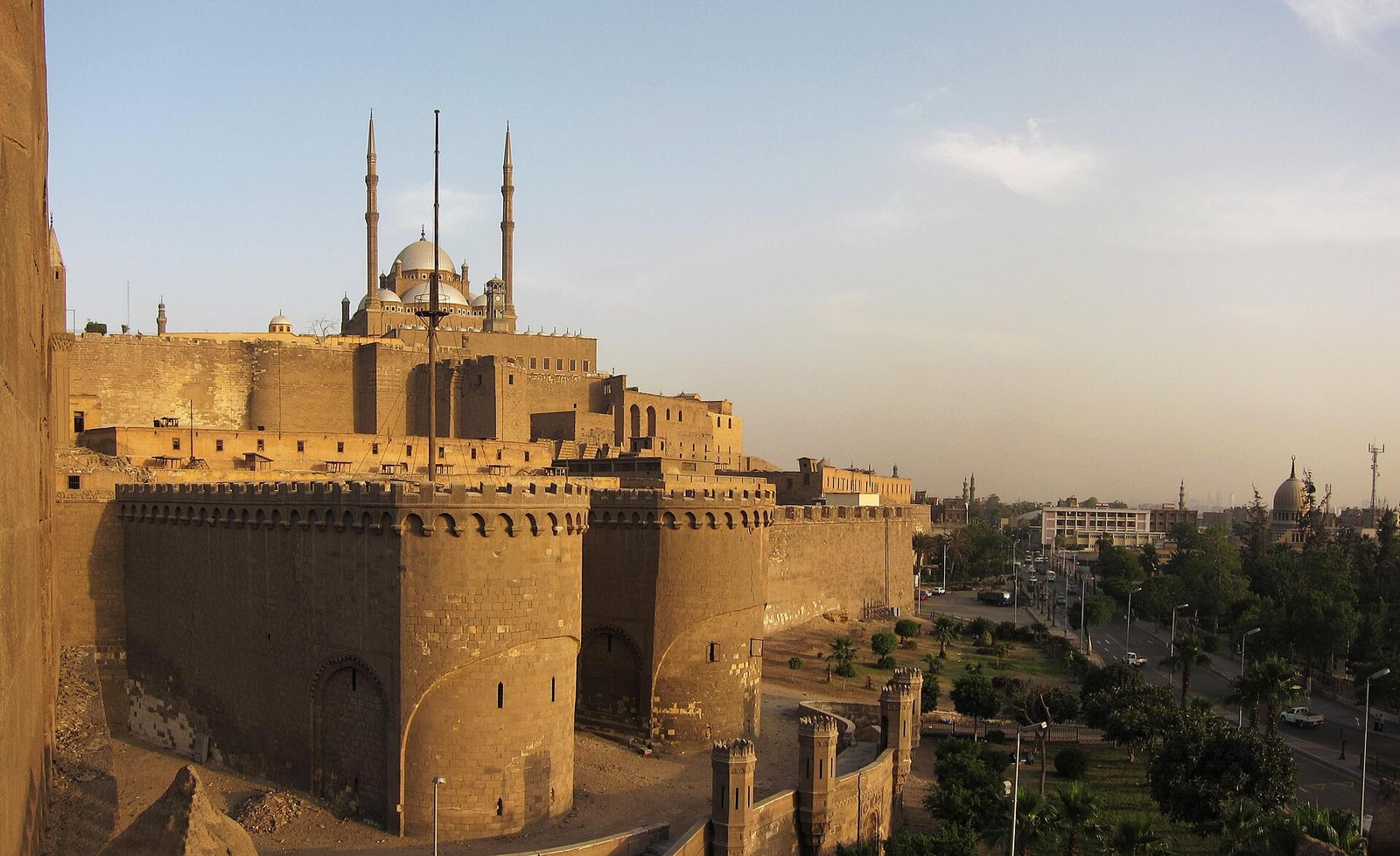
The Alabaster Mosque is the Mosque of Muhammad Ali, the great domed building with two needle-thin minarets on top of the Citadel of Saladin that appears in every photo of the Cairo skyline. Muhammad Ali Pasha built it between 1830 and 1848 on the model of the imperial mosques of Istanbul, so it looks like nothing else in the city. Its lower walls are faced with translucent Egyptian alabaster, the courtyard holds a clock that France sent in return for the Luxor obelisk, and the founder is buried inside by the door. You see it as part of the Citadel visit, shoes off, shoulders and knees covered, with the best view in Cairo on the terrace outside.
What the Alabaster Mosque is and why it owns the skyline
Cairo has hundreds of historic mosques, and the one every visitor recognizes was built last. The Mosque of Muhammad Ali stands on the highest ground of the Citadel, the fortified spur of the Mokattam hills from which the medieval sultans watched the city. Because it sits so high, and its two minarets are so tall and thin, you can pick it out from a balcony in Zamalek or from the airport road.
Two names mean the same building. Egyptians say the Mosque of Muhammad Ali, after the man who ordered it. Travelers say the Alabaster Mosque, after the pale stone on its lower walls.
It is the star of the fortress, not the whole fortress. The Citadel also holds an older Mamluk mosque, a deep well cut into the rock, museums and walls that span seven centuries. This page is about the mosque itself; for the layout of the complex and the order to walk it, read our guide to the Citadel of Saladin.
Muhammad Ali Pasha and eighteen years of building
The building only makes sense once you know the man. Muhammad Ali arrived in Egypt in 1801 as an officer in an Ottoman force sent to push out the French. Within four years he had maneuvered his way to the governorship, and within a decade he had destroyed the Mamluk beys who had run the country for centuries, famously inviting them to a ceremony inside this very Citadel and having them killed on the way out.
Then came modernization on a scale Egypt had not seen: a conscript army, cotton as a cash crop, factories, shipyards, medical and engineering schools, students sent to Paris. His dynasty ruled Egypt until the 1950s.
The mosque was his monument to all of that. Work began in 1830 on the site of Mamluk palaces he had demolished, under a Bosnian architect known as Yusuf Boshnak. The Pasha was in his sixties when the foundations went in and died in 1849, a year after the main structure was finished. A mosque this size on the most visible point of the capital, in a foreign style, was a political statement first and a religious one second.
Built on the Istanbul model, not the Cairo one
The first thing a good guide points out is that this mosque does not look Egyptian. Cairo's medieval mosques, Sultan Hassan below the Citadel, Ibn Tulun, Al Azhar, the line along Al Muizz street, follow Mamluk and Fatimid traditions: stone, open courtyards, heavy carved minarets with balconies and bulbs.
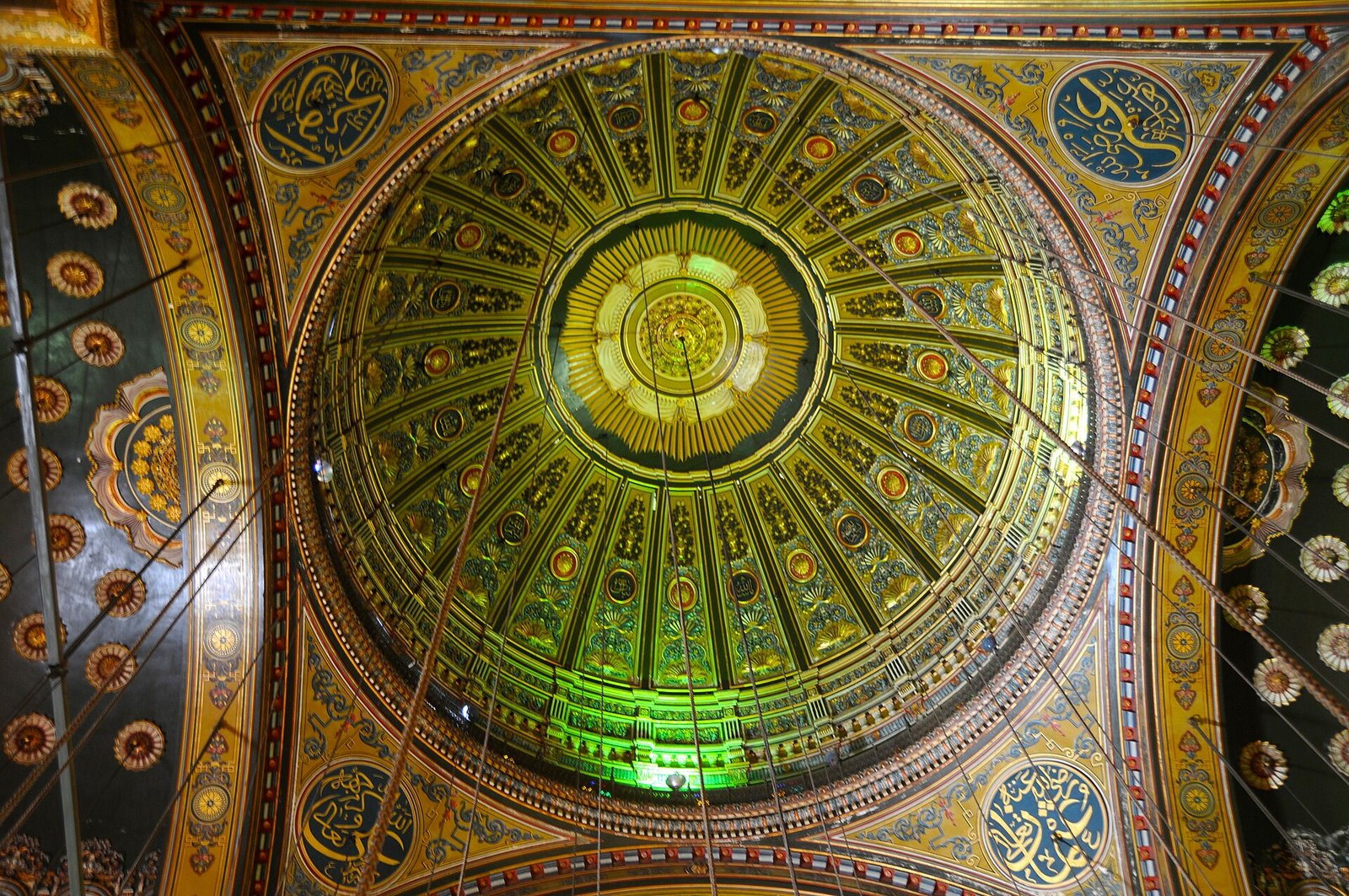
Muhammad Ali chose the imperial Ottoman style of Istanbul instead, the tradition that runs from Hagia Sophia through the Blue Mosque. The signature is one vast central dome carried on half domes on all four sides, so the prayer hall is a single open space under one roof. The central dome here is about 21 meters across and rises roughly 52 meters above the carpet.
The minarets follow the same logic. Ottoman minarets are tall, cylindrical and end in a sharp cone, which is why everyone calls them pencil minarets. This pair reaches about 82 meters, the tallest in Cairo. Beside a Mamluk minaret, shorter, octagonal and layered, the difference is obvious.
The choice was deliberate: a break with the Mamluks he had just wiped out. If you have already walked Islamic Cairo and its Mamluk masterpieces, stepping in here feels like a change of country.
The alabaster: where it came from and why it weathers
The nickname comes from the cladding. The lower walls, inside and out, and the whole courtyard arcade are faced with panels of Egyptian alabaster, a pale, honey-veined, faintly translucent stone. Technically it is a banded calcite rather than true gypsum alabaster, but Egyptians have called it alabaster for as long as anyone has quarried it.
The quarries lie in Middle Egypt, in the hills east of the Nile around Beni Suef and Minya. The same stone was cut in pharaonic times for canopic jars, lamps and the alabaster sphinx that still sits at Memphis. Hold a thin slab up to the light and it glows.
It is also soft, porous and sensitive to damp and pollution. In Cairo's air the panels darken, crack and lift, and the building has been through several rounds of cleaning and replacement. The dome itself had structural trouble within a century and was rebuilt in the 1930s under King Fuad.
The result is a patchwork. Look closely at the courtyard walls and you will see original panels, replacements in a different tone and restored stretches. Once you notice the color shifts you cannot stop seeing them.
The courtyard, the ablution fountain and the twin minarets
You enter through the courtyard, a broad marble square surrounded by an arcade of small painted domes on slender columns. Everything here is clad in alabaster to head height, and in morning light the whole square turns a warm cream that photographs beautifully.
In the center stands the ablution fountain, where worshippers wash hands, face and feet before prayer. It is a tall octagonal basin under a carved and painted wooden canopy with a small dome on top, far more ornate than the plain fountains of the older Cairo mosques.
From the courtyard you get the best view of the two minarets. Stand in the far corner and tilt your head back. Each is a single unbroken shaft with two narrow balconies and a lead-covered cone on top. They were built this tall to be seen from the whole city, and from here you understand why they became the emblem of Cairo on postcards.
The clock tower from France and the obelisk that went to Paris
On the west side of the courtyard, opposite the prayer hall, a slim brass clock tower rises above the arcade under an ornate canopy. This is the piece every guide saves for last, because the story is too good.
In the 1830s Muhammad Ali gave France one of the two obelisks that stood at the entrance of Luxor Temple. It was shipped down the Nile and across the Mediterranean on a vessel built for the job and raised in the Place de la Concorde in 1836, where it still stands. In return, King Louis Philippe sent the Pasha this clock, which arrived in the 1840s.
The joke, told with a straight face by every Cairene guide, is that the clock was damaged in transit and never kept time. So Egypt traded a three-thousand-year-old obelisk for a broken clock. Whether it ran briefly is debated; what matters is that Cairo has decided it never worked. The obelisk's twin still stands outside Luxor Temple, alone, with an empty base beside it.
Inside: the domes, the chandeliers and the sound
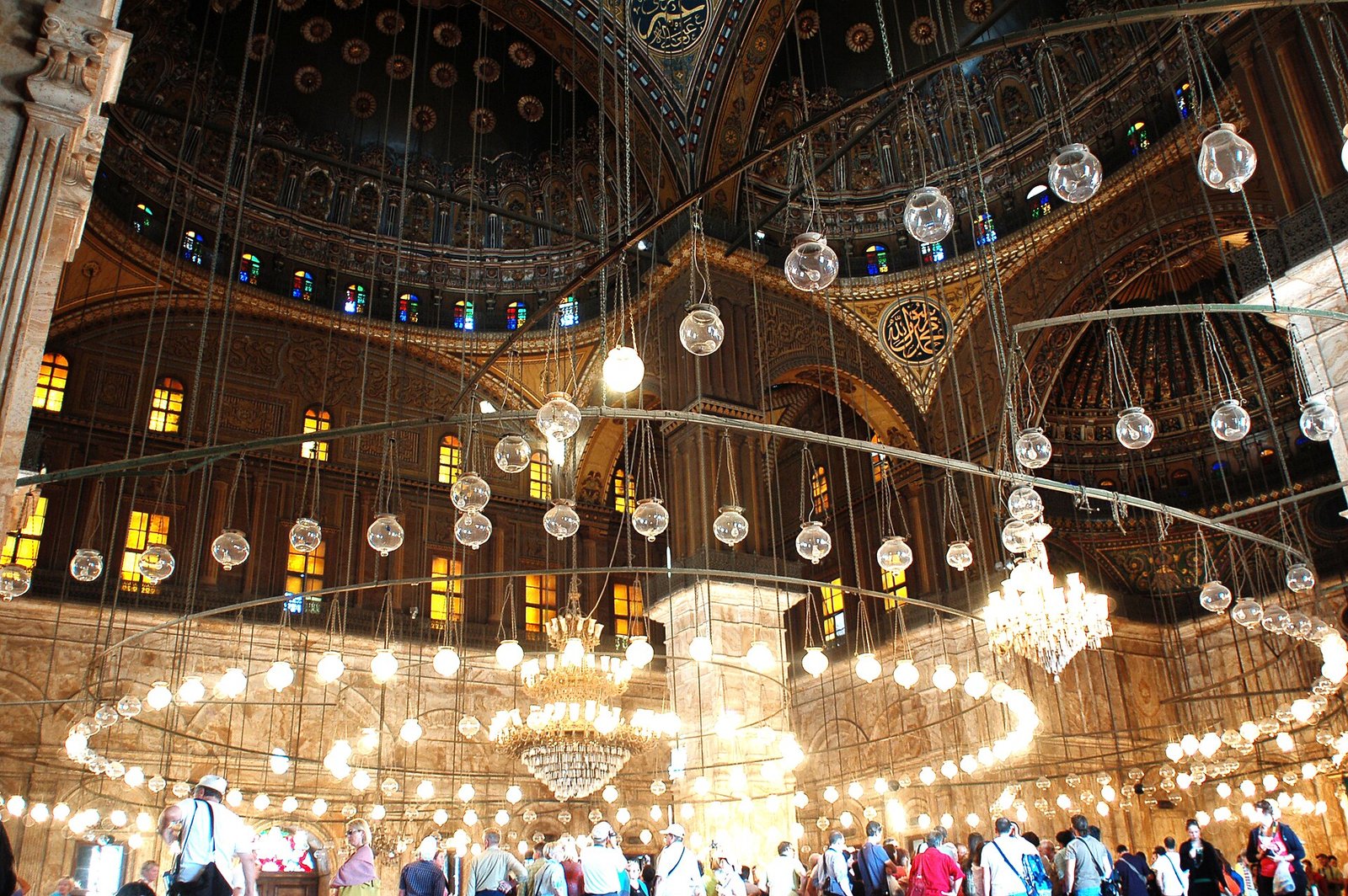
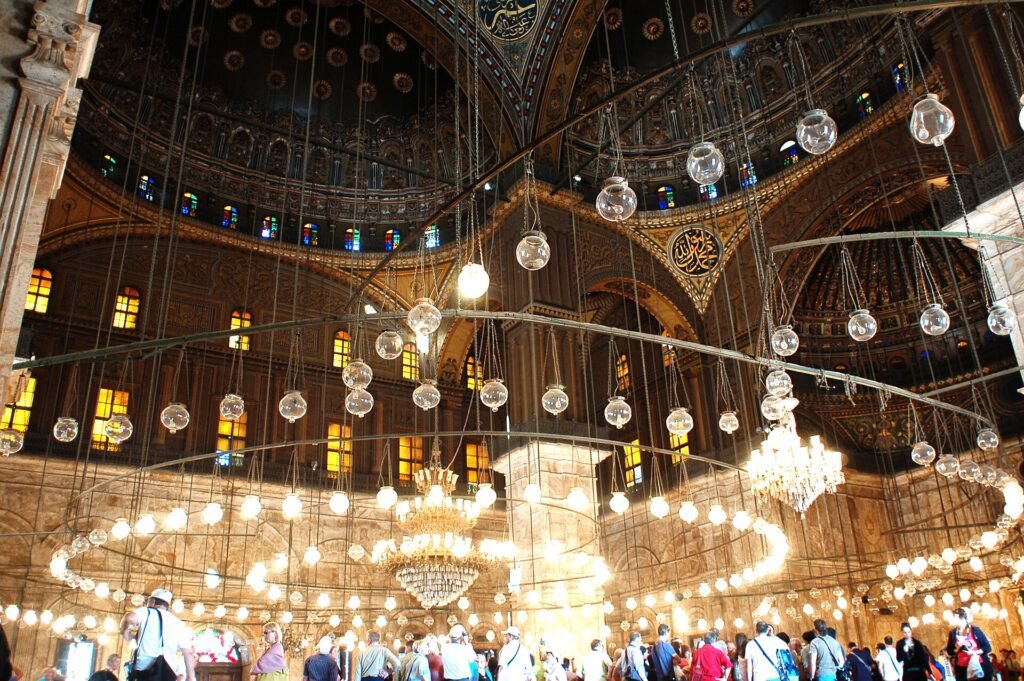
Shoes come off at the door and you step onto deep red carpet. The prayer hall is one vast room with no columns in the way, and the eye goes straight up. The central dome is painted in green, gold and red with medallions of calligraphy, surrounded by the four half domes that carry the weight down to massive corner piers.
From the center hangs a huge circular chandelier of glass globes, and below it, at about the height of a raised hand, a wide ring of smaller lamps on long chains. Those low lamps are the most Ottoman thing in the room; the same arrangement lights the mosques of Istanbul, and it is designed to put light on the worshippers, not the ceiling.
On the qibla wall, facing Mecca, stands an alabaster mihrab and, beside it, two pulpits. The original is a tall wooden minbar painted green and gold, one of the largest in Egypt. The smaller alabaster one was added a century later by King Farouk because the original was too grand to climb every Friday.
The acoustics catch people off guard. The dome returns sound with a long tail, so a voice fills the room from every side at once. If the call to prayer happens while you are inside, stand still and listen.
The tomb of Muhammad Ali and the terrace view
Immediately to the right of the entrance, behind a tall bronze screen, stands the white Carrara marble tomb of Muhammad Ali Pasha, carved with turbans, floral scrolls and inscriptions. It is easy to miss, because the pull of the dome takes everyone forward.
The Pasha died in Alexandria in 1849 and was first buried in the family plot in the Southern Cemetery; his grandson Abbas had the body moved here so that the founder would lie inside his own monument. Standing at the grille is where the building comes together: he took the country, built a modern state, raised the largest mosque in the city on the fortress he ruled from, and made it his grave.
Then leave by the courtyard and walk onto the terrace on the western edge of the Citadel. Directly below, two enormous mosques face each other across a narrow street: Sultan Hassan on the left, the fourteenth-century Mamluk masterpiece with the tallest portal in Cairo, and Al Rifai on the right, burial place of the royal family and of the last Shah of Iran. Beyond them the old city runs west to the Nile.
On a clear day, and there are more of them in winter, the Pyramids of Giza stand on the far horizon, faint gray triangles about 15 kilometers away. Morning is usually clearer than afternoon, and a rain shower the day before scrubs the air.
Mosque etiquette: shoes, dress and prayer times
The Alabaster Mosque is a working place of worship inside a tourist site, and the rules are the same as in any mosque.
- Shoes off. Remove them at the door of the prayer hall and carry them in a bag or leave them on the rack. Wear socks; the courtyard marble is hot in summer and cold in winter.
- Cover shoulders and knees. Everyone. Long pants or a long skirt, sleeves to the elbow. Women cover their hair, and a scarf is usually offered at the door, though your own is easier. Our guide to what to wear in Egypt has outfits that work all day.
- Prayer times. Five times a day the hall fills for a few minutes. Wait in the courtyard or stand quietly at the back, and never photograph people at prayer. Friday midday is the busiest; your guide times the visit around it.
- Voices and phones. Speak softly, no calls, no music. The dome carries everything.
- Photos. Fine inside without flash. No tripods, no drones.
Entry is included in the general Citadel ticket. Check the current opening hours before you go, because the complex closes earlier than most visitors expect and the hours shift during Ramadan.
How it fits into the Citadel visit, and what a guide adds
Plan on two hours for the Citadel, of which the mosque takes about forty minutes done properly: twenty in the courtyard and at the clock, twenty inside and at the tomb. The rest goes to the terrace, the Mamluk mosque of Al Nasir Muhammad next door and whichever museum is open.
The natural pairing is the rest of Islamic Cairo. A full day runs Citadel first, while it is quiet and the light is good on the alabaster, then down the hill past Sultan Hassan and Al Rifai, then Al Muizz street and the Khan el Khalili bazaar for lunch and the afternoon. If Islamic art is your thing, the Museum of Islamic Art sits on the way.
Can you do it without a guide? Yes. Should you? The gap between looking and understanding here is entirely in the storytelling. A guide gives you the Mamluk massacre, the Istanbul connection, the obelisk and the clock, and the two pulpits in the time it takes to cross the courtyard. Without that, it is a handsome room with a nice view.
| Element | On your own | With an Explora Egipto guide |
|---|---|---|
| Timing | You arrive when the tour buses do | Timed to beat the groups and avoid Friday prayer |
| The clock story | A plaque in two languages | The obelisk, the ship, the broken mechanism |
| The architecture | You notice it looks different | You can tell Ottoman from Mamluk for the rest of the trip |
| The rest of the day | A taxi negotiation at the gate | A driver waiting and the route down the hill planned |
How Explora Egipto slots the Alabaster Mosque into your trip
We are a local agency in Cairo with our own guides and vehicles, and the Citadel is on almost every itinerary we build. For most travelers it forms half of an Islamic Cairo day. With a single full day in the capital, it goes in the morning before the museum or in the afternoon after the Pyramids, when the terrace light is at its best.
Our page on what to see in Cairo shows how the pieces fit across one, two or three days, and the day trips are listed under Cairo excursions. Tell us your dates, how many days you have and what else you want to see, and we send you the plan and the quote.
Two notes from experience. The Citadel means a steady uphill walk from the gate and steps inside, so tell us in advance about limited mobility and we route around it. Summer afternoons on the courtyard marble are brutal, so between June and September we move the visit to early morning.
Frequently asked questions
Is the Alabaster Mosque the same as the Mosque of Muhammad Ali?
Yes. The Mosque of Muhammad Ali is the formal name, after the Pasha who commissioned it between 1830 and 1848. The Alabaster Mosque is the nickname, after the pale translucent stone on its lower walls and courtyard. Both refer to the domed mosque with two tall thin minarets on the summit of the Citadel of Saladin in Cairo.
Why does the Alabaster Mosque look Turkish rather than Egyptian?
Because Muhammad Ali deliberately chose the imperial Ottoman style of Istanbul, the tradition of Hagia Sophia and the Blue Mosque, instead of the Mamluk style of older Cairo mosques. That gives it the single huge central dome surrounded by half domes and the two pencil-thin minarets. It was a political choice, a break with the Mamluk past.
What is the story of the clock in the courtyard?
King Louis Philippe of France sent the clock to Muhammad Ali in the 1840s as a return gift for the Luxor Temple obelisk, which Egypt had given to France and which stands today in the Place de la Concorde in Paris. The clock was damaged on the way and, as every Cairo guide will tell you, never really kept time.
Do I have to cover up to enter the Alabaster Mosque?
Yes. It is an active mosque. Shoulders and knees must be covered for everyone, women are asked to cover their hair, and everybody removes their shoes at the door of the prayer hall. Scarves are usually available at the entrance, but your own light scarf and a pair of socks make the visit easier. Do not photograph people who are praying.
Is Muhammad Ali actually buried in the mosque?
Yes. His white Carrara marble tomb stands just to the right of the entrance inside the prayer hall, behind a tall bronze screen. He died in 1849 and was moved here from the family cemetery a few years later. Most visitors walk straight past it toward the dome, so look right as soon as you step onto the carpet.
How long does the visit take and can I see the Pyramids from there?
Allow about forty minutes for the mosque and two hours for the whole Citadel, including the terrace. On a clear day, usually in winter or after rain, the Pyramids of Giza are visible on the far western horizon from the terrace beside the mosque, with Sultan Hassan and Al Rifai directly below you. Mornings are clearer than afternoons.
See Cairo from the mosque that defines its skyline
Tell us your dates and how many days you have in Cairo, and we build the Citadel and the Alabaster Mosque into a day of Islamic Cairo with a guide who tells the stories and a driver at the gate. Ask us for the quote.