How were the pyramids built, and what can you still see of the work at Giza today
How were the pyramids built, and what can you still see of the work at Giza today
The pyramids were built by paid Egyptian workers, not slaves and not anyone from another planet, using limestone quarried a few hundred yards from the site, white casing stone shipped across the river from Tura, and granite floated down the Nile from Aswan. Blocks were cut with copper tools and stone pounders, dragged on wooden sleds over wetted sand, hauled up earth and rubble ramps, and set with levers. We know this from the quarries you can walk into, from the logbook of a boat captain named Merer who delivered stone to Giza in Khufu's reign, and from the excavated town and cemetery of the people who did the work. Below is the evidence and where to see it.
The short version, before the detail
Strip away the documentaries and the answer is a supply chain. A pharaoh chose a site on the desert edge, close to a limestone outcrop and close to the river. Crews cut the core blocks from that outcrop and dragged them uphill. Boats brought the better stone from farther away. Ramps carried blocks up as the monument rose, and levers set each one in place.
Behind that stood an administration that fed, housed, paid and buried tens of thousands of people. The Great Pyramid of Khufu, roughly 2.3 million blocks, was finished in about two decades. Where a question is still open, we say so, because a good guide at the pyramids of Giza should tell you which parts are proven and which are still argued over.
Where the stone came from: Giza, Tura and Aswan
Three kinds of stone went into a Giza pyramid, each from a different place.
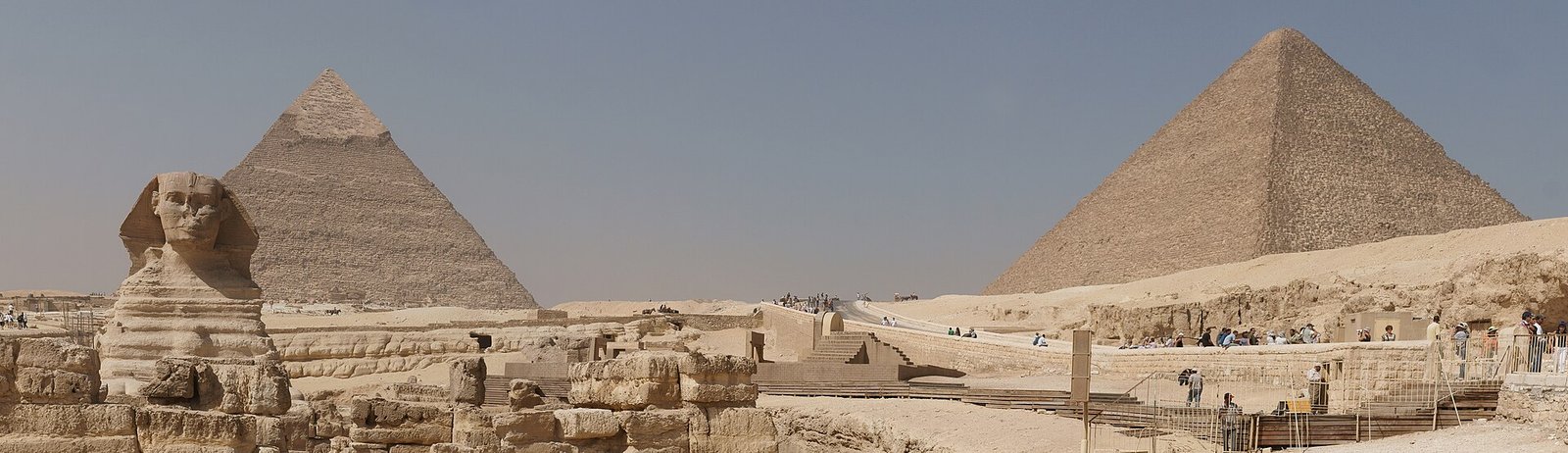
- Core limestone from the plateau itself. The bulk of every Giza pyramid is coarse local limestone cut on site. Khufu's main quarry is the wide horseshoe-shaped hollow just south of the Great Pyramid. Khafre's quarry lay to the east, and the knoll of rock left standing in it became the Great Sphinx.
- Casing limestone from Tura. The smooth white outer skin was a fine, dense limestone from the Tura quarries on the east bank of the Nile, south of modern Cairo. It came across the river by boat.
- Granite from Aswan. The King's Chamber of the Great Pyramid, its stress-relieving chambers and the sarcophagus are Aswan granite, as are the lower casing courses of Menkaure's pyramid. Aswan is roughly 500 miles upriver, so every block, some weighing tens of tons, traveled the Nile on a barge.
The quarrying is easy to picture once you have seen the Unfinished Obelisk in Aswan, still lying in its trench covered in pounder marks. Limestone was simpler: cut a channel around the block with copper chisels, split it along a line of wedges, lever it free.
The Merer papyri: a boat captain's logbook from Khufu's reign
For most of history there was not a single written source from the years the Great Pyramid went up. That changed in 2013, when a French team excavating an Old Kingdom harbor at Wadi el Jarf, on the Red Sea coast, found the oldest inscribed papyri ever recovered in Egypt, among them the working diary of an official named Merer.
Merer led a team of about forty men. His job was to ferry fine limestone from Tura to Giza, which the text calls Akhet Khufu, the Horizon of Khufu. He logs each trip, loading, sailing, handover and return, a few days per round trip, and records the bread and beer issued to his crew.
Two details matter most. The boats did not stop at the riverbank: the diary describes canals and a basin that brought stone to the foot of the plateau, matching the harbor remains archaeologists have since found east of the pyramids. And it names the man in charge as Ankhhaf, Khufu's half-brother, whose painted bust is one of the great pieces of Old Kingdom sculpture.
There is no mention of slaves or punishment. It is a delivery log with dates, cargoes and rations.
The town that fed the workforce
The second source is a place. Southeast of the Sphinx, behind a massive stone wall known as the Wall of the Crow, excavation has uncovered a planned settlement from the reigns of Khafre and Menkaure. Egyptologists call it Heit el Ghurab, the pyramid builders' company town.
What came out of the ground is provisioning, not a slave camp:
- Long gallery buildings that look like barracks, with sleeping platforms for rotating crews.
- Bakeries with rows of heavy ceramic bread molds and dough vats, built to turn out loaves by the thousand.
- Enormous quantities of cattle, sheep and goat bone, much of it young male cattle, prime beef driven in from herds raised elsewhere.
- Seal impressions from the royal administration.
The workers' cemetery
Up the slope, west of the Wall of the Crow, lies the cemetery of the people who built the monuments, found in 1990. Laborers lie in simple graves built from leftover blocks and mud brick, some with small stepped tops that copy the pyramids in miniature. Above them are the tombs of overseers, with titles such as overseer of a side of the pyramid.
The skeletons show hard labor, arthritis in the spine and knees, healed fractures. But the fractures healed well, meaning bones were set, and at least one person survived an amputation. People buried with titles and offerings beside the king's monument, who received medical care, were not slaves.
Tools, sleds and the trick with wet sand
The Old Kingdom had no iron, no pulleys and no wheels for heavy haulage. It had copper, hard stone, wood and rope.
| Tool | What it did | Where the evidence is |
|---|---|---|
| Copper chisels and saws | Cut limestone; sawed harder stone with sand as the abrasive | Saw marks on granite sarcophagi, chisel marks in the Giza quarry |
| Dolerite pounders | Bashed granite away a grain at a time | The Unfinished Obelisk trench in Aswan |
| Wooden sleds and rope | Moved blocks and statues over prepared tracks | Sleds recovered at pyramid sites; the tomb of Djehutihotep shows a colossus on one |
| Wooden levers | Lifted a block a few inches at a time | Lever sockets cut into block edges across Giza |
The detail visitors remember is the water. The Djehutihotep painting shows a man on the front of the sled pouring water on the sand ahead of it. Physicists tested this and found that dampening the sand to the right degree roughly halves the force needed to drag a heavy sled, because wet grains stiffen instead of piling up in front of the runners.
How the blocks went up: the ramp question
Getting a block to the base of the pyramid is well understood. Getting it to the top is still argued over, and any honest answer says so. Three families of ramp are on the table.
A straight ramp
One long earth and rubble ramp climbing to the working level. Easy to haul on, but the Great Pyramid rises over 450 feet, so a gentle straight ramp would have been longer than the pyramid is wide. It works well for the lower courses, where most of the stone is, and badly near the top.
A spiral or wrap-around ramp
A ramp coiling up the outside on the unfinished casing. It saves material but hides the corners the surveyors needed to sight along.
An internal ramp
A tunnel-like ramp inside the body of the monument, proposed by a French architect. Elegant on paper, not confirmed by excavation.
Most Egyptologists expect a combination: a big straight ramp for the lower structure, then something smaller and steeper for the top, where only a few blocks a day needed to arrive. The ramps were dismantled at the end, though traces of fill and haul roads survive.
The Hatnub find
The best physical evidence for steep hauling came from Hatnub, an alabaster quarry in the Eastern Desert. In 2018 an Anglo-French team uncovered a ramp there, dated by inscriptions to Khufu's reign, flanked by two staircases and lined with post holes. Wooden posts in those holes would have served as anchor points, letting teams haul a sled up a slope far steeper than a plain ramp allows.
Leveling the base and lining up with the stars
The precision stops engineers in their tracks. The base of the Great Pyramid, about 756 feet on a side, is level to within roughly an inch, the four sides differ in length by only a few inches, and the pyramid faces true north to within a small fraction of a degree.
The leveling is usually explained by cutting shallow trenches in the bedrock, flooding them, marking the waterline and dressing the rock down to that mark. Only the outer band of the base needed this, because a core of natural bedrock was left inside the pyramid.
The orientation has two candidate methods. One is astronomical: sighting on a pair of stars near the celestial pole as they lined up vertically. The other uses the sun, tracking the tip of a rod's shadow through a day near the equinox to find an east-west line. Both work with Old Kingdom tools. The intent is not in doubt: the pyramid faced the imperishable northern stars because that was where the king was going.
Who did the work, and who did not
The workforce was Egyptian, and it was paid, in bread, beer, cloth, meat and, for skilled men, a tomb near the king. A permanent core of craftsmen lived on site year round. Around them rotated larger crews of farm laborers who came for a stint and went home, especially in the months when the Nile flood covered the fields.
The crews were organized in named gangs, split into smaller units. Some gang names survive as painted graffiti on blocks inside the pyramids, and they are cheerful: Friends of Khufu, Drunkards of Menkaure. Those are not names slaves paint on their work.
How many people were on site at once is estimated, not known. The ancient Greek figure of a hundred thousand is too high; modern reconstructions based on the town and the quarry output put the peak around twenty thousand, with a much smaller skilled core.
On the alternative theories, aliens, a lost civilization, an unknown high technology: none is supported by a single artifact, text, bone or quarry mark, while the human explanation is supported by all of them.
From Sneferu's experiments to Khufu's masterpiece
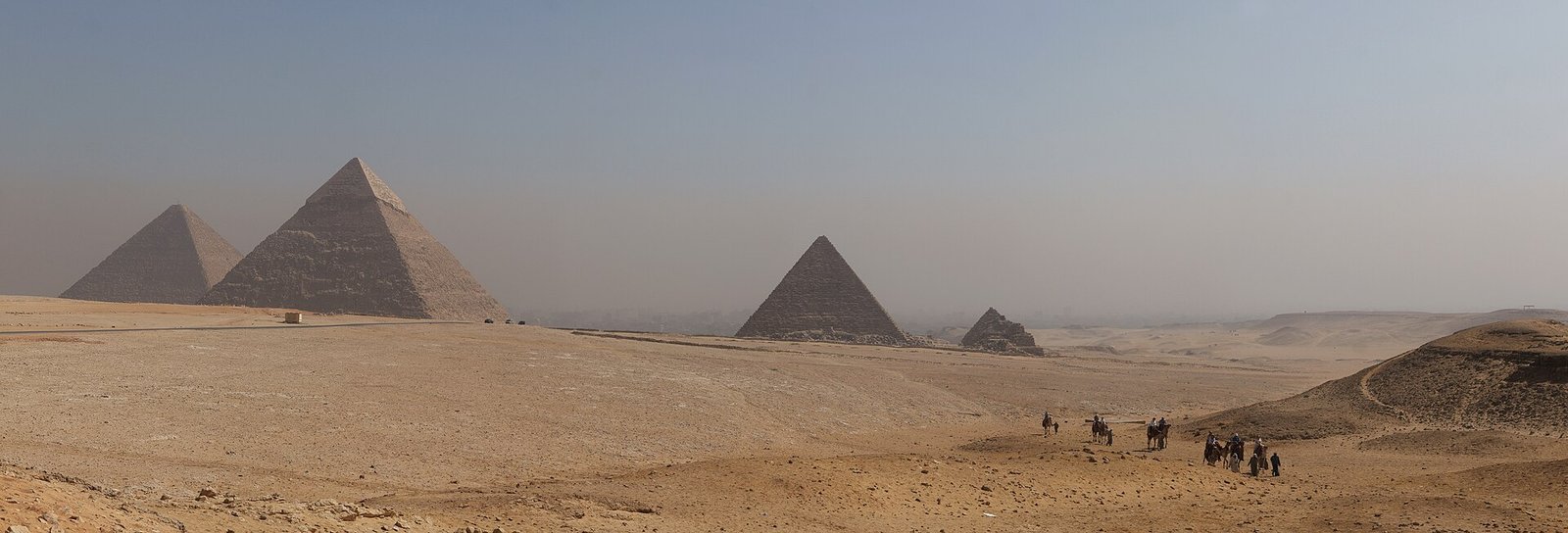
The Great Pyramid sits at the end of a century of learning, and you can walk that century in a day south of Cairo.
| Monument | King | What it taught the builders |
|---|---|---|
| Step Pyramid, Saqqara | Djoser | The first large stone building anywhere: six mastabas stacked up, enlarged in stages as the plan grew. |
| Meidum pyramid | Sneferu | A step pyramid converted to a true pyramid. Its outer layers later collapsed into the mound you see today. |
| Bent Pyramid, Dahshur | Sneferu | Started steep, then switched to a shallower angle partway up when the structure showed stress. Most of its casing survives. |
| Red Pyramid, Dahshur | Sneferu | The first successful true pyramid, built at the safe angle from the ground up. |
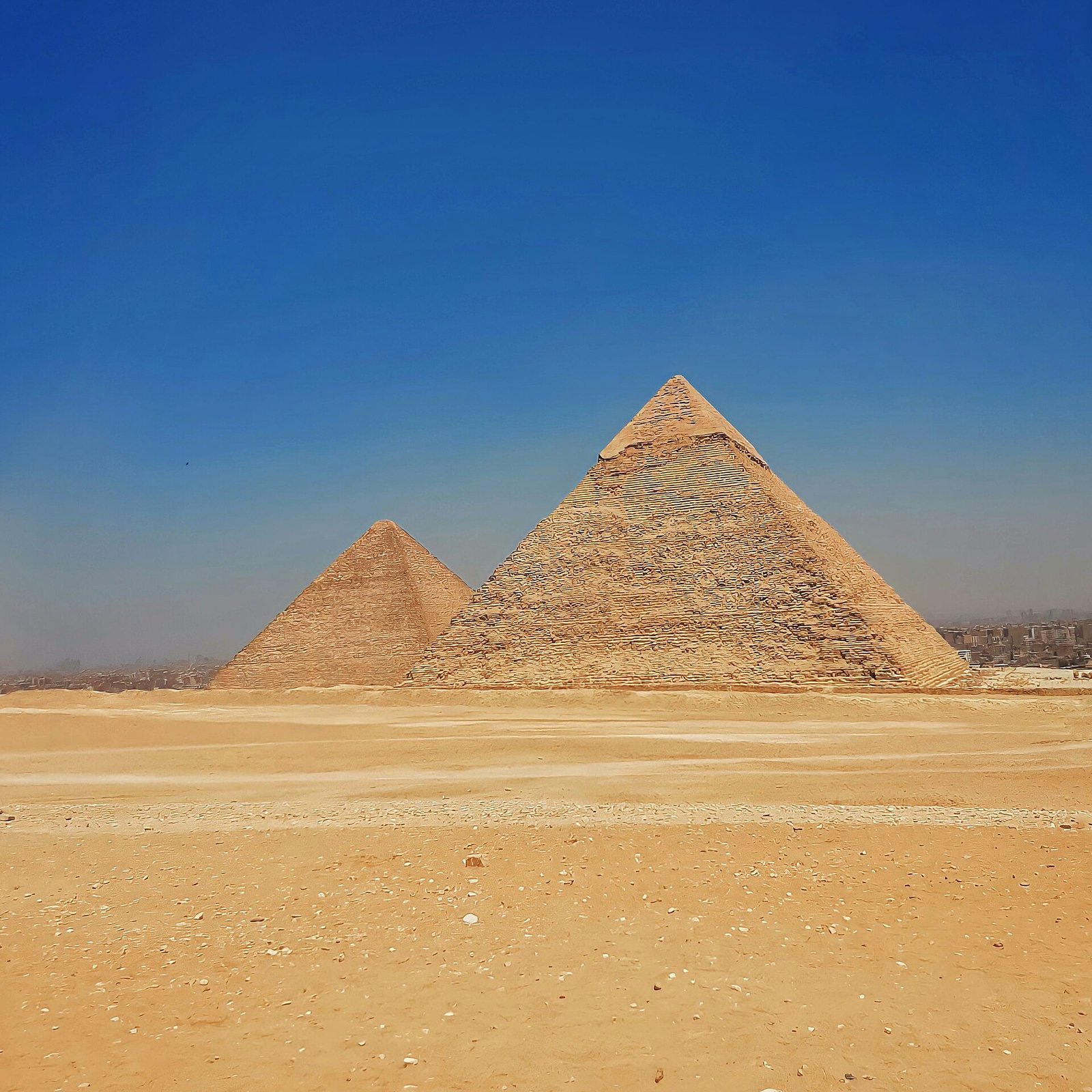
| Great Pyramid, Giza | Khufu | Sneferu's son took the proven method, raised the angle again, and built bigger than anyone before or since. |
Sneferu built more pyramid by volume than any other king, and his work at Dahshur are why Khufu's engineers knew which angle held and how to run a workforce over decades. See Dahshur before Giza if you can.
What you can see of all this on site
Most of the evidence is visible if someone points you at it.
- The quarry. Walk south of the Great Pyramid to the edge of the wide hollow. The vertical cuts, channel lines and half-cut blocks are the Khufu quarry.
- The Sphinx enclosure. The Sphinx is a leftover block of Khafre's quarry; the trench around it is where stone for his temples was cut.
- The casing. A few Tura casing blocks survive at the base of the Great Pyramid's north face. The smooth cap on Khafre's pyramid is the original casing that once covered the whole thing.
- The boat pits. Long rock-cut pits beside the Great Pyramid. One held the cedar boat now reassembled in the Grand Egyptian Museum, a full-size vessel of the kind Merer's crew sailed.
- The causeway and temples. Khafre's causeway runs from his valley temple beside the Sphinx up to his pyramid. The basalt paving east of the Great Pyramid is the floor of Khufu's mortuary temple.
- The workers' town and cemetery. South of the Sphinx, the Wall of the Crow stands ten yards high, the town behind it, the cemetery on the slope above. Access varies, so let your guide check what is open.
- The tools and the papyri. Copper chisels, pounders and cubit rods are in Cairo's museums, and the Merer papyri have been exhibited there. Ask where they are showing when you travel.
What a guide adds, and how Explora Egipto builds the day
You can walk the plateau alone and see three pyramids and a Sphinx. What you cannot do alone is read it. The quarry looks like a rough hillside until someone shows you a channel line.
Our guides are Egyptian Egyptologists who have spent years on the plateau. On a guided Giza pyramids tour they take you to the quarry edge, walk the causeway, explain the gang graffiti, and give you the ramp debate straight.
The day we recommend for this question:
- Early start at Giza before the heat, quarry first, then the pyramids and the Sphinx.
- Drive south to Dahshur for the Bent and Red pyramids, casing and change of angle visible from the base.
- Saqqara for the Step Pyramid and the beginning of the whole story.
- Back to Cairo and, if you have the energy, the boat at the Grand Egyptian Museum.
Private vehicle, one guide all day, tickets handled. If you are combining it with Luxor, Aswan and a Nile cruise, it slots in as the first full day of any of our Egypt tour packages. Tell us your dates and we send you the quote.
Frequently asked questions
How were the pyramids built, in one paragraph?
Core limestone was quarried a few hundred yards from each pyramid, fine casing stone came by boat from Tura across the river, and granite came down the Nile from Aswan. Blocks were cut with copper tools, dragged on sleds over wetted sand, hauled up ramps and set with levers. A paid Egyptian workforce did it, run by an administration that kept written accounts, in about twenty years.
Were the pyramids built by slaves?
No. The workers' town beside the Sphinx shows barracks, industrial bakeries and enormous quantities of beef, and the workers' cemetery holds people buried with titles, offerings and evidence of medical care, next to the king's monument. The Merer papyri record rations of bread and beer, not punishment. The builders were a skilled core plus rotating crews of farmers, and they were paid.
How did they lift the blocks to the top?
With ramps and levers. Most Egyptologists expect a large straight ramp for the lower courses, where the bulk of the stone is, and a smaller, steeper or wrap-around arrangement for the top. A ramp with staircases and post holes found at Hatnub, dated to Khufu's reign, shows they could haul sleds up steep slopes. The exact system for the top is still debated.
Who was Merer and why does his diary matter?
Merer was an official who led a crew of about forty men during Khufu's reign. His diary, found at Wadi el Jarf on the Red Sea coast, logs trips carrying Tura limestone by boat to a harbor at the foot of the Giza plateau, with the rations his men received. It is the only contemporary written account of the Great Pyramid's construction, and it names Khufu's half-brother Ankhhaf as the man in charge.
How long did it take to build the Great Pyramid?
About twenty years, most of Khufu's reign. That figure comes from ancient sources and holds up against modern reconstructions of quarry output and crew size. It implies setting a block every few minutes, which only works with the provisioning the workers' town reveals. Sneferu's pyramids at Dahshur took similar spans.
Can I see the quarry and the workers' cemetery when I visit Giza?
The quarry south of the Great Pyramid is open ground on the plateau and any guide can walk you to its edge. The Sphinx enclosure is itself a quarry. The workers' town and cemetery south of the Sphinx are excavation areas where access changes, so we check what is open on your dates. The boat pits are visible beside the pyramid.
Stand in the quarry and the whole thing makes sense
Tell us your dates and how many days you have in Cairo, and we come back with a pyramids day built around this question, Giza first, then Dahshur and Saqqara, with an Egyptologist who can show you the channel lines and the boat pits, and the quote in your inbox.