Esna Temple is the Temple of Khnum, the ram-headed potter god, and what survives is one Roman-period hypostyle hall sunk about 30 feet below the streets of a market town an hour south of Luxor. Every Nile cruise between Luxor and Aswan passes Esna because the river lock is here, but many ships only transit the lock and never tie up. Inside, 24 columns with capitals that change from one to the next hold up a ceiling that recent conservation has cleaned back to its original blues, yellows and reds: a zodiac, a procession of vultures, decans and planets.
Esna is a working river town on the west bank of the Nile, roughly 34 miles south of Luxor, about an hour by road. By boat it is the first place every cruise ship reaches after leaving Luxor, and the last before arriving, because the barrage and lock that regulate this stretch of river sit just south of town.
The temple is in the middle of the town. For most of the past fifteen centuries the hall was buried to its capitals in silt, rubbish and the foundations of houses, while Esna went on living on top of it. When the fill was cleared, the streets stayed where they had risen to and the hall stayed where it had always been: a stone hall at the bottom of a pit, about 30 feet down, ringed by shops and apartment blocks.
The pit explains why the hall survived so well. Buried stone is protected stone, and the colors on the ceiling are there today because nobody could see them for a very long time.
To read Esna you need to know its god. Khnum is one of the oldest creator gods in Egypt, shown as a man with the head of a ram with wavy horizontal horns. He sat at a potter's wheel and shaped each human being out of Nile clay, body and ka, the life force, together, then placed the finished figure in its mother's womb. You will see him doing exactly that on the walls here, wheel between his knees, a small figure rising under his hands.
At Esna he shared the temple with the goddess Neith, the ancient huntress and weaver, the lioness Menhit, and their son Heka, magic itself given a face. The walls carry long hymns to Khnum, festival calendars, and the rules for which priests did what on which day.
If the gods blur together, our guide to recognizing the Egyptian gods by their headdresses and animals is worth ten minutes before the cruise. Khnum is the easy one: ram head, potter's wheel.
Khnum was worshipped at Esna for thousands of years, but the building you walk into is late. The hypostyle hall was begun under the emperor Tiberius, in the first century of our era, as the front hall of an older Ptolemaic temple whose sanctuary has vanished under the town. The back wall, the one you face as you enter, is the facade of that earlier temple, which is why its style looks slightly different.
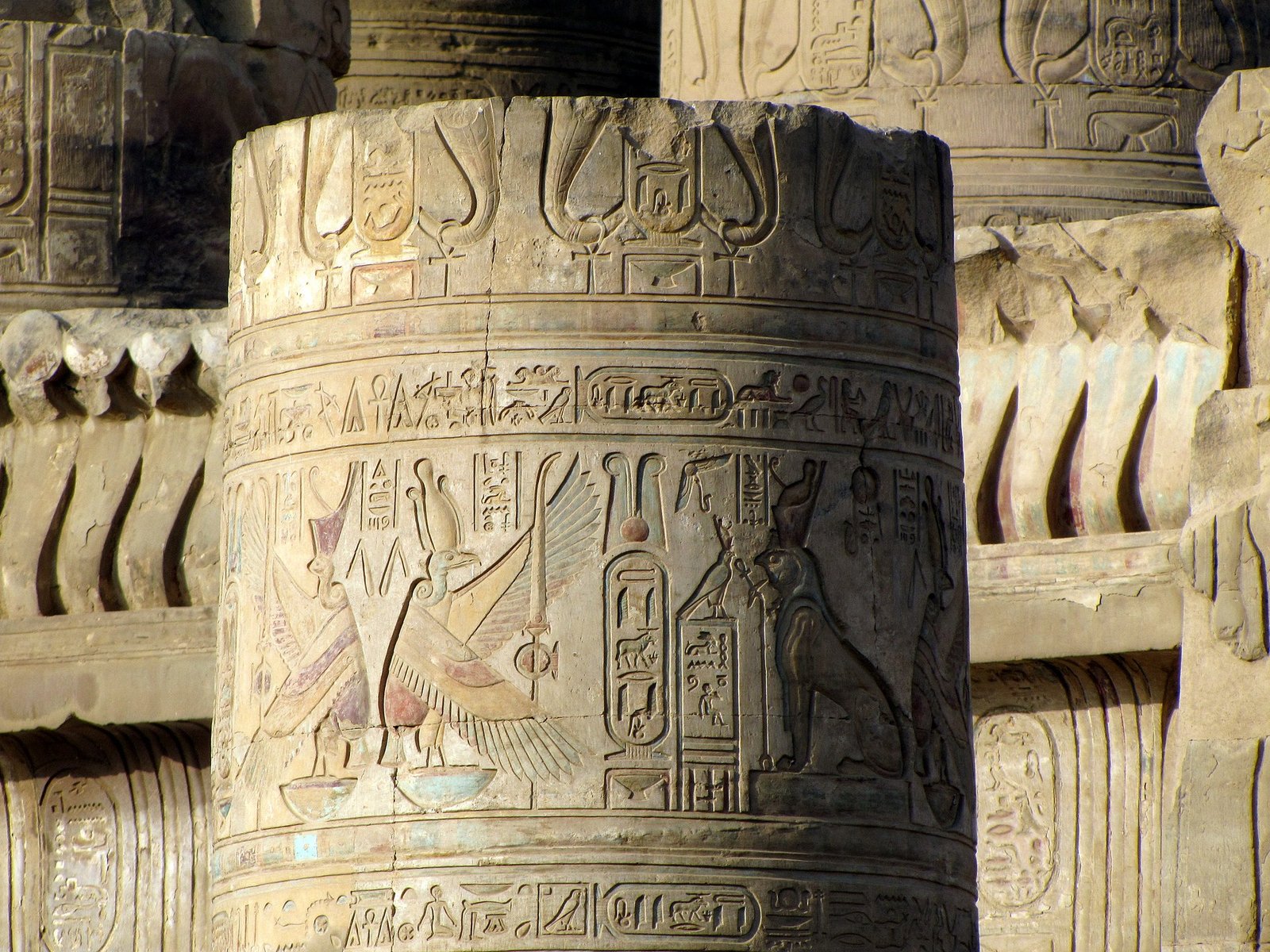
Decoration went on for two centuries. Claudius, Vespasian, Domitian, Trajan, Hadrian, Antoninus Pius, Marcus Aurelius, Septimius Severus and Caracalla all appear on the walls and columns, every one dressed as a pharaoh, offering to Khnum in the double crown. The cartouche of Decius, on a column here, is the last time any Roman emperor's name was written in hieroglyphs anywhere in Egypt. After Esna, the script that had run for three thousand years simply stops.
You are looking at the last chapter of pharaonic Egypt, carved by priests who knew it was the last chapter.
The hall is about 110 feet wide and 55 feet deep, and its roof rests on 24 columns, each over 40 feet tall. The facade is six of those columns joined by half-height screen walls with the door in the middle, so the front was open to light above waist height and closed below. Inside, the other 18 stand in three rows.
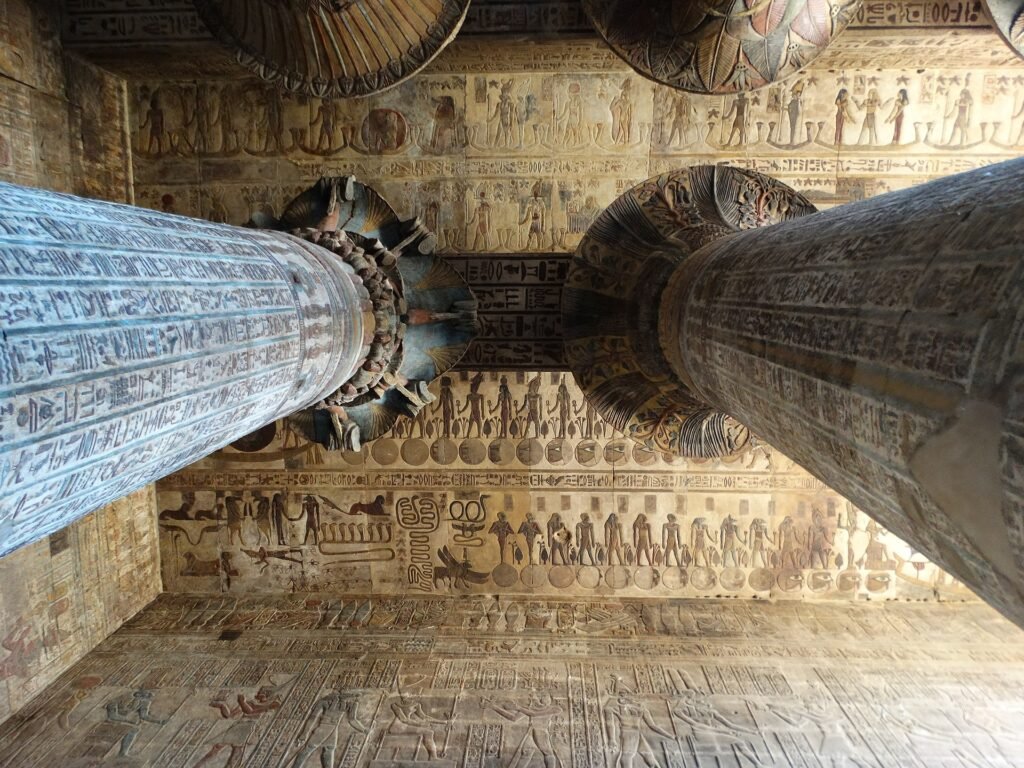
Look up at the capitals before anything else. In most Egyptian temples the capitals in a hall match. At Esna they do not. Palm fronds on one, open papyrus on the next, lotus buds, then a composite capital stacking several plants together, then clusters of leaves and fruit you will not see anywhere else. From the floor it reads as a stone garden where every plant is a different species: the reed marsh of the first creation, from which Khnum's clay came.
The hall also stays noticeably cooler than the street, which matters when Esna is pushing 100°F (38°C) in summer.
For most of its life the Esna ceiling was black. Centuries of oil lamps, cooking fires from the houses above, bird and bat droppings, dust and salt had sealed it under a thick black crust.
An Egyptian and German conservation team has been cleaning that crust away, panel by panel, with solvents and fine tools rather than repainting, and what comes out from under it is the original paint. Not a reconstruction. The colors are strong: a deep blue ground, ochre yellows, greens, reds, white outlines. The work is ongoing, so what you see depends on when you visit, but the central aisle and several bays are already the most vivid painted ceiling you will stand under in Egypt.
What the ceiling shows is the sky:
The cleaning has also brought out details nobody had recorded: inscriptions in red ink, some in Greek, and names of constellations that were in no catalog. At Esna, do not look at the floor. Look up.
Two columns at Esna carry a puzzle Egyptologists still argue over. On one, a hymn to Khnum is written almost entirely with the ram hieroglyph, repeated dozens of times, each ram carrying a small difference in crown, posture or attribute that changes its reading. On another, a hymn is written almost entirely with crocodiles, row after row of them.
This is cryptographic writing, a game the late temple priests loved. By the Roman period the script had swollen from a few hundred signs to several thousand, and the priests of Esna used that freedom to write texts only they could read. A ram could stand for the sound of Khnum's name, for the god himself, or for the word for soul, depending on a tiny detail.
If you are curious how the normal script works, start with our guide to how hieroglyphs work and how to read the basics, then come to Esna and see the extreme case.
South of the town a barrage crosses the Nile. It was built to control the river for irrigation, and it created a drop of roughly 30 feet between the Luxor side and the Aswan side. Every vessel sailing between the two cities passes through the lock beside it, a concrete chamber with gates at each end that fills or empties to lift the boat or lower it to the next level.
The ship enters, the gates close behind it, the water rises or drops slowly, the far gates open and the ship moves on. In high season there can be a line of boats waiting their turn, which is why many ships cross at night while the passengers sleep.
If you cross by day, go up on deck. The lock is where the rowboat vendors work: men in small boats paddle alongside and throw galabeyas and tablecloths up to the sun deck in plastic bags. If you want one you haggle by shouting and send the money back down in the bag; if not, you throw the bag back. Read our notes on how haggling in Egypt works before you get into a shouting match from four decks up.
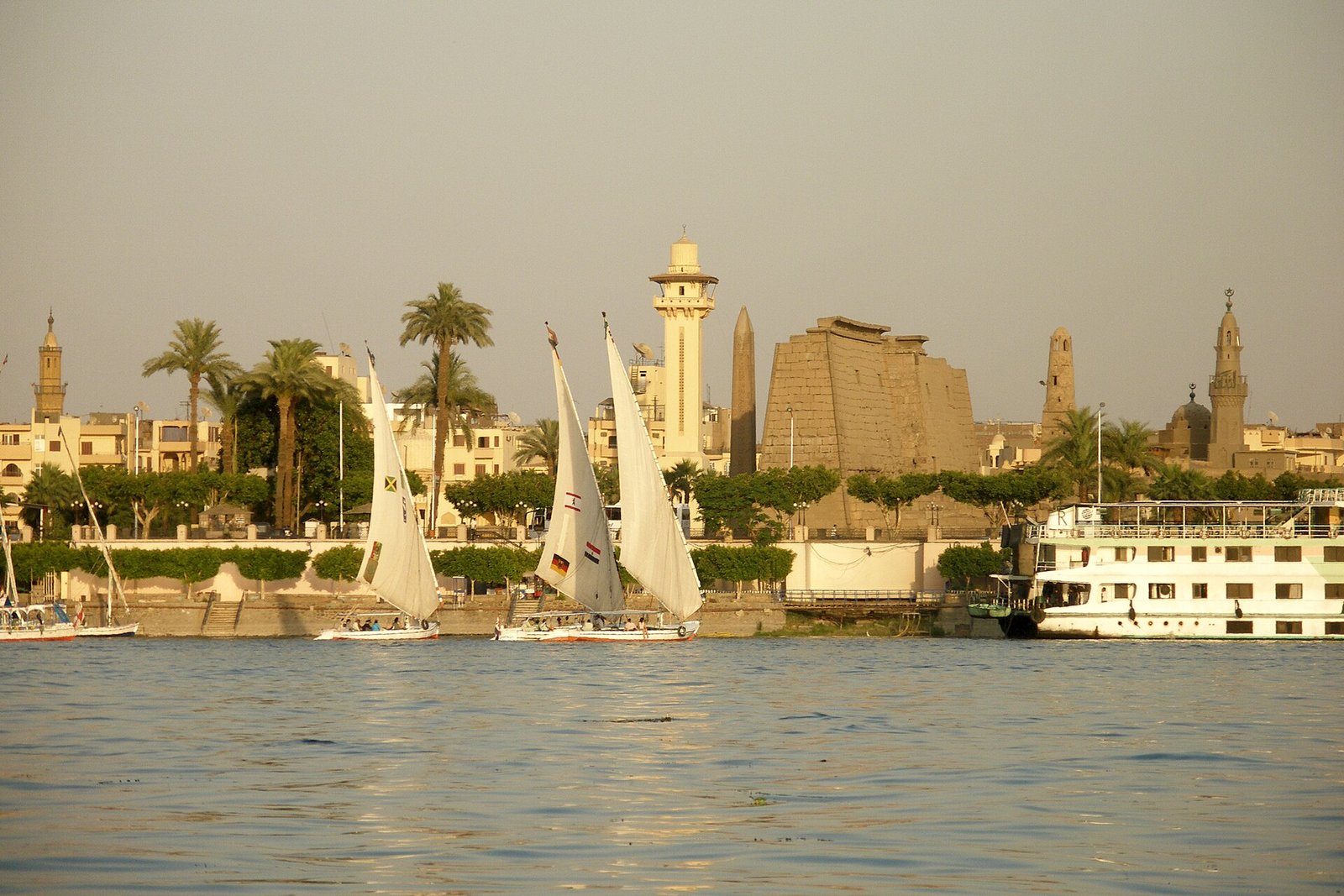
Cruise ships tie up at the Esna corniche, in the town itself, a short way north of the lock. From the gangway to the temple ramp is a walk of ten to fifteen minutes, and the route is the reason to do it on foot rather than by carriage.
You cross the corniche road, pass the horse carriages waiting for the boats, and turn into the covered market street that runs toward the temple. It is one of the older souks on the river, with carved wooden shopfronts from the Ottoman period, sacks of spices and hibiscus, cotton galabeyas in rows, and shopkeepers who know exactly which ship you came off. Above the roofs stands a slim brick minaret, one of the oldest surviving in Egypt.
The selling is persistent. Esna sees fewer boats than Edfu and Kom Ombo, so each one matters more. A smile, a firm no thank you and steady walking is all it takes; nobody follows you far. If you do want a galabeya, this is a fair place to buy one and the cotton is good.
Thirty to forty five minutes inside the hall is right. There is only one room, so it is not a long visit, but it is a dense one. Door to door from the ship, with the walk both ways and a stop in the souk, count on an hour and a half.
Light matters more here than at most temples. The hall faces east and is open above the screen walls, so in mid morning the sun comes in low over the facade and lights the ceiling from below, and the colors read without a flashlight. By early afternoon the pit is in shadow and the ceiling goes flat. Late afternoon is softer again, with west light bouncing in off the pit walls.
Sailing south from Luxor, Esna is usually the first morning; sailing north from Aswan, it is often the last afternoon. Both work. Wear shoes you can walk in, because the ramp is long, the steps uneven and the floor original stone, and bring a hat and water for the walk in summer. The hall itself is cool.
Here is the honest version. A standard cruise runs on a tight clock built around the lock schedule, the Edfu and Kom Ombo stops and the sailing hours the river authority allows. Esna is the easiest stop to cut: a single hall, right where the boats wait for the lock anyway, and for years a dark room with a black ceiling that passengers forgot the next day. So the big ships cross at night and sail on.
That logic is out of date, and the ceiling is why.
| Lock transit only | Lock transit plus temple stop |
|---|---|
| Ship crosses the lock, often at night | Ship ties up at the corniche for about two hours |
| You see Esna as a wall of concrete from the deck | You walk through the souk into the town |
| No Roman period temple on the itinerary | The last Roman emperors written in hieroglyphs |
| No painted ceiling anywhere on the cruise | The zodiac and vultures in original color |
| Typical on 3 and 4 night cruises | Standard on dahabiyas and on request with us |
Direction changes when the stop happens, not whether it happens; our comparison of Luxor to Aswan versus Aswan to Luxor covers that, and southbound gives you Esna in the better light. A dahabiya sailing cruise is not tied to the lock convoy times, and Esna is a natural overnight for them.
More than at almost any other temple on the river. Karnak and the Valley of the Kings impress you on their own. Esna does not. Without someone to point, you see a room full of columns and a nice ceiling, and you are back on the ship in twenty minutes wondering what the fuss was about.
With an Egyptologist guide the hall opens up. They show you Khnum at his wheel and the small figure taking shape under his hands. They find the cartouche of Decius and explain why it is the end of a script. They walk you down the central aisle reading the vultures, then turn you to the zodiac and show you the sign you were born under, in the colors the priests chose for it.
They also know which bays have been cleaned this season and where to stand for the light. Our guides are Egyptian, trained Egyptologists, and they have been in this hall many times, which is the only way to know a place that keeps changing under conservation.
We are a local agency in Egypt with our own guides and vehicles, and we do not run a single fixed cruise product. We place you on the boat that fits your dates and standard, and we build the shore program around it. How Esna fits depends on the boat:
Our 5 day Nile cruise from Luxor to Aswan is the itinerary most people start from, and the one where an Esna stop fits most easily. Tell us Esna matters to you when you write, and we confirm before you book rather than after.
Yes, and more so now than at any time in living memory. The hall is the only Roman-period Egyptian temple on the cruise route, its columns carry the last hieroglyphic cartouches ever carved, and the ceiling has been cleaned back to original color, with a zodiac and a procession of vultures you will not see painted anywhere else.
No. Every cruise passes through the Esna lock, because it is the only way between Luxor and Aswan, but many ships cross at night and never tie up in the town. Whether yours stops depends on its sailing plan and the lock convoy times. Confirm the stop before booking, or visit by road from Luxor.
Khnum is a ram-headed creator god, one of the oldest in Egypt. He shaped each person and their life force out of Nile clay on a potter's wheel, and he controlled the source of the Nile flood at the first cataract. At Esna he was worshipped with the goddess Neith, the lioness Menhit and their son Heka, the god of magic.
Because it is painted in its original colors. Centuries of soot and bird droppings had turned it black, and an Egyptian and German conservation team has been cleaning it panel by panel, revealing the blues, yellows and reds the Roman-period craftsmen applied. The ceiling shows the sky: the zodiac, the 36 decans, the planets, and vultures with spread wings along the central aisle.
Plan an hour and a half door to door. The walk from the corniche through the covered souk to the temple is ten to fifteen minutes each way, and thirty to forty five minutes inside the hall is enough to see the columns, the hymns and the ceiling properly with a guide. Mid morning is the best light.
A barrage south of Esna creates a drop of roughly 30 feet in the river, and the lock beside it is a chamber that lifts or lowers each vessel to the next level. Every boat between Luxor and Aswan has to pass through it, so ships line up, especially in high season, and many cross at night. Crossing by day is worth watching from the deck.
Tell us your dates, how many nights you want on the river and whether you would rather sail south from Luxor or north from Aswan. We come back with a cruise plan that stops at Esna in the right light, an Egyptologist guide who knows the ceiling, and the rest of the Luxor to Aswan program around it. No prices on this page, just the quote in your inbox.