Egypt off the beaten path is the second trip most people wish they had taken first
Egypt off the beaten path is the second trip most people wish they had taken first
Egypt off the beaten path means the places a standard eight-day tour drives straight past: the painted temples of Dendera and Abydos north of Luxor, the rock tombs of Middle Egypt, the fossil whales of the Fayoum, the chalk sculptures of the White Desert, the oasis road through Kharga and Dakhla out to Siwa, the monasteries of Wadi el Natrun, Rosetta and Tanis in the Delta, the quarries of Gebel el Silsila, and the reefs of Wadi el Gemal in the deep south. None of them replace the Pyramids or Karnak. Each bolts onto a classic route as an extra day or a short block, and this guide shows where the bolt goes.
Why most tours skip these places, and the one rule for adding them
The classic circuit exists for a reason. Cairo, a Nile cruise between Luxor and Aswan, and Abu Simbel cover the greatest monuments on earth in about a week, and the roads, hotels and boats are built around that flow. What it leaves out is everything that needs a detour: a temple two hours north of Luxor, a valley of fossils three hours from Cairo, a camp with no hotel at the end of the day. Each costs time, which a packaged week does not have, so the operator skips them and you never hear their names.
The rule we apply to every itinerary is simple. Off the beaten path Egypt is a layer you add, not a swap you make. First trip: keep the Pyramids, Luxor and Abu Simbel and add one or two detours from the list below. Already done the circuit: the whole list becomes the trip, and our guide to a second time in Egypt explains how those two situations differ.
Dendera and Abydos, the day trip north of Luxor that changes how you see temples
Dendera is the temple of Hathor, an hour north of Luxor. It is Ptolemaic and Roman, which is why it looks so complete: a full roof, columns with Hathor faces, crypts you crawl into, ceilings with their blue and gold paint cleaned back to life. The circular zodiac is a cast; the original is in the Louvre. The Cleopatra and Caesarion reliefs on the back wall are original.
Abydos is another hour and a half north. The temple of Seti I holds the finest raised relief in Egypt, carved so finely the figures seem to breathe, and much of its paint survives. Behind it, the Osireion is a half-sunk stone hall that feels older than everything around it.
Who it suits: anyone who stood in Karnak and wanted more. It is the easiest detour on this page: no camping, no rough roads.
How to add it: one extra night in Luxor. Leave early, do Abydos in soft light, return through Dendera, and you are back by late afternoon. If your Nile cruise does not include it, we add the day on land before the boat.
Middle Egypt: Beni Hasan, Amarna and Tuna el Gebel
Between Cairo and Luxor lies a stretch of the Nile almost no foreign visitor sees. The base is Minya, about four hours south of Cairo by road; our guide to Minya and Middle Egypt covers the logistics.
- Beni Hasan. Middle Kingdom tombs cut high into the east bank cliff, painted rather than carved: wrestlers working through holds, birds netted in the marshes, a caravan of foreign traders in striped robes. Daily life from four thousand years ago.
- Amarna. The city Akhenaten built for his single god and abandoned within a generation. Little stands, which is the point: you walk the plain where a capital stood and visit the northern tombs with the royal family under the sun disc.
- Tuna el Gebel. The necropolis of Hermopolis, with the tomb of Petosiris, a priest who blended Greek and Egyptian styles, and galleries where millions of mummified ibises and baboons were buried for Thoth.
Who it suits: repeat visitors, readers who know the Akhenaten story, and anyone who wants tombs without a single bus in the parking lot.
How to add it: two nights in Minya, driven from Cairo, then on to Luxor by road or train instead of flying, so it sits between Cairo and the start of a Nile cruise.
The Fayoum and Wadi el Hitan, whales in the desert two hours from Cairo
The Fayoum is a green depression southwest of Cairo, centered on Lake Qarun: palm groves, waterwheels, and the pottery village of Tunis on the shore. Our Fayoum oasis guide covers the whole region.
The reason to go is the desert beyond the lake. Wadi el Rayan has the only waterfalls in Egypt, small but startling in that landscape. Farther out, Wadi el Hitan, the Valley of the Whales, is a UNESCO site where skeletons of early whales lie where they died some forty million years ago, when this was a shallow sea. The fossils stay in place along a walking trail, small hind legs still visible on some.
Who it suits: families with older kids, natural history fans, and anyone who arrives in Cairo a day early and wants open landscape rather than another museum.
How to add it: a long day trip from Cairo with a 4x4 for the last stretch, or one night at a lodge near Tunis to see the fossils in early light, at the start or end of the Cairo block.
The Black and White Deserts, one night under the stars
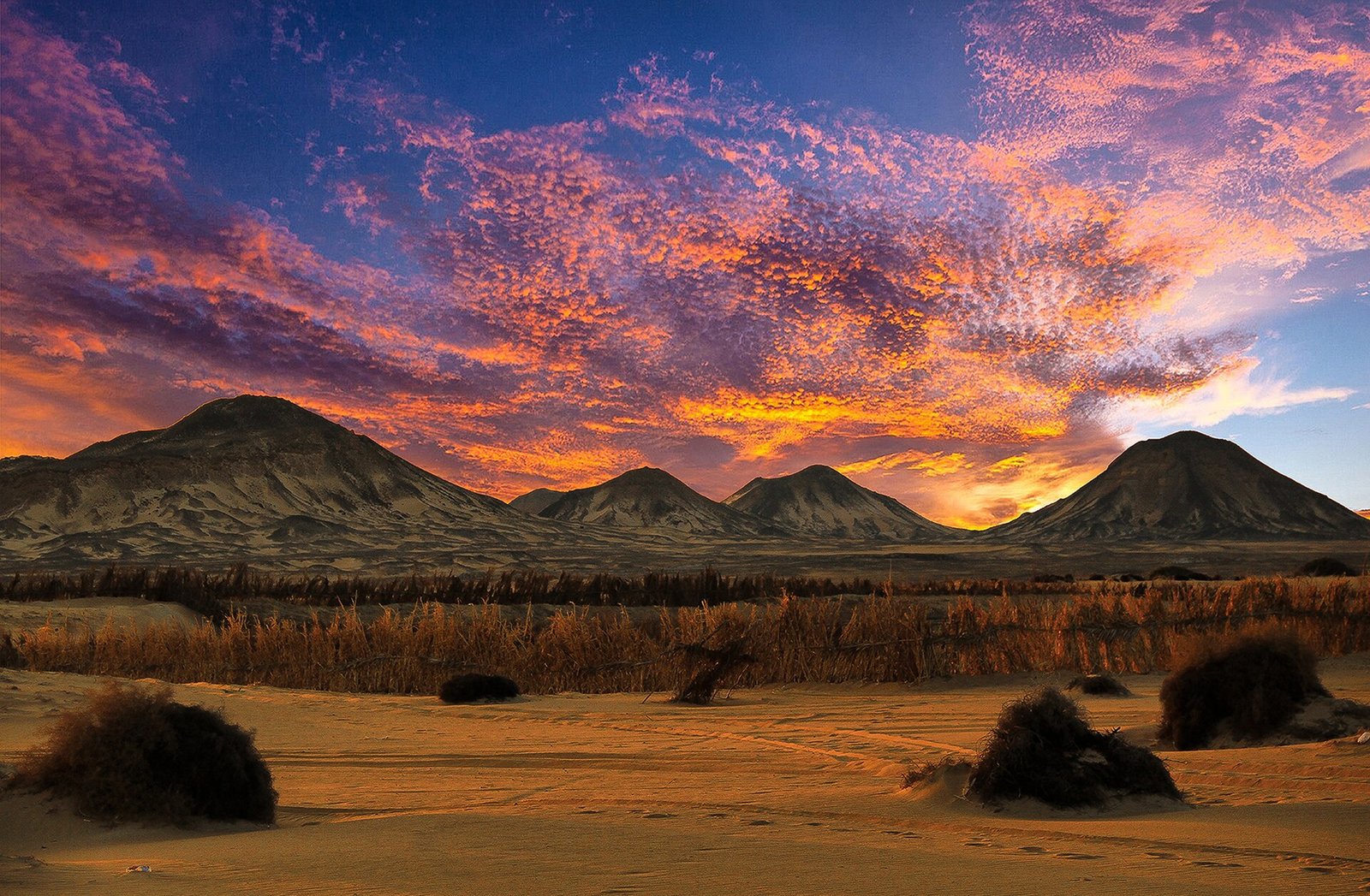
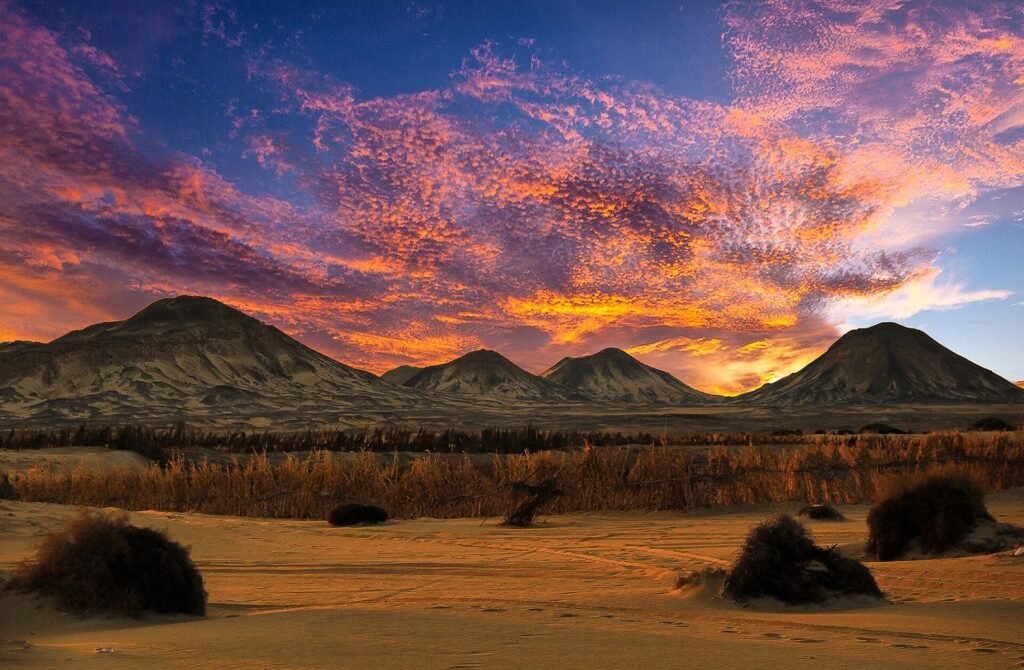
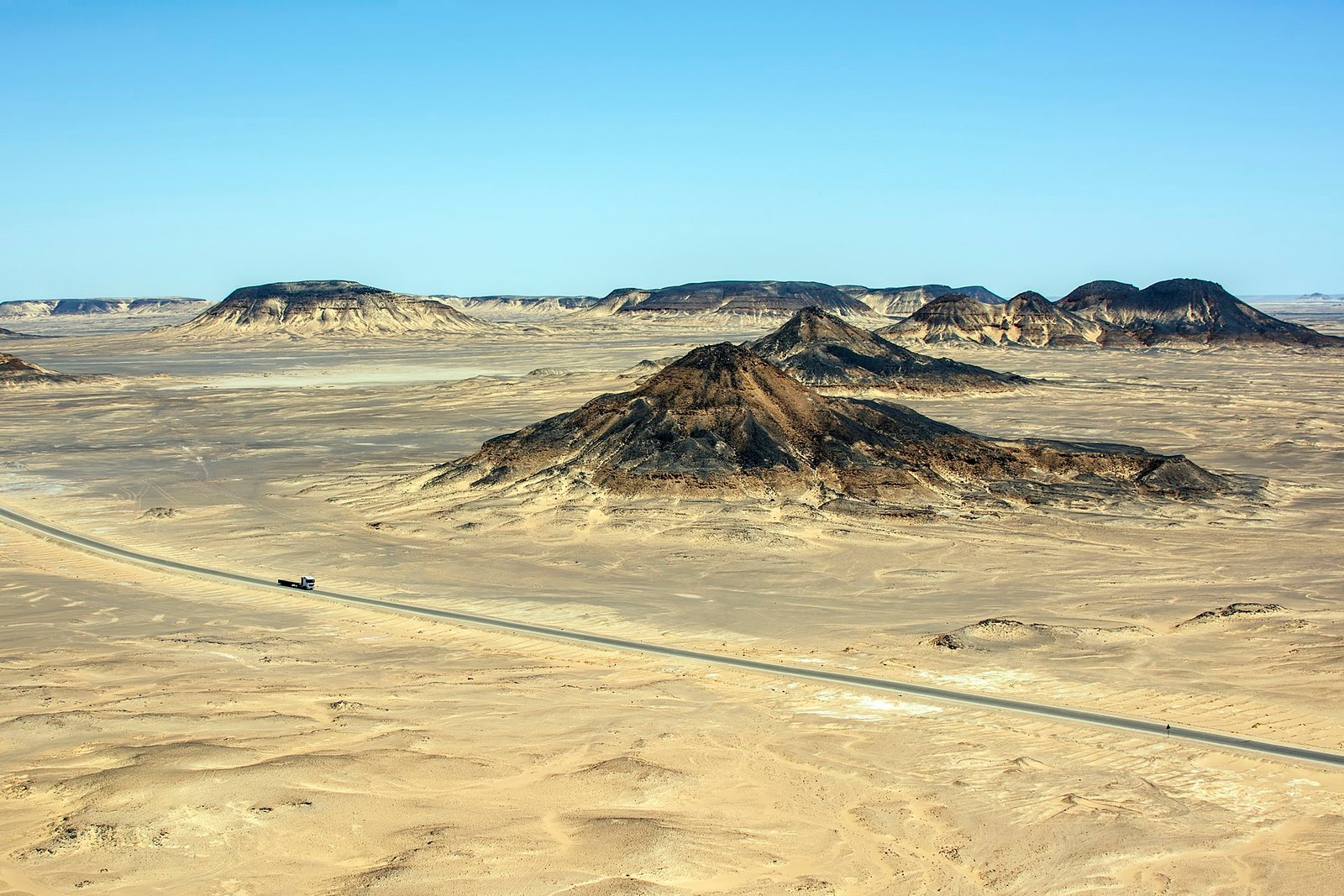
Drive four to five hours southwest of Cairo and you reach Bahariya, a working oasis of date palms and hot springs. From there a 4x4 crosses three landscapes in an afternoon: the Black Desert, low hills dusted with dark volcanic stone; Crystal Mountain, a ridge of quartz; then the White Desert, a field of chalk carved by wind into mushrooms, chickens, sphinxes and whatever else you decide you can see.
You camp among them. The crew cooks over a fire, foxes come to the edge of the light, and the chalk glows under the moon. Winter nights drop to around 0 C (32 F), so the blankets matter. Our guide to the White Desert in Egypt explains what the camp is really like.
Who it suits: couples, friends, photographers, and anyone who has stood in a crowded temple and wanted silence. Not ideal if a night without a bathroom door is a deal breaker.
How to add it: two days and one night out of Cairo, best at the end of the trip when a change of pace is welcome. If you are tempted, tell us now and we build the route around that night.
Siwa, Kharga and Dakhla, the long oasis road
These three are not detours; each is a trip in itself.
Siwa sits near the Libyan border, about ten hours by road from Cairo, and belongs to North Africa more than the Nile. People speak Siwi, an Amazigh language, the mudbrick fortress of Shali rises over the town, and the temple where Alexander consulted the oracle of Amun stands on a rock above the palms. Add salt lakes you float in and the dunes of the Great Sand Sea at sunset. Read our Siwa oasis guide before deciding, because the distance is real.
Kharga and Dakhla lie south on the old caravan route. Kharga has the temple of Hibis from the Persian period and Bagawat, a hillside of early Christian mudbrick chapels with painted ceilings. Dakhla has Al Qasr, a medieval town of covered lanes still partly lived in, and the Roman temple of Deir el Hagar.
Who it suits: second and third visits, travelers with two weeks or more, and people happy with simple lodges and long road days.
How to add it: Siwa needs three to four nights on its own, reached from Cairo via Marsa Matruh. The southern oases work as a loop from Cairo through Bahariya, Farafra, Dakhla and Kharga to Luxor, which our Egypt oasis route guide lays out day by day; it replaces the Cairo to Luxor flight with a week of desert.
Wadi el Natrun, Rosetta, Tanis and the Delta, the north nobody visits
Everything north of Cairo gets ignored because the road to Alexandria is treated as a transfer.
Wadi el Natrun is a desert valley off the Cairo to Alexandria road with four Coptic monasteries inhabited since the fourth century: Saint Bishoy, the Syrians, Saint Macarius and Baramus. Each has ancient churches, a keep tower with a drawbridge, and monks who show you around.
Rosetta, Rashid in Arabic, sits where the western branch of the Nile meets the sea. It has the finest Ottoman merchant houses in the country, red and black brick with lattice windows, and the fort where a French soldier found the stone that unlocked hieroglyphs.
Tanis, in the eastern Delta, was a royal capital of the later dynasties: a field of fallen obelisks and statues reused from Ramesses II, and intact tombs that held gold masks and a silver coffin, a treasure second only to Tutankhamun's.
Who it suits: Coptic history buffs, anyone driving to Alexandria anyway, and travelers who want green fields and small towns after the desert.
How to add it: the monasteries on the way up to Alexandria, Rosetta as a day from the city, Tanis as a long day out of Cairo on its own.
Gebel el Silsila, the Nile stop only a dahabiya makes
Between Edfu and Kom Ombo the cliffs close in on the river at Gebel el Silsila, where the sandstone for most of Upper Egypt's temples was quarried. The walls still carry ancient chisel marks, and along the west bank runs a row of rock shrines, including the chapel of Horemheb. Big cruise ships pass at speed because there is no dock.
A dahabiya, the sailing boat with a handful of cabins, ties up directly against the rock. You step off the deck into the quarry, walk the shrines with nobody else there, and swim off the boat afterward. Our guide to a dahabiya Nile cruise explains how the boat differs from the standard ships.
Who it suits: couples and small groups who want the Nile slowly, and anyone who has done the standard Luxor to Aswan cruise once.
How to add it: book the dahabiya instead of a motor cruise for the Luxor to Aswan leg. It takes a day or two longer and the stops are built into the sailing, so nothing else in the route changes.
Berenice, Wadi el Gemal and the deep south Red Sea
Most Red Sea trips stop at Hurghada. Keep driving south past Marsa Alam and the coast empties into a national park. Wadi el Gemal protects a stretch of shore and the mountains behind it: mangrove channels at Qulaan where Ababda families make tea on the sand, reefs that drop straight off the beach, the Sataya reef where spinner dolphins rest in the mornings, and inland, the Roman emerald mines of Sikait.
Berenice, at the bottom, was a Roman port for the India trade, and excavations keep turning up everything from pepper to a pet cemetery. The point is the reefs, the least visited in the country.
Who it suits: divers and snorkelers who have seen Hurghada, honeymooners who want an empty beach, and anyone pairing the Nile with the sea. Our Marsa Alam guide covers the base town.
How to add it: three or four nights at the end of the trip, driven from Luxor or Aswan across the Eastern Desert, then a domestic flight from Marsa Alam back to Cairo.
Every detour at a glance
| Place | What it is | Base | Time needed | Slots into |
|---|---|---|---|---|
| Dendera and Abydos | Two painted temples, the finest reliefs in Egypt | Luxor | 1 long day | Extra night in Luxor, or before the cruise |
| Beni Hasan, Amarna, Tuna el Gebel | Middle Kingdom tombs, Akhenaten's city, a Greek-Egyptian necropolis | Minya | 2 nights | Between Cairo and Luxor, by road |
| Fayoum and Wadi el Hitan | Lake, waterfalls, fossil whales | Cairo or Tunis village | 1 day or 1 night | Start or end of the Cairo block |
| Black and White Deserts | Volcanic hills and chalk sculptures, camping | Bahariya | 2 days, 1 night | End of the trip, after the monuments |
| Siwa | Amazigh oasis, oracle of Amun, salt lakes | Siwa | 3 to 4 nights | A trip of its own from Cairo |
| Kharga and Dakhla | Persian temple, Christian necropolis, medieval mudbrick town | Dakhla | 3 to 5 nights as a loop | Replaces the Cairo to Luxor flight |
| Wadi el Natrun | Four inhabited Coptic monasteries | Cairo or Alexandria | Half a day | On the way to Alexandria |
| Rosetta | Ottoman houses, the fort of the Rosetta Stone | Alexandria | 1 day | Day trip from Alexandria |
| Tanis | Ruined royal capital in the Delta | Cairo | 1 long day | Extra day in Cairo |
| Gebel el Silsila | Quarries and rock shrines on the Nile | Dahabiya | Built into the sailing | Replaces the motor cruise |
| Berenice and Wadi el Gemal | National park, mangroves, empty reefs | Marsa Alam | 3 to 4 nights | End of the trip, after Aswan |
Add the days up before you fall in love with the list. A first trip absorbs one or two short ones; a two-week second trip takes a desert block plus two or three day detours. Nobody does all of it in one go.
How Explora Egipto builds a second-visit itinerary
We are a local agency in Egypt with our own guides and vehicles, which is what makes these places practical: a driver who knows the Minya checkpoints, a camp crew in Bahariya, a captain in Hamata. When someone writes to us about an off the beaten path Egypt trip, it runs like this.
- We ask what you have already seen. A second visit skips what you loved last time unless you want it again, and that frees the days.
- We pick one anchor block. The Western Desert loop, Middle Egypt plus Abydos, or the deep south coast. One block gives the trip a shape; two makes it a road trip with no time to stop.
- We add the short detours where they fall. Dendera on the way into Luxor, Wadi el Natrun on the road to Alexandria, the Fayoum on your first free day in Cairo.
- We set the pace honestly. Oasis lodges run on generator hours, restaurants serve what was cooked that day, English thins out past the Nile. Our guide is with you throughout.
- We send the plan and the quote. One document, day by day, every drive time stated. You change whatever you like before anything is booked.
Every route is built from scratch, so ask us for the quote and it comes back with the itinerary attached.
Frequently asked questions
Can I do Egypt off the beaten path on a first trip?
Yes, as long as you add rather than replace. Keep the Pyramids, a Nile cruise and Abu Simbel, then add one or two short detours: Dendera and Abydos from Luxor, the Fayoum from Cairo, or a night in the White Desert at the end. Save Siwa, the southern oases and Middle Egypt for a second visit.
Which off the beaten path place in Egypt is the easiest to add?
Dendera and Abydos. It is one long day from Luxor on a good road, with no camping and no change of hotel, and the two temples are among the finest in the country. The Fayoum with Wadi el Hitan is the equivalent from Cairo. Both slot into any classic itinerary with a single extra night.
Is it safe to travel to Middle Egypt and the Western Desert?
Both are visited regularly with a licensed guide and driver, which is how we run them. Middle Egypt has police checkpoints and your guide handles the paperwork. The desert routes use established tracks and camp crews, and Siwa is reached on a paved road. Check your own government's current travel advice before you go.
How many days do I need for a full off the beaten path Egypt trip?
Two weeks combines one anchor block with several short detours: Cairo with the Fayoum, two nights in Minya, Abydos and Dendera into Luxor, a dahabiya to Aswan, and a White Desert night to finish. Three weeks adds Siwa or the southern oasis loop. A single desert night or a temple day fits into a week.
Do I need a 4x4 for these places?
Only for the last stretch into Wadi el Hitan, the White Desert camp, the Great Sand Sea at Siwa and the tracks inside Wadi el Gemal. Everything else, including Abydos, Middle Egypt, the oasis towns, Wadi el Natrun, Rosetta and Tanis, is reached on paved roads in a normal car. We provide the right vehicle for each day.
What is accommodation like off the main circuit?
Simple and often charming. Expect ecolodges and guesthouses in the Fayoum and the oases, mudbrick rooms in Siwa, a tented camp in the White Desert, and basic local hotels in Minya. Hot water may be solar, power may run on a generator schedule, and internet may be absent. The trade is silence, stars and hosts with time to talk. Tell us your limits and we choose accordingly.
See the Egypt that the buses drive past
Tell us what you have already seen, how many days you have and whether a night in a tent sounds like a treat or a threat. We come back with a day-by-day route, the drive times stated honestly, and the quote attached.