Ancient Egyptian writing was four scripts, and here is how to read a wall of it on your trip
Ancient Egyptian writing was four scripts, and here is how to read a wall of it on your trip
Ancient Egyptian writing was never a single script. Over roughly three and a half thousand years Egypt used four: hieroglyphs, the carved picture signs on temples and tombs; hieratic, the fast brush cursive of papyrus; demotic, the even faster script of contracts and daily business; and Coptic, the Egyptian language written in Greek letters that still sounds in Cairo's churches. Hieroglyphs mix signs that stand for words, signs that stand for sounds and silent signs that mark meaning, and they write no vowels, which is why nobody could read them for fourteen centuries until the Rosetta Stone. Below is how the system works, who wrote it, what survives to read on site, and how our guides read a wall for you.
Four scripts for three thousand years
The picture signs everyone recognizes are hieroglyphs, from a Greek phrase meaning sacred carvings. They appear around 3200 BC and stay in use until 394 AD, when the last dated inscription was cut at Philae near Aswan. They were reserved for what had to last: temple walls, tomb chapels, stelae and the cartouches around a king's name.
Carving a falcon with every feather is slow, so from the beginning scribes also wrote a brush cursive on papyrus. That is hieratic, the script of letters, accounts and school exercises. Around the seventh century BC an even faster cursive, demotic, took over daily business and ran Egypt's paperwork for a thousand years. It is the middle band on the Rosetta Stone.
Finally, from about the third century AD, Egyptian Christians wrote their language with the Greek alphabet plus six or seven letters borrowed from demotic. That is Coptic. It faded as a spoken tongue after the Arab conquest but survives in church liturgy, and it turned out to be the key to everything older.
| Script | In use | Written on | Used for | Where you meet it today |
|---|---|---|---|---|
| Hieroglyphic | About 3200 BC to 394 AD | Stone, painted plaster, fine papyri | Monuments, religious texts, royal names | Every temple and tomb wall, Book of the Dead papyri |
| Hieratic | Old Kingdom to the Late Period | Papyrus, ostraca, linen | Letters, accounts, literature, school | Museum papyri and ostraca, Deir el Medina |
| Demotic | About 650 BC to the fifth century AD | Papyrus, ostraca, stone | Contracts, business, some stories | Rosetta Stone middle band, graffiti at Philae |
| Coptic | Third century AD to today, in church | Papyrus, parchment, paper, stone | Christian texts, letters, spells | Coptic Museum, church liturgy, monastery walls |
How hieroglyphs actually work
The classic system used around 700 signs, growing to several thousand in the Greek and Roman temples. Each sign does one of three jobs, and the same picture can switch jobs between words.
- Logograms. A sign that means what it shows. A sun disk with a dot means sun or day. A small vertical stroke beneath a sign usually flags this use.
- Phonograms. A sign for a sound of one, two or three consonants. The water ripple is n, the mouth is r, the horned viper is f, the scarab writes kheper. String them together and you can spell anything, including foreign names like Ptolemy, which is exactly what cracked the code.
- Determinatives. A silent sign at the end of a word that gives its category: walking legs for motion, a sealed papyrus roll for abstract ideas, a seated god for a divinity. Egyptian had no spaces or punctuation, so the determinative also shows where one word ends.
No vowels
Like Arabic and Hebrew, Egyptian wrote consonants only. Beautiful is spelled nfr; we say nefer by convention, but nobody knows how a scribe in Thebes pronounced it, which is why one book says Amenhotep and another Amenophis.
Which way to read
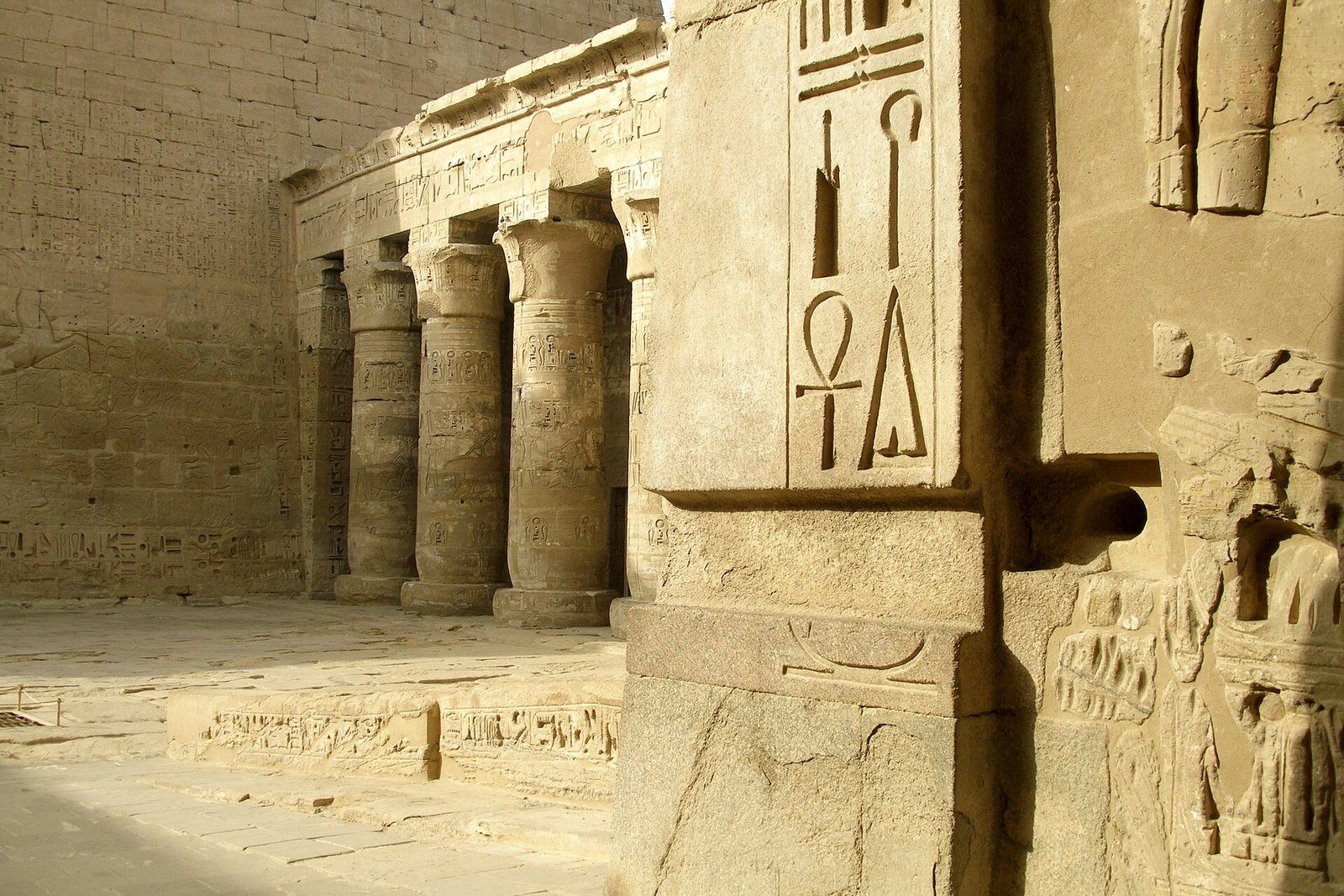
Signs face the beginning of the line. If the birds and people look left, start at the left and read toward their faces. Columns read top to bottom, and on a doorway the two jambs mirror each other so both read inward. Our guide to hieroglyphs and how to read them goes through the alphabet sign by sign; this page is about the system around them.
The scribes: who learned to write and how
By the most accepted estimates only a tiny minority of Egyptians could read, perhaps one person in a hundred. Writing was a profession, not a skill, and the door to every career that mattered, from tax assessor to vizier.
Boys started young, in schools attached to temples, palaces and offices, or apprenticed to a father in the trade. They spent years copying set texts onto ostraca, the limestone flakes and potsherds that served as a free notebook. Hieratic came first, because that is what an office used; hieroglyphs came later, for temple and monument work. Thousands of these exercises survive with the teacher's red corrections still on them.
The most copied school text, the Satire of the Trades, is a father telling his son that the metalworker has fingers like crocodile hide, the weaver sits with his knees at his chest, and only the scribe is his own master. It was classroom propaganda, and it worked: a scribe paid no labor tax, did no field work and could rise as far as his skill took him.
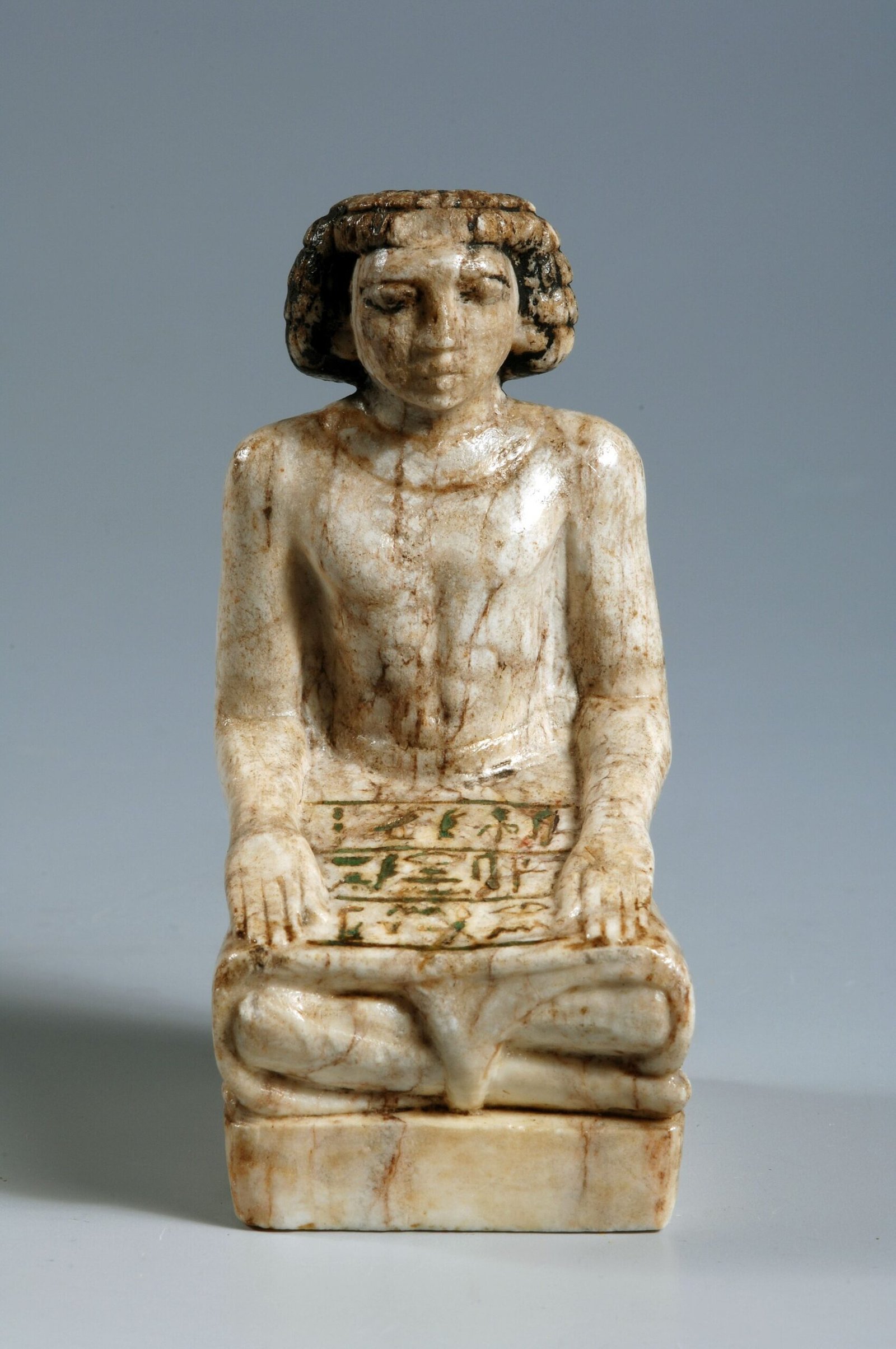
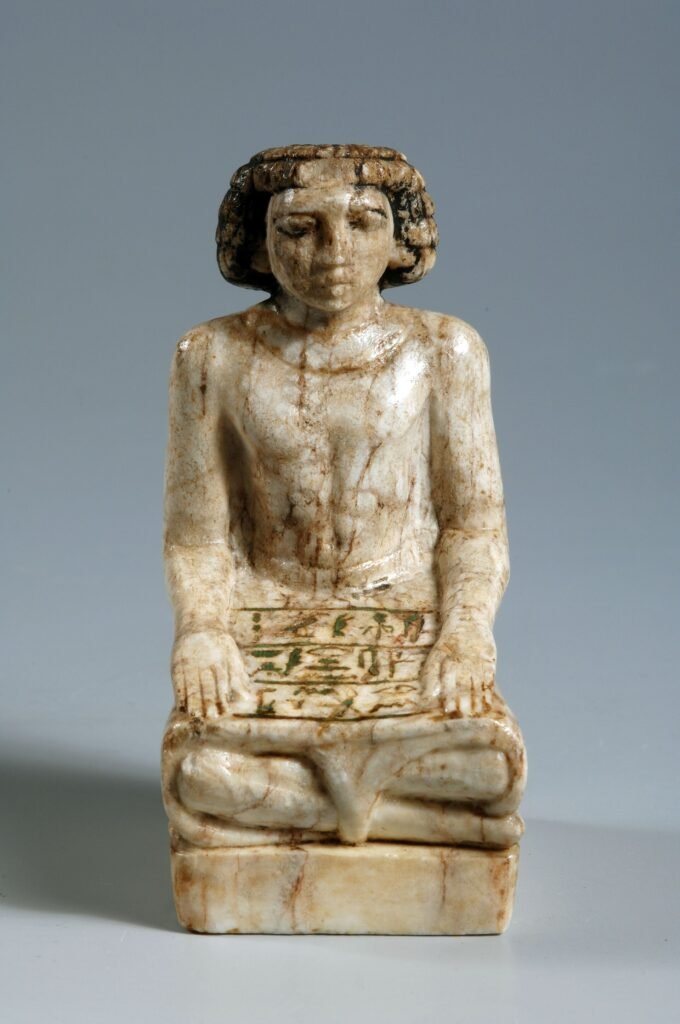
You will meet the profession in stone in the seated scribe statues of Cairo's museums, cross-legged, kilt pulled tight as a desk, papyrus open on the lap.
Papyrus, ostraca and the reed pen
Papyrus was Egypt's gift to the world's paperwork. Cut the stem of the marsh plant, strip the rind, slice the white pith into strips, lay one layer side by side and a second across it, then press and pound. The plant's own sap glues the layers. Dry the sheet in the sun, polish it, and glue sheets edge to edge into a roll; the longest known runs well over a hundred feet.
That crossed grain is also how you tell a real papyrus from a tourist fake. Hold it to the light: a genuine sheet shows an irregular lattice of two layers, while banana leaf imitations look uniform. Papyrus was expensive, so for anything short Egyptians used ostraca, the free flakes of limestone and broken pottery that litter every quarry and village.
The kit
- The pen. Not a quill and not a nib. A thin rush stem chewed at the tip into a fine brush. The split reed pen only arrived with the Greeks.
- The palette. A slim wooden board with two wells, black ink from soot and red from ochre, and a slot for brushes. Palettes were buried with their owners and fill museum cases.
- The ink. Dried cakes activated with a wet brush, like a watercolor block. Black for the text, red for headings, dates and dangerous words.
The Rosetta Stone and how the code was broken
After Philae, hieroglyphs fell silent. For fourteen centuries Europeans took them for mystical symbols, and every attempt to read them that way failed.
In 1799 French soldiers rebuilding a fort at Rashid, the town Europeans call Rosetta, pulled out a slab of dark granodiorite carrying one priestly decree of 196 BC in three scripts: hieroglyphic, demotic and Greek. Greek could be read, so at last there was a key. Thomas Young in England showed that the ovals in the hieroglyphic band spelled Ptolemy in sound signs. Jean Francois Champollion, who had learned Coptic as a teenager, realized the sound signs also wrote Egyptian words, and Coptic gave him those words.
In 1822 he read a cartouche copied from Abu Simbel: a sun disk, re in Coptic, then the signs for mes and s. Ra-mes-es. The whole system opened from there. The stone has been in the British Museum since 1802, and what you see in Egypt is a cast, but the full story is in our guide to the Rosetta Stone. The Coptic side of it sits in the Coptic Museum in Coptic Cairo, a short walk from the oldest churches in the city.
What you can actually read on site
Four things repeat so often that a visitor spots them by the second temple.
Cartouches
The oval rope loop holds a royal name. A king had five names and two go in cartouches: the throne name, introduced by the sedge and the bee, and the birth name, introduced by a duck and a sun disk meaning son of Ra. Learn the sun disk and the three fox skins that write mes, and you can find Ramesses on half the walls of Luxor.
The offering formula
Almost every stela and false door opens the same way: an offering which the king gives to Osiris, so that he may give bread and beer, oxen and fowl, to the spirit of the person named. It begins with a reed plant and a loaf on a mat, and once seen you will see it everywhere.
The Narmer Palette
A slate palette from Hierakonpolis, around 3100 BC, showing a king uniting the two lands. His name sits above his head as a catfish and a chisel, nar and mer, inside a palace facade. It is one of the earliest pieces of writing in the world, displayed in Cairo; collections have been moving to the Grand Egyptian Museum, so your guide confirms which building holds it.
Tomb autobiographies
Officials carved their careers on their tomb walls. At Qubbet el Hawa in Aswan, the expedition leader Harkhuf copied out a letter from the boy king Pepi II begging him to bring a dancing dwarf home safely. On papyrus, the spells of the Book of the Dead show the cursive hieroglyphs that sat between carved script and hieratic.
Where to see Egyptian writing, in the right order
You can follow the whole history of the script on the ground, ideally in this order.
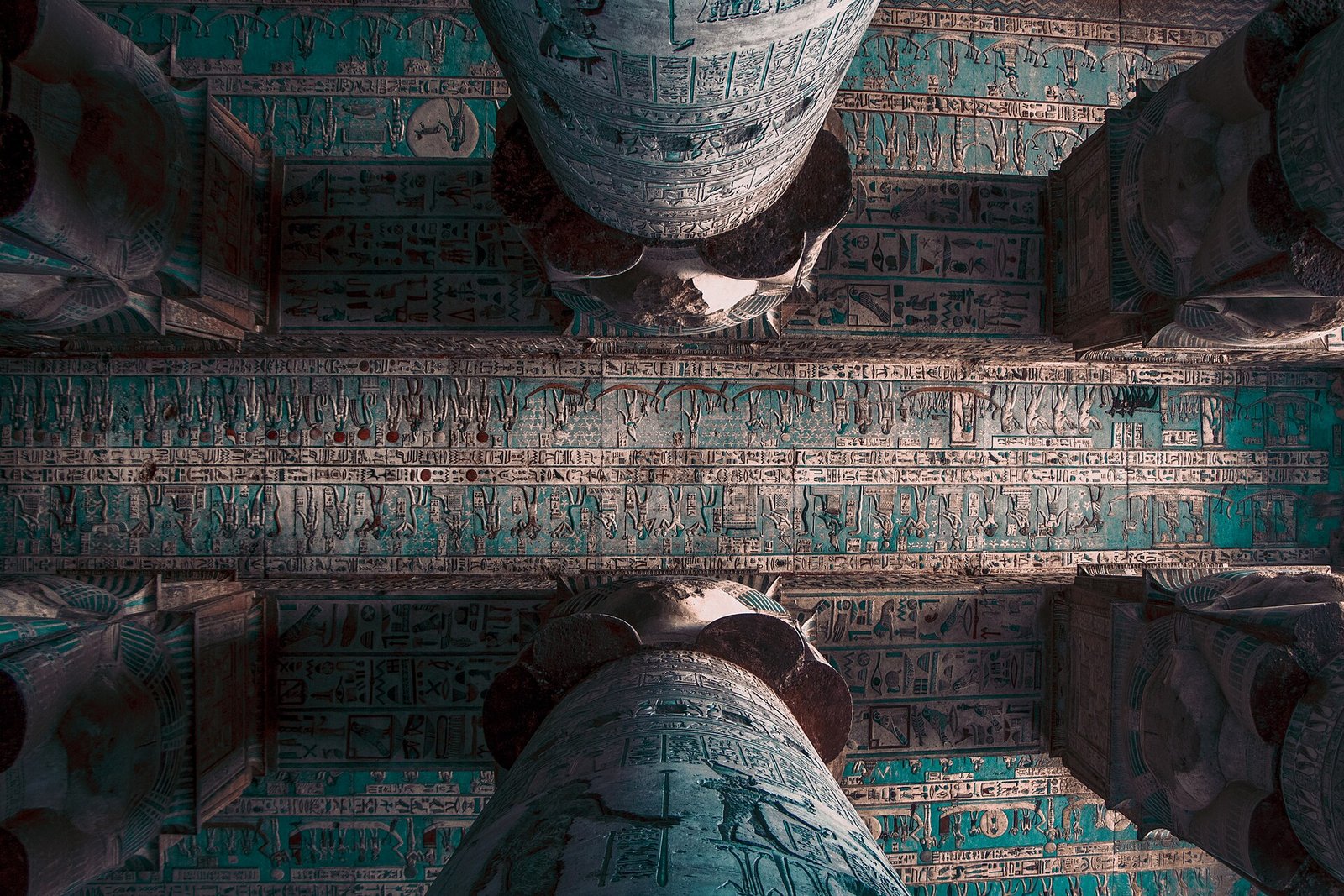
- Saqqara. The pyramid of Unas holds the Pyramid Texts, the oldest religious writings that survive anywhere, columns of blue-filled hieroglyphs under a ceiling of stars. Ask whether the chamber is open on your date.
- Cairo's museums. Scribe statues, palettes, papyri, ostraca and the Narmer Palette. The Egyptian Museum in Tahrir Square is where the writing cases are densest.
- Karnak and Luxor Temple. Hieroglyphs at monumental scale. The annals of Thutmose III at Karnak Temple and the Kadesh poem on the pylon of Luxor are the great narrative texts.
- Deir el Medina. The village of the tomb builders, source of most of the ostraca in the world's museums, with the painted tombs of the workers themselves.
- The Valley of the Kings. The Amduat and the Book of Gates, painted in the early tombs in a quick cursive that looks like a papyrus unrolled onto the wall.
- Philae. The last dated hieroglyphic inscription, from 394 AD, and the last demotic one, from 452 AD. Philae Temple is where the ancient script ends.
- The Coptic Museum in Old Cairo. Egyptian in Greek letters, which closes the circle: the newest script let Champollion read the oldest.
Deir el Medina: what ordinary Egyptians wrote down
Royal texts tell you what a king wanted remembered. Ostraca tell you what happened. The tomb builders of Deir el Medina were unusually literate, since they painted the texts in the royal tombs, and they wrote everything down on limestone flakes.
- Attendance registers with reasons for absence: stung by a scorpion, brewing beer, embalming a relative, drinking with a friend.
- The first recorded strike in history, in the twenty-ninth year of Ramesses III, when the crews put down their tools because their grain rations were weeks late.
- Loans, receipts, a lawsuit over a donkey, complaints to the vizier, love songs and satirical sketches of cats herding geese.
Most of the flakes are now in museums, but the village and the painted tombs of Sennedjem and Inherkhau are open, and those hieroglyphs were written by the same hands that wrote the shopping lists. Our page on the Deir el Medina workers' village covers the visit itself.
How a guide reads a wall for you
An Egyptologist guide does not translate a wall line by line; most of it is formula. What a good one does per scene is this.
- Orient you. Which way the signs face, so you know where the text starts, and whether it runs in rows or columns.
- Find the cartouches. Name the king, which dates the wall, and note whether a later king carved his own name over the original.
- Identify the god. By crown and animal head, then read the short columns in front of the face, which are speech: I give you all life, stability and dominion, forever.
- Read the action. The king offers Maat or wine, smites the enemies, receives the ankh at his nose. The verb sits right by the hand that does it.
- Show you the erasures. Hatshepsut hacked out by Thutmose III, the name of Amun chiseled away by Akhenaten and cut back in afterward, a cross scratched over a face. The damage is a second layer of history.
Done this way a wall stops being wallpaper and becomes a page. It is the biggest difference between seeing Egypt with a licensed Egyptologist and seeing it with a driver and a phone.
How Explora Egipto builds writing into your trip
We thread the subject through a normal Cairo, Luxor and Aswan itinerary so it builds in order and the guide has time to read. In practice:
- Saqqara before the Pyramids, so the Unas texts come first, then the Tahrir museum the same afternoon for the Narmer Palette and the scribe cases.
- A guide who reads hieroglyphs on every stop, briefed that you want the walls read, not summarized.
- A real papyrus workshop, not the shops by the bus stand, where you watch the strips pressed and can buy a genuine sheet.
- A domestic flight from Cairo to Luxor, then Karnak for the monumental script and Deir el Medina on the west bank afternoon for the ostraca side of the story.
- Qubbet el Hawa and Philae in Aswan, so the trip ends where the script ends, and the Coptic Museum on the last Cairo morning.
- For families, a sheet with your names in hieroglyphs to match on the walls.
Tell us your dates and how deep you want to go, and we send you the plan and the quote.
Frequently asked questions
What writing system did ancient Egypt use?
Four related scripts for one language. Hieroglyphs, the carved picture signs, served monuments from about 3200 BC to 394 AD. Hieratic was the brush cursive for papyrus. Demotic, faster still, handled business and contracts from about 650 BC. Coptic wrote late Egyptian in Greek letters from the third century AD and survives in Egypt's church liturgy.
Why do hieroglyphs have no vowels, and how do we know how to say them?
Egyptian, like Arabic and Hebrew, wrote consonants only; native readers supplied the vowels from knowing the language. We do not know the original vowels for most words, so Egyptologists insert an e by convention, which is why nfr becomes nefer. Coptic and Greek spellings of Egyptian names give real clues for some words, including the name of Ramesses.
Who could read and write in ancient Egypt?
A small professional class, by common scholarly estimate around one person in a hundred, mostly men trained for years in scribal schools attached to temples and offices. A scribe was exempt from field labor and could rise through the administration, which is why school texts praise the profession so hard and why fathers pushed sons into it.
Is the Rosetta Stone in Egypt?
No. The stone found at Rashid in 1799 passed to Britain in 1801 and has been in the British Museum in London since 1802. In Egypt you can see casts of it, and Rashid on the Delta coast has the fort where it was found. What you do see on site are the scripts themselves, hieroglyphic on every temple, demotic graffiti at Philae and Coptic in Old Cairo.
Which direction do you read hieroglyphs?
Toward the faces. The animals and people in a line of hieroglyphs look toward the beginning of the text, so if they face right you read from the right. Rows run in either direction; columns always read top to bottom. On doorways the two sides mirror each other so both read inward. The cursive scripts, hieratic and demotic, were almost always written right to left, like Arabic today.
Where is the best place to see hieroglyphs in Egypt?
For volume and quality, Karnak and the tombs of the Luxor west bank. For the oldest religious text, the pyramid of Unas at Saqqara. For painted hieroglyphs in perfect color, the tombs of Deir el Medina and the Valley of the Kings. For the very last ones, Philae in Aswan. For papyri, palettes and the Narmer Palette, the museums in Cairo.
Read the walls instead of looking at them
Tell us your dates, who is traveling and how much of the story you want, from the first name on the Narmer Palette to the last scratch at Philae, and we come back with an itinerary that follows the script in order, an Egyptologist who reads it aloud, and the quote in your inbox.