Wadi El Hitan, Egypt's Whale Valley, is the desert day trip most Cairo visitors never take
Wadi El Hitan, Egypt's Whale Valley, is the desert day trip most Cairo visitors never take
Wadi El Hitan, the Valley of the Whales, is a UNESCO World Heritage site in the Western Desert of Fayum where the fossil skeletons of early whales lie in the open sand, some of them still showing the small hind legs their ancestors walked on. You reach it from Cairo in a private 4x4 in roughly 3 hours each way, walk a marked trail among the skeletons, visit a small fossil museum sunk into the landscape, and drive back past the lakes and waterfalls of Wadi El Rayan. It works as a long day trip or, better, with a night in Tunis village.
What Wadi El Hitan actually is
Wadi El Hitan means Valley of the Whales in Arabic, and the name is literal. It is a stretch of pale desert inside the Wadi El Rayan Protected Area, southwest of Cairo in the Fayum governorate, where the bones of whales that swam here tens of millions of years ago have weathered out of the rock and now lie on the surface. You walk between them.
The area was once the floor of a warm, shallow sea called the Tethys. When it retreated, wind slowly uncovered what the sediments had buried: vertebrae in a line, ribs fanned out, a skull with teeth still in it, set among rock formations that look like another planet.
UNESCO listed the valley because it holds the most complete and concentrated record anywhere of the moment when the ancestors of whales gave up the land for good. Other sites have single specimens. Wadi El Hitan has a whole population, in the place where the animals died.
It belongs on a first visit only if you have a spare day in Cairo and like landscape as much as monuments. On a return trip it is close to essential, and we put it near the top of our ideas for a second time in Egypt.
The whales that still had legs
The two animals you will hear about most on the trail are Basilosaurus and Dorudon. Both are archaeocetes, the old whales, from the Eocene epoch.
Basilosaurus was the big one. The name means king lizard, because the first scientists to study it thought they had found a marine reptile. It had a long, snake-like body, a narrow skull with sharp teeth, and, near the base of the tail, a pair of tiny hind legs with a knee, an ankle and toes. Those legs could not have carried the animal on land. They are leftovers, evidence that its ancestors walked.
Dorudon was smaller and more compact, closer in shape to a large dolphin, and shared the same waters. Dorudon skeletons here include juveniles, one reason researchers believe the area was a calving ground. Some of the young bones carry bite marks that match Basilosaurus teeth.
The bigger story, told carefully, is this. Whales are mammals whose ancestors lived on land and, over a very long time, moved into the water to feed, then stayed. The final chapters of that journey, animals fully marine but still carrying the anatomy of walkers, are best preserved in this valley. A hand-sized leg bone beside a spine longer than a bus makes the point without any numbers.
The same rocks also hold sharks, turtles and fossilized mangrove roots that fix the ancient shoreline.
The walking trail and the fossil museum
The site is set up simply and well: a visitor building with shade, a museum and a marked walking trail that loops out through the fossils and back. Vehicles stay on the access track.
The trail
The loop is flat, sandy and exposed. Count on an hour to two hours at a relaxed pace with stops, longer if you photograph everything. The main skeletons sit behind a discreet rope with an information panel, and a few shelters built from local materials let you sit out of the sun. You pass a large Basilosaurus laid out in a line, several Dorudon, and the mangrove roots and shell beds.
The museum
The fossil museum is a low, sand-colored building set into a rise so it barely interrupts the view. The centerpiece is a full Basilosaurus skeleton mounted as it would have swum, which finally lets you see the shape of the animal after walking past its bones in pieces outside. Around it are smaller fossils, displays on the geology and a short film. Half an hour, best done before the trail.
Opening times change, so we confirm them for the day you travel rather than printing hours here. Your driver handles the tickets at the gate.
The landscape around it: Wadi El Rayan, the lakes and the dunes
Wadi El Hitan sits at the far end of a much larger protected area, and the drive through it is part of the day. Wadi El Rayan holds two lakes fed by drainage water from the Fayum farms. They look entirely natural, blue against yellow sand, with reeds and a surprising number of birds.
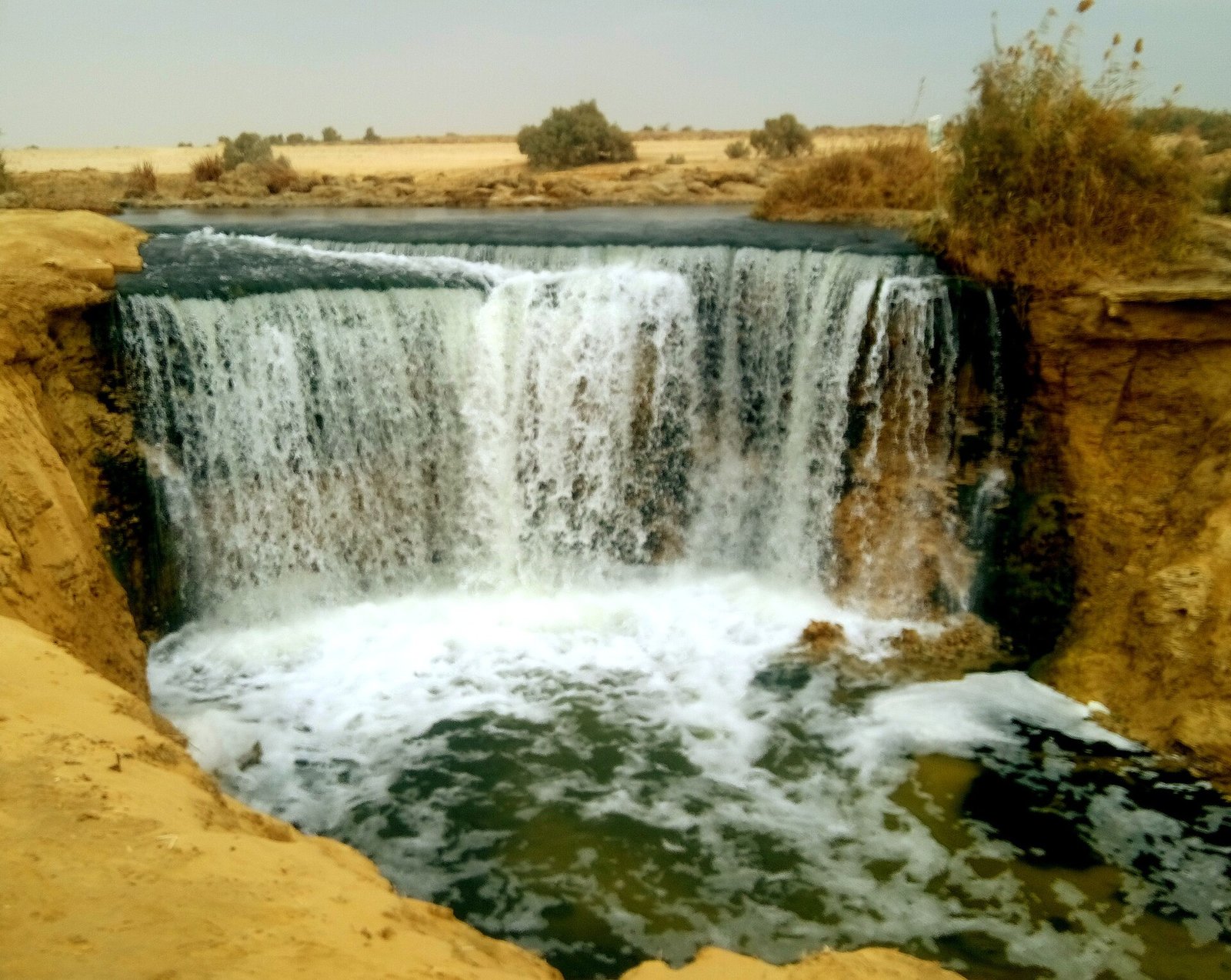
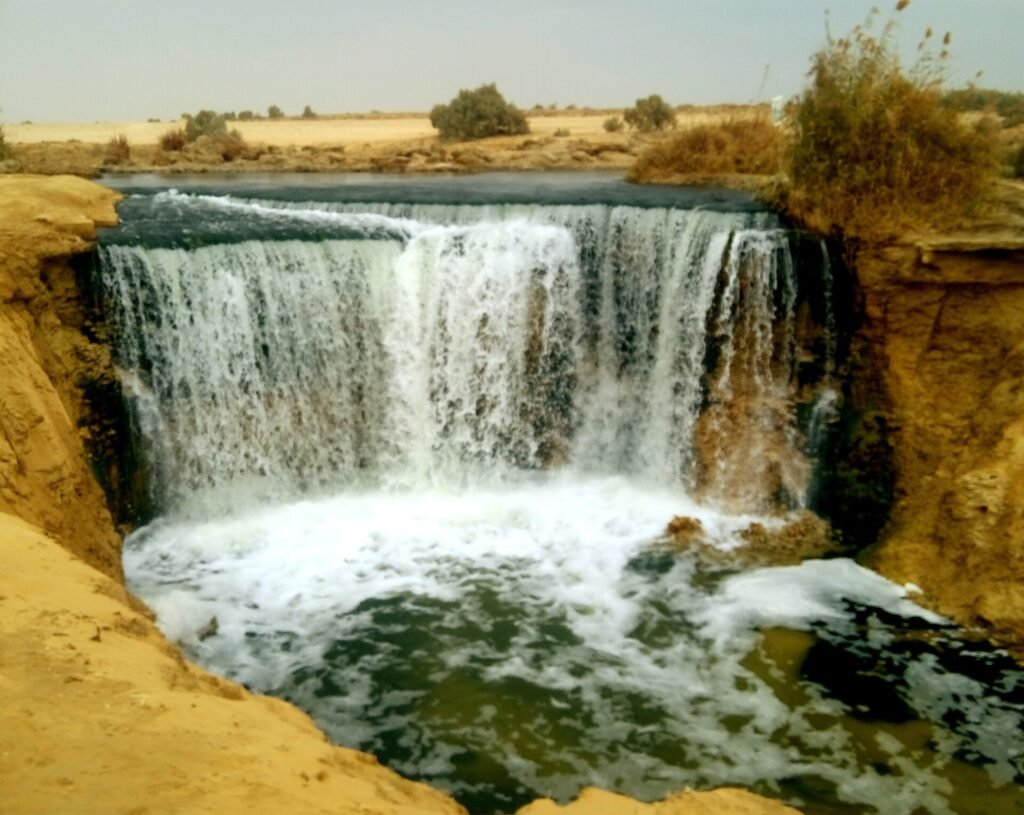
The two lakes sit at different levels, and where the upper one spills into the lower there is a set of small waterfalls, the only waterfalls in Egypt. They are modest, more rushing channels than a curtain of water, but the setting is striking.
Beyond the lakes the track climbs onto a plateau and the scenery changes. Golden dunes roll away to the horizon and the rock breaks into the mushroom-shaped buttes and eroded towers that make Wadi El Hitan itself look so strange. The last stretch is unpaved and soft in places, which is why the trip is done in a 4x4 with a driver who knows the track.
How to get there from Cairo, and the Tunis village option
There is no public transport to Wadi El Hitan. You go in a private vehicle, and the drive shapes the day.
The day trip from Cairo
- Pick-up at your Cairo hotel around sunrise, so you clear the city before the traffic builds.
- Highway southwest into the Fayum, roughly 2 hours, then through Wadi El Rayan and onto the desert track, roughly 1 more hour. About 3 hours door to door.
- Museum, trail and a rest in the shade. Two to three hours on site.
- Return via the waterfalls, arriving in Cairo after dark.
It is a long day, ten to twelve hours with six of them in the car, and the version that leaves people wishing they had stayed the night.
The night in Tunis village
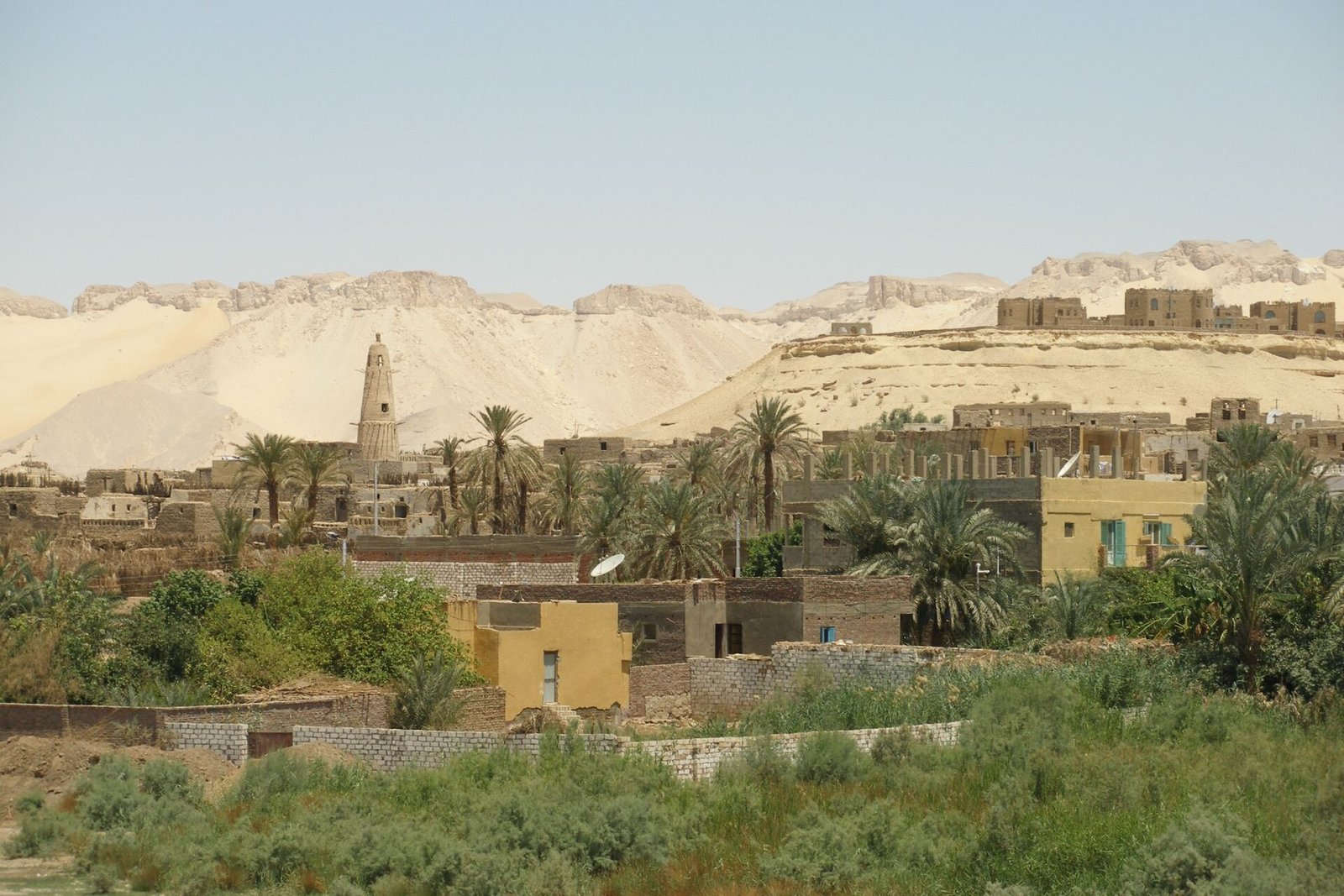
Tunis is a small village on the southern shore of Lake Qarun. It became known for pottery when a Swiss potter settled there decades ago, and it has grown into a quiet retreat of mud-brick guesthouses and workshops above the lake. From Tunis the whales are about an hour away, which turns the visit into an unhurried morning.
Drive from Cairo after breakfast, lunch in Tunis, an afternoon at the workshops and the lake, then out to Wadi El Hitan at first light when the air is cool and the rock is gold. Back to Cairo after lunch on day two. Our Egypt tourist map shows how close the Fayum sits to Cairo. It is nearer than most people expect.
Day trip or a night in Tunis: which suits you
| Option | What you see | Pace | Who it suits |
|---|---|---|---|
| Day trip from Cairo | Museum, the full fossil trail, the Wadi El Rayan lakes and a quick stop at the waterfalls. | Fast. Early start, about six hours of driving, on site around midday, back after dark. | Travelers with one spare day in Cairo, couples and friends who do not mind a long drive. |
| Night in Tunis village | Everything above plus Tunis pottery, Lake Qarun, a proper sunset and a dawn visit to the skeletons with nobody else there. | Relaxed. Short drives, the trail in cool morning light, time to sit in the shelters and actually look. | Families with children, photographers, older travelers, anyone on a second visit to Egypt. |
The short version: if you can, stay the night. If you cannot, the day trip is still one of the best of our Cairo excursions, and nothing else on that list looks remotely like this.
Best months and best hours, in Fahrenheit and Celsius
There is no shade except what the site provides, so the season matters more here than at any temple.
- October to April is the window. Daytime highs sit in the 70s and low 80s F (low to high 20s C) and a walk at noon is comfortable. December and January mornings can start in the 40s F (single digits C), so bring a layer for the dawn visit.
- May and September are workable if you go early. Highs push into the 90s F (mid 30s C). Do the trail at first light and be off it before late morning.
- June to August is the season we steer people away from. Highs pass 100 F (38 C) and the rock radiates heat back at you. If it is the only time you can come, it has to be a night in Tunis and a walk that starts at sunrise and ends by mid-morning. Never the trail at midday in summer, for anyone.
Whatever the month, the best hours on the trail are the first after sunrise and the last before sunset, when the low sun turns the sandstone gold and every rib casts a shadow. At midday the scene flattens and everything is white.
Spring sandstorms, usually in March and April, can close the track for a day, and we shift the date when we have to. For the wider picture, see our guide to the best time to visit Egypt.
What to bring
Pack for a desert walk, not a museum visit.
- Closed shoes with a proper sole. The trail is sand and loose rock, and sandals fill with grit within minutes.
- A wide hat and sunglasses. There is no tree on the entire loop.
- Water, more than you think. Your driver carries a cooler, but keep a bottle in your hand on the trail.
- A light scarf for the wind and dust, and a warm layer from November to February for the early morning.
- Snacks or a packed lunch. Do not rely on the small cafe at the visitor center being stocked.
- Cash in small notes for tickets and tips, since there is no card machine in the desert.
Our general what to pack for Egypt list covers the rest of the trip, but the whales need this shorter, more specific kit.
Combining the whales with Tunis pottery, Lake Qarun and the waterfalls
The whales are rarely the only stop. These are the three natural companions.
Tunis village pottery
The workshops in Tunis produce glazed bowls, plates and tiles painted with fish, birds and village scenes in blues and ochres. You can watch a wheel being thrown, try it yourself, and buy directly from the family that made the piece.
Lake Qarun
Qarun is an ancient natural lake, salty now, wide and shallow, with the desert escarpment rising on the far shore. A walk along the shore at sunset is enough. Birders should bring binoculars, since flamingos, herons and waders are common in the cooler months.
The Wadi El Rayan waterfalls
The waterfalls are on the way to the whales: a brief look on the way out, a longer stop with a swim on the way back.
Two days covers all of this without hurrying. Tell us what else is on your list and we fit the whales around it as part of a custom Egypt tour.
Children and the walk
Wadi El Hitan is one of the best places in Egypt for children, with a few conditions. The trail is flat, so the walk is easy for a school-age child, and the appeal is obvious: real whale skeletons, a whale with legs, and a desert to run around in. Children bored by the third temple come alive here.
Strollers do not work on the sand, so a toddler has to be carried, and summer is a bad idea for the very young. From around six upward, in the cool months, with a hat and a water bottle each, it is a wonderful day. Break the trail in half with a rest in a shelter.
The drive is the real test. Six hours in a vehicle in one day is a lot for a small child, another argument for the night in Tunis. More on pacing in our family guide to traveling in Egypt with kids.
One rule to explain before you arrive: the fossils are not to be touched or climbed, and nothing leaves the site, not even a shell.
Photography and drone rules, in general terms
Ordinary photography on the trail and in the museum is allowed and encouraged. The usual courtesies apply: stay on the marked path, do not step over ropes, and do not move anything, even a small stone, for a better composition.
For the best pictures, come at the golden hours, get low so the skeleton sits against the sky, and use a wide lens for the long Basilosaurus and a short telephoto for the skull. Keep the lens cap on between shots, since the wind carries fine sand.
Drones are a different matter. Egypt treats drones as controlled equipment. Flying one needs official authorization that tourists rarely obtain, and protected areas are where the rules are enforced most strictly. Do not bring a drone to Egypt expecting to fly it, and never fly one at Wadi El Hitan. A ranger who sees one can end your visit.
Our broader notes on cameras at monuments and where permits are needed are in our guide to photography tips and camera rules in Egypt.
What a guide adds at Wadi El Hitan
A determined traveler could walk the loop alone and come away impressed. What a guide changes is the difference between seeing bones and reading them.
A guide who knows the valley will point to the tiny leg bones on the Basilosaurus, which most visitors walk straight past because they are looking at the enormous spine. They will explain why the young Dorudon are here, and how the local Bedouin came to be the valley's guardians. On the drive they will name the rocks, the birds and the plants that survive on almost no rain.
There is also the practical side: a driver who knows the track, tickets at the gate, timing that puts you on the trail in good light and off it before the heat. Our guides are local, our vehicles are ours, and the Fayum is a route we drive every week.
Frequently asked questions
Is Wadi El Hitan worth the long drive from Cairo?
Yes, for anyone who likes landscape and natural history and has a full day to spare. The drive is about 3 hours each way, but the last hour through Wadi El Rayan is scenic in its own right, and the site itself is unlike anything else in Egypt. If the drive is what holds you back, split it with a night in Tunis village and the day becomes easy.
Can you visit Wadi El Hitan without a 4x4?
Not comfortably or reliably. The paved road ends inside the protected area and the final stretch to the whales is a desert track with soft sand. A sedan can get stuck, and there is no recovery service out there. We use 4x4 vehicles with drivers who know the track, and we advise strongly against attempting it in a rental car.
How long do you spend at the site?
Plan two to three hours: about half an hour in the museum, an hour to two hours on the walking trail with stops, and a rest in the shade. Photographers and families with curious children often stay longer. The rangers do not hurry anyone, and the only real limit is the sun, which is why we time arrival for the morning.
Is the walk suitable for older travelers or people with limited mobility?
The trail is flat and firm in most places, with shelters to rest in, so anyone who can walk on sand for an hour at a gentle pace will manage. Wheelchairs and strollers do not work on the surface. If mobility is a concern, tell us in advance and we plan a shorter version that covers the museum and the nearest skeletons.
Are there real skeletons on the trail or replicas?
The skeletons along the trail are the real fossils, left where they were uncovered and stabilized in place. That is what makes the valley a World Heritage site. The mounted Basilosaurus in the museum is assembled to show the whole animal. Nothing may be touched or removed, and the rangers enforce that carefully because the site depends on it.
Can Wadi El Hitan be combined with the pyramids on the same day?
Not sensibly. The whales need a full day from Cairo, and Giza deserves a morning of its own. What works is a two-day pairing: pyramids and Saqqara one day, then the Fayum the next, or Giza in the morning and a drive to Tunis village that afternoon with the whales at dawn the following day. We build either version for you.
Go and see the whale with legs
Tell us your dates in Cairo, whether you want the day trip or the night in Tunis, and who is traveling. We send you the quote with a private 4x4, a guide who knows the valley, and the stops at the lakes and the pottery village built in.