The Catacombs of Kom el Shoqafa are the strangest hour you will spend underground in Egypt
The Catacombs of Kom el Shoqafa are the strangest hour you will spend underground in Egypt
The Catacombs of Kom el Shoqafa are the largest Roman-era burial site in Egypt, three levels of tombs cut into the bedrock of Alexandria in the second century AD and forgotten until a donkey fell through the roof in 1900. You go down a spiral staircase around the shaft where coffins were lowered on ropes, pass a rock-cut dining room where families feasted with their dead, and reach a burial chamber where the god Anubis stands guard dressed as a Roman legionary. The lowest level is flooded and closed, the upper two are open, and a guided visit takes about an hour. It fits naturally into an Alexandria day from Cairo with Pompey's Pillar and the Qaitbay Citadel, which Explora Egipto runs with its own guide and vehicle.
What the Catacombs of Kom el Shoqafa actually are
Kom el Shoqafa means Mound of Shards in Arabic, and the name is older than the archaeology. For centuries the hill in the Karmouz district of Alexandria was littered with broken pottery and nobody asked why. The answer was under their feet: a private burial complex begun in the second century AD for one wealthy family, then expanded over roughly two hundred years into a public necropolis with hundreds of burial niches on three underground levels.
This was Roman Alexandria, a Greek-speaking city ruled from Rome and built on Egyptian ground. The families who paid for these tombs wanted all three identities on the walls, so the architecture is Greek, the funerary imagery is Egyptian and the clothing in the carvings is Roman. No other site in the Mediterranean mixes the three this openly in a single room.
Our guide to what to see in Alexandria explains how the city keeps most of its ancient past underwater or underground. Kom el Shoqafa is the one place where you walk into that past and stand in a decorated room that has not moved in eighteen centuries.
The donkey that found it in 1900
Every guide in Alexandria tells the story, and it is true in its essentials. On a September day in 1900 a donkey pulling a cart across the hill stepped onto ground that gave way and dropped into the access shaft of the catacombs. The men who climbed down after it found themselves at the top of a stone staircase spiraling into the dark.
The timing was not luck alone. The city's Greco-Roman Museum had been searching that hill for years, because ancient writers and stray finds all pointed to a major necropolis in the area. The donkey simply got there first. Within months a German expedition was documenting the reliefs, and the site became the most complete Roman-period tomb ever recorded in Egypt.
What they found was not treasure in the Tutankhamun sense. The niches had been emptied in antiquity and the sarcophagi are solid rock, carved to look like closed coffins. The treasure was the decoration, intact because nobody had been down there to damage it.
The spiral staircase and the three levels
The visit starts at ground level with a round opening in the floor. Around it winds the staircase, about a hundred steps in a wide spiral, cut so that a coffin could be lowered straight down the central shaft on ropes while the mourners walked beside it. Small windows in the shaft wall lit the way.
The first level opens into a rotunda with a domed ceiling and a well in the middle, the same shaft continued. Off it are the triclinium, the banqueting hall we cover below, and passages lined with loculi, the rectangular burial slots stacked in the walls like shelves.
The second level is the reason you came: a short staircase leads to the vestibule and burial chamber of the principal tomb, with the Anubis figures and the embalming reliefs. The third level is under water and closed. You see the top of the stairs going down and the dark surface below, and since nothing decorated is on that level, you miss depth rather than a room.
| Level | What is there | Open |
|---|---|---|
| Ground | Shaft opening, top of the spiral staircase, relocated tombs in the garden | Yes |
| First | Rotunda, triclinium, loculi galleries, Hall of Caracalla | Yes |
| Second | Principal tomb: vestibule, burial chamber, Anubis reliefs, sarcophagi | Yes |
| Third | Plain burial galleries, permanently flooded | No |
Anubis in Roman armor, and why the mix of styles matters
Stand at the door of the burial chamber and look at the two figures flanking it. On one side is Anubis, the jackal-headed god who guards the dead, wearing a Roman legionary's cuirass and strap skirt and holding a spear. On the other is a second jackal-headed guardian with the lower body of a serpent. The Egyptian idea, the Roman uniform and the Greek carving technique share one block of stone.
The whole tomb reads like that. The facade has columns with capitals built from papyrus, lotus and acanthus leaves under a pediment with a winged sun disk and Horus falcons. Inside, the three rock-cut sarcophagi are Roman in shape, decorated with garlands, ox skulls and Medusa heads, while the scenes carved above them are pure pharaonic: a mummy on a lion-headed bed with Anubis embalming it, Thoth and Horus attending, and an Apis bull receiving a necklace from an emperor dressed as a pharaoh.
Two bearded serpents guard the vestibule, each wearing the double crown of Egypt and holding the caduceus of Hermes and the thyrsus of Dionysus, with a Gorgon shield above to ward off robbers. None of this is confusion. A family that felt Greek, lived under Rome and was buried in Egypt asked for exactly this.
To name the figures yourself, read our page on how to recognize the Egyptian gods, and for what the embalming scene shows, the guide to mummification in ancient Egypt.
The triclinium and the Hall of Caracalla
Off the rotunda on the first level is a square room with stone benches along three walls around an open center. This is the triclinium, a dining room, and it changes how you read the site. Greek and Roman custom required families to visit their dead on set days and eat a meal in their company. Relatives came down the stairs with food and wine, reclined on cushions on these benches and held a banquet a few yards from the burial niches.
The pottery was considered unclean after contact with the dead, so it was smashed and left on the hill above rather than carried home. Two thousand years of broken cups became the mound of shards that named the site. The catacombs were built for the living to return to.
The Hall of Caracalla
Through a breach in the wall on the first level you enter a separate, older tomb complex that excavators broke into by accident. It is called the Hall of Caracalla, and when it was cleared it held a mass of human and horse bones piled together. Tradition links them to 215 AD, when the emperor Caracalla visited Alexandria, took offense at the city's mockery and had a large number of its young men killed. It cannot be proven, but the story has stuck to the room.
The same wing has painted tombs rather than carved ones, with traces of the color the whole complex once had. Look for the mummification of Osiris painted next to the abduction of Persephone, an Egyptian and a Greek story of death and return on the same wall.
Why the lowest level is under water
The flooding is not neglect. Alexandria sits on a strip between the sea and Lake Mariout, and its groundwater has risen steadily over the last century because of building, leaking pipes and the loss of the old natural drainage. The catacombs were cut downward through bedrock, and the deepest level ended up below the water table. It has been wet since the excavation and it stays wet.
The real concern is what the water does to the stone. Dissolved salt creeps up the rock, dries and crystallizes, and the crystals pry the surface apart, the same process eating at the monuments of Giza. Pumping and drainage campaigns have stabilized the upper levels.
For a visitor the result is simple. Two of the three levels are on the route, both decorated chambers are on those levels, and the closed level was for plain burials. You lose depth, not content.
The Tigrane tomb and the other tombs in the garden
Do not walk straight from the gate to the staircase. The grounds around the shaft hold several tombs found elsewhere in Alexandria, dismantled and rebuilt here to save them from construction. The best is the Tigrane tomb, named for the street where it turned up in the 1950s: a small Roman-period chamber with painted rather than carved decoration, and its colors have held far better than anything in the main catacombs.
Inside, a mummy lies on a bed between Isis and Nephthys under a winged sun disk, with Egyptian and Greek ornament mixed around it, the same fusion as below but in paint. You see it in five minutes, and it shows you what the great chamber downstairs looked like when its reliefs were still colored.
Nearby are the Wardian tomb, another relocated chamber, and a scatter of sarcophagi. Give the garden ten minutes at the start rather than skipping it on the way out.
How long it takes, the stairs and the humidity
A full visit with a guide runs about an hour: the garden, the descent, the rotunda and triclinium, the principal tomb, the Hall of Caracalla and the climb back up. On your own you can be done in half that.
The stairs are the main physical demand. You go down roughly a hundred steps on the spiral and a shorter flight to the second level, then back up all of them. The treads are wide and even, but there is no elevator and no other route. Anyone who manages a couple of flights at home can do it at their own pace. With a knee or hip problem, go slowly and use the wall.
Underground it is cool and damp in every season, the air feels heavy and the floor is wet in places near the lower stairs. The lighting is functional rather than generous, so a small flashlight or your phone light helps you see the detail on the sarcophagi.
- Wear closed shoes with grip. Sandals slip on the lower steps.
- Carry a light layer even in summer. It is noticeably cooler than the street.
- Leave large bags in the vehicle. The passages are narrow.
- Photography rules change, so your guide confirms what is allowed on the day.
- Check current opening hours before you go, especially around holidays and Ramadan.
Building the Alexandria day: catacombs, Pompey's Pillar and Qaitbay
Most Americans see the catacombs on a day trip from Cairo, and the geography makes that easy. The catacombs and Pompey's Pillar are in the same Karmouz neighborhood, a few minutes apart by car and walkable when the weather is kind. The pillar is the one monumental column still standing in Alexandria, on the site of the Serapeum, the temple that held the overflow of the ancient library, with rock-cut galleries beneath it where the scrolls were stored.
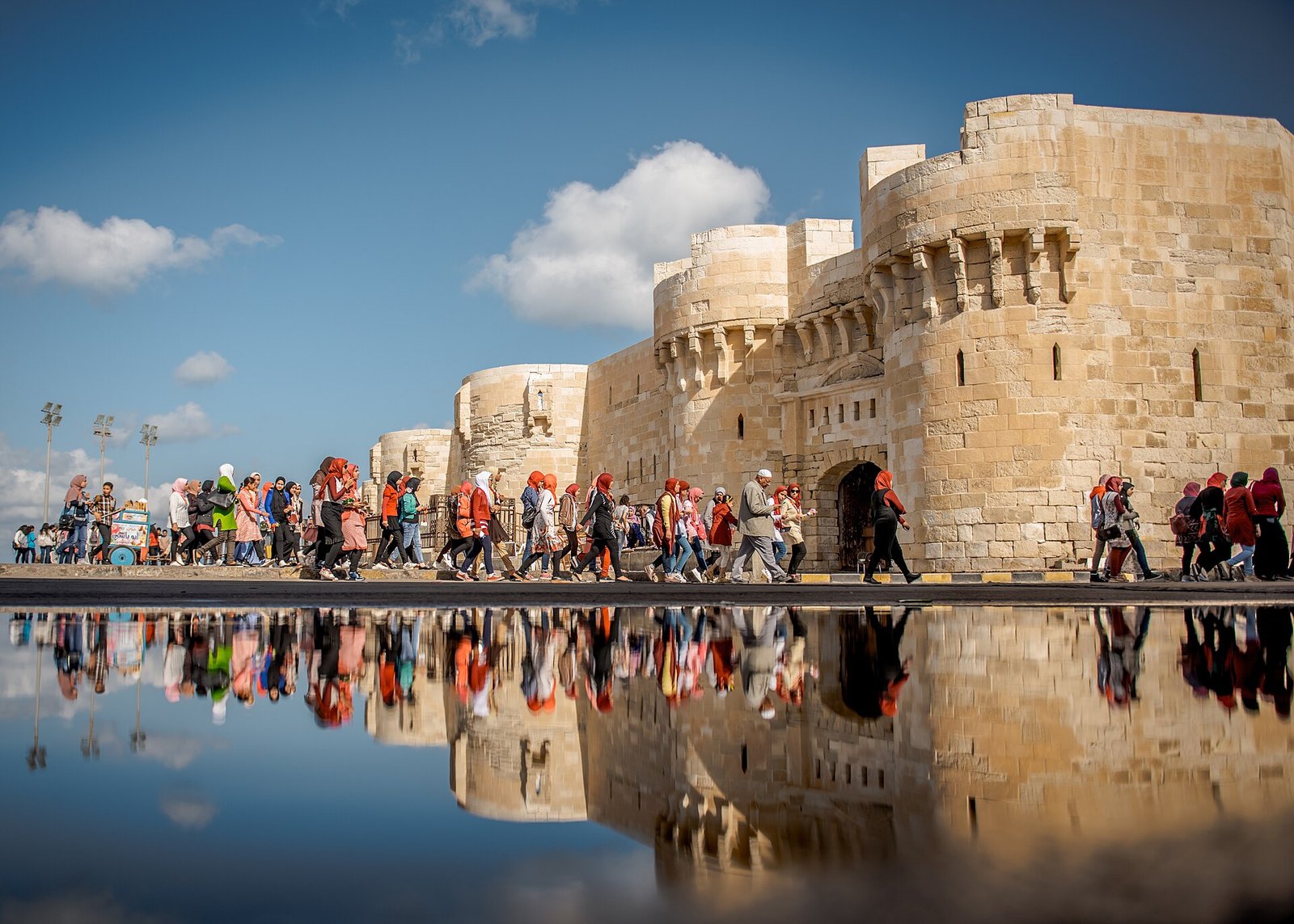
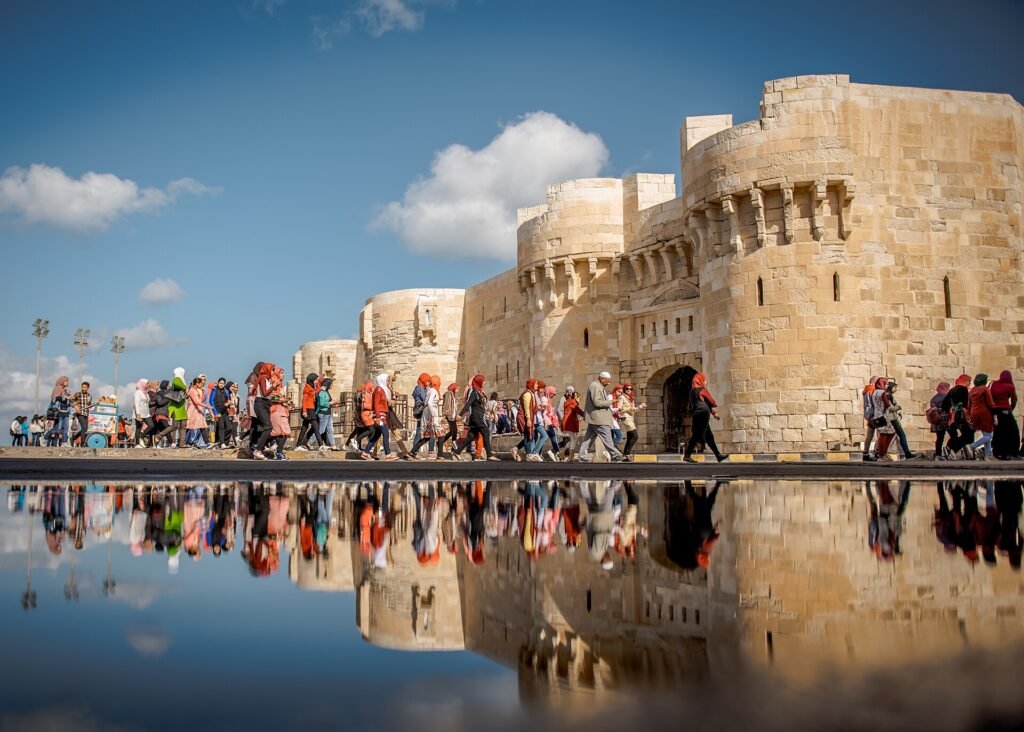
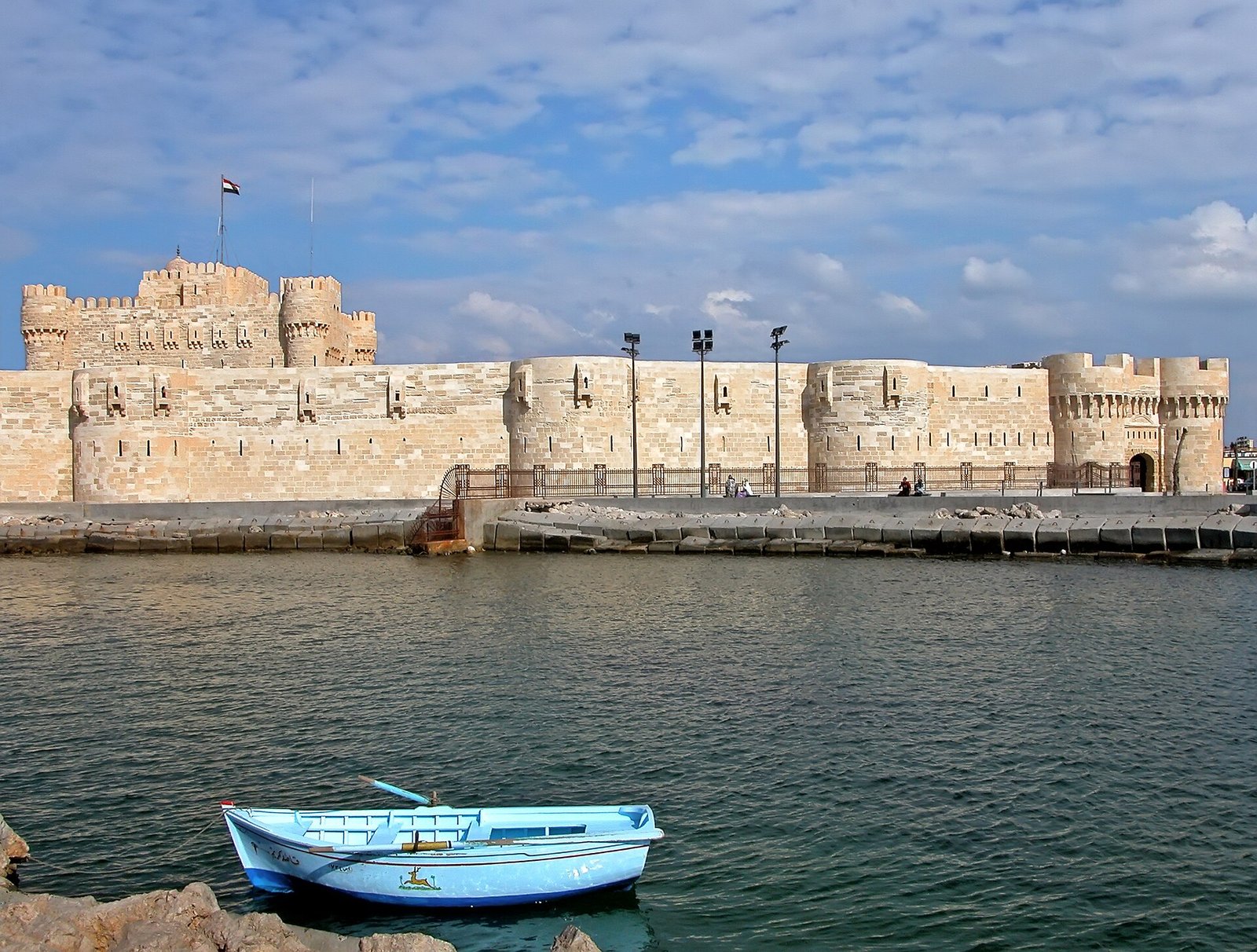
From there the day moves north to the sea. The Qaitbay Citadel sits on the tip of the eastern harbor on the foundations of the Pharos lighthouse, with blocks from the lighthouse built into its walls. Then the Corniche, a fish lunch by the water, and the Bibliotheca Alexandrina, the modern library built where the ancient one stood, before the drive back.
The drive is the price of the day: around three hours each way on the desert road, so an early start and a late return. If you can give the city a night, you see the same sites without the clock, add the Greco-Roman Museum, and get an evening on the Corniche, which is when Alexandria is at its best.
Alexandria is also the city of Cleopatra, and while her palace is under the harbor, the catacombs are the closest you get to the Alexandria that came right after her. Read our page on Cleopatra and her Alexandria before you go, and the guide to the Rosetta Stone, found just down the coast.
What a guide adds, and how Explora Egipto runs the visit
This is the site in Egypt where a guide makes the biggest difference per minute. The pyramids impress you without a word. The catacombs are a series of dim rooms with worn carvings, and without someone pointing at Anubis and explaining why his armor is Roman, most people walk through in twenty minutes and come out wondering what the fuss was about.
A good Egyptologist guide reads the reliefs figure by figure, explains how a coffin went from the shaft into a loculus sealed with a plastered slab, tells the Caracalla story in the room where the bones were found, puts the triclinium into context, and manages the pace when a coach group arrives at the principal tomb. They also handle Alexandria's logistics: Corniche traffic, ticket windows and where to eat fish well.
We are a local agency in Egypt with our own licensed guides and vehicles, and Alexandria is one of the days we run most often. The car collects you at your Cairo hotel early with a guide who travels with you rather than a driver who hands you over at the gate. We start at the catacombs before the port groups arrive and the heat builds, walk or drive to Pompey's Pillar, then head to the sea for Qaitbay, lunch and the library. If you prefer a night in Alexandria, we book the hotel on the Corniche and split the sites across two days.
The day slots into any of our Cairo stays and works well as the last day before a domestic flight to Luxor or Aswan. See our list of excursions from Cairo for how it fits alongside Giza and Saqqara. Prices depend on group size, hotel and whether you stay the night, so tell us your dates and we send you the quote.
Frequently asked questions
Are the Catacombs of Kom el Shoqafa worth visiting?
Yes, if you have any interest in history beyond the pyramids. It is the largest Roman-era burial site in Egypt and the only place where Egyptian, Greek and Roman art sit together in one carved room. The visit takes about an hour and combines easily with Pompey's Pillar and Qaitbay in one Alexandria day. Go with a guide, because the reliefs need explaining.
How were the catacombs discovered?
By accident, in September 1900, when a donkey fell through the ground into the central shaft. The Greco-Roman Museum of Alexandria had been searching the hill for the necropolis that ancient sources described, and the collapse showed them the entrance. The whole complex was cleared and recorded over the following months.
How many steps are there and can older travelers manage them?
About a hundred steps on the spiral staircase, then a shorter flight to the second level, and you climb back up the same way. The treads are wide and even, there is a wall to lean on and you set your own pace. There is no elevator, so anyone who cannot do stairs at all should see the garden tombs and skip the descent.
Why is Anubis wearing Roman armor?
Because the family that built the tomb lived in three cultures at once. They kept the Egyptian belief that Anubis guards the dead, dressed him as a Roman legionary to show their standing in the empire, and had the figure carved by a sculptor trained in the Greek style. The same mixing runs through the whole tomb.
Can you visit the flooded lower level?
No. The third and deepest level has been under groundwater since the site was excavated, because Alexandria's water table has risen above it. You see the stairs disappearing into the water from the second level. That level held plain burial niches, so the two open levels contain everything worth seeing.
Can I see the catacombs on a day trip from Cairo?
Yes, and that is how most visitors do it. The drive is around three hours each way, so the day starts early and returns after dark, with the catacombs, Pompey's Pillar, the Qaitbay Citadel, lunch on the Corniche and the Bibliotheca Alexandrina in between. With a night in Alexandria the same sites spread across two days. Write to us and we send you the quote for either version.
Go down the staircase with someone who can read the walls
Tell us your dates in Cairo and whether you want Alexandria as a day trip or a night by the sea, and we come back with the plan: the catacombs first thing, Pompey's Pillar, Qaitbay and the library, an Egyptologist guide and our own vehicle from your hotel door. No prices on this page, just a quote in your inbox.