Tutankhamun's tomb and treasure are now in two different cities, and this is how you see both
Tutankhamun's tomb and treasure are now in two different cities, and this is how you see both
Tutankhamun was a minor king of the 18th Dynasty who took the throne as a boy and died at about eighteen. He is the most famous pharaoh in the world for one reason: Howard Carter found his tomb almost intact in the Valley of the Kings in November 1922, packed with more than five thousand objects, the solid gold mask among them. Today the treasure and the tomb are far apart. The complete collection is displayed together at the Grand Egyptian Museum beside the Giza pyramids, while the mummy still lies in KV62 in Luxor, beside the painted burial chamber. Seeing both takes a Cairo stay, a domestic flight and a morning on the west bank.
Who Tutankhamun was, and what the Amarna years left him
Tutankhamun ruled around 1330 BC, near the end of the 18th Dynasty, for roughly nine years. He was born Tutankhaten, "living image of the Aten", while his father turned Egypt upside down. That father, according to the DNA study of 2010, was Akhenaten, the king who closed the temples of Amun, promoted the sun disk as the one god and moved the court to a new city at Amarna.
The boy became king at about nine. Real power sat with the courtier Ay and the general Horemheb, and the policy they steered is what his reign is remembered for: undoing Amarna. The court returned to Memphis and Thebes, the old temples reopened, and the king changed his name to Tutankhamun, "living image of Amun". A stela at Karnak records the restoration.
He married Ankhesenamun, a daughter of Akhenaten and Nefertiti, and died without an heir. Ay reigned briefly, then Horemheb, who erased the whole Amarna episode from the record; later king lists jump from Amenhotep III straight to Horemheb. That erasure is the quiet hero of this story: a pharaoh nobody was supposed to remember is a pharaoh whose tomb nobody comes looking for. Among the pharaohs of Egypt, the least important reign produced the greatest find.
November 1922: Carter, Carnarvon and the first step
Howard Carter was an English excavator; Lord Carnarvon was the wealthy aristocrat who wintered in Egypt for his health and paid for the digging. The valley concession came free in 1914, when the American Theodore Davis gave it up as exhausted. Carter disagreed: Davis had found embalming materials and a cup bearing Tutankhamun's name, so the king had to be nearby. He dug from 1917 with little to show; in 1922 Carnarvon funded one last season.
On 4 November 1922 the workmen, clearing ancient huts beneath the tomb of Ramesses VI, exposed a step cut into the bedrock. Sixteen steps led down to a plastered doorway stamped with necropolis seals. Carter refilled the stairs, cabled Carnarvon in England and waited almost three weeks.
On 26 November, with Carnarvon, his daughter Lady Evelyn and the engineer Arthur Callender beside him, Carter made a small hole in a second sealed door, held up a candle and looked in. Asked whether he could see anything, he answered: yes, wonderful things. Clearing the four rooms took ten seasons, until 1932, every object photographed in place by Harry Burton before it moved. How the site works now is in our guide to Valley of the Kings tickets and tombs.
Why this tomb survived when the others were emptied
Every other royal tomb in the valley was stripped in antiquity. KV62 survived by a chain of accidents.
- It is small. Four rooms, cut in a hurry, only one decorated. Most Egyptologists think it was a private tomb, possibly meant for Ay, pressed into service when the king died unexpectedly.
- It was robbed, then resealed. Thieves broke in at least twice soon after the burial and took what could be resold without trace: oils, cosmetics, some jewelry. Necropolis officials restacked the boxes and sealed the doors again, and that resealing saved the rest.
- It was buried by its neighbor. About two centuries later, the workmen cutting the tomb of Ramesses VI directly above dumped their rubble and built their huts over the entrance. From then on, everyone searching the valley walked over the doorway.
Add a name chiseled out of history, and the tomb stayed invisible for three thousand years.
Four shrines, three coffins and the gold mask
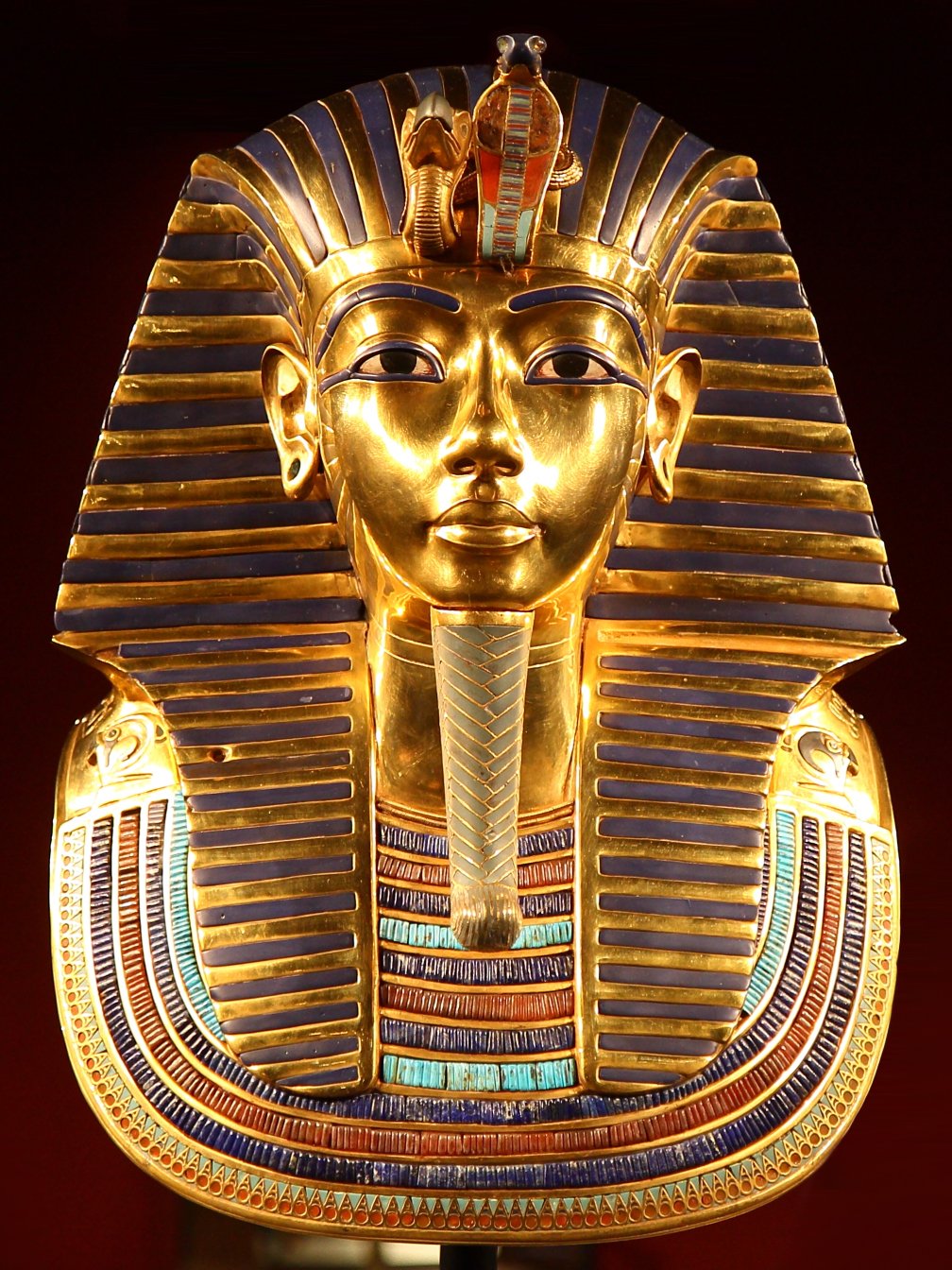
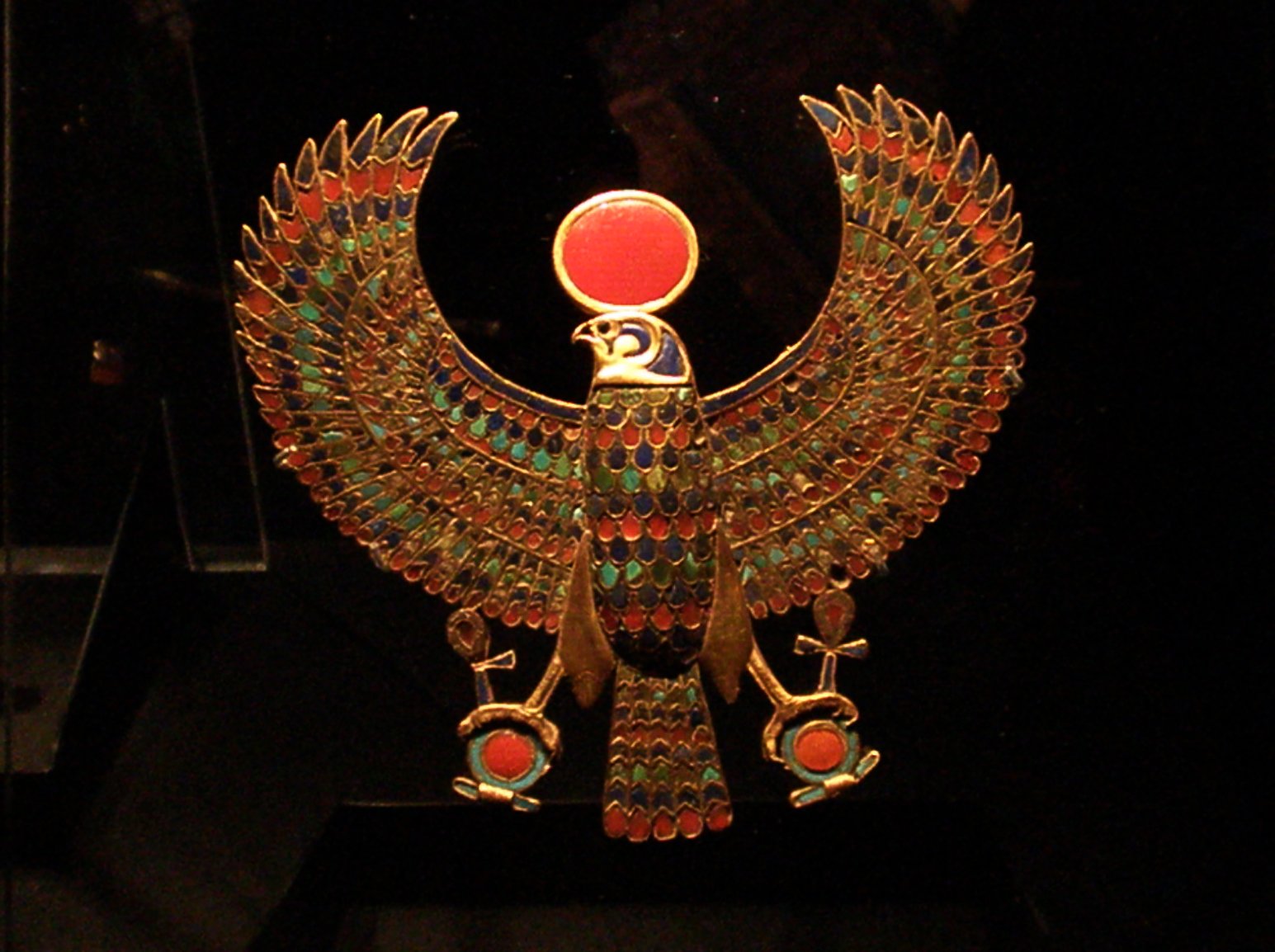
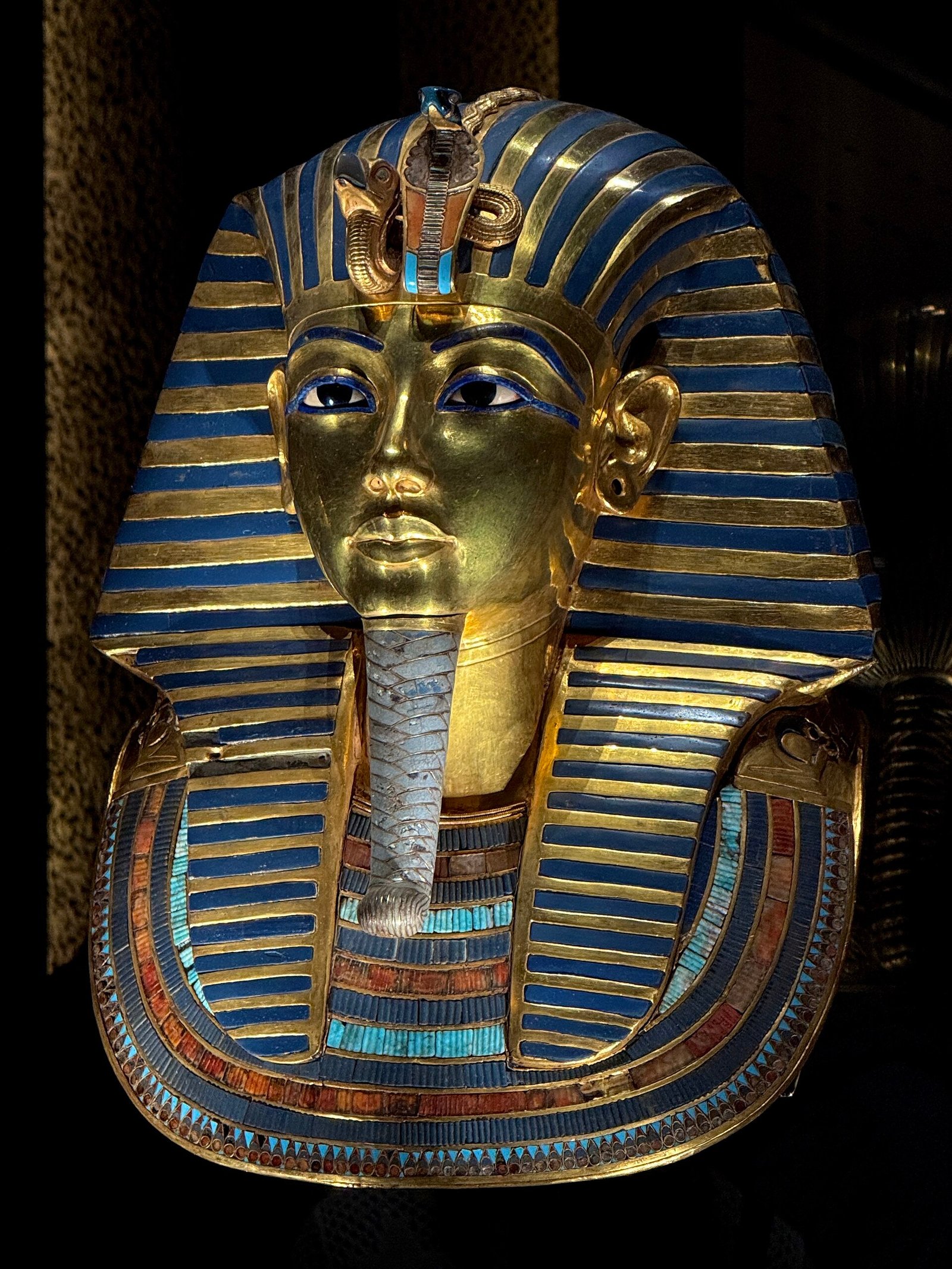
The burial chamber was packed like a nesting doll. Four gilded wooden shrines stood one inside the other, the outermost filling the room almost wall to wall. Inside the last shrine sat a quartzite sarcophagus with a mismatched granite lid, cracked and patched in antiquity. Inside that, three human-shaped coffins: two of gilded wood inlaid with glass and stone, the third of solid gold, about 110 kilograms, roughly 240 pounds. And over the head of the wrapped body, the mask.
| Layer | What it is | Where it is today |
|---|---|---|
| Four shrines | Nested gilded wood, covered in funerary texts | Grand Egyptian Museum |
| Sarcophagus | Quartzite box with four goddesses at the corners | Still in KV62 |
| Outer coffin | Gilded wood, the largest of the three | Still in KV62, inside the sarcophagus |
| Middle and inner coffins | Gilded wood with inlay, then solid gold | Grand Egyptian Museum |
| The mask | Gold with lapis lazuli, quartz, obsidian, carnelian and glass | Grand Egyptian Museum |
| The mummy | The king's body, unwrapped in 1925 | Still in KV62, in a climate-controlled case |
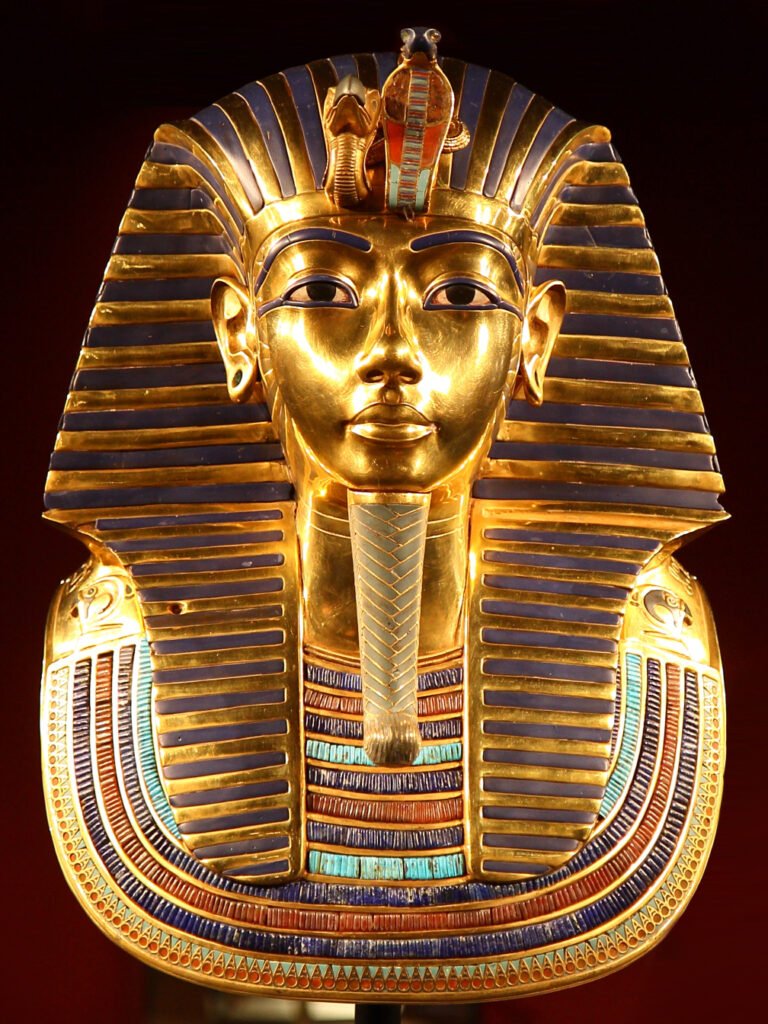
The mask weighs about ten kilograms, just over twenty-two pounds: the striped nemes headcloth, the vulture and cobra on the brow, the braided false beard, and on the shoulders a spell from the Book of the Dead protecting the head. The other rooms held the gilded throne, six dismantled chariots, the Anubis shrine, a dagger whose iron blade was shown in 2016 to be meteoritic, trumpets, game boards, wine jars labeled with year and vineyard, and about 130 walking sticks. Two small coffins held two premature girls, almost certainly his daughters.
The treasure at the Grand Egyptian Museum
For almost a century the collection was split: the mask and the highlights in the Egyptian Museum on Tahrir Square, thousands of smaller pieces in storage or on tour. That is over. The complete Tutankhamun collection is now shown together at the Grand Egyptian Museum at Giza, with the pyramids in view, the first time all of it has been in one building since it left the tomb.
What that changes for you is the ordinary objects. Gold you expect. What stays with you is the child-sized chair, the sandals with enemies painted on the soles, the packed food, the game boards. The galleries follow the order of discovery, antechamber to treasury. Allow half a day and give them your first hours. Our Grand Egyptian Museum guide covers the layout and how to get there, and we compare the Grand Egyptian Museum and the Egyptian Museum in Tahrir if you wonder whether the older museum still earns a visit.
KV62 today: what you actually see inside the tomb
Some visitors are disappointed by the tomb, so know why before you go. KV62 is tiny next to the corridors of Seti I or Ramesses VI. You go down the sixteen steps, along a short passage and into the bare antechamber. The annex and the treasury are closed. The visit inside takes ten to fifteen minutes.
What makes it worth the separate ticket is what is still there. In the antechamber, in a climate-controlled glass case installed in 2007, lies the mummy of Tutankhamun, wrapped in linen with the face and feet exposed. He never left the valley. A railing separates you from the burial chamber, the only painted room, where the quartzite sarcophagus still holds the outermost gilded coffin.
On the yellow walls: the funeral procession, Ay performing the Opening of the Mouth on the king shown as Osiris, the twelve baboons of the first hour of the night, and the king welcomed by Nut. The brown spots are ancient microbial growth, long dead, deliberately left in place by the conservation project finished in 2019 with the Getty Conservation Institute.
Two practical points. The general valley ticket covers three tombs of your choice, and Tutankhamun's is not among them; it needs its own ticket from the ticket office before the shuttle. Photography rules change, so check on the day. Which three tombs to pair with it is the subject of our guide to the best tombs in the Valley of the Kings.
The curse, a newspaper legend
Lord Carnarvon died in Cairo on 5 April 1923, less than five months after looking into the tomb. He had nicked a mosquito bite while shaving, the wound became infected, and blood poisoning and pneumonia followed. He was 56 and in poor health. The press did the rest. Carnarvon had sold exclusive rights to the story to The Times of London, which left every other newspaper hunting for an angle it could print, and a dead aristocrat plus an ancient king supplied it.
Against that, the record. Howard Carter, who spent more hours in the tomb than anyone, died in 1939, sixteen years later. Lady Evelyn lived until 1980. A medical study published in 2002 found no survival difference between the Westerners who entered the tomb and those who did not. No curse text was found in KV62. The one real hazard is mold spores in a chamber sealed for millennia, which is why conservators wear masks.
What the CT scan and the DNA study found
Douglas Derry unwrapped the body in 1925 and did real damage: the resins poured over the mummy at the funeral had set like glue, and freeing it from the gold coffin meant cutting it apart. An X-ray in 1968 added a bone fragment inside the skull to the story. Then came two modern studies by an Egyptian team, now the standard reference.
The CT scan of 2005 read the king as eighteen or nineteen at death, about five feet six inches tall, with a slightly cleft palate. There was no sign of a blow to the head; the loose bone was put down to embalming or the 1925 handling. There was a fracture of the left thigh just above the knee with embalming resin inside the break, read by part of the team as an injury received shortly before death.
The DNA study of 2010 identified the mummy from tomb KV55 as his father, equated by the team with Akhenaten, and the Younger Lady from KV35 as his mother, his father's full sister. Amenhotep III and Queen Tiye came out as his grandparents, and the two fetuses as his daughters. It also reported malaria DNA in his tissue and bone disease in the left foot, which fits the walking sticks. Some geneticists question ancient DNA from Egyptian mummies, but these remain the published findings. What the embalmers did to the body is in our explainer on mummification in ancient Egypt.
How he died: the theories, presented as theories
Nobody knows. These are the serious explanations, with what each leans on and what weakens it.
- Murder. Built on the 1968 X-ray, the bone fragment in the skull and the convenient rise of Ay and Horemheb. The 2005 CT scan found no blow to the head, removing the physical basis.
- A chariot crash. Built on the broken thigh, the six chariots and the crushed chest. The problem is the chest: the ribs appear to have been removed after 1925, probably by whoever took the beaded collar glued to them, so the case rests on the leg.
- Malaria on top of a fracture. The 2010 team's own reading. A frail young man with a fresh fracture and severe malaria could die of infection. It is the most conservative theory and the one guides repeat.
- A hippopotamus. Proposed from the missing chest and the hunting gear. No direct evidence.
- Inherited frailty. His parents were siblings, and hormonal conditions and even epilepsy have been proposed, mostly from Amarna art rather than the body.
Every version agrees on the ending: an unplanned death at eighteen or nineteen, then a hurried burial in a tomb not designed for a king. The theory that Nefertiti lies behind the north wall was tested with radar in 2018 and not confirmed.
How to see both the tomb and the treasure in one trip
The treasure is in Giza and the tomb is in Luxor, about 400 miles south, linked by a domestic flight of roughly an hour or the sleeper train. Put Cairo first: the objects give the empty room its meaning.
| The treasure | The tomb | |
|---|---|---|
| Where | Grand Egyptian Museum, Giza | KV62, Valley of the Kings, Luxor west bank |
| What you see | The mask, the gold coffin, the shrines, the throne, the chariots | The mummy, the sarcophagus with the outer coffin, the painted burial chamber |
| Time needed | Half a day, Tutankhamun galleries first | Fifteen minutes inside, a morning for the valley |
| Ticket | Museum entry | Separate ticket on top of the general valley ticket |
A workable sequence: the pyramids and the museum in Cairo, a morning flight to Luxor with Karnak that afternoon, the west bank at opening time the next day with the KV62 ticket in hand, then a Nile cruise to Aswan. From October to April the valley mornings are mild. In July and August it passes 104 F, about 40 C, by late morning and the small tomb is stuffy, so be at the gate when it opens. Guides may not talk inside the tombs, so a good one walks you through the burial chamber scenes before you go in.
How Explora Egipto builds it
We are a local agency in Egypt with our own Egyptologist guides and vehicles, and Tutankhamun is our most frequent request.
- In Cairo, a guide who takes the museum in the order of discovery, with time for the everyday objects that tour groups walk past.
- In Luxor, a west bank start at opening time, the KV62 ticket bought for you, and the three other tombs chosen from what is actually open that week.
- The domestic flight timed to protect the valley morning, then a Nile cruise, a dahabiya or a return to Cairo.
- No fixed program. Tell us your dates and who is traveling and we shape a custom Egypt tour around the two visits. No prices on this page; ask us for the quote.
Frequently asked questions
Where is Tutankhamun's treasure now?
At the Grand Egyptian Museum at Giza, next to the pyramids. The complete collection, the gold mask, the coffins, the shrines, the throne, the chariots and thousands of smaller objects, is displayed together in dedicated galleries for the first time since it left the tomb. The highlights used to sit in the Egyptian Museum on Tahrir Square.
Is Tutankhamun's mummy still in his tomb?
Yes. The body has never left the Valley of the Kings. Since 2007 it has lain in a climate-controlled glass case in the antechamber of KV62, wrapped in linen with the face and feet exposed, next to the burial chamber where the outermost coffin still rests inside the sarcophagus. It is the one part of the find you see only in Luxor.
Do I need a separate ticket for Tutankhamun's tomb?
Yes. The general Valley of the Kings ticket lets you enter three of the tombs open that day, and KV62 is excluded from it. You buy the Tutankhamun ticket separately at the ticket office by the visitor center before boarding the shuttle. Prices change, so check at the office; with us the ticket is arranged for you.
Is the curse of Tutankhamun real?
No. The legend grew from Lord Carnarvon's death in April 1923 from an infected mosquito bite, amplified by newspapers shut out of the story by an exclusive deal. Howard Carter, who spent more time in the tomb than anyone, lived another sixteen years, and a later medical study found no survival difference between those who entered the tomb and those who did not.
How did Tutankhamun die?
Nobody knows for certain. The CT scan of 2005 ruled out a blow to the head and found a fracture of the left thigh shortly before death; the DNA study of 2010 found malaria and a diseased foot. The most repeated reading combines a leg injury with severe malaria in a frail young man. Murder and a chariot crash remain theories with less support.
Can I see the tomb and the treasure in the same trip?
Easily, and you should. The museum is in Giza and the tomb is in Luxor, linked by a domestic flight of about an hour. A typical plan gives the museum half a day in Cairo, then a morning in the Valley of the Kings after flying south, often as the start of a Nile cruise. Five days covers both; a week adds Aswan.
Stand in front of the gold, then stand in the room it came from
Tell us your dates, who is traveling and how many days you have. We come back with a plan built around the Tutankhamun galleries and KV62, our own guide at both ends, and the quote in your inbox.