Edfu Temple, the Temple of Horus on the west bank of the Nile between Luxor and Aswan, is the best-preserved temple in Egypt. The Ptolemies built it between 237 and 57 BC, then sand and Nile silt buried it for centuries with a village on its roof, which is exactly why the pylon, both hypostyle halls, the ceilings and the granite shrine in the sanctuary are still standing. Almost everyone visits it as a Nile cruise stop, riding a horse carriage from the dock through town. Plan on about two hours, go as early as the boat allows, and walk it with an Egyptologist who can read you the Horus and Seth drama on the west wall. Here is how the visit actually works.
Most Egyptian temples you rebuild in your head, a column here, half a wall there, the guide asking you to imagine a roof. Edfu is the opposite. You pass through the pylon and a few minutes later you are inside a nearly complete building, ceiling overhead, halls in half darkness, crisp reliefs on every surface and the shrine still standing in the sanctuary.
It survived because it disappeared. After the temple closed in the Christian era, sand blew in from the desert and every Nile flood left another layer of silt, until the fill rose almost to the top of the pylon. The town of Edfu grew on top, with mud brick houses built on the roof of the hypostyle hall. That mountain of dirt looked like a disaster and was in fact a blanket against rain, wind and stone robbers.
The French Egyptologist Auguste Mariette began clearing it in 1860, and what emerged was a temple standing much as its priests had left it. It is the second largest temple in Egypt after Karnak, and by far the most complete. It is also the one place where you feel how a temple was designed to work: the light shrinks, the floor rises, the ceiling drops and the doorways narrow as you walk toward the god.
Edfu is not a pharaonic temple in the strict sense. The Ptolemies built it, the Greek dynasty that ruled Egypt after Alexander the Great. Ptolemy III Euergetes laid the foundation in 237 BC. The inner temple was structurally finished within a few decades and the decoration went on for generations. The pronaos was added under Ptolemy VIII, and the pylon and courtyard were the last pieces, completed in 57 BC under Ptolemy XII, the father of Cleopatra.
That is about 180 years of work on one building, which is why it feels so unified. The Ptolemies were foreigners who wanted the Egyptian priesthood on their side, so they built in a deliberately traditional style, following the classic plan more strictly than many older temples do. If you want to understand what an Egyptian temple is, this is the one to study.
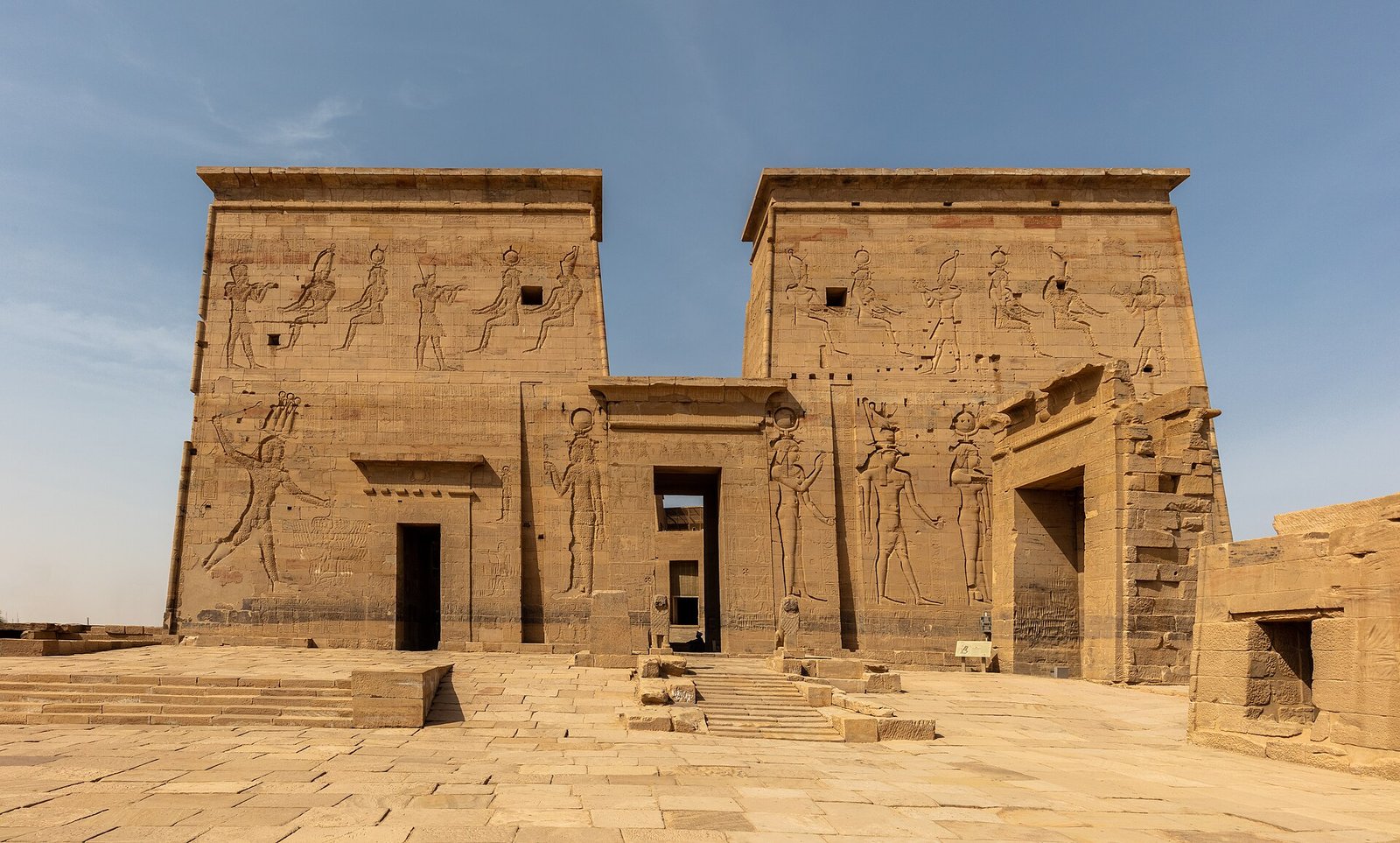
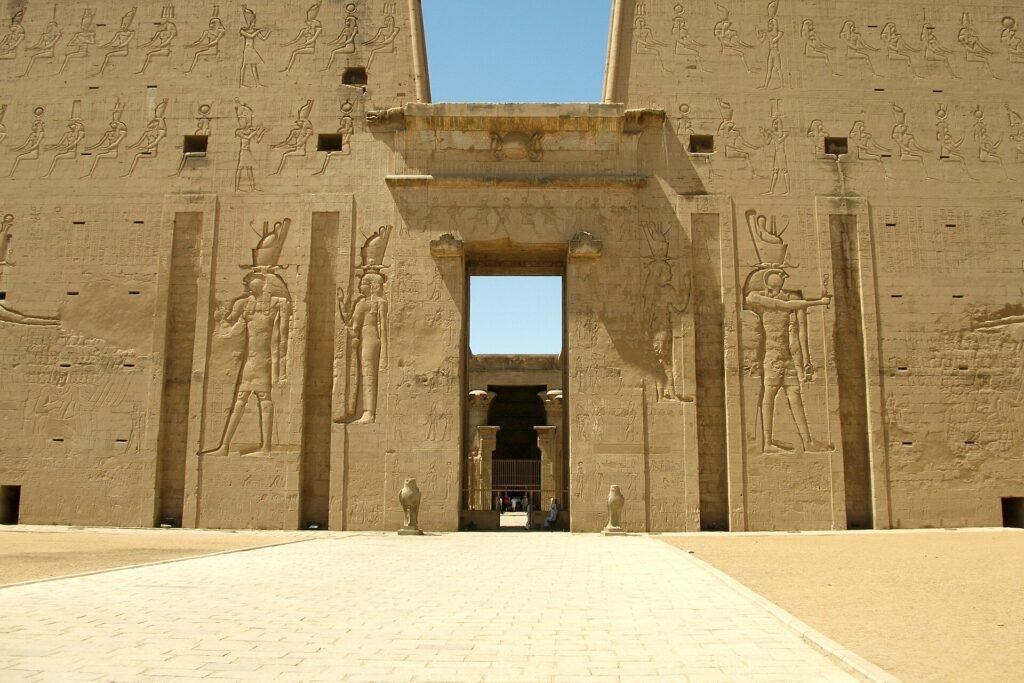
The carriage drops you near the visitor entrance and you walk around to face the pylon. It is about 118 feet (36 meters) tall, two trapezoidal towers with a gate between them, the largest surviving pylon in Egypt after Karnak. The reliefs are colossal: Ptolemy XII, at the scale of a giant, grips a bundle of enemies by the hair and raises his mace in front of Horus and Hathor. The four vertical grooves held the flagpoles.
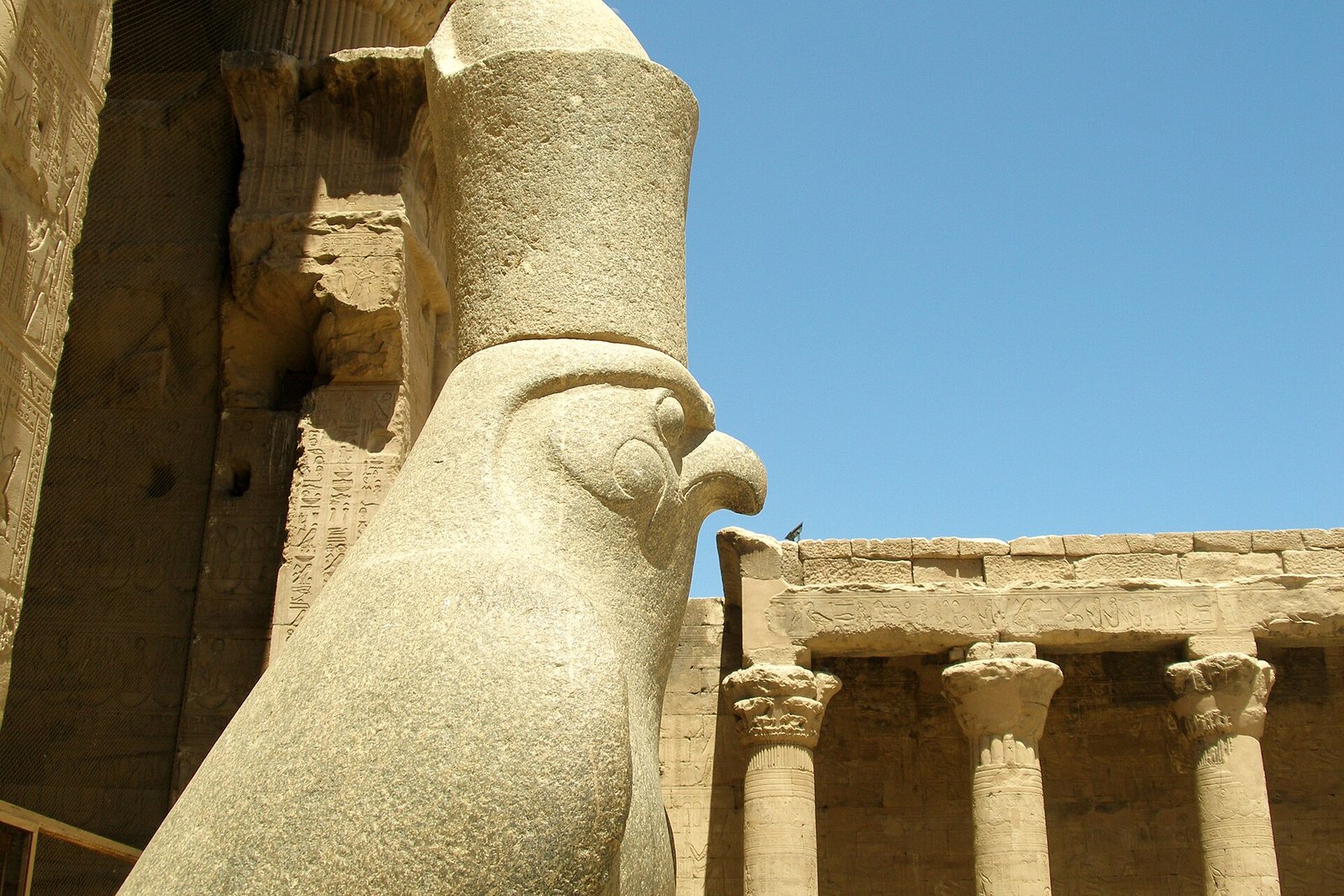
Then the falcons. Horus of Behdet, named for the town's cult name, was worshipped as a falcon, or as a man with a falcon's head wearing the double crown of Upper and Lower Egypt, and the temple keeps granite images of him at its thresholds. A pair flanks the pylon gate, one of them damaged. The famous one stands at the doorway of the first hypostyle hall, on the left as you cross the courtyard: a single block of black granite, the double crown on its head, the gaze fixed somewhere above your shoulder. It is the most photographed object in Edfu and it deserves it.
Beyond the pylon is the Court of Offerings, framed on three sides by 32 columns whose capitals, palm, lotus, papyrus and composite, never repeat between neighbors. This is the last space with full daylight, so guides gather the group here to explain the plan before the temple swallows the light.
The first hypostyle hall, the pronaos, is the great room behind the falcon. Twelve massive columns in two rows carry a ceiling that is still in place, with an astronomical decoration you can just make out under the soot. Two small chambers flank the entrance: the library, where the catalogue of the temple's scrolls is carved into the wall, and the House of the Morning, where the officiating priest was washed and dressed before entering.
The second hypostyle hall is older, lower and darker, again with twelve columns. Its side rooms are the practical heart of the temple: the laboratory, with recipes for incense and sacred oils inscribed on the walls; the treasury; and the Nile chamber, with a passage down to the well that supplied the rituals. From here the axis runs through the Hall of Offerings and a vestibule into the sanctuary, each doorway narrower and lower than the last.
The sanctuary sits on the central axis as a freestanding room within the temple, wrapped by a corridor lined with small chapels. Inside stands the naos, a monolithic shrine of gray granite about 13 feet (4 meters) tall. It is older than the building around it: the inscription names Nectanebo II, the last native pharaoh, so the Ptolemies salvaged it from the earlier temple on the site and set it at the center of their new one. This is where the cult statue of Horus lived, behind sealed wooden doors.
In front of the naos is a modern replica of the sacred barque, the portable boat in which priests carried the god out of the temple on festival days. The reliefs around it show the daily service in order: breaking the seal at dawn, washing and anointing the statue, dressing it, offering food, closing the doors again.
One practical note: the sanctuary and the chapels around it are genuinely dark. Bring your phone light rather than relying on the guards, who will offer a flashlight and then expect something for it.
Every guide in Egypt tells you the myth. Osiris, the good king, is murdered by his brother Seth, god of chaos. Isis hides their son Horus in the marshes, and when he is grown he goes to war with his uncle for the throne. Horus wins, order is restored, and every pharaoh from then on rules as the living Horus.
Edfu is the one place where that story is carved out in full, scene by scene, like a graphic novel in stone. Walk out into the ambulatory, the open corridor between the temple and its enclosure wall, and turn to the inner face of the western wall. Horus stands in a papyrus boat driving a harpoon into a hippopotamus, which is Seth in his most dangerous form. The hippo is shown deliberately tiny, a way of belittling the enemy inside the picture itself.
The scenes run through ten harpoon strikes and end with the hippo cut up and eaten. This was not decoration. The panels are the script of a sacred play, the Triumph of Horus, performed during the Festival of Victory with a lector priest reading the lines, the king or his stand-in wielding the harpoon, and a hippo-shaped cake carved and shared at the end.
Ask your Egyptologist to take you to that wall and read it. If you have read our guide to how to recognize the Egyptian gods, this is where you test yourself.
On the eastern side of the complex, outside the main axis, a staircase cuts down toward the groundwater. This is the Nilometer. Each summer the priests read the height of the flood on its marked walls, and from that reading they predicted the harvest and set the year's taxes. It shows the temple was also the local revenue office. Ask for it; most groups walk past.
The same goes for the library off the pronaos, whose wall list of titles is one of the very few catalogues of a temple archive that survive.
And then there is the color. High on the walls of the pronaos and on the undersides of lintels, where the sand protected the stone from sun and hands, blues and ochres from more than two thousand years ago are still there. Point your phone light upward. You will also notice that many figures have their faces hacked away, the work of early Christians who used the temple. Look at the hands and the hieroglyphs instead, which are almost always untouched.
Edfu has an arrival like no other temple in Egypt. The cruise dock is roughly a mile (1.5 to 2 kilometers) from the temple, and the traditional link is the caleche, a horse carriage with a bench for two to four passengers. For ten minutes you trot through the real town: the vegetable market, the bakery, tuk-tuks, boys on bicycles who wave.
Here is the honest version. The drivers work for tips and some will ask for extra money on the way, again at the temple, and again at the boat. When you travel with us the fare is arranged and paid by the agency, so anything you give is a gesture, not a debt. Our guide to tipping in Egypt explains what feels fair for a short ride.
If the welfare of the horses worries you, tell us in advance. We work with drivers we know and whose animals are in decent condition, and on request we arrange a minibus from the dock instead.
Almost nobody visits Edfu on its own. It is one of the two great stops between Luxor and Aswan on every Nile cruise, and that is where it makes sense: you fall asleep in one place and wake up moored in front of a two thousand year old temple. Sailing from Luxor, the boat passes the Esna lock overnight and ties up at Edfu before dawn, so you visit first thing. Sailing from Aswan, you may reach it around midday or the following morning, depending on the boat's schedule.
Early is best, and not only for the light. From April through October the temperature at Edfu passes 95 F (35 C) by late morning, and the courtyard and the carriage ride are in full sun. At sunrise the pylon glows, the low light rakes across the reliefs and makes them legible, and you share the sanctuary with a handful of people. By mid morning several boats have docked at once and the sanctuary corridor becomes a slow shuffle.
Allow 90 minutes to two hours from gangway to gangway. That covers the carriage each way, the courtyard, the two halls, the sanctuary and the west wall, and time to look up at the colors. Inside the halls it is cool and shaded. Bring water, a hat, sunscreen and shoes for uneven stone.
Most four night cruises visit both Edfu and Kom Ombo on the same day, and they pair well because they are so different. Kom Ombo is about 40 miles (65 kilometers) south, a double temple shared between Sobek the crocodile god and Haroeris, an older form of Horus. Edfu is enclosed, dark and complete. Kom Ombo is open, bright and half ruined, with a crocodile museum next door. The direction of your cruise decides the order.
| Cruise direction | Edfu | Kom Ombo | What the day feels like |
|---|---|---|---|
| Luxor to Aswan | Early morning, after the overnight lock at Esna | Late afternoon, often at sunset | The best sequence. Edfu in cool light, a lazy sail, Kom Ombo glowing gold. |
| Aswan to Luxor | Late morning or the next morning | Morning of the first sailing day, or the evening before | Works fine, but Edfu can land in the heat. Ask for the earliest slot the boat offers. |
If you are still choosing, our comparison of Luxor to Aswan or Aswan to Luxor goes stop by stop. For travelers who are not cruising, both temples fit into one long day by private car with a driver and an Egyptologist, and we run that as part of our Aswan excursions.
Without a guide, Edfu is a beautiful building covered in pictures that all look alike. With a licensed Egyptologist it becomes the clearest lesson in Egyptian religion you will get anywhere. In the two hours you have, a good one will:
Our guides are Egyptian, university trained in Egyptology and licensed, and they work in English for our American groups.
We are a local agency based in Egypt with our own Egyptologist guides and our own vehicles, and Edfu is on our cruise program every week. On our Luxor to Aswan cruise and the reverse Aswan to Luxor cruise, the stop works like this:
If you are building a land itinerary instead, we combine Edfu and Kom Ombo as a day from Luxor or Aswan by private car, alongside the Luxor excursions on the same trip. Tell us your dates and how you want to travel, and we send you the quote.
Edfu is famous as the best-preserved temple in Egypt. Sand and Nile silt buried it for centuries with a village on top, so when Auguste Mariette cleared it in the 1860s the pylon, the courtyard, both hypostyle halls with their ceilings and the sanctuary with its granite shrine were all intact.
In the Ptolemaic period, by the Greek dynasty that ruled Egypt after Alexander. Ptolemy III laid the foundation in 237 BC, the pronaos was added under Ptolemy VIII, and the pylon and courtyard were completed in 57 BC under Ptolemy XII, Cleopatra's father. Roughly 180 years of construction on one building, following the classic Egyptian plan.
By horse carriage. The dock is about a mile from the temple, and the caleche ride takes around ten minutes through the streets and market of Edfu town. Note your carriage number, because the same driver brings you back. When you travel with us the fare is arranged in advance, our guide rides with the group, and a minibus is available on request if you prefer not to use the horses.
Allow 90 minutes to two hours from the boat and back, including the carriage ride each way. That is enough to see the pylon and the Horus falcons, walk the courtyard and both hypostyle halls, stand in the sanctuary in front of the shrine, and read the Horus and Seth reliefs on the west wall. Go as early as your boat allows: better light, less heat and an empty sanctuary.
Yes. Edfu sits on the highway between Luxor and Aswan, roughly halfway, so it works as a day trip by private car from either city, usually combined with Kom Ombo. It is a long day of driving, but we arrange the car, the driver and the Egyptologist guide. Ask us for the quote.
On the inner face of the western enclosure wall, Horus stands in a boat and harpoons a hippopotamus, which is Seth, the god of chaos who murdered Horus's father Osiris. Ten strikes, then the hippo is cut up and eaten. The scenes are the script of a sacred play, the Triumph of Horus, performed during the Festival of Victory.
Tell us your dates, whether you want a cruise or a land itinerary, and who is traveling, and we come back with a plan that puts Edfu at the right hour with the right guide, the carriages already arranged, and Kom Ombo, Luxor and Aswan built around it. No prices on this page, just a quote in your inbox.