Egyptian cotton is worth buying in Egypt, if you know what real Egyptian cotton feels like
Egyptian cotton is worth buying in Egypt, if you know what real Egyptian cotton feels like
Real Egyptian cotton is an extra-long staple fiber from the species Gossypium barbadense, grown in the Nile Delta and Upper Egypt under the Giza variety names, picked by hand and spun into a thread finer, stronger and smoother than the upland cotton in most American closets. Sheets and towels made from it feel soft on day one and improve with every wash instead of pilling. Most of what carries the name, in Egypt and in US stores, is not the real thing. Below is how to tell with your hands and the label, why thread count is the wrong number to chase, what to buy, where to shop in Cairo, Luxor and Aswan, and how a one-hour stop fits your itinerary.
What makes Egyptian cotton different from the cotton in your closet
Almost every cotton sheet, towel and T-shirt sold in the United States is upland cotton, Gossypium hirsutum, the medium-staple plant that fills the fields of Texas and the Mississippi Delta. Egyptian cotton is a different species, Gossypium barbadense, the same one as American Pima and the old Sea Island cotton. The fiber is longer, finer and stronger from the moment it leaves the boll.
Length is the whole story. Upland fiber runs about an inch; extra-long staple runs well past an inch and three eighths. When a spinner twists long fibers into thread, far fewer fiber ends stick out along it. Fewer loose ends means fewer tiny hairs lifting when the fabric rubs your skin, which is why the real thing does not pill and stays smooth for years.
A long, fine fiber can also be spun very thin without snapping, so a mill can weave a sheet that is light and dense at once, cool on a hot night yet substantial in the hand, and a towel that drinks up water without weighing what a blanket weighs. If you have slept on Supima sheets, you know the feeling; Egyptian cotton is the older cousin.
The Giza varieties, and why a number on the label is a good sign
Egyptian cotton varieties are named Giza followed by a number, after the agricultural research station outside Cairo where they were bred. Two families matter to a shopper. The extra-long staple group, Giza 45, Giza 87, Giza 88, Giza 92 and Giza 96 among them, grows mainly in the Delta and is what the most demanding mills in Italy and Japan compete to buy. Giza 45 is the aristocrat, grown on a tiny area and rarely seen outside the finest shirtings.
The long-staple group, Giza 86, Giza 90 and Giza 94, grows further south. It is still genuine Egyptian cotton, a little shorter in the fiber, and it makes excellent everyday sheets and towels.
The practical point: a label or a clerk who can name the variety is a good sign, because counterfeiters almost never bother to invent one. No variety, no mill, no fiber content means you assume imported short staple until proven otherwise.
Why this fiber grew up in the Nile Delta
The story begins in the early nineteenth century, when a French engineer in the service of Muhammad Ali, Louis Alexis Jumel, noticed a cotton plant growing as an ornamental in a Cairo garden, with a fiber far longer than anything in cultivation. Muhammad Ali ordered it planted across the Delta. Within decades cotton was the country's main cash crop, and when the American Civil War cut Southern cotton off from Europe, Egyptian fiber filled the gap.
The Delta gives the plant silt soil, steady irrigation, clear skies and moderate humidity. Planting is in spring and the harvest runs from late summer into fall, by hand and in several passes, because the bolls do not open together.
From the field the cotton goes to spinning mills in the Delta, where Mahalla el Kubra has been the textile capital for a century, or it is exported raw to mills abroad. The fiber is Egyptian, but the sheet can be woven in Italy or Pakistan and still be authentic. The reverse is also true: a sheet sewn in Egypt can be made from imported short-staple yarn.
How to recognize real Egyptian cotton with your hands and the label
You do not need to be a textile engineer to eliminate most fakes. Run this sequence in the store, in this order. A good share of what is sold as Egyptian cotton fails at step one.
- Read the fiber content, not the brand name. Egyptian cotton in big letters and a polyester blend in small letters is the classic move. Look for the sewn-in content tag, the kind US law requires at home. A cardboard hang tag alone is a warning.
- Touch it dry with the back of your hand. The real thing feels soft, cool and slightly heavy. It does not slide like synthetic satin.
- Hold it up to the light. The weave should be even, with no thin patches. Short fiber shows fuzz along the surface against a window.
- Rub a corner hard for a few seconds. If fibers lift or a shine appears, it is short staple or a blend.
- Smell it. Heavy fabric softener or a plastic smell means a finish designed to fool your fingers, and it washes out on the first cycle.
- Ask which mill made it. A serious seller knows the mill and the variety. In a bazaar stall you get a smile and a change of subject.
There is also a registered seal from the association of Egyptian cotton growers and exporters, a cotton-plant logo that licensed brands print on their labels. Treat it as supporting evidence, not proof: many small honest mills never apply for the license, and a bazaar printer can copy a logo in an afternoon. It is the same logic as our guide to amulets like the ankh, scarab and Eye of Horus. The label matters less than what the object does when you test it.
The thread-count myth
Thread count is the number of threads in one square inch of fabric, warp and weft added together. It is a real measurement, and it has become the favorite tool of the counterfeit trade, especially in the American market, because shoppers have been trained to believe a bigger number means a better sheet.
There are two tricks. The first is ply counting: if the mill uses two-ply or three-ply yarn and counts each strand separately, the number doubles or triples while the fabric gains nothing. The second is physics. Only so many threads fit in an inch, and the four-digit figures on some packaging are impossible with single-ply yarn.
Extra-long staple flips the logic. Because the yarn is fine and strong, an Egyptian cotton sheet with a moderate count, somewhere in the low to mid hundreds, is softer, cooler and longer lasting than a short-staple sheet with a giant number on the box. Judge the fiber first, then pick the weave for your climate.
| Weave | Feel | Look | Who it suits |
|---|---|---|---|
| Percale | Cool, dry, a little crisp at first, like a good hotel pillowcase | Matte, no sheen | Hot sleepers, humid summers, anyone who likes a crisp bed |
| Sateen | Silky and smooth from the first night | Soft luster, drapes with more weight | Anyone who wants the plush feel and a little more warmth |
What to buy in Egypt: sheets, towels, galabeyas and shirts
Sheets and duvet covers
This is the purchase people thank us for months later. The catch for an American buyer is sizing. Egyptian mattress sizes do not map neatly onto US twin, full, queen, king and California king, and a fitted sheet two inches short never sits right. Bring your mattress dimensions in inches and centimeters, including the depth. White and ivory show the weave best.
Towels and bathrobes
A long-loop Egyptian cotton towel absorbs an astonishing amount and dries fast on the rail. Check that the loops are dense, the selvedge is finished and the towel has some weight. They are bulky, so count your luggage space before you fall in love with six.
Galabeyas
The traditional Egyptian robe is the most photogenic souvenir and the one where synthetic blends circulate most freely. A pure cotton galabeya has finished interior seams, buttons sewn with matching thread and a hand that does not cling. The bazaar version is usually a blend and shines in the sun. Buy the cotton one; it becomes the robe you wear at home for years.
Shirts and dress fabric
Some Cairo tailors and mill outlets sell Egyptian cotton poplin shirts, sometimes made to measure if you have two or three days in the city. It is the purchase you will wear most in July. Our guide to what to pack for Egypt shows how to leave room from the start.
Where to shop with confidence in Cairo
Mill outlets and the public textile companies
The big spinning and weaving companies, several of them state owned, run their own outlets downtown, in Zamalek, in Heliopolis and in a few malls. They are charmless rooms with metal shelving and fluorescent light, and they are exactly where we shop: fiber content sewn in, a clerk who knows the mill, fixed prices. If you walk into one store on this page, make it one of these.
Hotel boutiques
The shops inside the large hotels downtown, near the Pyramids and aboard Nile cruise ships usually stock genuine cotton, labeled in English and often in US sizes. The selection is short and the convenience is real if you have one free hour.
Khan el Khalili and its traps
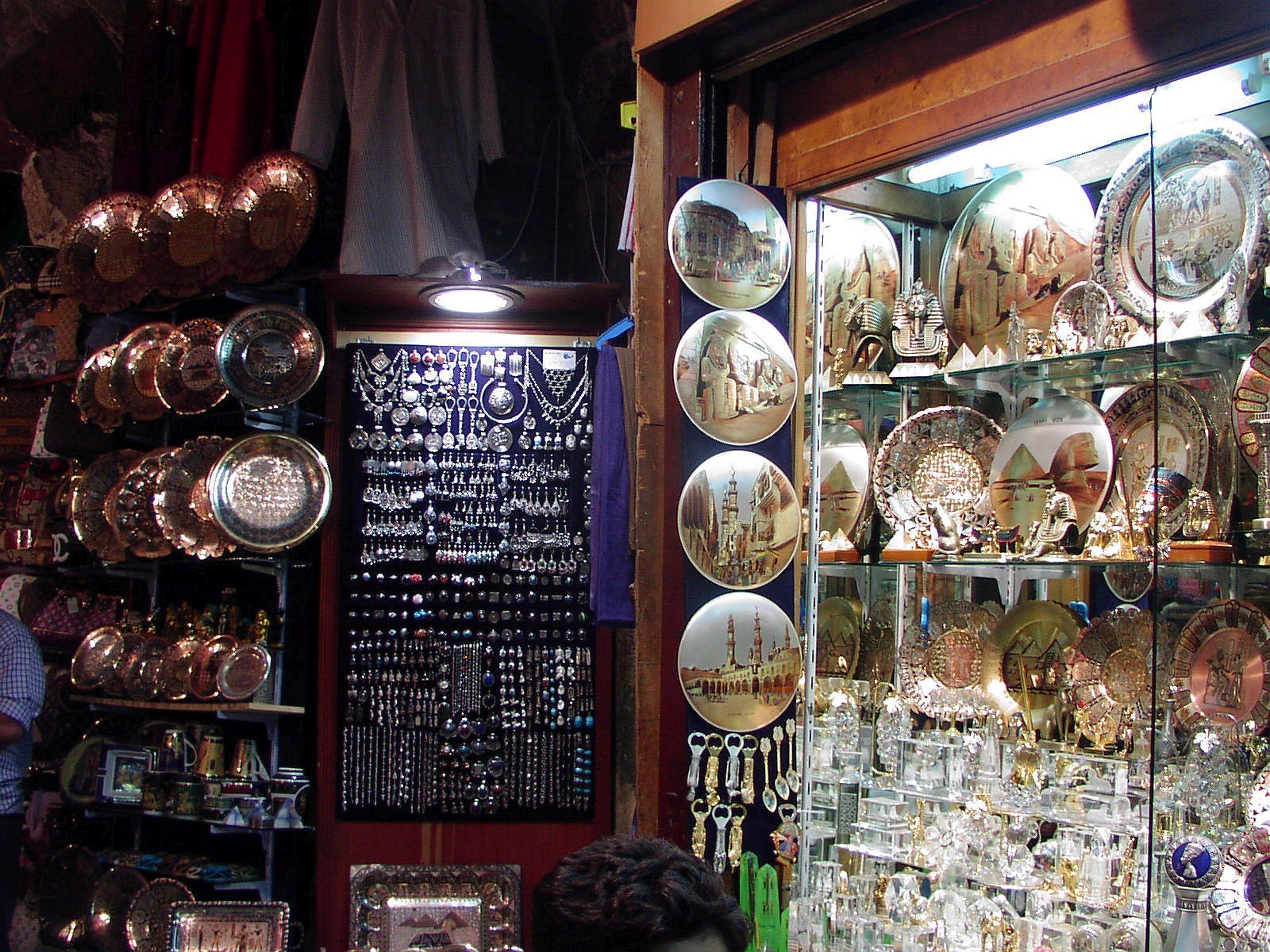
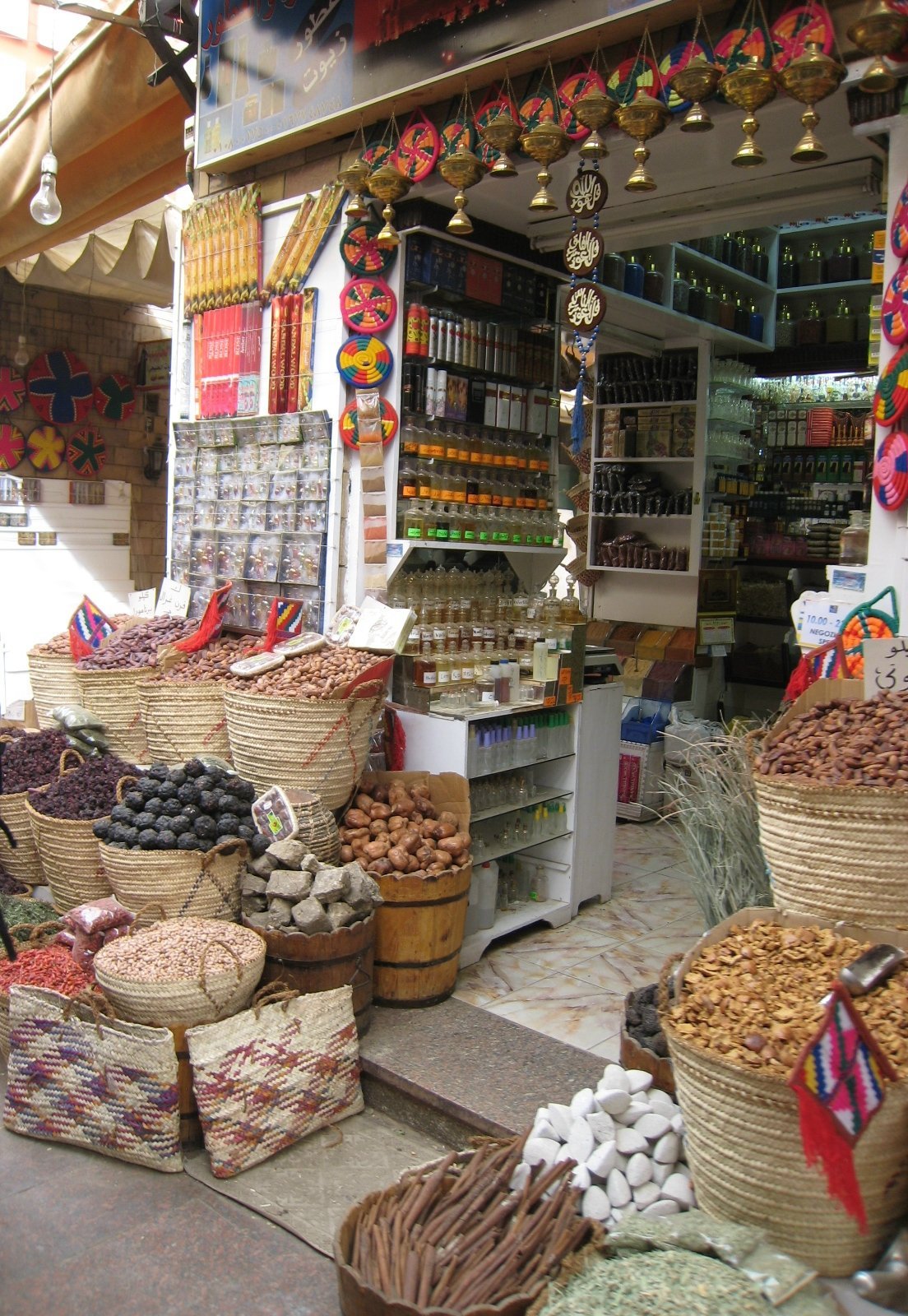
The bazaar is wonderful for spices, copper, lanterns and sheer theater, and it belongs in any walk through Islamic Cairo. For cotton it is hostile ground. The scarves are mostly viscose, the sheets in sealed plastic rarely carry a fiber label, and the word Egyptian is applied to any white fabric in the building. You can find correct pieces, but only by running the whole checklist and negotiating calmly, as we explain in haggling in Egypt.
Buying cotton in Luxor and Aswan
In Luxor the reliable shops cluster around the temple and in the streets running down to the corniche, small family businesses that have sold textiles to cruise passengers for decades. The souk carries more galabeyas and scarves than bedding; apply the same light and label rules. Between the west bank and Karnak there is always an hour to spare among the other Luxor excursions.
In Aswan cotton meets Nubian craft. You will find scarves, light galabeyas and cushion covers in the town souk and on the stalls of the villages we visit on the Nubian village trip from Aswan. It is local cotton woven on simple looms, less refined than Delta bedding but genuine, made by someone you can shake hands with.
How to spot a fake: the label tricks we see most
- Egyptian cotton in the brand name, with a fiber content that says blend, or cotton with no origin at all.
- A cardboard hang tag and no sewn-in label. US rules require one; Egyptian rules are not always enforced.
- A thread count that is impossible with single-ply yarn.
- Sealed plastic that stops you touching the fabric. Ask them to open one; a refusal is your answer.
- A slippery, cold hand that reminds you of polyester, with a shine under direct light.
- A seller who gets irritated when you ask about the mill or the variety.
No single sign condemns a piece. When three line up, put the bag back on the counter and walk. The biggest trap for an American buyer is the sealed pack, because it looks like the packaging you know from home and you assume someone checked the label. Here, nobody did.
Packing it home and washing it so it lasts for decades
In the suitcase
Sheets compress beautifully. Take them out of the rigid packaging, fold them flat and lay them on the bottom of the case, where they cushion anything fragile. Towels are the problem; roll them tight and use them to pad copper or ceramics. If you fly domestically between Luxor or Aswan and Cairo, the checked-bag allowance on the internal flight is often lower than you are used to, so check the weight limit before you buy. At US customs, textiles for personal use are declared like any other purchase.
At home
- First wash alone, with a little detergent, in cold or warm water, to remove finishing residue. Skip your machine's default hot setting.
- No chlorine bleach and no optical brighteners. Egyptian cotton white stays white on its own.
- No fabric softener, ever. It coats the fiber and kills absorbency, and towels show it within weeks.
- Line dry, or tumble on low and pull the load out while slightly damp. High dryer heat ages a good sheet faster than anything.
- If you iron, do it while the fabric is damp and, on colors, inside out.
How a guided shopping stop fits an Explora Egipto itinerary
On our tours the cotton stop is not the commission-shop detour many travelers dread. It is a one-hour visit to a mill outlet or textile store we have checked ourselves, with no commission to the guide and complete freedom to walk out without buying.
In Cairo we slot it between the Egyptian Museum and Khan el Khalili, or at the end of the Pyramids day when everyone wants air conditioning. In Luxor it goes between the west bank and Karnak. On a custom Egypt tour you tell us how much time to give it and what you are after, and the guide has the store located before you land.
The guide solves three things that can only be solved on the ground. He translates the fiber content when the label is in Arabic. He checks that the size on the package matches your mattress, converting centimeters to inches on the spot. And he separates what is made from extra-long staple fiber from what only carries the name. When negotiating is called for, he does that too.
Frequently asked questions
How can I tell if a sheet is real Egyptian cotton?
Start with the sewn-in content label: it should say cotton with no blend, and ideally name the Giza variety or the mill. Then touch it dry, hold it up to the light to check the weave is even, and rub a corner to see whether it fuzzes or shines. Buy at a mill outlet or hotel boutique rather than a bazaar stall, and ask to open the packaging.
Is a higher thread count better?
Not necessarily. Thread count is inflated by counting every strand of a multi-ply yarn, and beyond a certain figure the number is physically impossible with single-ply thread. An extra-long staple sheet with a moderate count is softer and more durable than a short-staple sheet with a huge number on the box. Judge the fiber and the weave first.
Where do I buy Egyptian cotton in Cairo without getting ripped off?
At the outlets run by the large spinning mills, several of them state owned, in downtown Cairo, Zamalek, Heliopolis and some malls, or at the boutiques inside the big hotels. In both cases the fiber content is sewn in, the seller knows the mill and the price is fixed. Khan el Khalili is great for spices and copper, but for cotton the odds are against you.
Can I buy Egyptian cotton in Luxor or Aswan?
Yes. Luxor has reliable family-run shops near the temple and on the streets toward the corniche, with mill-made sheets, towels and galabeyas. In Aswan the cotton is more artisanal: scarves, light galabeyas and cushion covers woven in the Nubian villages, less refined but genuine. Skip the galabeyas sold on board for the cruise party; they are almost always blends.
How do I wash Egyptian cotton sheets and towels?
First wash alone with a little detergent in cold or warm water. No chlorine bleach, no optical brighteners and no fabric softener, which coats the fiber and stops it absorbing. Line dry or tumble on low and take the load out while slightly damp; if you iron, do it then, inside out on colors. The fabric improves for years instead of wearing out.
Is a cotton galabeya worth buying?
Yes, if it is pure cotton and not a blend. Check the interior seams, which should be finished, the buttons, which should be sewn with matching thread, and the hand, which should not cling or shine in the sun. A good one becomes a light robe you wear at home for many summers. Buy it in Luxor or at a Cairo mill outlet, not on the boat.
Take home the fiber Egypt sends to the world
Tell us which days you have in Cairo, Luxor or Aswan and what you want to bring back, and we place the shopping stop in the exact gap in your itinerary, with an English-speaking guide who reads the label, checks the sizing and lets you shop without pressure. No prices on this page, just a quote on WhatsApp.