A Nubian village in Aswan is best visited through a family, not from a tour boat queue
A Nubian village in Aswan is best visited through a family, not from a tour boat queue
A Nubian village tour in Aswan means a motorboat south from the Corniche, past the granite rocks of the First Cataract, to Gharb Soheil on the west bank, or a short walk into the two villages on Elephantine Island. The good version is a late afternoon: you sit in a family home painted blue and white, drink hibiscus tea, watch henna being drawn, hear how the High Dam moved these families from old Nubia, and ride back at sunset. The bad version is a line of boats at a souvenir street. The difference is who takes you and when, and this guide covers both, plus how it fits a cruise day or a day with Philae.
Who the Nubians are, and why the villages sit where they do
Nubia is the stretch of the Nile valley that runs south from Aswan into Sudan. The people who live along it are the descendants of the kingdoms that traded, fought and intermarried with pharaonic Egypt for thousands of years. They have their own languages, Kenzi around Aswan and Nobiin further south, their own music and house style, and a strong sense of being a people apart.
The villages you visit today are where they are because of two dams. The first Aswan Dam, built at the start of the twentieth century and raised twice afterwards, flooded the lowest Nubian villages. Then the High Dam, finished in the 1960s, created Lake Nasser and put almost all of old Nubia under water. Whole communities were moved, mostly to new government villages north of Aswan around Kom Ombo, flat farmland far from the river they had lived on. Nubians speak of it as the great displacement, and the older people still tell the story.
Some families did not go north. They settled on the islands and the west bank right at Aswan, on land that was already Nubian, and rebuilt their houses in the old way. Gharb Soheil and the Elephantine villages are the result. Hear this from a Nubian, in their house, at their pace. Do not press for numbers; ask where the family came from and what the old village was called.
Gharb Soheil and the villages on Elephantine Island
When people search for a Nubian village in Aswan they usually mean Gharb Soheil, West Soheil. It sits on the west bank a few miles south of the city, opposite Soheil Island and just below the First Cataract, where the river narrows and breaks over black granite. It grew from a few farming families into a place built around visitors, so it has the brightest paint and the most boats.
Gharb Soheil
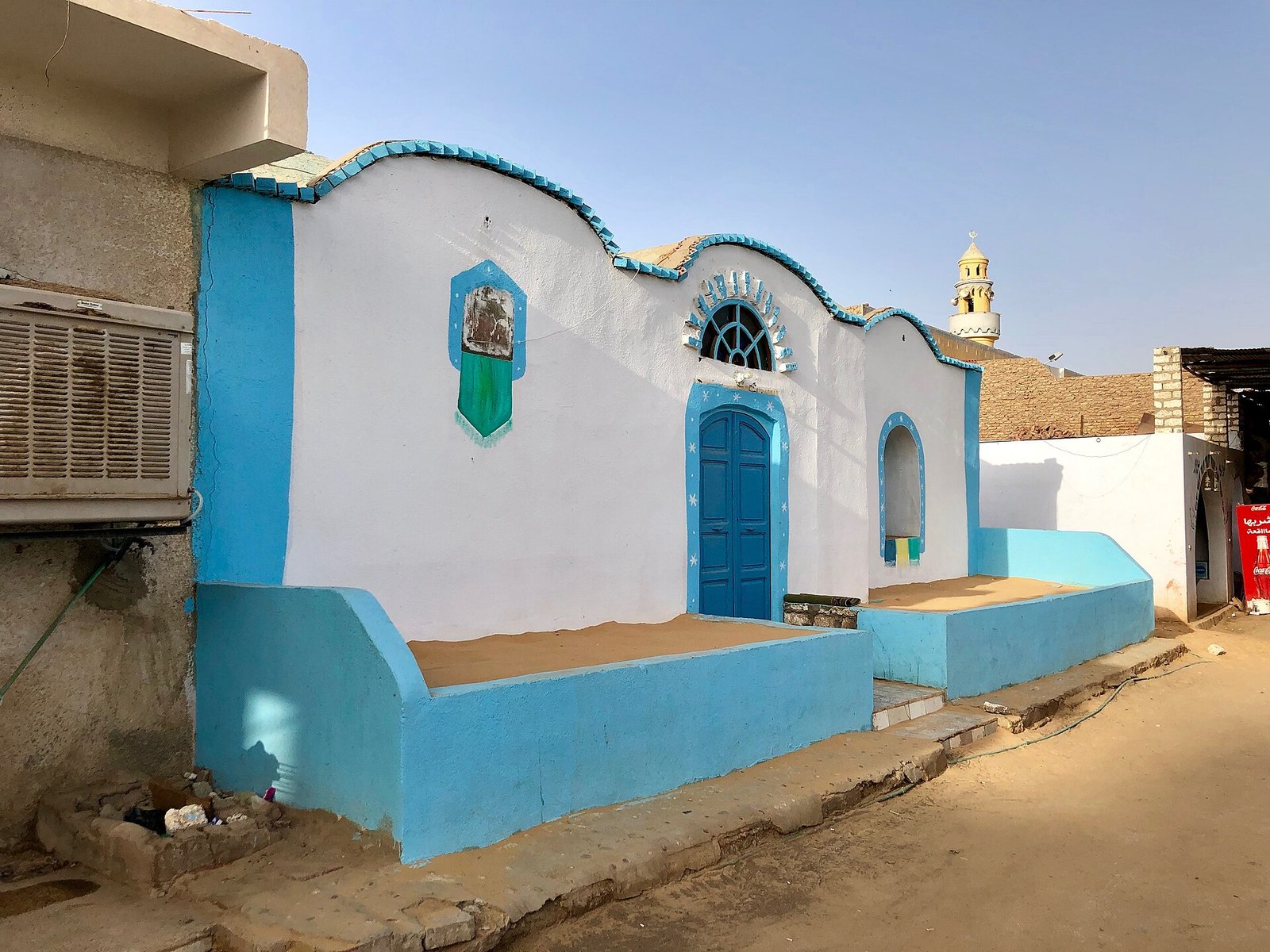
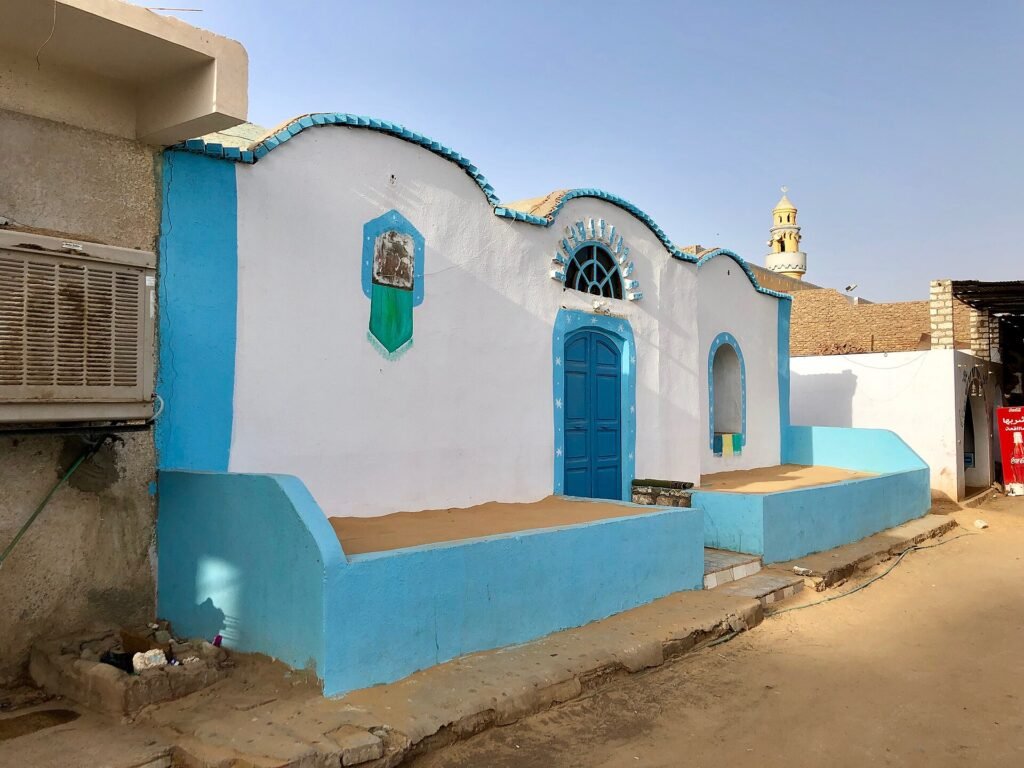
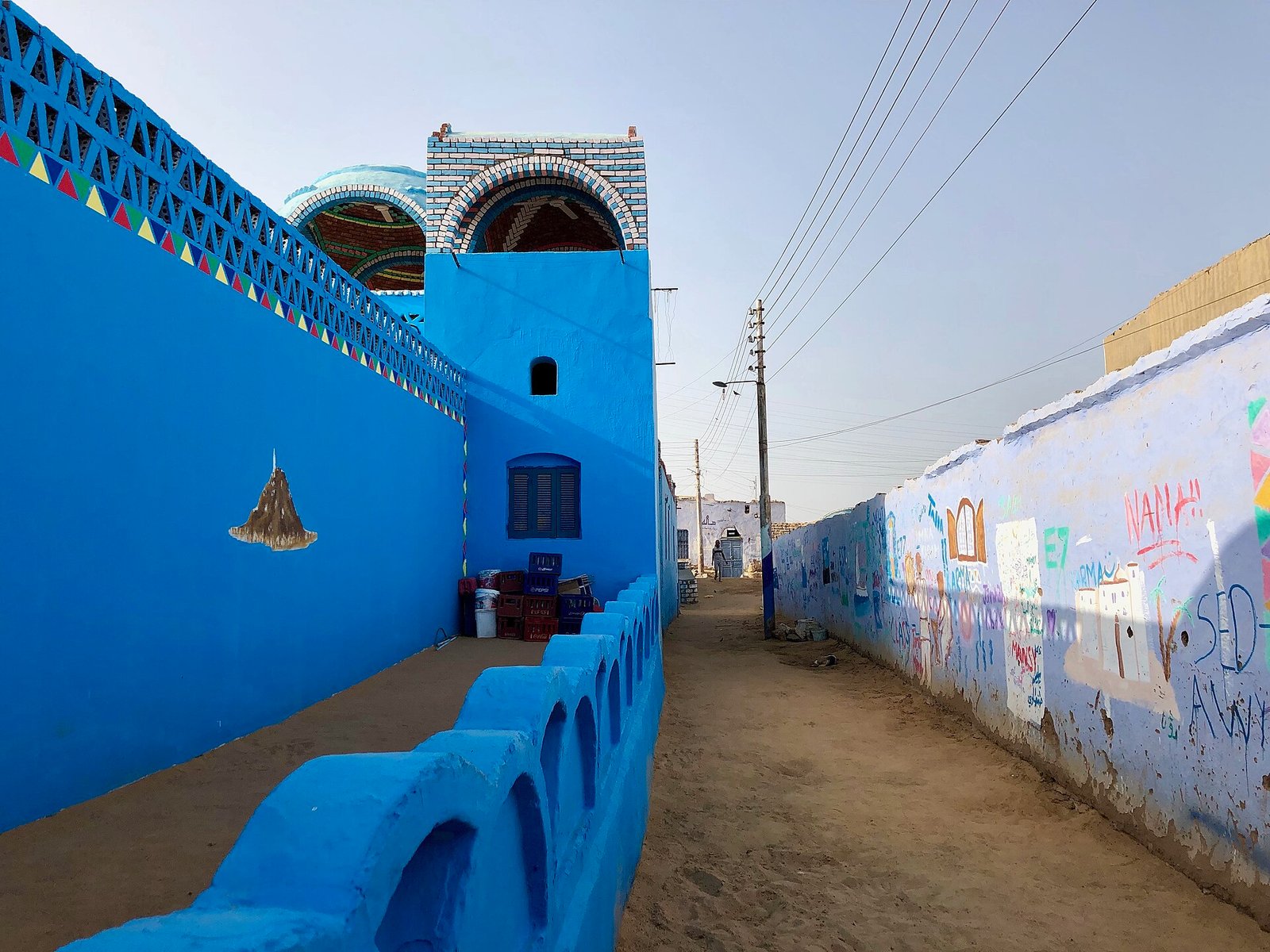
The houses are the reason people come. Nubian building is domed and vaulted mudbrick, plastered and painted in blue, white, ochre and green, with hand prints, crocodiles, scorpions and boats drawn on the walls and old plates set into the plaster. Sandy lanes run between the courtyards, the biggest houses have opened their front rooms as tea houses, and a market street runs up from the beach where the boats land. Behind the village is a dune where camels wait for anyone who wants to arrive that way.
Siou and Koti on Elephantine
Elephantine Island lies right in front of the Aswan Corniche. Its southern tip holds the ruins of ancient Abu, the temple of Khnum, the Nilometer and the Aswan Museum. The middle of the island holds two living Nubian villages, Siou and Koti, with palm gardens, goats and children on the paths. There is no market street and almost nothing for sale. It is quieter, more residential and reached by public ferry rather than a hired boat, which changes the feel entirely.
How you get there: motorboat, felucca, or on foot
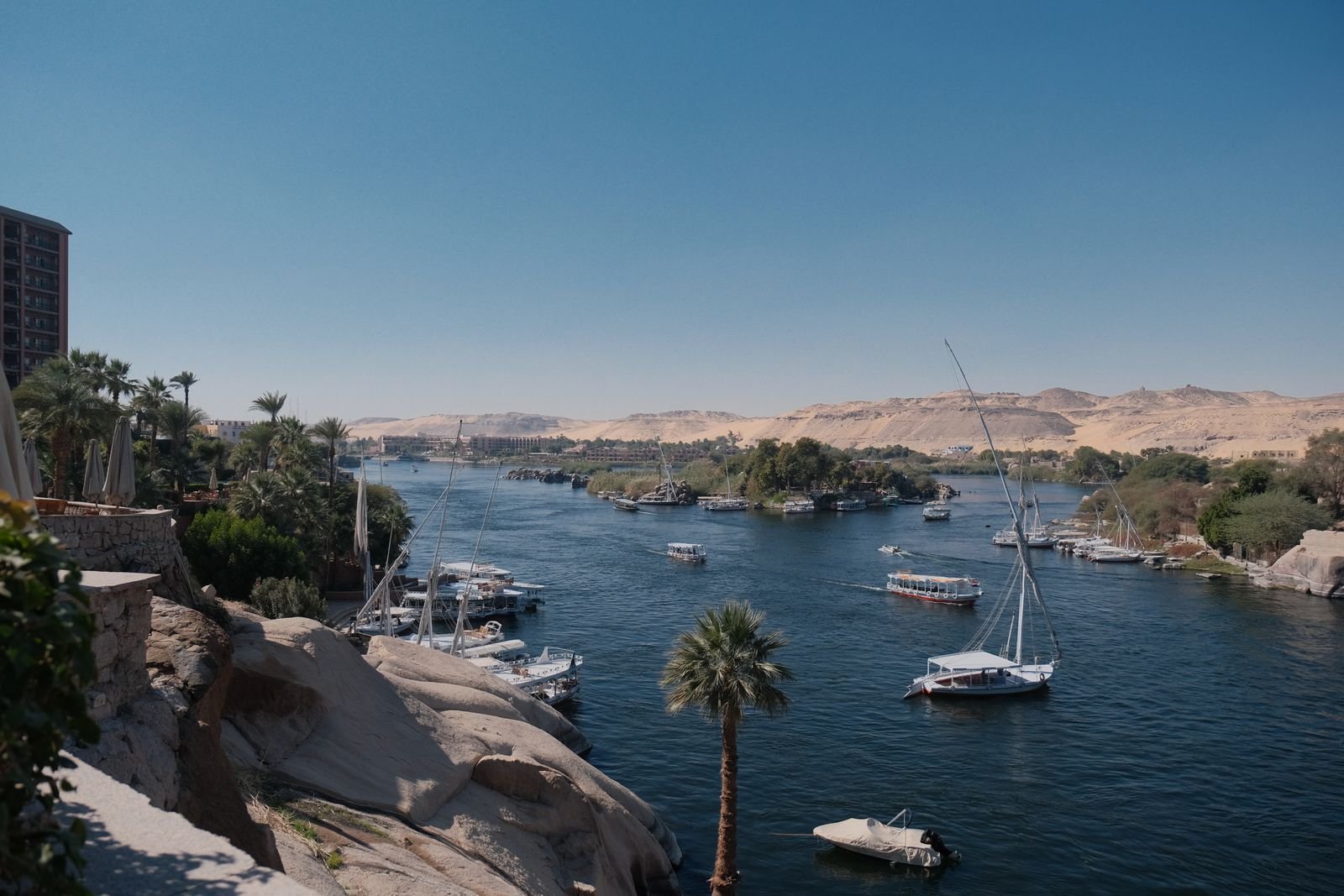
The villages face the river, so the boat is part of the visit, not just transport.
- Motorboat from the Corniche. A small covered launch leaves from the Corniche or your ship's mooring and runs south for roughly half an hour, past the Aga Khan mausoleum and the Old Cataract Hotel, then into the boulders and channels of the First Cataract. The captain will cut the engine at the prettiest spot if you ask.
- Felucca. The traditional lateen-sailed boat. Silent and slow. With a good north wind it reaches Gharb Soheil in an hour or more, and the return is often under tow. Right if the sailing is the point; wrong if you have a ship departure to meet. If slow sailing is what you love, read about the dahabiya cruise.
- The walk on Elephantine. Public ferry from the Corniche, then south through Siou and Koti on paths sometimes only shoulder wide, past gardens and painted doorways. An hour at a stroll, ending at the museum and the ruins. No boat to hire, no bargaining.
On a private visit our driver meets you at the hotel or the ship, our boat is waiting, and the captain is someone we work with every week. No negotiation at the landing.
What a visit looks like, from the landing to the tea
An afternoon at Gharb Soheil as we run it:
- The landing. The boat noses onto the sand and you walk through the lanes to the house, which is when you see the paint at its best.
- The house. Built around a courtyard open to the sky, with the rooms and the domed kitchen off it. You sit on cushions in the reception room. The walls are hand painted, the plates in the plaster are wedding gifts, and the dried crocodile over the door is an old protection charm.
- Tea and hibiscus. Black and sweet, or karkadeh, the deep red hibiscus drink served hot or cold. Accept the first cup.
- Henna. The women of the house draw patterns on hands and forearms in natural reddish brown henna that fades over a week or two.
- Talk. The part a queue never gives you: where the family came from, the village under the lake, how weddings are done. Our guide translates when needed and steps back when not.
- Music. If the family has a tanbura or a drum, someone will play. Nubian music is closer to what you hear in Khartoum than in Cairo.
- The market street and the river. Stalls of spices, beadwork, painted plates and dried hibiscus on the way back, then the boat, the sunset and the lights of Aswan coming on across the water.
The tourist-trap version versus a visit through a family we know
The reviews of this village are full of disappointed people. There are two ways the afternoon goes.
In the first, a boat from the cruise ship or a tout on the Corniche drops thirty people at the main landing at the same time as three other boats. Everyone walks the same market street, is steered into the same big house converted into a bar, poses with a baby crocodile and is back on the boat in forty minutes. Nobody meets a family.
In the second, you arrive with someone the village knows, at a house that has hosted us for years, at an hour when the groups have gone. You drink tea with the people who live there, the henna is drawn by the aunt rather than a stall, and the questions go both ways. The difference is not the boat but the relationship behind it.
To tell them apart before you book, ask three things: who you will visit (a family, or "the village"), when you leave (late afternoon means someone thought about the light) and how many people share the boat. Six is a visit. Thirty is a delivery.
The crocodiles, and the ethical question
You will see them, so you should know the story. Some houses in Gharb Soheil keep small Nile crocodiles in cages, tanks or a dry pool in the courtyard. The custom comes from old Nubia, where a dried crocodile fixed above the door protected the house. In the village today the live animals are mainly there for visitors, who are invited to hold a young one for a photo.
Our position is simple. We do not include the crocodile handling, we do not stop at the houses that lead with it, and we do not pay for the photo. The animals live in small enclosures, often with their mouths taped, and are not returned to the river when they grow. Holding one teaches a child nothing that a dried charm and a conversation would not. If you want to see a crocodile, the honest place is Lake Nasser from a boat.
We do not lecture the families; the trade exists because visitors pay for it, and the way to change that is to visit differently.
The best time of day, and how long it takes
Go in the late afternoon. At midday in Aswan the paint bleaches, the sand throws the sun back at you and the lanes are empty. From about two hours before sunset the light turns gold, the blue houses glow, the cataract rocks go from grey to black, and the river on the way back becomes the picture you came for. In summer, when the afternoon stays over 100 F (38 C) until late, we push the departure as close to sunset as the captain allows. In winter, when the evening drops to about 60 F (16 C) after dark, bring a layer for the ride back.
Timing, door to door:
- Boat to Gharb Soheil: about half an hour.
- In the village and the family home: an hour to an hour and a half.
- Return at sunset: half an hour.
- Total: three hours from hotel or ship and back. By felucca, a full afternoon.
If your only window is morning, go early and choose Elephantine on foot, shaded by palms and busy with village life before noon.
How it fits a cruise day or an Aswan day
Almost everyone who visits the village is in Aswan for a Nile cruise that boards or ends here, or for a stay built around Abu Simbel and Philae. The village fits both, but the order matters.
On a cruise day
Ships boarding in Aswan usually leave the first afternoon free and do the High Dam and Philae the next morning. The ship's village trip is a full boat at a fixed hour. If you are with us, we take you off the ship in the late afternoon and bring you back for dinner, on our boat, to our family. Ships ending in Aswan leave a free last afternoon that is perfect for this.
On an Aswan day with Philae and the botanical island
The classic day: early morning, Philae, the island temple of Isis south of the Old Dam, reached by its own boat from the marina at Shellal. Late morning, the High Dam viewpoint and the unfinished obelisk. Lunch and a rest through the heat. Late afternoon, a boat from the Corniche that stops at the botanical island, the old Kitchener's Island with its avenue of palms, then continues past the cataract to Gharb Soheil and the sunset ride home. Philae and the village use different boats from different landings, so they are two halves of a day, not one trip. More combinations are on our Aswan excursions page.
With Abu Simbel
The road to Abu Simbel leaves before dawn and returns you early afternoon, tired. Adding the village that evening works, but each is better with its own day. On a longer route such as our 10 day Egypt itinerary that is exactly how we place them.
Photography, dress and manners in the village
The village is somebody's home, and the painted lanes are the walls of their houses.
- Ask before photographing people. Always, especially women and children. A smile and a gesture with the camera is enough; a shake of the head is final. Our photography and camera rules for Egypt apply here too.
- Dress modestly. Shoulders and knees covered, loose cotton, a light scarf for women in the house, shoes that slip off at the door. See what to wear in Egypt.
- Drones. Not in the village, not over the river, not near the dam.
- Gifts. A small tip for the host family, yes. Sweets for children, no.
Best photographs: the boat entering the cataract, the lane behind the main house an hour before sunset, a doorway with plates in the plaster, and the wake with Aswan turning pink behind it.
Visiting with children
One of the best afternoons in Egypt for a family, and we say that after enough temple days to know when children have had enough columns. A boat, sand, goats, a camel, henna on the hands and a house that looks like a drawing. A child who has been shy all week usually ends up on the courtyard floor with a Nubian cousin and a drum.
- Life jackets on the motorboat exist but are not always offered. Ask us and we bring the sizes you need.
- The lanes are sand and uneven. A stroller is useless; a carrier for a toddler is perfect.
- Henna on children is fine; the village uses the natural red kind, and black "henna" is a no anywhere.
- Skip the crocodile holding; children understand the animal argument faster than adults.
Our family travel guide for Egypt covers the rest of the trip, from Cairo traffic to cruise cabins.
Three ways to visit, compared
| Option | How it works | Best for | Where it falls short |
|---|---|---|---|
| On your own | Hire a motorboat at the Corniche, or take the ferry to Elephantine and walk. You arrive as a stranger. | Independent travelers with a second day in Aswan, or anyone who only wants the walk on Elephantine. | Bargaining at the landing, no family home, and you land where everyone lands. |
| With a private guide and boat | Our driver, boat and captain, a guide who translates, a family the agency knows, late afternoon, sunset on the way back. | First visits, families with children, photographers, anyone who wants the human part rather than the street. | Needs to be planned a day ahead so the family expects you. |
| From the cruise ship | The ship's optional excursion or the included felucca sail. A full boat, a fixed hour, the main landing and a big house set up for groups. | Convenience when your schedule is the ship's and you only want to see the paint. | Same crowd, same street, same crocodile photo. Little contact with a family. |
Frequently asked questions
Is the Nubian village in Aswan worth visiting?
Yes, if you go in the late afternoon and through someone who takes you to a family rather than a market street. The boat past the First Cataract, the painted houses, an hour in a Nubian home with tea and henna, and the sunset ride back make one of the best afternoons in Upper Egypt. The rushed midday group version is why some people say it is not worth it. They are describing a different visit.
Which Nubian village should I visit, Gharb Soheil or Elephantine?
For a first afternoon, Gharb Soheil, because the boat ride past the cataract and the family home are the heart of the experience and it is the village most set up to receive guests. Elephantine's villages of Siou and Koti are quieter, reached by public ferry and best walked in the morning. With two days in Aswan, do both.
How do you get to the Nubian village from Aswan?
By boat. A motorboat from the Corniche or from your cruise ship's mooring takes about half an hour south to Gharb Soheil, passing Elephantine, the Aga Khan mausoleum and the rocks of the First Cataract. A felucca takes an hour or more. For Elephantine you take the short public ferry and walk. On a private visit with Explora Egipto the boat and driver are arranged in advance.
Should I hold the crocodile?
We say no, and we do not include it. The small crocodiles kept in some houses are there for visitor photos, live in small enclosures and are not released when they grow. The old Nubian custom was a dried crocodile above the door as a protection charm, and that is the version worth asking about. If seeing a crocodile matters to you, the answer is a boat on Lake Nasser.
How long does a Nubian village tour take?
About three hours from your hotel or ship and back: half an hour on the boat each way and an hour to an hour and a half in the village and the family home. By felucca, an afternoon. Adding the botanical island on the way takes another forty minutes. It fits the free afternoon of a cruise day or the second half of a day that starts with Philae.
What should I wear and can I take photos in the village?
Cover shoulders and knees, choose loose light fabrics and wear shoes you can slip off at the door of the house. Photographs of the painted walls and doorways are welcome. Photographs of people need a request and a yes first, especially women and children, and a no is final. No drones near the village or the river. Inside the home, ask your host once at the start and follow the answer.
Meet a Nubian family in Aswan, at the right hour
Tell us your dates in Aswan, whether you are on a ship or in a hotel, and who is traveling. We will place the village visit at the best light, with a family we have known for years, and send you the quote with the rest of your Aswan day worked out around it.