The Qaitbay Citadel is the closest you will ever stand to the lighthouse of Alexandria
The Qaitbay Citadel is the closest you will ever stand to the lighthouse of Alexandria
The Qaitbay Citadel is a fifteenth-century Mamluk fortress at the tip of the breakwater that closes Alexandria's Eastern Harbor, and it stands on the footprint of the Pharos, the lighthouse that was one of the Seven Wonders of the ancient world. Sultan Qaitbay built it in the late 1470s from local limestone and from the lighthouse's own fallen blocks, which is why red Aswan granite columns still stick out of its walls. Inside there is a square keep with a small mosque, tight spiral stairs and a roof with the best view in the city. You see it in under an hour, ideally in late afternoon light, in the same day as the Bibliotheca and the catacombs.
What the Qaitbay Citadel is, in two minutes
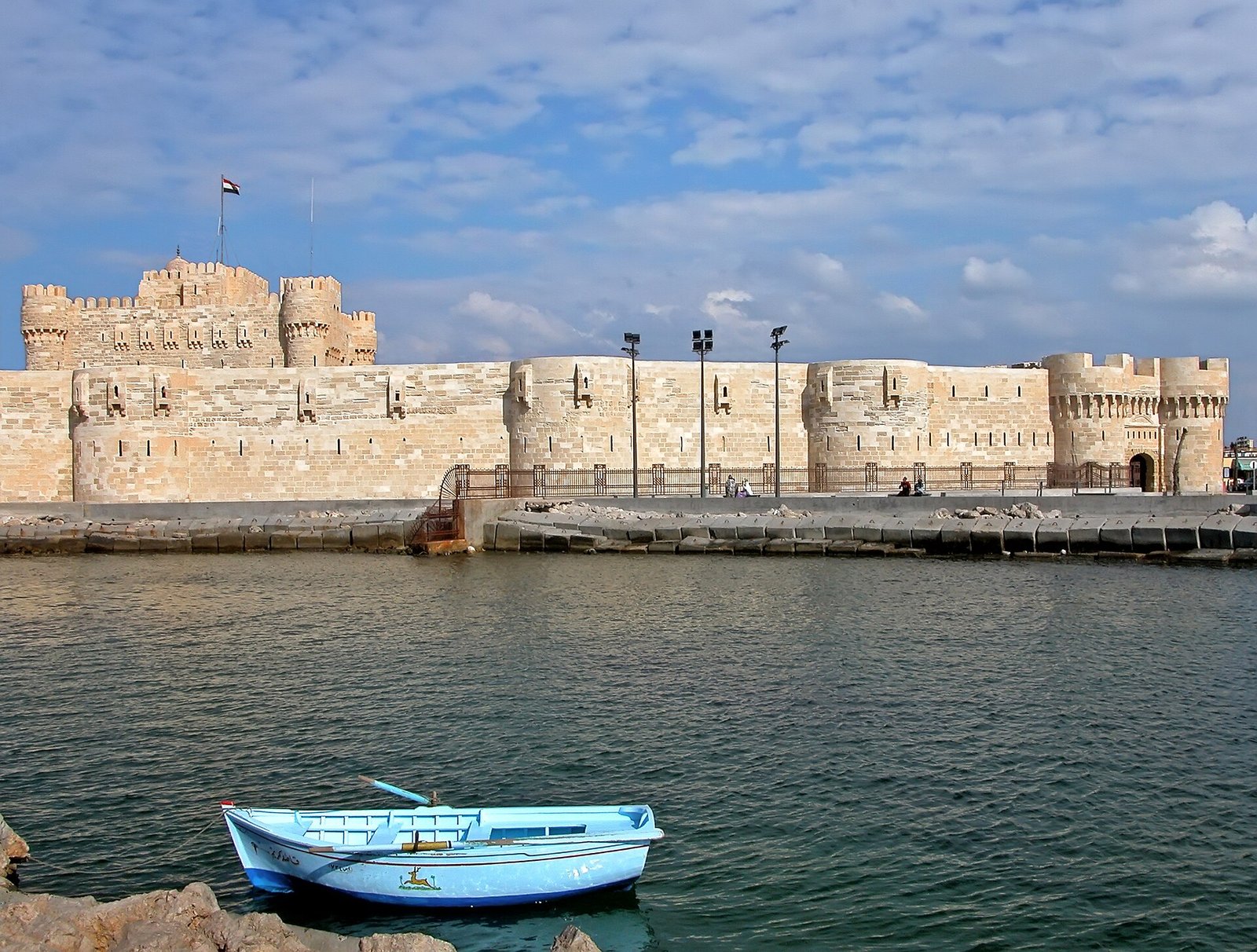
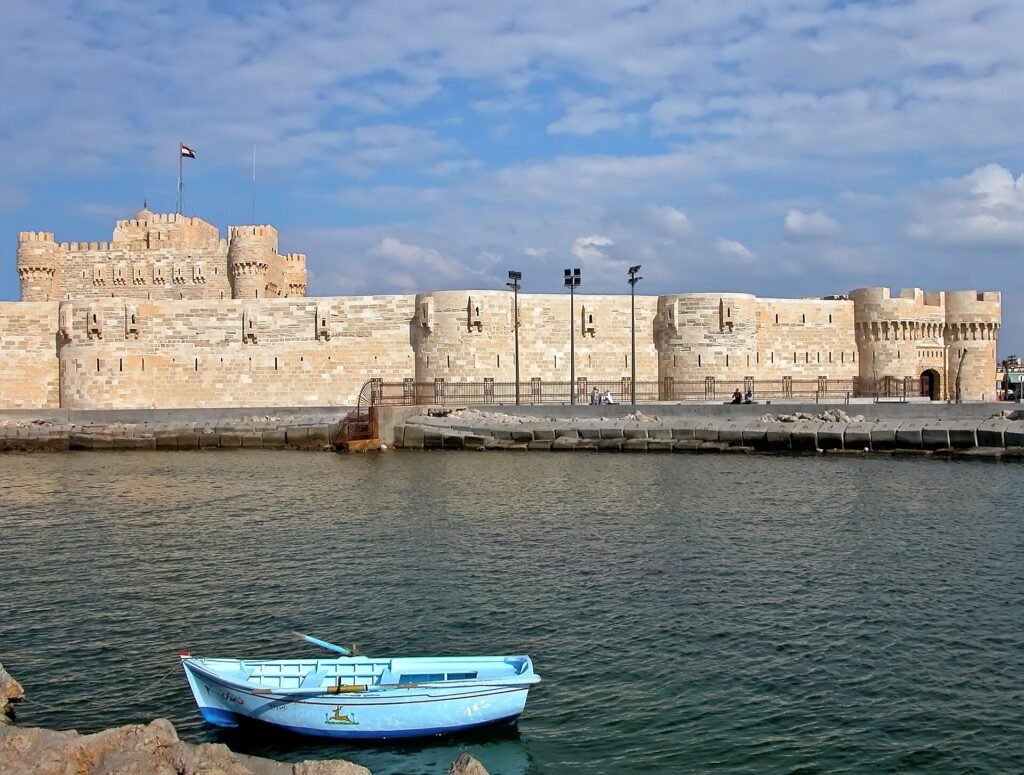
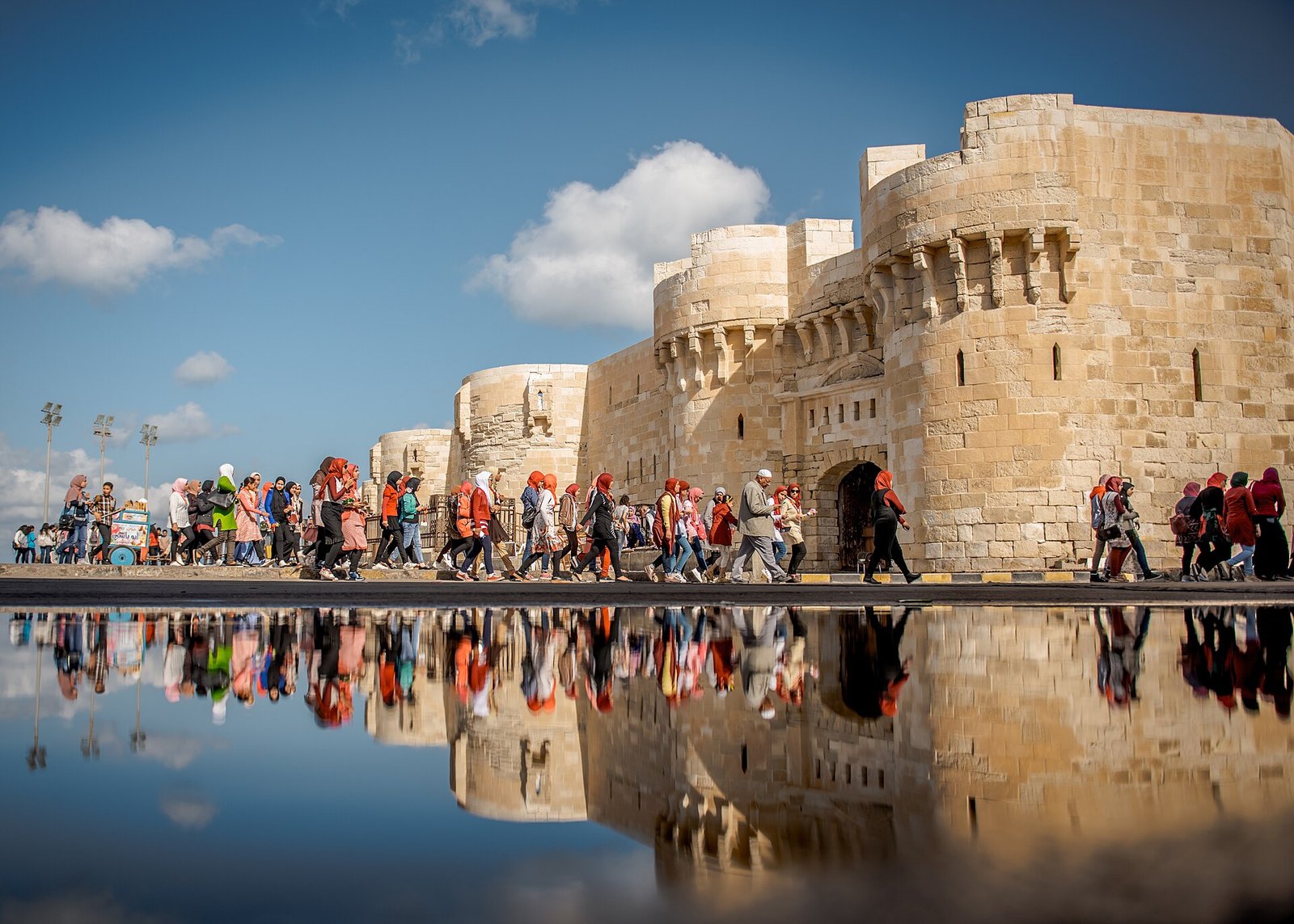
Alexandria has two harbors. The older one, the Eastern Harbor, is held in by a curved arm of land that ends in a rocky point, and on that point sits a low, pale, square-towered fort with the Mediterranean on three sides. That is the Qaitbay Citadel, the picture every postcard of Alexandria uses.
It was ordered by al-Ashraf Qaitbay, one of the last great Mamluk sultans of Egypt, and finished around 1479, when Ottoman sea power was the threat and the harbor mouth needed artillery. So it is not a medieval castle with high thin walls. It is a squat, thick, gunpowder-era work, built to take cannon fire and return it.
The layout is simple. An outer wall with a walkway on top encloses a courtyard, and in the middle stands the keep, a square tower three stories high with a round bastion at each corner. What you cannot see from outside is why the fort matters more than any other Mamluk building in Egypt: what stood on this rock before it.
The lighthouse that stood here first
The Pharos of Alexandria went up in the early third century BCE, under the first two Ptolemies, on the island that gave it its name. It was a tower in three stages, square at the bottom, octagonal in the middle, round at the top, with a fire at the summit whose light was reflected out to sea. Estimates of its height start at around 100 meters, taller than anything built in antiquity except the pyramids at Giza.
It was still working in the early Islamic centuries. Then the earthquakes came. One in the tenth century brought down the top stage, two in the early fourteenth century finished the job, and Ibn Battuta, who saw it in ruins in 1326, found it collapsed beyond entry in 1349.
When Qaitbay's engineers arrived a century and a half later, they found a rocky point covered in enormous blocks of cut stone and granite, already shaped, already on site. They used them. So at the foot of the citadel you are standing on the base of the Pharos, and when you touch certain stones in its walls you are touching the lighthouse. That is the whole point of the visit.
Where to find the Pharos in the walls
The citadel is built of a pale local limestone. Anything in the walls that is not that stone is a clue. Look for red and pink granite, quarried at Aswan far up the Nile, the material the Ptolemies used for the monumental parts of the lighthouse: its columns, thresholds and facing.
The easiest to spot are the columns. Along the outer face of the keep and in stretches of the enclosure wall you will see round granite shafts laid horizontally through the masonry so that only their circular ends show. The Mamluk masons used them as ties, the way a modern builder uses steel rebar.
- Round red granite ends set flush in the limestone: reused column shafts from the lighthouse or the Ptolemaic buildings beside it.
- Large blocks of a darker, harder stone at the base of the keep: lighthouse foundation material, too heavy to move far.
- A polished granite threshold in an otherwise limestone doorway: reused Ptolemaic architecture.
Nobody labels these. Once you know what to look for you will find a dozen in ten minutes, and the fort changes from a pretty fortress into a building made out of a Wonder of the World.
Inside the keep: the mosque, the stairs and the roof
You enter the keep through a single doorway on the courtyard side and find a hall with thick piers and a vaulted ceiling. Off that hall is the fort's mosque, a small prayer space with four iwans around a central bay and a mihrab still readable in the south wall. It is often described as one of the oldest surviving mosques in Alexandria.
Narrow spiral staircases climb through the two upper floors, the garrison levels: rooms for soldiers, stores, and firing slits angled toward the harbor mouth. The steps are tall and worn and there is no elevator, so anyone with knee trouble should decide at the bottom whether the roof is worth it. For most people it is.
The roof is the reward. You come out onto a terrace ringed by the parapet and the whole geography of Alexandria opens up: the Eastern Harbor and the corniche to the east, the fishing harbor of Anfushi with its painted boats to the west, and straight ahead nothing but Mediterranean. From up here you understand why a fort had to be on this rock. It commands the only entrance to the harbor.
One expectation to set. The rooms are empty: no furnished chambers, no mannequins, no displays. It is a bare stone fortress that rewards you in proportion to how much of its story you arrive knowing.
The ramparts, the sea view and the naval museum
After the keep, walk the ramparts. A path runs along the top of the enclosure wall, and the seaward stretch is the one to do slowly: waves on the rocks under you, wind straight off the water, and on a clear day the full line of the city to the far end of the corniche.
The courtyard held what a garrison needed: cisterns cut into the rock, storerooms for grain and powder, barracks. Some of these rooms now house the citadel's small naval museum, a modest collection of ship models and finds from the sea. Which rooms are open changes with restoration schedules. If it is open, give it fifteen minutes; if not, you have missed very little.
The fort you walk through is also not entirely Qaitbay's. In 1882 the British fleet bombarded Alexandria and the citadel took heavy damage on its northern side. It was rebuilt in the early twentieth century and restored again in the 1980s. The plan and the core of the keep are original; some of the crisp upper walls are reconstruction. Your guide can point out the seam.
For the rest of the city, its Greek layers, its cafes and its sea front, start with our guide to what to see in Alexandria.
What lies under the water offshore
The lighthouse did not vanish. Most of it fell into the sea, and it is still there, in shallow water a short distance from the fort. From the 1990s onward, underwater archaeologists mapped thousands of pieces on the seabed: enormous blocks, column shafts, sphinxes, obelisk fragments and colossal statues from the Pharos and from the Ptolemaic royal quarter beside it.
A few pieces were raised. The best known is a colossal statue of a Ptolemaic king carved as a pharaoh, which now stands outside the Bibliotheca Alexandrina. Most of the rest was left where it lay, to protect it and because there is too much to lift.
Can you dive on it? In principle yes. Local operators run trips over the Pharos site and the sunken royal quarter, subject to sea conditions, a permit and variable visibility. This is not the Red Sea, so go for the archaeology rather than the reef, and tell us early so we can check whether it can be arranged for your dates. Even if you never get wet, that bay is one of the densest concentrations of monumental sculpture in the Mediterranean, a few feet under the surface.
The fish market, Anfushi and the corniche next door
The citadel sits at the end of a neighborhood called Anfushi, and the walk back along the harbor is half the pleasure of the visit. Beside the fort is the fishing harbor, where the catch comes in on wooden boats painted blue, green and yellow, and where the fish market and its row of restaurants are. You choose the fish from the ice, say grilled or fried, and it arrives with tahini, salad and rice.
This is where we usually put lunch on an Alexandria day, before or after the fort depending on the light. It is the most Alexandrian hour of the trip, loud, salty and unlike anything in Cairo. If seafood is not your thing, tell us and we route the meal elsewhere.
From the fish harbor the corniche begins, the seafront road that follows the curve of the Eastern Harbor to the Bibliotheca and beyond. Walking a stretch of it is how the city shows itself: old cafes, boys jumping off the breakwater, and the citadel always at the end of the bay. Late afternoon, when the whole city comes out to sit by the water, is its best hour.
Best light, how long, and what to wear
Practical points, in the order people ask them.
| Question | Our answer |
|---|---|
| How long inside | Forty-five minutes to an hour for the keep, the roof and the ramparts. Add time for photos and the naval museum if it is open. |
| Best light | Late afternoon, when the sun drops over the water and the limestone turns gold. Morning light is flat on the seaward walls; midday is harsh in summer. |
| Wind | Almost always. In winter the spray reaches the walkway, so bring a layer even when Cairo is warm. |
| Footing | Narrow spiral stairs with tall worn steps, uneven flagstones, no handrails in places. Closed shoes with grip, not sandals. |
| Crowds | Busiest on Fridays and public holidays with local families. Weekday late afternoons are the sweet spot for light and space. |
| Drones | Photography on foot is fine everywhere. Do not bring a drone expecting to fly it here. |
Opening times and ticketing change, and parts of the fort close for work from time to time, so check the current situation before you fix your plan. Alexandria is cooler than Cairo, with summer afternoons around 30 degrees Celsius softened by the sea breeze and winter days that can be windy and wet, so pack for the coast.
To see how the fort fits into a first trip to the country, our overview of what to see in Egypt puts Alexandria beside the pyramids and the Nile.
Combining Qaitbay with the Bibliotheca and the catacombs
Alexandria is a day trip from Cairo, a little under three hours each way by road or train. That leaves six or seven usable hours, enough for the three essential sites plus lunch in a sensible order. This is the order we use.
- Leave Cairo early. You want to be in Alexandria before the city is fully awake.
- Catacombs first. The catacombs of Kom el Shoqafa are underground, cool at any hour and best before the tour buses.
- Pompey's Pillar. Ten minutes away, twenty minutes to see. A single vast red granite column from the same quarries as the blocks in the citadel walls.
- Lunch at the fish harbor. Anfushi, beside the fort.
- The Qaitbay Citadel. Early to mid afternoon, when the light has started to warm.
- The Bibliotheca Alexandrina. Drive along the corniche to the Bibliotheca Alexandrina, the modern library built to honor the ancient one, with the colossal statue raised from the water in front of the fort at its entrance.
- Corniche at sunset, then back to Cairo. A last walk by the water and the drive home in the dark.
With two days the rhythm relaxes: add the Roman theater, the Alexandria National Museum, Montaza gardens and a long evening in the old cafes. With only a morning, keep the citadel and the Bibliotheca and sacrifice the catacombs.
Alexandria was also the city of the last Ptolemaic queen, and the palace quarter under the harbor was hers. If that story interests you, read our page on Cleopatra before you come.
What a guide adds, and how Explora Egipto runs the Alexandria day
You can visit the Qaitbay Citadel without a guide, climb to the roof, take the photo and leave having seen a handsome fort by the sea. What you will not have seen is the lighthouse, because it is invisible unless someone shows you the granite in the wall, points to the water where the statues lie and explains why a sultan needed cannon on this exact point. That is the difference between a stop and a visit.
A guide also solves the logistics that eat an Alexandria day: which fish restaurant is worth it, how to time the catacombs before the buses, where the driver waits at the citadel, and when to leave so the desert road is not a parking lot.
Here is how we run it. Explora Egipto is a local Egyptian agency with its own guides and vehicles. Your driver collects you at your hotel early in a private air-conditioned car. Your guide, an Egyptologist who speaks fluent English and knows Alexandria as a city, is with you from first stop to last. We handle tickets, order, lunch and timing. You handle looking at things.
Most guests do it as one of their Cairo excursions in the middle of a longer trip, between the pyramids and a domestic flight south to Luxor or Aswan. If you are building the whole trip with us, look at our Egypt tour packages and tell us you want Alexandria added. Ask us for the quote and we send it the same day.
Frequently asked questions
Is the Qaitbay Citadel really built on the lighthouse of Alexandria?
Yes. The fort stands on the eastern tip of the former island of Pharos, where the lighthouse stood until earthquakes brought it down. When Sultan Qaitbay fortified the point in the late 1470s, his builders reused the fallen blocks. The red granite columns laid through the walls come from the lighthouse, and the rest of it lies on the seabed offshore.
How long do you need at the Qaitbay Citadel?
Under an hour for the keep, the mosque, the roof and a loop of the ramparts. Allow a full hour if the naval museum rooms are open. On our Alexandria day from Cairo we give the citadel about an hour and put lunch at the fish harbor next to it.
Can you go inside the citadel and climb to the top?
Yes. The keep is open, including the ground-floor mosque and the two upper floors, and the roof terrace is reached by narrow spiral staircases. The view over the Eastern Harbor, the fishing port and the open Mediterranean is the best in Alexandria. The stairs are steep and worn, so wear closed shoes with grip. Sections can close for restoration, so let us confirm on the day.
Is there a museum inside the Qaitbay Citadel?
There is a small naval museum in some of the courtyard rooms, with ship models and finds from the sea. It is modest and its opening depends on restoration work, so think of it as a bonus rather than the reason to come. The fort itself, the lighthouse blocks in its walls and the roof view are the visit.
Can you see or dive on the sunken lighthouse?
From the ramparts you see the water where it lies, not the stones; they are a few feet down and the water is rarely clear enough to spot them from above. Diving on the Pharos site and the sunken Ptolemaic quarter is possible through local operators, subject to a permit, sea conditions and your dates, with modest visibility. It is an archaeology dive, not a reef dive. Tell us early if you want us to look into it.
What is the best time of day to visit the Qaitbay Citadel?
Late afternoon, roughly the last two hours before sunset. The sun is over the sea to the west, the limestone glows, the wind usually eases and the corniche fills with Alexandrians. Mornings are quieter but the light is flat on the seaward walls. Avoid Friday afternoons if crowds bother you, and summer midday, when there is no shade on the roof.
Stand where the lighthouse stood, with someone who can show you what is left of it
Tell us your dates in Cairo and whether you want a single day or a night on the coast, and we come back with the plan: the private car, the guide who knows the citadel stone by stone, lunch at the fish harbor and the Bibliotheca on the way back. Ask us for the quote and we send it the same day.