Hatshepsut was the queen who ruled Egypt as a king, and you can still walk through her reign in Luxor
Hatshepsut was the queen who ruled Egypt as a king, and you can still walk through her reign in Luxor
Hatshepsut was an 18th Dynasty royal woman who began as regent for her young stepson Thutmose III around 1479 BC, then took the full titles of pharaoh and ruled Egypt for roughly two decades as the senior king. She had herself carved with the false beard of a king, sent a trading fleet to the land of Punt, raised granite obelisks at Karnak and built the terraced temple at Deir el Bahari. Twenty years after her death, Thutmose III had her name as king chiseled out. It did not work. Her temple, her standing obelisk, her Red Chapel and, by the accepted reading, her mummy are all there to see, and this guide shows how we fit them into one Luxor morning.
Who Hatshepsut was, and why "queen" undersells her
Hatshepsut was born into the royal family of the 18th Dynasty, at the start of the New Kingdom, when Egypt was at its richest. Her father was Thutmose I, the warrior king who pushed the borders deep into Nubia and Syria, and her mother was his principal wife, Ahmose. She married her half brother Thutmose II, the son of a lesser wife, and as his Great Royal Wife she also held the priestly title God's Wife of Amun. They had one daughter, Neferure.
The word "queen" is where most people go wrong. Hatshepsut was a king's wife first and a reigning king second. For the last twenty or so years of her life she was pharaoh in the full Egyptian sense: five royal names, the double crown, the right to offer to the gods for the whole country. Egyptian had no word for a female king, so the scribes used the male title and often kept the female pronoun in the same sentence.
She belongs on the short list in our page on the pharaohs of Egypt, and hers is one of the calmest reigns on it.
From regent to king: how she took the throne
Thutmose II died young. His heir, Thutmose III, was the son of a secondary wife named Isis and still a small child. A widowed queen governing for a boy king was nothing unusual, and for the first years that is what Hatshepsut did.
Around the seventh year of his reign the record changes. Hatshepsut appears with a throne name of her own, Maatkare, a full royal titulary and the crowns of a king. She did not depose Thutmose III. He kept his titles and appears beside her on monuments, but she was the senior partner in a joint reign.
She justified it two ways, both carved on her temple walls. The first was an oracle: Amun, in procession, chose her publicly. The second was a divine birth story in which Amun takes the form of Thutmose I, visits Queen Ahmose and fathers Hatshepsut. A daughter of the god could hardly be denied the god's throne. Behind the theology stood a capable administration and the priesthood of Amun at Karnak, rewarded with buildings and land, and that combination kept her on the throne for over two decades without a civil war.
The false beard: how to read her statues
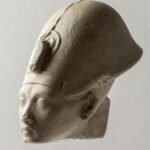
In her later statues Hatshepsut wears the striped nemes headcloth, the short kilt, a flat male torso and the plaited ceremonial beard strapped to the chin. Visitors sometimes read this as a disguise. It was not.
The office of pharaoh had a fixed image, worked out over a thousand years, and every element of it was male because every previous holder had been. To be shown as king was to be shown in that uniform. Male kings wore the false beard too; none of them grew one. It was a badge of the office, not of the person.
You can watch the change across her statues. The earliest show a woman in a fitted dress with a queen's crown. A middle group shows the king's costume on a body with a soft face and a slight chest. The latest are indistinguishable from any other king of the dynasty. The texts, meanwhile, alternate "his majesty" and "she" in the same line with no sense of contradiction.
A reign of trade and stone rather than war
Most New Kingdom pharaohs earned their reputation on the battlefield. Hatshepsut's reign records only small actions in Nubia and pours its energy into trade, quarrying and building.
The expedition to Punt
The defining episode of the reign was a voyage, not a battle. Around year nine she sent a fleet to the land of Punt, somewhere on the southern Red Sea coast of Africa, and had the whole journey carved on the middle terrace of her temple. The reliefs read like a documentary: ships being loaded, Punt houses on stilts, the local chief and his wife receiving the Egyptians, and incense trees carried aboard in baskets with their root balls intact for replanting in Egypt.
The cargo list includes myrrh, incense, ebony, ivory, gold, skins and live baboons. In the temple forecourt archaeologists found the pits where the trees were planted, with root remains still in them, a rare case of an Egyptian relief checked against physical evidence at the same site. The message was plain: the incense of the gods had reached Egypt at Amun's own command, under a ruler whose right to the throne had been questioned.
The obelisks at Karnak
Hatshepsut raised at least two pairs of obelisks at Karnak. The famous pair went up between the fourth and fifth pylons around year sixteen, each cut from a single block of Aswan red granite; an inscription on the base says the work from quarry to erection took seven months. One still stands, roughly 97 feet (about 29.5 meters) tall, among the tallest in Egypt and visible from almost anywhere in the precinct. Its partner fell in antiquity, and its upper section lies near the sacred lake, where you can read the hieroglyphs at eye level.
Her monuments also record expeditions to the turquoise mines of Sinai, reopened quarries at Aswan and a program of restoring temples damaged during the foreign rule that preceded the New Kingdom.
Senenmut and the court that held it together
No reign runs on one person. The name that turns up everywhere in Hatshepsut's is Senenmut, a man of modest birth who rose to be steward of the royal household, overseer of the estates of Amun and tutor to the princess Neferure. Several statues show him holding the child on his lap.
He is credited with directing the building of Deir el Bahari, and he managed something no non-royal had done before: small images of himself carved inside the temple, behind the doors of the niches, seen only when the doors stood open. He built two tombs, one on the hill of Sheikh Abd el Qurna and a second, unfinished one just outside the temple precinct, whose ceiling carries the oldest known star map in Egypt.
The relationship between the two has fueled speculation for a century, including an obscene graffito scratched by a workman in an unfinished tomb above the temple. Not one document supports anything beyond exceptional political trust, and Senenmut disappears from the record before the end of the reign, for reasons nobody has established.
Deir el Bahari, terrace by terrace
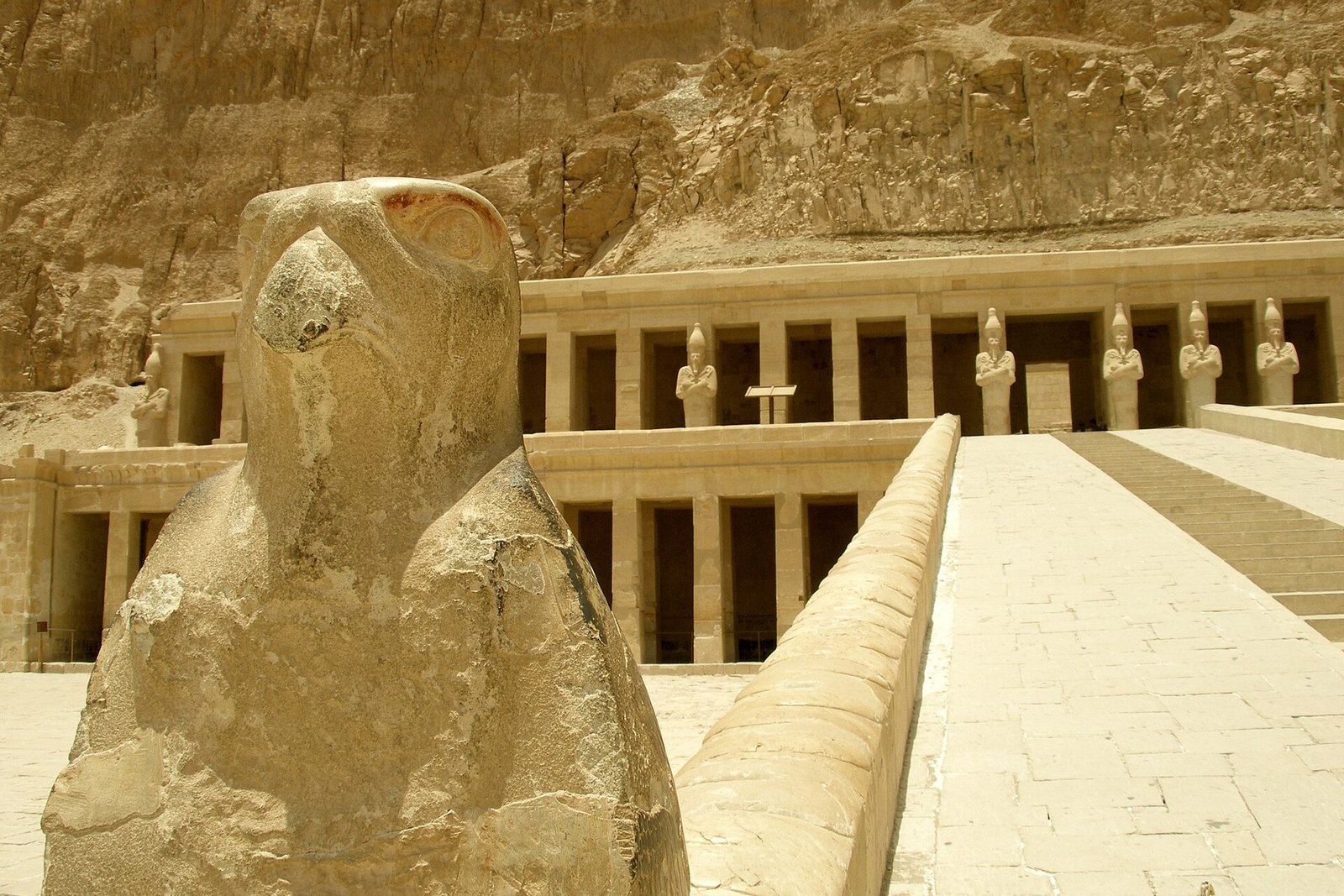
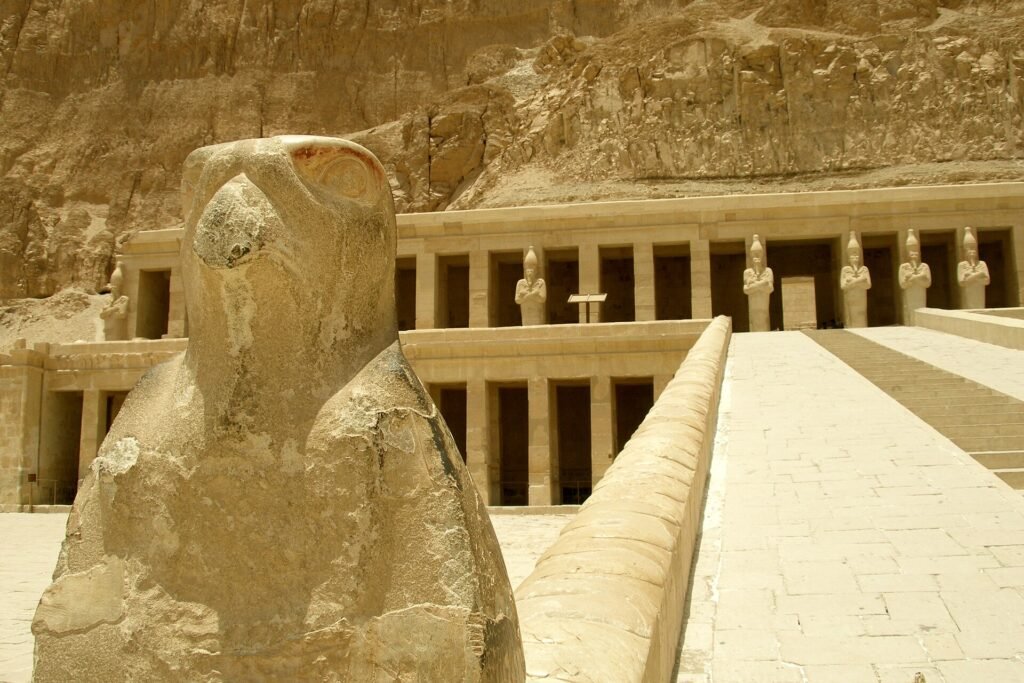
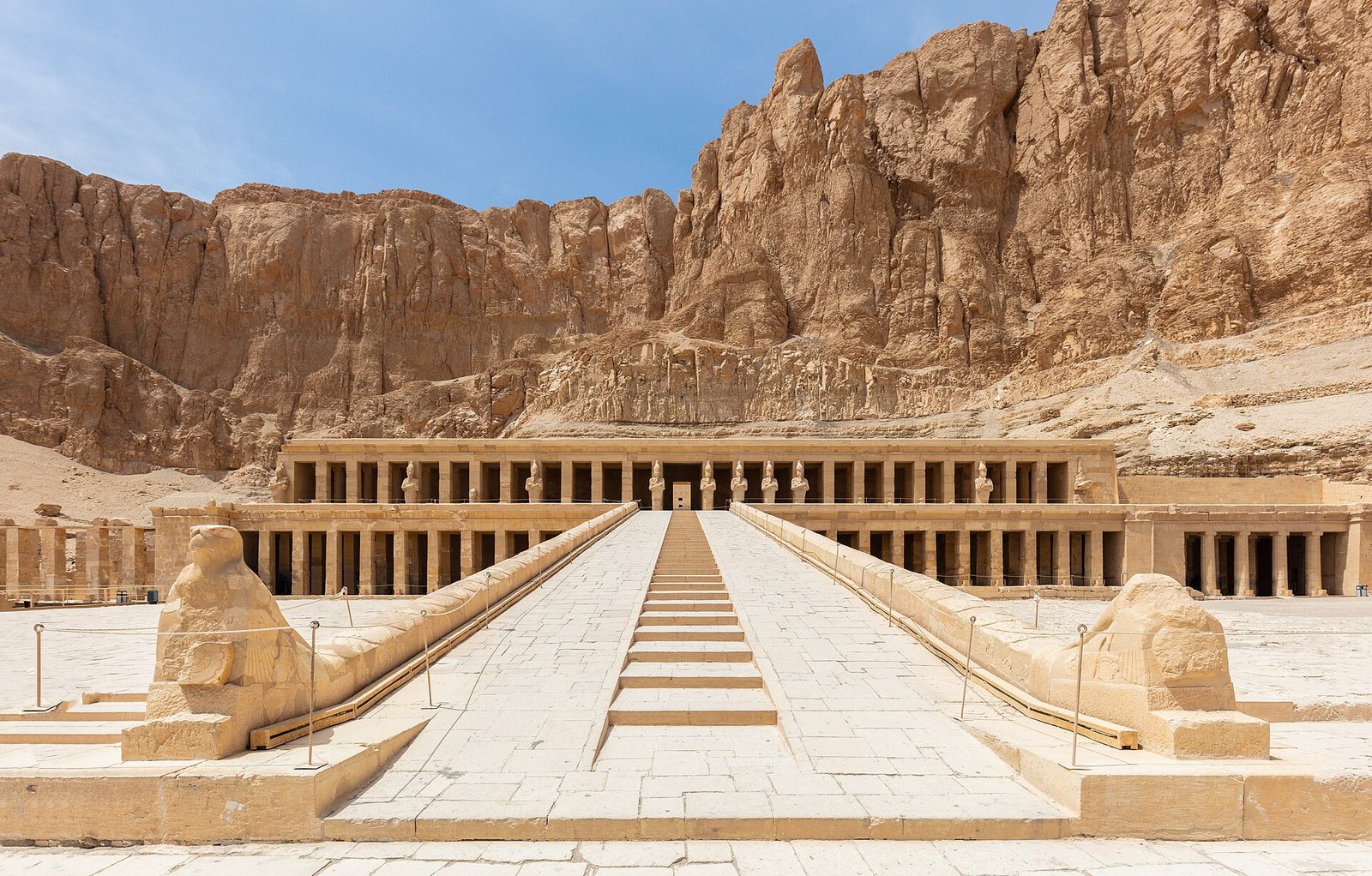
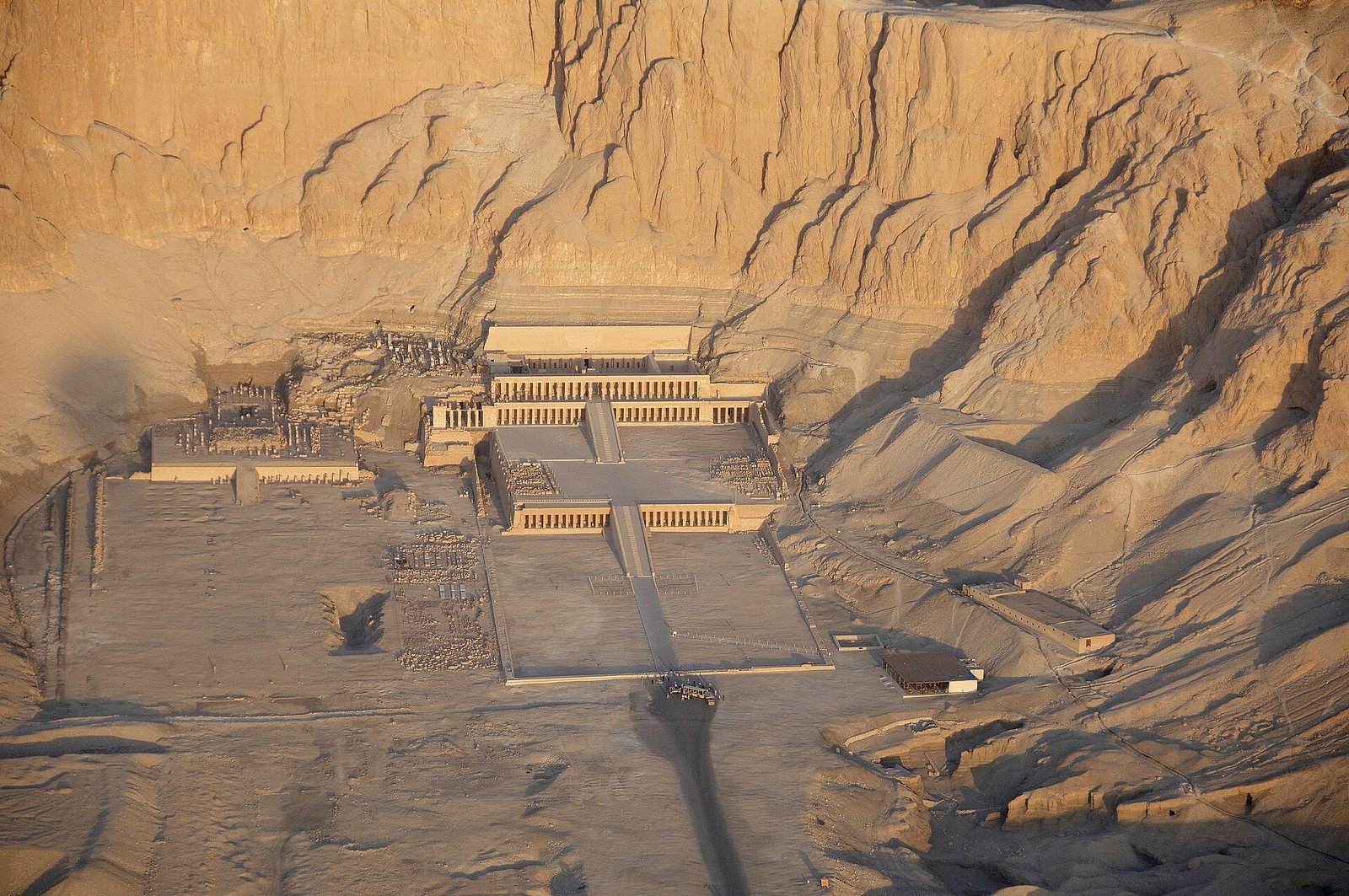
Hatshepsut's memorial temple sits in a bay of cliffs on the Luxor west bank, next to the older, ruined temple of Mentuhotep II that inspired its design. Its ancient name was Djeser Djeseru, "holy of holies", and its axis lines up with Karnak across the river. The building rises in three broad terraces linked by ramps, with colonnades along the back of each. Here is what to look for as you climb:
- Lower terrace. Once a garden with the Punt trees. The colonnade reliefs show her obelisks being shipped from Aswan by barge.
- Middle terrace, south side. The Punt portico: the ships, the stilt houses, the chief of Punt and his wife, whose heavy figure the artists drew with unusual realism. Beyond it is the chapel of Hathor, with her face on the column capitals.
- Middle terrace, north side. The divine birth portico, where Amun visits Queen Ahmose and the child Hatshepsut is shaped on a potter's wheel by the god Khnum. Beyond it, the chapel of Anubis keeps some of the best color in the temple.
- Upper terrace. A row of Osiride statues of Hatshepsut as king fronts the colonnade, then a court and, cut back into the cliff, the sanctuary of Amun.
The temple was damaged in antiquity, quarried when a monastery occupied the upper terrace, and has been under reconstruction by a Polish Egyptian mission since 1961. It is the centerpiece of every Luxor west bank program we run.
Her mummy: KV60 and the tooth
Her sarcophagus was found empty in her tomb. In 1903 Howard Carter cleared a small, undecorated tomb nearby, KV60, and found two female mummies. One lay in a coffin inscribed for Sitre In, Hatshepsut's wet nurse. The other, a heavy woman with her left arm bent across the chest in a royal pose, was left on the tomb floor.
The link came in 2007. A wooden box bearing Hatshepsut's cartouche, found decades earlier in the royal cache at Deir el Bahari, contained embalmed organs and a single molar. When the KV60 mummy was CT scanned, her upper jaw had a socket missing exactly that tooth, and the root left in the jaw matched it. On that basis the Egyptian authorities identified the KV60 mummy as Hatshepsut, and that is the reading you will hear from every guide and read on the museum label.
The scans suggested she died in her fifties, overweight and ill, a very different picture from the slim king on the temple walls. The mummy is now displayed in the royal mummies hall of the National Museum of Egyptian Civilization in Cairo, where the royal mummies were moved in a ceremonial parade in 2021.
The erasure, and why it came twenty years late
Late in his own long reign, Thutmose III ordered Hatshepsut's name and image as king removed from her monuments. Cartouches were chiseled out and replaced with his own or those of his father and grandfather. Her statues at Deir el Bahari were smashed and dumped in a quarry pit in front of the temple. Her obelisks at Karnak were not destroyed but walled in behind masonry, which is why the standing one survived so well. Her name was left off the later king lists.
The old explanation was revenge. The evidence does not fit. The attack began roughly twenty years after her death, when Thutmose III was an old man with a grown heir, Amenhotep II, and it was selective: her images as queen were largely left alone, and only Hatshepsut the king was targeted.
The current view is that this was about the succession. A female king who had ruled successfully was an awkward precedent, and there may have been relatives on her side of the family whose claims needed closing off before Amenhotep II took over. Removing Hatshepsut the king turned the record into an unbroken male line. It was administrative, not emotional, and it failed: enough was missed, walled in or buried that archaeologists could reassemble her story, and the smashed statues from the pit now stand in museums in Cairo and New York.
Where to see Hatshepsut today
Her reign is spread across both banks of Luxor and two museums in Cairo. For a preview at home, the Metropolitan Museum in New York has a gallery of statues its excavators recovered from the pit at Deir el Bahari. In Egypt, this is the list:
| Site | Where | What you see |
|---|---|---|
| Temple at Deir el Bahari | Luxor west bank | The terraces, the Punt and divine birth reliefs, the Hathor and Anubis chapels, the Osiride statues |
| Standing obelisk | Karnak, between the fourth and fifth pylons | Her tallest surviving monument, plus the fallen partner near the sacred lake |
| Red Chapel | Karnak open air museum | Her bark shrine in red quartzite and black stone, reassembled from blocks found in later pylon fill |
| KV20 | Valley of the Kings | Her tomb, a long curving corridor cut deep into the rock; rarely open |
| Egyptian Museum | Tahrir Square, Cairo | Statues and objects from her reign, including pieces from the temple pit |
| National Museum of Egyptian Civilization | Fustat, Cairo | Her mummy in the royal mummies hall |
The Red Chapel is the piece visitors miss most, because the open air museum needs its own ticket and sits off the main axis of Karnak; the blocks show her and Thutmose III performing the rituals side by side. KV20 is long, steep and poorly ventilated, so it is normally closed. Our guide to the Valley of the Kings tombs explains which tombs are usually open and how the tickets work.
In Cairo, look for the sphinxes and kneeling statues in the king's costume with a soft face, pulled out of the pit in the 1920s and rebuilt. The Egyptian Museum in Tahrir Square holds several.
How we build your Luxor west bank morning
Hatshepsut's temple sits ten minutes from the Valley of the Kings, so we build the morning around it:
- Optional dawn balloon. The balloon over Luxor flies at sunrise over the same bay of cliffs. You land, have breakfast, and the car picks you up.
- Valley of the Kings first. We start here while the corridors are still cool and before the tour buses arrive.
- Deir el Bahari mid morning. The temple faces east and the morning sun lights the terraces; by midday the facade glares and the ramps are hot, often well above 95 F (35 C) from spring to fall. Your Egyptologist walks you through the Punt and birth reliefs, which mean little without explanation.
- Colossi of Memnon and one more stop. On the way back we pause at the Colossi of Memnon and add Deir el Medina, the Ramesseum or a couple of nobles' tombs if you have the appetite.
- Back across the river by lunch. Karnak, with her obelisk and the Red Chapel, works better in the late afternoon when the light is low and the heat has broken.
We do all of this with our own vehicles and licensed guides, and we hold the tickets before you arrive. If you are coming from Cairo, a short domestic flight the evening before puts you in position without losing a day. Tell us your dates and we send you the quote.
Frequently asked questions
Was Hatshepsut a queen or a pharaoh?
Both, in sequence. She was queen consort as the wife of Thutmose II, then regent for her stepson Thutmose III, and around the seventh year of his reign she took the full titles of a king and ruled as the senior pharaoh for roughly two decades. Egyptian had no word for a female king, so the texts use the male title.
Why did Hatshepsut wear a false beard?
Because kings did. The ceremonial beard was a strap-on badge of the royal office worn by every pharaoh, none of whom grew one. When Hatshepsut was shown as king she was shown in the full royal uniform, beard included. It was not an attempt to pass as a man, and her inscriptions kept referring to her as a woman.
Where is the land of Punt?
Nobody has pinned it down. The reliefs show a coastal land reached by sea, with stilt houses, incense and myrrh trees, ebony, ivory and baboons. Most Egyptologists place it on the African shore of the southern Red Sea, around modern Eritrea, eastern Sudan or northern Somalia.
Has Hatshepsut's mummy really been found?
By the accepted reading, yes. A mummy left in tomb KV60 in the Valley of the Kings was matched in 2007 to a single molar kept in a box bearing her cartouche, using CT scans of the jaw. Egypt's antiquities authority identified her on that basis, and the mummy is displayed in Cairo.
Can you go inside Hatshepsut's tomb, KV20?
Usually not. KV20 is a long, steep, curving corridor with no decoration to speak of and poor air at the bottom, so it is normally closed to visitors. The general Valley of the Kings ticket covers tombs that are far more rewarding, and if KV20 happens to be open when you visit, your guide will know on the day.
How much time do you need for the temple of Hatshepsut?
Plan about an hour and a half with a guide: the ramps, the Punt and divine birth reliefs on the middle terrace, the Hathor and Anubis chapels and the upper court. Go in the morning, when the east-facing terraces are lit and the heat is manageable, and combine it with the Valley of the Kings, a short drive away.
Stand on the terraces the female king built
Tell us your dates, how many days you have for Luxor and whether Cairo is on the route, and we come back with a plan that follows Hatshepsut from the Valley of the Kings to Deir el Bahari, her obelisk at Karnak and the museums in Cairo, with an Egyptologist guide who can read the walls to you. No prices on this page, just a quote in your inbox.