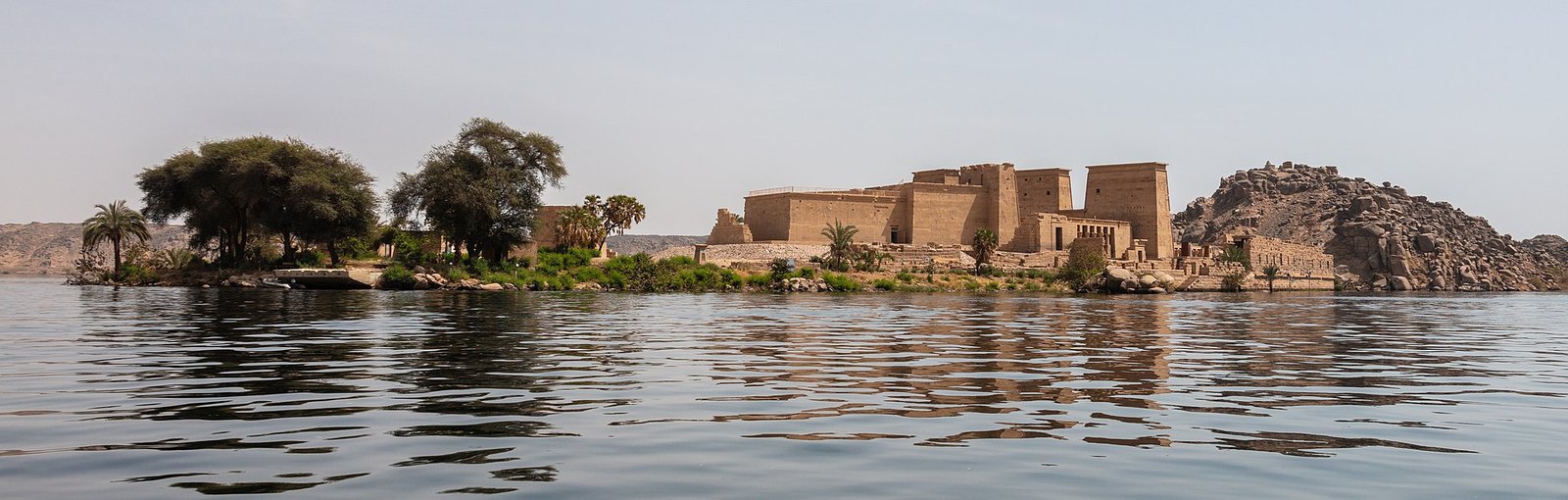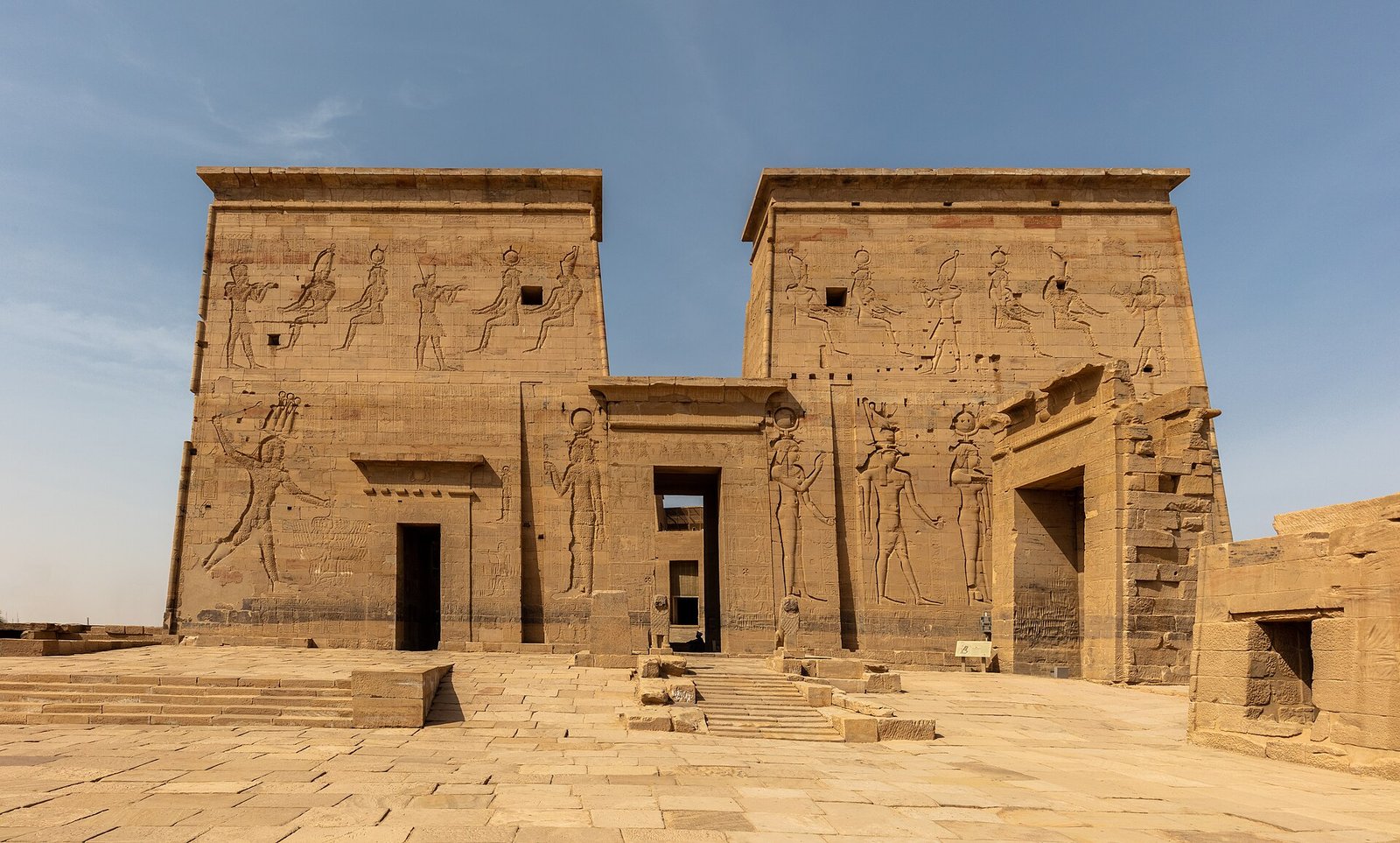
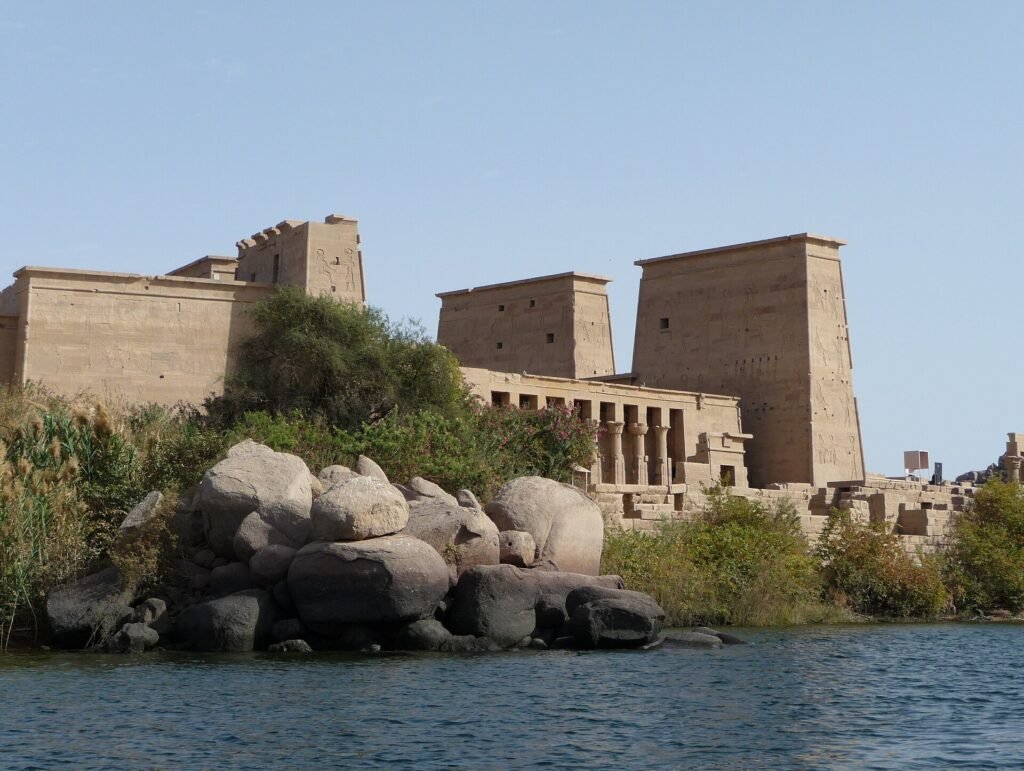
Philae temple is the temple of Isis, the most sacred sanctuary of the final centuries of ancient Egyptian religion and the place where the last hieroglyphic inscription was carved in 394 AD. It stands today on Agilkia island, a short motorboat ride from the Shellal dock south of Aswan, because between 1972 and 1980 a UNESCO team cut it into about 40,000 blocks and rebuilt it there, above the water trapped between the two Aswan dams. You cross by boat, walk it in a little over an hour, and most travelers pair it with the High Dam and the Unfinished Obelisk in one morning. Below is what you will see, in the order you will see it, and how to do it without the dock hassle.
Philae was the great house of Isis, the goddess Egyptians loved above all others. Set murdered her husband Osiris and scattered his body along the Nile; Isis gathered the pieces and with her magic brought him back long enough to conceive Horus, who would avenge his father. From that story she became the goddess of motherhood, healing and resurrection.
Next to Philae lies Biga island, where the priests taught that Osiris himself was buried. Every ten days the statue of Isis crossed by boat to pour milk on her husband's tomb. That is why this rock at the First Cataract drew pilgrims from Egypt, Nubia and eventually the whole Roman world.
The surprise is the date. Almost everything you walk through was built by the Ptolemies and the Roman emperors, not the pharaohs of the pyramid age. Ptolemy II raised the main temple, Ptolemy XII carved the pylons, and Augustus, Trajan and Hadrian left their names. Our guide to how to recognize the Egyptian gods covers Isis, Osiris, Horus and Hathor, the four you will meet most here.
Philae holds a record no other building on earth can claim. On a wall of the Gate of Hadrian, a priest named Esmet-Akhom carved a small figure of the Nubian god Mandulis, a few lines of text and a date that works out to August 24, 394 AD. It is the last hieroglyphic inscription anyone wrote in antiquity.
By 394 Christianity was the official religion of Rome and the temples of Egypt had been closed by decree. Philae survived because of geography. The Nubian tribes south of the cataract worshipped Isis, and Rome had signed a treaty allowing them to come to Philae and even borrow the statue of the goddess for an annual procession. A frontier deal kept the old religion alive for another century and a half.
The end came under Justinian, around 535 to 537 AD. The temple was closed, the priests arrested and the statues shipped to Constantinople. A bishop named Theodore turned the hypostyle hall into a church, which is why you will find crosses cut into the columns. If the writing interests you, our explainer on what hieroglyphs mean and how to read them makes the cartouches on the pylons legible.
The temple you visit is not where it was built. It stood on Philae island, a few hundred yards to the south, and now stands on Agilkia. The reason is water, in two acts.
The first act opened in 1902 with the old Aswan Dam, just downstream. Its reservoir put Philae under water for most of the year. For decades travelers rowed between the columns, and the vivid color that earlier visitors described was washed away. The second act was the High Dam, finished around 1970. Philae now sat between two dams, and the daily rise and fall of the water between them would have eroded the sandstone within a generation.
UNESCO had already launched its campaign to save the monuments of Nubia, the same effort that lifted Abu Simbel up a cliff. At Philae the engineers drove two rings of steel piles around the island, packed the gap with sand and pumped the inside dry. Between 1977 and 1980 every building was surveyed, cut into around 40,000 numbered blocks and carried to Agilkia, a granite island about a third of a mile away and higher above the water. Today you cannot find a seam. It is the sister story to the rescue of Abu Simbel, and the two visits explain each other.
Philae sits about seven miles south of central Aswan, next to the old dam. Every visit starts at the Shellal dock, a small marina with a ticket office and a row of covered motorboats. There is no bridge and no ferry; you hire a boat, it waits, and it brings you back.
This dock has a reputation, and it is deserved. Boats are hired per boat, not per seat, and independent travelers walk into a negotiation that changes shape every minute: a figure per person, then per boat, then a waiting fee, then a different figure for the return. None of it is dangerous, but it happens in the sun and it sets the mood for the temple.
With a guide none of this touches you. The boat is arranged before you get out of the car, the return time is agreed in Arabic, and your guide knows the boat number and the captain. That is the biggest practical reason to do Philae guided. If you go alone: agree the round trip and the waiting time before you step on, pay at the end, and note the number painted on the bow. The crossing takes ten to fifteen minutes, threading between black granite boulders until the pylons rise over the water.
The boat drops you at the southern tip of Agilkia, and you walk north through the temple in the order the ancient processions did.
Ask your guide to show you the French inscription on the left tower. Napoleon's soldiers, chasing the Mamluks south in 1799, carved a record of their arrival: the same expedition that found the Rosetta Stone, on the island where hieroglyphs were written for the last time.
Through the first pylon you enter the forecourt, and the building on your left is the mammisi, or birth house. It celebrates the birth of Horus, and on its inner walls Isis nurses the infant god in the papyrus marshes where she hid him from Set.
Straight ahead is the second pylon, and it is not in line with the first. The builders angled it to fit the rock, and rather than cut away a granite outcrop at its base they carved it into a stela of Ptolemy VI granting land to the temple.
The second pylon opens into the hypostyle hall, ten columns under a ceiling of stars and vultures. Look up at the capitals: the blue and green paint is original, faded but real. Beyond are three small vestibules and the sanctuary, a dark room with a granite pedestal that carried the sacred boat of Isis. A staircase climbs to the Osiris rooms on the roof, where the goddess mourns and reassembles her husband; they are not always open, and worth the climb when they are.
Back in the hypostyle hall, look at the columns at eye level and you will find crosses, dozens of them, cut into the stone with a chisel. This is the church of Saint Stephen that Bishop Theodore created after the closure. The Christians also hacked away the faces and hands of the gods on many reliefs. Our guides read it as a layer rather than vandalism: the crosses are as much a part of the story as the cartouches.
Walk out of the west side of the main temple and you reach the Gate of Hadrian, a small doorway that once faced the sacred island of Biga. Its reliefs are the best on Philae. Inside the passage the Nile god Hapi crouches in a cave beneath a pile of rocks, a serpent coiled around him, pouring water from two jars: the source of the Nile as the Egyptians imagined it, springing from the cataract you just crossed. And here is the graffito of Esmet-Akhom, the last hieroglyphs, small enough that you will walk past unless someone shows you.
Turn back toward the water on the east side and you meet the building on every Aswan postcard. Trajan's kiosk is an open pavilion of fourteen columns with floral capitals, built under the Roman emperor around 100 AD. Above each capital sits a plain block meant to be carved into a Hathor head and never was; the timber roof is gone; and only a few inner reliefs were finished, showing Trajan offering incense to Isis and Osiris.
It was the ceremonial landing where the boat of Isis was received on its return from Biga, so the columns open straight onto the river. Photograph it from inside looking out through the columns, then again from the boat as you leave; the second shot, with the whole kiosk reflected, is the one you will frame.
Two smaller buildings nearby are usually skipped. The temple of Hathor, just north of the kiosk, has a relief of the dwarf god Bes playing a harp while monkeys play lutes, the only smile you will get from a temple wall in Egypt.
Philae is one of the few temples in Egypt you can visit after dark. You cross from Shellal in the dark, the temple appears lit against black water, and the audience walks the site in stages, ending in seats facing the lit kiosk of Trajan while a narration tells the story of Isis and Osiris and of the rescue. It runs roughly an hour to seventy-five minutes.
Our view after seeing it many times: the narration is old-fashioned and theatrical, recorded voices with orchestral music, not modern projection mapping. What works is the setting: the crossing in the dark and the lit kiosk reflected on the river.
Do it if you overnight in Aswan, have already walked the temple by day and want a second, quieter look. Skip it if you leave for Abu Simbel before dawn, or if you saw the sound and light show at the Pyramids and did not enjoy the format, because the style is the same. Shows rotate through several languages, so confirm the English night for your week.
Philae has almost no shade and Aswan is the hottest city on the tourist route, so timing matters more here than at Luxor.
| Window | Light | Crowds | Best for |
|---|---|---|---|
| First hour after opening | Soft, low, from the east | Lowest, cruise groups arrive later | Photography, reliefs, your own pace |
| Late afternoon | Warm, from the west, onto Trajan's kiosk | Moderate, thinning toward closing | The kiosk reflection, cooler air |
| Evening show | Artificial, dramatic | One seated audience | A second visit, the crossing in the dark |
Budget about two hours door to door from a hotel or cruise dock in Aswan: twenty minutes of driving each way, ten to fifteen minutes on the water each way, and a good hour on the island.
In summer the island passes 100 F (38 C) by late morning, and the glare off the water adds to it. Bring water, a hat, sunscreen and closed shoes for uneven paving, plus a little cash in Egyptian pounds for a cold drink at the landing. Check the opening hours for your week, because they shift with the season.
Almost nobody visits Philae on its own. It is one of the three classic Aswan sights, with the High Dam and the Unfinished Obelisk, on a natural loop south of town that takes a half day. The order matters, and we have a firm opinion.
With a private vehicle the loop takes four to five hours including the boat. That leaves the afternoon for a boat trip to a Nubian village on the west bank or a felucca at sunset, and the next day for Abu Simbel. On a Nile cruise between Aswan and Luxor the ship does this same trio as its Aswan day, in a large group on a fixed schedule; if you want the island quiet, ask us about doing Philae privately before or after the ship's program.
Without a guide you see columns, a pylon and a pretty kiosk. With one you see the last hieroglyph, the crosses over the gods, the source of the Nile in a cave, the French graffiti and the granite rock that became a stela. The reliefs here are late and crowded, and they do not explain themselves the way Karnak does. The guide also removes the friction: the boat, the ticket line, the timing, and the judgment about which side buildings deserve your energy on a hot day.
Here is how we run it. We are a local agency in Egypt with our own vehicles and our own licensed Egyptologist guides; there is no middleman. Pickup is from your Aswan hotel or the cruise dock in a private, air-conditioned vehicle. The guide holds the tickets and has the boat arranged. We do Philae, the High Dam and the Obelisk in the order above, adjust it for the season, and drop you back for lunch. The full menu is on our Aswan excursions page, and if you are combining it with a cruise or a longer itinerary we plan it as one piece. Ask us for the quote and we send it the same day.
Because the two Aswan dams would have destroyed it. The old dam of 1902 flooded Philae island for most of every year, and the High Dam of 1970 left it between two reservoirs with daily changes in water level that would have eroded the sandstone. Engineers dismantled the temples into about 40,000 blocks between 1977 and 1980 and rebuilt them on Agilkia island, above the water.
Agilkia island, in the Nile between the old Aswan Dam and the High Dam, about seven miles south of central Aswan. The original Philae island lies under the water a few hundred yards to the south. Agilkia was reshaped to match the outline of Philae so the temple keeps its orientation. Everyone still calls the site Philae.
By road to the Shellal dock next to the old dam, then by motorboat to the island, a crossing of ten to fifteen minutes. Boats are hired per boat and wait for you; there is no public ferry. With a guide the boat is arranged in advance and the return time agreed for you. Independently, settle the round trip before boarding and pay at the end.
Plan about two hours from your hotel and back: twenty minutes of driving each way, ten to fifteen minutes on the water each way and an hour on the island for the main axis from the landing to the sanctuary. Add thirty minutes for the Gate of Hadrian, the Hathor temple and the roof rooms.
As a second look, yes; as your only visit, no. The show lasts about an hour to seventy-five minutes and walks you through the temple in stages, ending in front of the lit kiosk of Trajan. The narration is old-fashioned, but the crossing in the dark and the reflection of the lit temple on the river are special. Confirm the English night for your week.
On almost every cruise between Aswan and Luxor, yes. Philae, the High Dam and the Unfinished Obelisk make up the ship's standard Aswan day, done as a group with the ship's guide. On our own cruises Philae is always in the Aswan day, and we can run it privately for cruise passengers who want the island before the groups.
Tell us your dates in Aswan, where you are staying and whether you are on a cruise, and we come back with the day planned: the boat already arranged at Shellal, an Egyptologist who can show you the last hieroglyph, and the High Dam and the Unfinished Obelisk in the order that beats the heat. No prices on this page, just a quote in your inbox.