On Sunday, August 2, 2027, the Moon's shadow crosses North Africa and a band of Upper Egypt goes dark in the middle of the day. Luxor sits close to the center line of that band, where totality lasts longest: over six minutes, one of the longest of the century. The path enters Egypt through the Western Desert near Siwa, crosses the Nile at Luxor and leaves over the Red Sea near Marsa Alam. Cairo and Alexandria only get a partial eclipse. The August sky over Upper Egypt is about as reliably clear as any on Earth, the heat is brutal, and the beds inside the path are the first thing to run out. Here is how to plan it.
A total solar eclipse happens when the Moon passes exactly between the Sun and the Earth and its darkest shadow, the umbra, touches the ground. That umbra draws a band a couple of hundred miles wide that races across the planet, and only inside it does the Sun disappear completely. Outside it you get a partial eclipse: the Sun looks bitten, but it never goes out and the glasses never come off.
The 2027 band starts in the Atlantic, clips southern Spain, crosses Morocco, Algeria, Tunisia and Libya, enters Egypt through the Western Desert, crosses the Nile at Luxor and heads out over the Red Sea toward Arabia. Egypt sits near the middle of that track, where totality stretches longest.
The whole event, from the first notch in the Sun to the last, takes close to three hours. Totality is a few minutes in the middle. In Egypt it falls around midday local time with the Sun very high, so you need a clear sky, not a clear horizon. The exact minute depends on where you stand and on the clock rules that summer, so take it from a current ephemeris in the year of the trip.
The shadow arrives from Libya over the far Western Desert, and the center line runs close to Siwa Oasis, the remote date-palm oasis near the Libyan border. From there it sweeps southeast across open desert, crosses the Nile valley in Upper Egypt right around Luxor, continues over the Eastern Desert mountains and exits at the Red Sea coast in the stretch around Marsa Alam.
What is left out matters as much as what is in. Cairo, Giza, the Delta and Alexandria all lie north of the band. They will see a deep partial eclipse, but the Sun will not vanish and there will be no corona and no darkness. Anyone who travels for the eclipse and spends that day in Cairo has missed the point of the trip. Hurghada is also outside, to the north. Aswan sits down toward the southern edge, and edges are exactly where you do not want to be.
At the edges the difference is decided by tens of miles: one village is in, the next is out, and between the edge and the center there are whole minutes at stake. Use the path maps published by astronomical sources to choose your spot. The only large Egyptian city that is unarguably well inside the band, with an airport, hotels and Nile ships, is Luxor.
The center line is the track followed by the exact middle of the umbra. The closer you stand to it, the longer the shadow takes to pass over you. Luxor falls very close to it, which makes the city something rare: mature tourism infrastructure at the best geometric point of an exceptional eclipse. Most total eclipses give two or three minutes; along this central stretch totality runs over six, which in eclipse terms is enormous.
Three things set the duration at your spot, and they decide where you stand.
In practice: do not chase a number, chase the center line. Anywhere in the Luxor area puts you within seconds of the best this eclipse offers.
| Where you are that day | What you will see |
|---|---|
| On or very near the center line, Luxor area | Full, long totality. Corona, visible planets, real darkness, a sunset glow around the whole horizon. |
| Inside the band but near an edge | Real totality, but much shorter. A few miles of position cost whole minutes. |
| Just outside the band | A very deep partial eclipse. The Sun is never fully covered and the filter never comes off. |
The west bank is the city of the dead, with the Valley of the Kings and the temple of Hatshepsut, and it has open ground, farmland and hotels with gardens facing the Theban hills. It is our first choice for a group that wants space, a dramatic backdrop and shade close by. How the two banks divide up is laid out in our guide to what to see in Luxor.
A ship moored at Luxor, or a dahabiya anchored on a quiet stretch of river, gives you a sun deck, shade a few steps away and a horizon of water and palms. If your trip includes a Nile cruise in summer, timing it so the ship is in Luxor on August 2 is the simplest way to combine everything.
The coast around Marsa Alam is inside the band, with totality somewhat shorter than at Luxor but still generous, and it offers a sea breeze, resort pools and a reef to snorkel the day before and after. It is the answer for families and for anyone who wants the eclipse without the inland heat; the trade-off is a long drive to the temples. Siwa is remote with few beds, a choice for people who already wanted the desert.
An eclipse breaks the normal logic of a travel season. The date cannot move, the band cannot be widened, and the number of beds inside it is what it is. Eclipse chasers book years ahead, and Luxor's hotels are a finite pool shared with demand from the whole world. As the date approaches, hotels inside the band block those nights, minimum stays appear, and when Luxor is gone people look at towns hours away, which puts them on the road the morning of the eclipse with thousands of others.
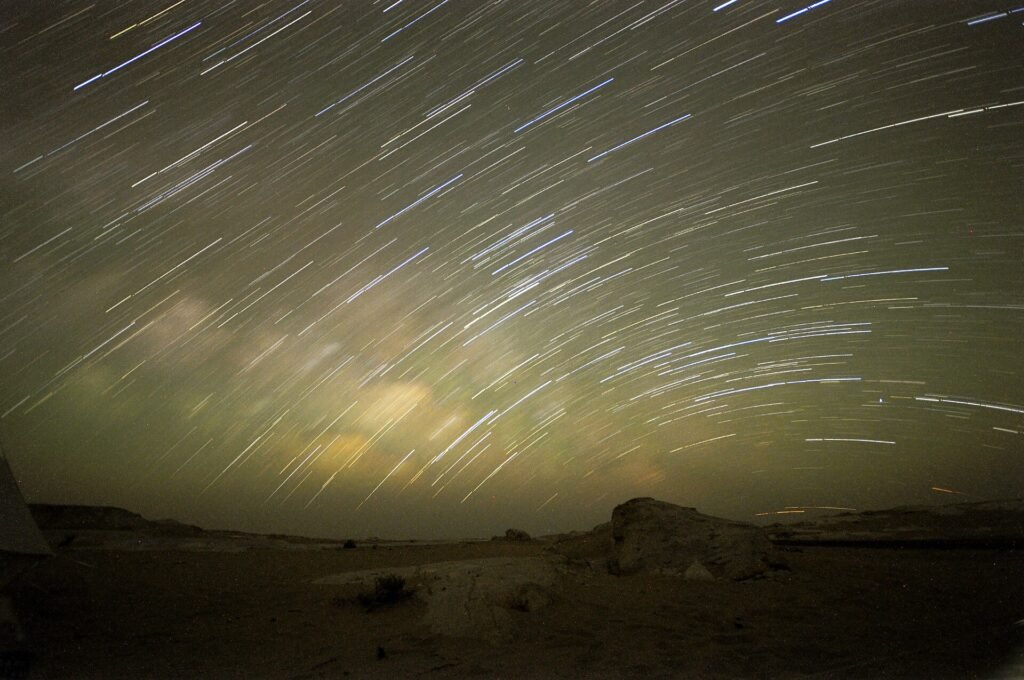
Here is the second big advantage of Egypt for this eclipse, and its one real cost. Upper Egypt and the Western Desert are among the driest, clearest places on the planet, and August is not a rainy month there. The realistic risk is haze or blowing dust that dulls the view without hiding the Sun.
The cost is the heat. August is the hottest month of the year in Luxor. Afternoon highs sit around 105 to 110 F, which is 40 to 43 C, and the eclipse arrives at midday, when the ground has been baking for hours. During totality the temperature drops noticeably, but before and after you have to hold up. What the month is like in general is in our guide to visiting Egypt in August.
This is the part with no gray area. Looking at the Sun without proper protection damages the retina, and it does not hurt, because the retina has no pain receptors. The feeling that nothing is wrong is the problem.
Cameras follow the same rule: a solar filter on the lens for the partial phases, off during totality, back on the instant it ends. The honest advice for a first totality, though, is to look. A corona seen through a viewfinder is half a corona.
First contact is discreet. With the glasses on you see a tiny notch on the edge of the solar disk; without them, nothing. For a long first half hour it is easy to think the whole thing is overrated.
Then the light starts to misbehave. It does not dim like a sunset; it gets thinner, more metallic. Under any palm tree, dozens of crescent suns appear on the ground. The temperature falls, the wind shifts and the birds go quiet.
In the last minutes everything accelerates. The light sinks fast, a darkness advances across the horizon, and on the edge of the Sun a row of bright points appears, Baily's beads, winking out until a single one is left: the diamond ring. That is when the glasses come off.
What follows looks like no photograph. A perfect black disk in the middle of the sky, surrounded by the corona, silver filaments no camera reproduces the way the eye sees them. The sky settles into a deep twilight blue with planets visible, and the whole horizon lights up orange at once. People shout, or go silent, or are moved without knowing why. Then a flash on the opposite edge says it is over, the glasses go back on, and the light returns in seconds.
Totality lasts minutes and the trip lasts days, so turn the plan around: a great trip to Egypt that also happens to include an unrepeatable eclipse.
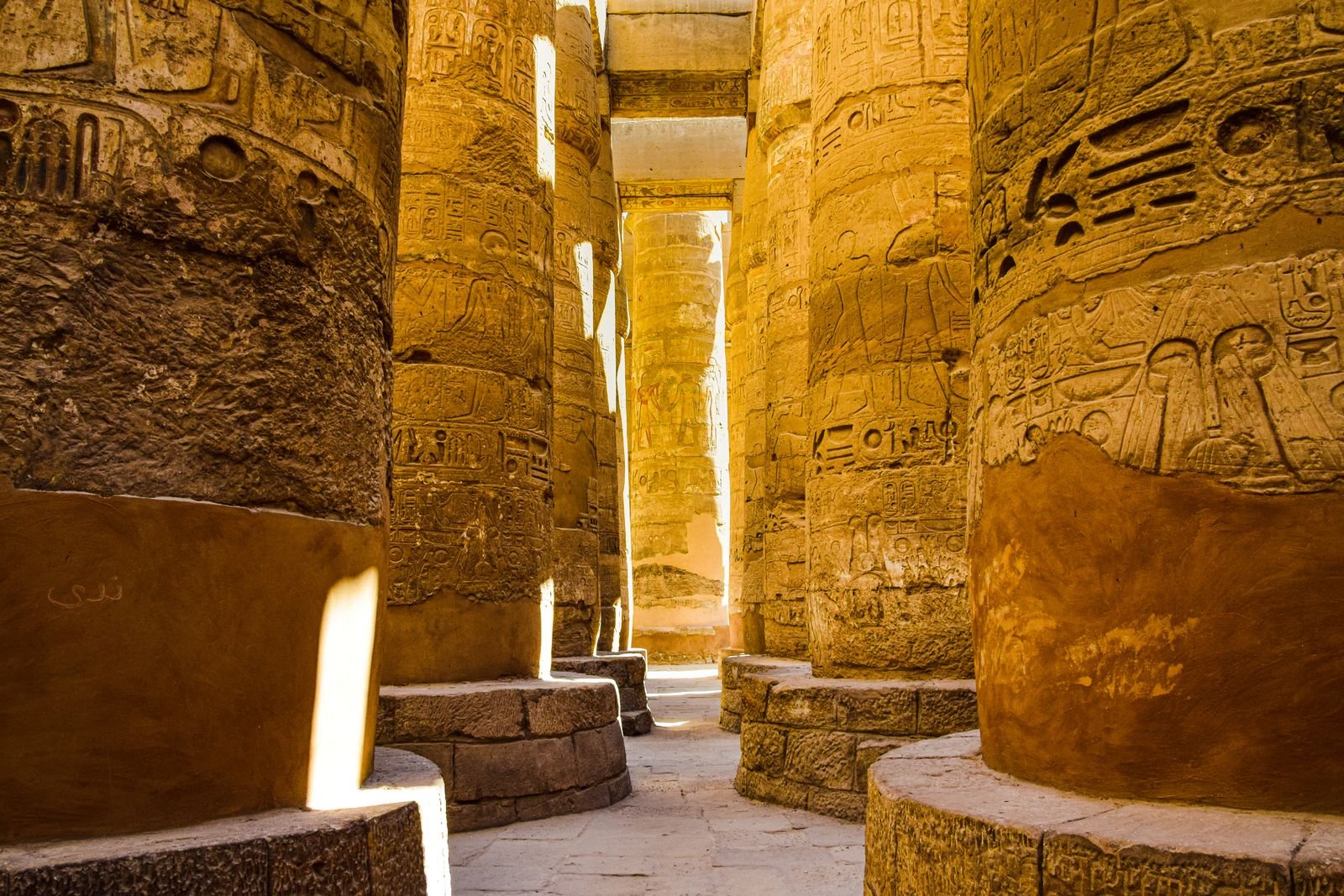
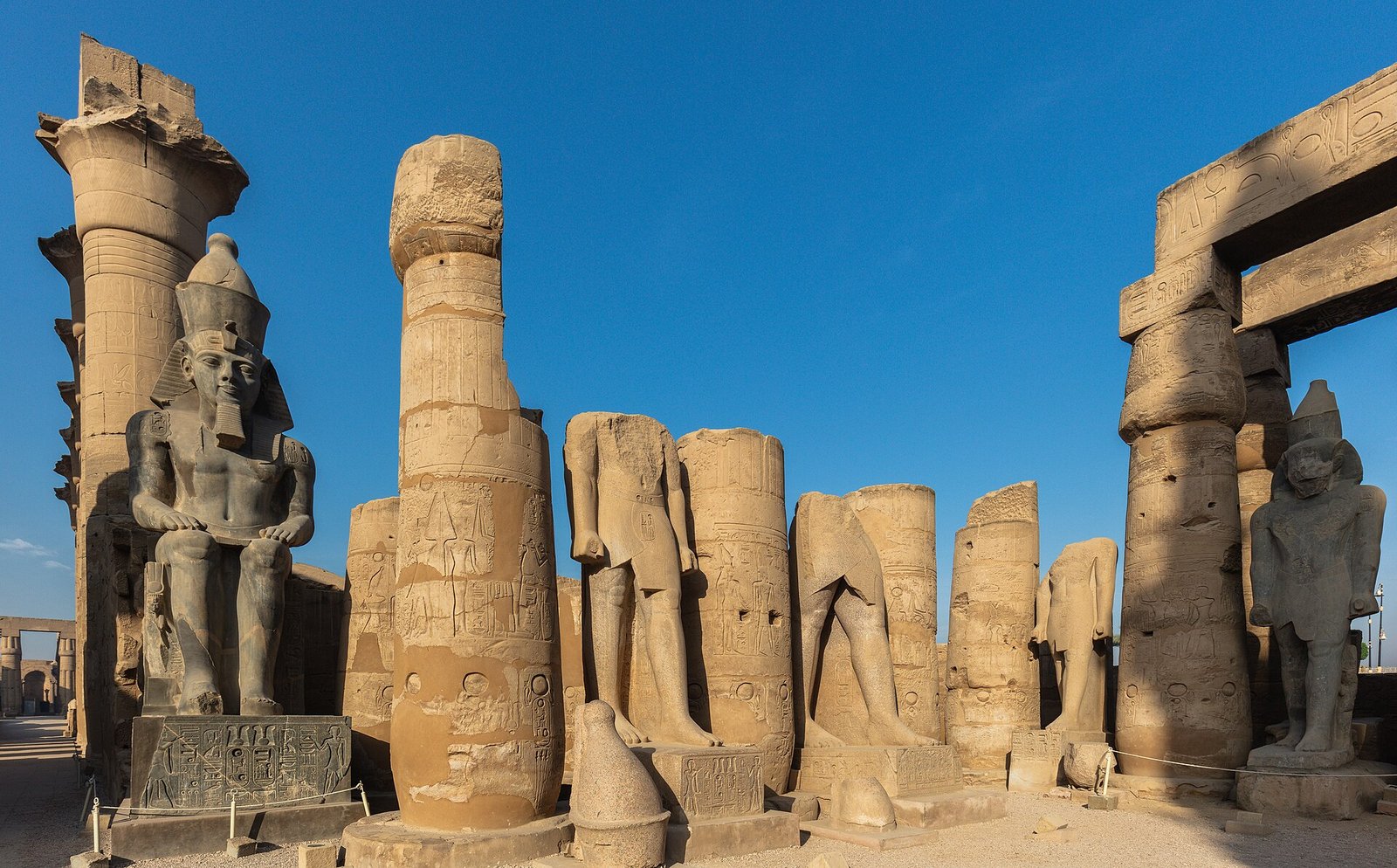
Luxor fills several days on its own: Karnak and Luxor Temple on the east bank, the Valley of the Kings and the mortuary temples on the west. The heat forces early starts, and that works in favor of a hot air balloon over Luxor at dawn, when the light on the Theban mountain is the best of the day. Then a long siesta and back out in the late afternoon.
To link Luxor with Aswan, a Nile cruise solves transport, lodging and sightseeing at once, with the hottest hours spent on board in the shade. Sailing from Luxor on August 3 is a natural rhythm: the eclipse as the climax, then Edfu, Kom Ombo, Philae and Abu Simbel as the descent.
A shape that works: two days in Cairo for the Pyramids and the museums, a flight to Luxor on July 31 or August 1, eclipse day on the west bank or the ship, then the cruise to Aswan and Abu Simbel, and either a flight back to Cairo or a few days on the Red Sea.
We are a local agency based in Egypt, with our own guides and vehicles, and we build the in-country part of the trip around one fixed point: where you will be standing at midday on August 2, 2027. We do not run a scheduled eclipse departure and will not promise a program that does not exist. What we do is organize your Egypt trip for those days with Luxor at its center.
Tell us your dates, your group and whether you want the river, the west bank or the coast, and we send you the quote.
For most travelers, yes. Luxor sits close to the center line, where totality lasts longest, and it is the only large city inside the Egyptian part of the band with an airport, hotels and Nile ships. Siwa and Marsa Alam are also inside the path, but Luxor combines the longest totality with the easiest logistics.
No. Cairo, Giza and Alexandria lie north of the band and will see a deep partial eclipse only. The Sun will look strongly bitten through your glasses, but it will not disappear and there will be no corona and no darkness. If you travel for the eclipse, you need to be in Upper Egypt, ideally around Luxor, on August 2.
Near the center line around Luxor it runs over six minutes, which is extraordinary; most total eclipses give two or three. The exact figure depends on your distance from the center line and drops toward the edges of the band; take the times for your hotel from an ephemeris in the year of the trip.
No. Only glasses certified to ISO 12312-2 are safe for the partial phases, bought from a reputable supplier at home and inspected before you fly. Sunglasses, smoked glass and filters at the eyepiece are all dangerous. The glasses come off only during totality, when the Sun is completely covered, and go straight back on when the first sliver returns.
Very. August is the hottest month in Upper Egypt, with afternoon highs around 105 to 110 F, or 40 to 43 C, and totality falls around midday. The temperature dips during totality, then climbs back. Plan a spot with shade a few steps away, drink far more water than feels necessary, and wear a hat and long sleeves.
As early as you can decide. Beds inside the band are a fixed inventory shared with eclipse chasers from the whole world, and Luxor hotels block those nights and add minimum stays as the date approaches. Secure the nights of August 1 to 3, 2027, first, then the domestic flights, then the rest. Write to us and we check what is still available.
If you want to watch the Sun go out over the Nile at Luxor on August 2, 2027, the useful decision is made now, not in 2027. Tell us your dates, who is traveling and whether you want the west bank, a ship or the Red Sea coast, and we come back with the nights held inside the band, the domestic flights, the guide and the rest of Egypt built around the six minutes that matter. No prices on this page, just the quote.