Real papyrus is made from strips of the plant stem laid in two crossed layers and pressed, so held up to the light a sheet shows an uneven grid of fibers, some strips wider than others, with the joins showing through. Roll a corner around your finger and let go: real papyrus springs back with no mark. The two fakes you will meet everywhere in Egypt are pressed banana leaf, which cracks and leaves a white line when folded, and dyed rice paper, which is perfectly smooth and shows no grid at all. Those tests settle the sheet. They say nothing about whether the painting was done by hand, which is the question that decides what the piece is worth.
Papyrus is a sheet made from the inside of the stem of Cyperus papyrus, a tall marsh sedge with a triangular, spongy stalk that once grew in dense stands along the Nile and across the Delta. The Egyptians wrote on it for three thousand years; as the marshes were drained the plant almost vanished, and the craft went with it.
What you buy today comes from a revival. In the 1960s an Egyptian engineer named Hassan Ragab brought the plant back and reconstructed the process by trial and error. Every workshop supplying the shops of Cairo, Giza and Luxor descends from that reconstruction.
That process leaves fingerprints. You can feel the ridges of the strips, the edges rarely come out straight, the joins never fall in the same place on two sheets, and the sheet is never uniform white or perfectly smooth.
Three things are sold as papyrus that are not what the label says.
The fake you will meet most. Pressed banana fiber has a warm tone and a bit of grain, and at arm's length it fools most people. It fails on behavior: it is brittle, so a fold cracks it and leaves a whitish line that never goes away. Its grain runs in one direction only, with none of the crossed grid. It weighs less and often carries a glossy varnish to hide the missing texture.
The second family is simply paper, tinted to look aged. You recognize it by what is missing: no grid against the light, no joins, no ridges under your fingertip. A fold creases cleanly, like a notebook page. Every sheet measures exactly the same because it came off a guillotine.
This is not a forgery. The sheet is genuine, but the scene was printed rather than painted, so it passes the light test. What gives it away is flat, even color, a matte gold that is ink rather than leaf, and above all repetition: the identical scene, line for line, in three different shops. Nothing wrong with buying one, as long as you know it is a print and pay for a print.
None of these needs a tool. Ask before you handle the piece; a seller who will not let you hold a sheet up to the window has already answered.
The light and the roll take ten seconds and catch almost every substitute. The rest confirm a piece you are serious about.
The crossed grid is the most reliable sign that the sheet is papyrus, which is why sellers do the test for you, unasked. It answers one question only: nothing about painted versus printed, the width of the strips, or the number on the tag. Under thick paint the grid can hide, so check an unpainted margin or the back. Some pressed fiber imitations do show texture, but parallel and regular, without the right angle cross. To calibrate your eye, look at the ancient sheets under glass in the Egyptian Museum in Tahrir Square before you buy anything.
A blank sheet of papyrus is cheap to make. What you pay for in a finished piece is almost entirely the painter's time, which is why two equally genuine papyri can sit on the same shelf at very different levels without either being a rip-off. An honest shop says which is which before you ask.
Hand painting shows in the details. Lines have a beginning and an end where the brush touched down and lifted. Gold is real leaf or a thick metallic paint that stands proud of the surface. Two figures that should mirror each other are close but not identical. A print is the opposite: uniform, flat, symmetrical, identical to the one next door. Ask the seller to put one of each side by side; good shops are proud to.
If you order your name in a cartouche, ask the painter to transliterate it in front of you and compare the signs with a chart. Our guide to ancient Egyptian writing explains how names were spelled and why a cartouche with your name is a modern convention.
In Cairo, Giza and Luxor there are businesses that call themselves papyrus institutes, museums or centers. With very few exceptions they are shops. No body certifies papyrus for travelers, and the certificate that sometimes comes with the piece is issued by the shop that sold it.
When one of these stops appears in an itinerary at no extra charge, it is usually there because the shop pays a commission to the driver, the guide or the agency on whatever the group spends. That is not illegal and it does not mean the product is fake; many of these places sell real, well painted papyrus. What changes is the number on the tag, which now includes that commission, and the pressure, because the van is waiting outside.
The same pattern repeats with alabaster, perfume oils, carpets and cotton, and the mechanism is described in our guide to common scams in Egypt. You are not being cheated; you are shopping in a place somebody else chose for you.
Because the number on a papyrus depends on the painting, arguing about the number alone gets you nowhere. Look at the shop.
| Sign of a shop that works well | Sign to say thank you and leave |
|---|---|
| They let you hold, turn and measure the sheet without hurrying you | Someone positions himself between you and the door |
| The total is stated before anything is wrapped | The total appears at the end or is left for later |
| They show a printed piece and a painted piece side by side | Everything is hand painted and museum quality |
| You can leave without buying and they say goodbye just as warmly | The tone changes when you say you will think about it |
| They roll and wrap the piece in front of you | They take the sheet to the back and return with a sealed package |
What justifies paying more is concrete: wide, well matched strips with no gaps at the joins; a large sheet, far harder to make without flaws; fine lines done with a brush rather than a stencil; and a scene you do not find repeated next door. Two rules. Keep your eye on the sheet you chose, because a swap for a smaller or printed piece happens at the wrapping stage. And agree the total, tube included, before anyone touches anything. In a bazaar stall the first number is an opening position, as our guide to haggling in Egypt explains; in a shop with marked tags, including the institutes, bargaining is not the custom.
The sheets in the shops mostly come from two places, and neither is the shop. The first is Qaramous, a village in the eastern Delta in Sharqia governorate, where papyrus has been grown and pressed as a cottage industry since the revival. Whole families cut, soak, lay and press sheets that are sent blank to the painters in Cairo and Luxor. It is on no tourist circuit.
The second is Fayoum, the green depression southwest of Cairo, where papyrus grows in the wetlands around the lake and is pressed in small workshops. A visit fits into a day that also takes in the pottery village of Tunis; our page on the Fayoum oasis covers the rest of that day.
Visiting a workshop changes how you buy. You see the soaking trays, the presses and the blank sheets drying, and afterwards no showroom demonstration impresses you again. You buy from the person who held the brush. Papyrus is one of the few items on our list of what to buy in Egypt where going to the source is both possible and worth the detour.
Frame it at home, not in Egypt. A framer near you can use conservation glass and an acid free mat that keeps the sheet off the glass, and you avoid carrying a pane of glass through three airports. If it arrives curled, rest it flat for a few days between two sheets of card; never iron or dampen it. Hang it out of direct sun. Never laminate it: lamination is irreversible and kills the texture. Float mounting, with the uneven edges visible inside the mat, shows off a handmade sheet.
The sheets sold in shops are single pages. The ancient Egyptians almost never used papyrus that way. Sheets were pasted end to end into rolls that could run to many yards, and a scribe wrote on the roll with a reed pen in black carbon ink, headings in red ochre, in the fast cursive script called hieratic rather than the formal hieroglyphs of temple walls.
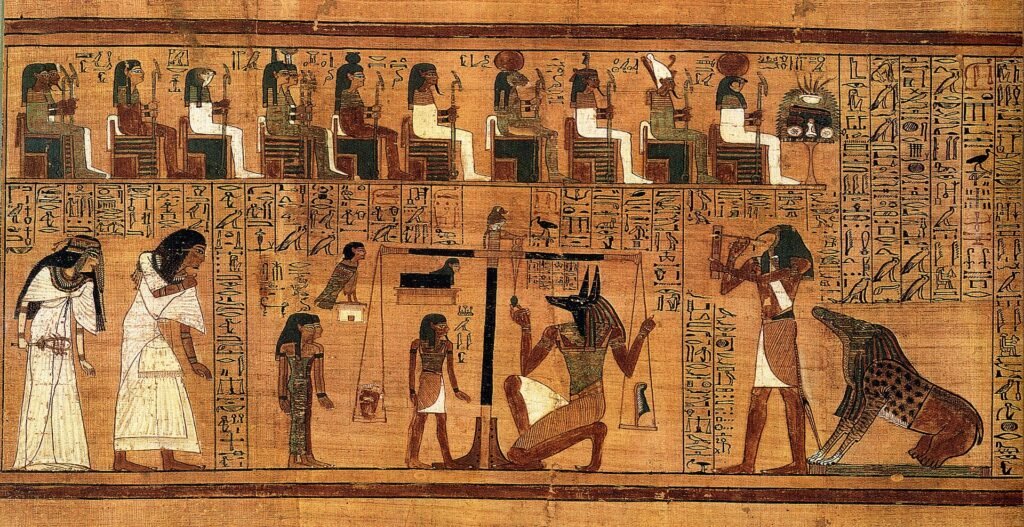
The most famous rolls, and the source of most scenes painted in the shops, are the funerary texts. The weighing of the heart, with Anubis at the scale and Thoth recording the result, is a vignette from the Book of the Dead, the spells buried with the dead to guide them through the underworld. The shop version is a copy of something painted for a specific person three thousand years ago, and knowing that is a large part of the pleasure of owning one. The dry climate is why so much survived, and why your souvenir dislikes humidity.
We are a local agency in Egypt with our own guides and vehicles, and we know how the commission system works because we are offered it every week. The day belongs to you, and no shop pays us to put you in it.
If you would rather choose the shopping stop yourself than have a commission choose it for you, write to us and we plan it into the route.
Hold it up to the light. Real papyrus shows a grid of crossed strips of unequal width with the joins visible, and some patches are more translucent than others. Then roll a corner around your finger and let go; real papyrus springs back flat with no mark. A smooth, even background, or a fold that leaves a white line, means banana leaf or paper.
Roll it, yes. Fold it, no. Papyrus tolerates being rolled and unrolled many times, which is how the ancient rolls were used. A sharp fold breaks the crossed fibers and leaves a line that never recovers. Roll it loosely around a tube, painted side in, and carry it on.
Mostly pressed banana leaf, which cracks and turns white where it is folded and has grain running in one direction, and dyed rice paper or card, which shows no grid against the light and feels smooth on the back. A third kind is real papyrus with a printed scene. That one passes the light test, so check the brushwork under raking light and whether the identical scene appears in other shops.
Very little. It is issued by the same business that sold you the piece, not by any independent body, and it is printed in batches. No organization in Egypt certifies papyrus for travelers. A gold stamp on the back is no substitute for holding the sheet up to the light yourself.
No. Those stops usually exist because the shop pays a commission on what the group spends, and nobody is obliged to buy anything. Watch the demonstration, do the same tests you would do anywhere else, and leave with empty hands if you like. To skip the stop altogether, say so before the car leaves.
Not if it is sold as a print. The sheet is real papyrus and the light test proves it. What it is not is hand painted, so it should be described and valued as a print. Flat, uniform color, gold that does not catch the light, and the same scene in every shop are the signs.
Tell us your dates and cities, and we send you a plan with a real workshop visit built in, no commission stops, and a guide who knows banana leaf from the real thing. No numbers on this page, just a quote in your inbox.