The best sunsets in Egypt, and exactly where to stand for each one
The best sunsets in Egypt, and exactly where to stand for each one
The best sunsets in Egypt are a short list of places where the sun goes down behind something worth watching. A felucca on the wide reach of the Nile at Aswan is the one everybody remembers, and the top deck of a Nile cruise between Esna and Kom Ombo comes a close second. Then Luxor Temple as its floodlights come on, the panorama point above the Giza pyramids, a Nile-side rooftop in Cairo, Fatnas island in Siwa, the White Desert, the Lighthouse reef at Dahab with the Saudi mountains glowing across the water, Ras Mohammed and the lake shore at Abu Simbel. Below is where to stand for each, when to go and how we build the day around it.
Why the light in Egypt is different from the light at home
People come back convinced the sunsets were bigger and redder than anywhere else, and they are right for a physical reason. The air over the Nile valley and the deserts carries fine dust. Those particles scatter the blue and let the red and orange through, so the sun looks larger and stays warm-toned far longer than in a clean, humid sky. The golden hour stretches long enough to change position and shoot three different pictures. On a windy day the same dust swallows the sun in a brown band before it reaches the horizon.
The second ingredient is water. The Nile is broad and slow, so on a still evening it becomes a mirror and every felucca photo carries two sunsets in one frame. The third is stone. The chalk of the White Desert and the sandstone of the temples change color themselves as the sun drops.
Aswan from a felucca, the one you plan the trip around
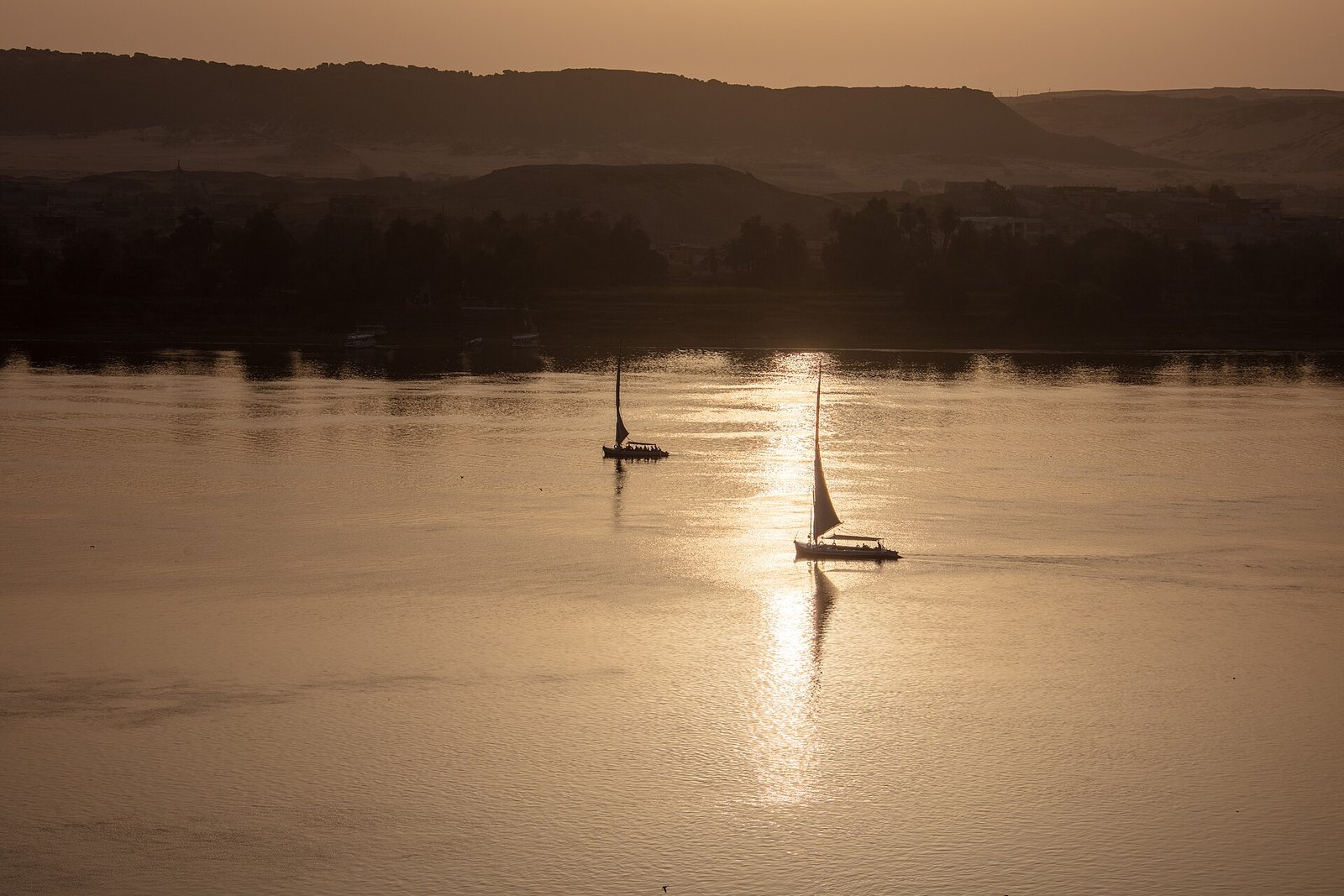
If you get one sunset in Egypt, make it this one. At Aswan the river widens between granite islands, and the western shore is a wall of pale dunes with the Aga Khan mausoleum on top. The sun goes down behind those dunes, the water turns orange and then rose, and the white lateen sails cross in front of it.
Where to be: on the river. Ask the captain to turn the boat west with the sail open when the sun is a hand above the dunes. From land, the east bank Corniche at the level of Elephantine island gives you the dunes, the sails and the reflection with a cold drink in hand.
Board forty minutes before sunset, not ten. The wind drops after dark and the captain needs time to take you upstream and drift back. Our page on the felucca ride on the Nile explains how the boats work and why this stretch beats every other.
- Best months: October to April, clear sky and a warm rather than hot evening.
- Bring: a light layer for the ride back. Skip the tripod, the boat moves.
The top deck of a Nile cruise between Esna and Kom Ombo
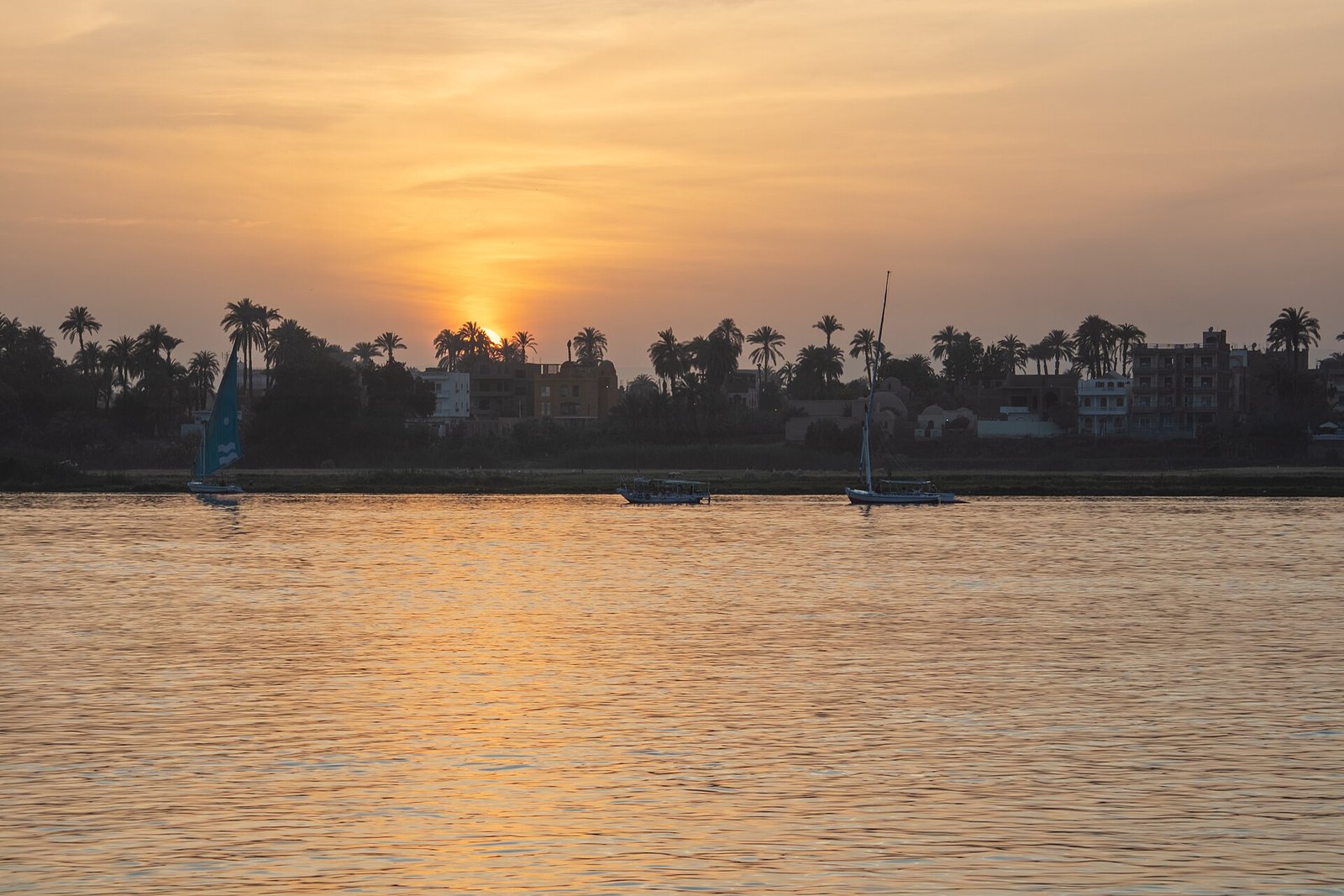
On a Luxor to Aswan cruise the boat usually sails through the late afternoon of the second or third day, somewhere between Esna, Edfu and Kom Ombo. This is farmland Egypt: palm lines, sugar cane, water buffalo, a minaret every mile. The sun sets over the west bank fields, and because you are moving, the foreground changes every minute.
Go up to the sun deck half an hour before, take a chair on whichever rail has the sun, and stay twenty minutes after it is gone. The afterglow, with the river still holding color while the villages light up, is the better half of the show, and most passengers have already gone down to dinner.
A dahabiya, the small sailing boat with a handful of cabins, moors at islands the big boats cannot reach, which puts you on a sandbank with nobody else at exactly this hour.
Luxor, where the temple lights up as the mountain goes dark
Luxor has the most cinematic sunset in the country, in two parts. The sun drops behind the Theban mountain on the west bank, the ridge that hides the Valley of the Kings, and at nearly the same moment the floodlights of Luxor Temple come on. For about fifteen minutes you have warm light on carved sandstone against a sky that still has color.
Where to be: inside Luxor Temple, in the first court of Ramesses II looking back through the pylon and the obelisk. Enter an hour before sunset, walk the temple in daylight, and be back at the front as the lights come up. Check the closing time for the season.
The second Luxor spot is the Corniche on the stretch in front of the old Winter Palace hotel. You look straight across the river to the mountain, with feluccas crossing and the cliffs turning from ocher to purple. It costs nothing and the riverside tea gardens are the right place to wait.
Giza, the panorama point and then the sound and light
The pyramids at sunset are a different monument from the pyramids at ten in the morning. The buses have gone, the limestone turns gold and the three silhouettes line up against a lit sky. The place to stand is the panorama point, the rise in the desert south-west of the plateau, with nothing behind the pyramids but sky.
The catch is the plateau closing time, which changes by season and does not always run past sunset. From November to February you can usually be at the panorama point with the sun on the horizon. From May to September the site often closes first, and you watch the last light from a terrace on the plateau edge or a rooftop facing the Sphinx.
Then stay for the second act. The pyramids sound and light show runs after dark on the Sphinx side, a little theatrical and still the only way to sit in front of the Sphinx at night.
Cairo from a Nile-side rooftop
Cairo does not get enough credit for its sunsets. The sun goes down over the Giza side, and from a rooftop in Zamalek, Garden City or the downtown Corniche you get the river, the bridges, the feluccas and a skyline turning from beige to bronze. On a clear winter evening from a high terrace you can pick out the pyramids as small triangles on the horizon.
Book the rooftop table for an hour before sunset, not at dinner time when the color is gone. It suits a first evening in Egypt. Our guide to Cairo at night covers what follows, from the tea houses of Khan el Khalili to the food streets that wake up after dark.
The Western Desert, Fatnas island and the White Desert
Siwa is the far west of Egypt, a palm oasis under a limestone escarpment with the Great Sand Sea beginning at the edge of the date groves. Its sunset spot has a name every local knows: Fatnas island, a palm-covered spit in the salt lake west of town. You sit under the palms with a mint tea, the lake goes pink, the dunes beyond go gold and the air smells of dates and wood smoke. Give the Siwa oasis the whole afternoon, swim in Cleopatra's spring first, and arrive at the lake with forty minutes to spare.
The White Desert is the other kind of desert sunset, and many people rank it above all the rest. The chalk formations standing in the sand like giant mushrooms pass through a sequence as the sun drops: white, pink, orange, mauve, then a cold blue as the first stars appear. The stone itself changes, not just the sky. Any small rise in the camp works. The rule is to have camp set up beforehand, so nobody is unloading a jeep during the ten minutes that matter.
The night is half the reason to go. The White Desert is a two-day trip from Cairo through Bahariya, with dinner over a fire and no light for a hundred miles. In winter it can fall close to 40°F (about 5°C) after dark, so pack a real layer.
The Red Sea, Dahab, the Saudi mountains and Ras Mohammed
First the correction everybody needs. On the mainland coast at Hurghada, El Gouna and Marsa Alam the shore faces east, so the sun does not set into the sea. It drops behind the desert hills at your back and you get a pink and violet sky over calm water. On that coast it is the sunrise that comes straight out of the sea.
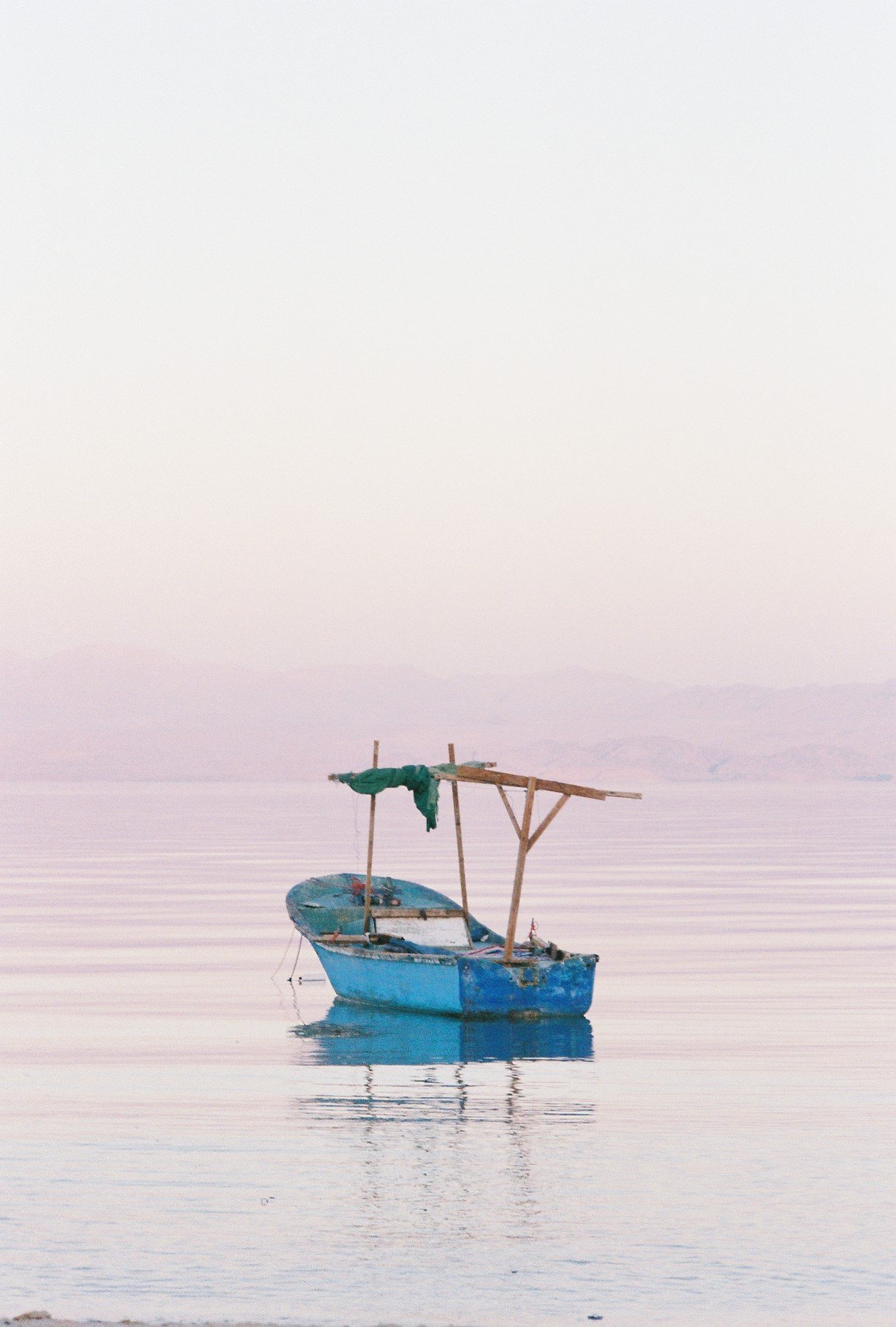
Dahab is the exception. The town sits on the Gulf of Aqaba with the granite mountains of Sinai behind it and the coast of Saudi Arabia across the water. The sun drops behind Sinai, and for a quarter of an hour afterward the Saudi mountains, a dozen miles across the gulf, glow rose and then violet. Where to be: the Lighthouse reef at the north end of Masbat bay, on the cafe cushions after your last snorkel, facing east across the gulf rather than west. Our guide to Dahab covers the reefs, the Blue Hole and the Bedouin dinners that follow.
Ras Mohammed, the national park at the southern tip of Sinai, gives the reverse. From its western shore you look across the Gulf of Suez, and there the sun does go down over water, behind the low hills of the mainland. Park hours can end before sunset, so confirm this one with the ranger post on the day.
Abu Simbel from the lakeside, the quiet one
Everyone talks about Abu Simbel at sunrise, when the facade faces east and takes the first light full on. Fewer people sleep in the village, and those who do get a sunset the day-trippers from Aswan never see. The temples go into shadow early because they face away from the setting sun, so the show is Lake Nasser.
Walk to the shore in front of the temples and look out over the water. The lake is enormous and flat, the far shore is bare rock, and the surface turns from copper to pewter while the colossi behind you become a dark outline. Then the site is floodlit and you walk back to the colossi under lamps with nobody else there.
It pairs with the morning. Sleep in Abu Simbel, watch the lake at dusk, and be at the gate before the convoys arrive for the sunrise at Abu Simbel. One night, two of the best moments of light in the country.
Sunset times by season, and how fast it gets dark
Egypt sits between roughly 22 and 31 degrees north, so day length swings less than in Chicago, but it still swings. Sunset in Cairo lands a little before five in December and close to seven in June. Aswan, four hundred miles south, sets later in winter and earlier in summer than Cairo by fifteen to twenty minutes. Egypt also moves its clocks in spring and fall, so check the day's sunset time rather than relying on memory.
| Months | Cairo, approximate | Luxor and Aswan, approximate | What it means |
|---|---|---|---|
| December to January | Just before 5 pm | Around 5:20 pm | Sunset before dinner, some sites close around it |
| February to March | 5:30 to 6 pm | 5:45 to 6:10 pm | The best balance of light, temperature and open sites |
| April to May | 6:15 to 6:45 pm | 6:20 to 6:45 pm | Clocks moved forward, sunset lands on the felucca hour |
| June to August | Close to 7 pm | 6:45 to 7 pm | Late sunsets, hot afternoons, the evening is when the day starts |
| September to November | 6:30 pm down to 5 pm | 6:30 pm down to 5:20 pm | The window shortens fast through October |
Twilight is short at these latitudes: twenty to twenty-five minutes from the sun touching the horizon to real darkness, so be in position twenty minutes early and plan a walk back you can do in the dark. Temperature follows the same rule. In the deserts and at Aswan in winter an afternoon of 75°F (24°C) can be 55°F (13°C) by the time you finish the tea, so keep a light jacket in the daypack from November to March.
Photography tips that actually work in Egypt
- Be there thirty minutes before and stay twenty after. The best color often comes after the sun has gone, when the dust lights up from below.
- Expose for the sky. On a phone, tap the sky and drag the brightness down until the sun stops being a white blob. The felucca or pyramid becomes a clean silhouette.
- Use the water. At Aswan, Siwa and Abu Simbel, get low and put the reflection in the bottom half of the frame.
- Let the sun be big. A longer lens or the 3x on a phone makes the dust-swollen sun look the size it feels. Wide angles shrink it to a dot.
- Turn around. At Luxor, Dahab and the west bank the color is on the stone or the mountains behind you. Shoot that, then turn back.
- Leave the drone at home. Drones are not permitted for visitors in Egypt and airport security holds them.
- Ask before photographing people. The captain will pose with the sail. A guide handles the asking in Arabic.
How Explora Egipto times the day around the light
Most group tours put the sunset where it falls, usually on a bus. We build the day backward from it. On the Aswan day that means Philae and the High Dam in the morning, the Nubian village at lunch, a rest through the afternoon heat, and the felucca boarding forty minutes before the sun touches the dunes, with the driver waiting at the landing afterward.
In Luxor we swap the usual order: west bank tombs in the morning, Karnak in the early afternoon, Luxor Temple last so you are inside when the floodlights come on. At Giza we check the plateau closing time for your date before deciding between the panorama point and a terrace.
All of it runs with our own Egyptologist guides and vehicles, booked directly with us in Egypt. Send us your dates and we send you the quote.
Frequently asked questions
Where is the single best sunset in Egypt?
From a felucca on the Nile at Aswan. The river is wide, the western shore is a line of dunes, the sails cross in front of the sun and the water reflects the whole sky. It needs no ticket and fits any itinerary that passes through Aswan.
Can you watch the sunset at the pyramids of Giza?
Yes, with a seasonal catch. The panorama point inside the plateau gives the classic view, but the site closes at a fixed time and in summer that can be before sunset. Then you watch from a terrace or rooftop outside the fence. Either way the sound and light show on the Sphinx side runs after dark and makes a natural second act.
Does the sun set over the sea on the Red Sea coast?
On the mainland coast at Hurghada, El Gouna or Marsa Alam, no. The shore faces east, so the sun sets behind the desert hills and the sunrise is the one that comes out of the sea. At Dahab the show is the Saudi mountains across the gulf glowing pink after the sun drops behind Sinai, and at Ras Mohammed the sun does go down over the Gulf of Suez.
What time is sunset in Egypt?
Roughly a little before 5 pm in December and close to 7 pm in June, with Aswan and Luxor a few minutes later than Cairo in winter and slightly earlier in summer. Egypt changes its clocks in spring and fall, so check the exact time for your date. Twilight lasts about twenty to twenty-five minutes, so be in position early.
Is the White Desert sunset worth the two-day trip from Cairo?
For many travelers it is the highlight of the whole country. The chalk formations change color themselves, from white to pink to orange to mauve to blue, and the night that follows has a sky with no light pollution for a hundred miles. With nine days or more in Egypt it fits. Bring a warm layer from November to March.
Can I fly a drone to film the sunset at the pyramids or on the Nile?
No. Drones are not permitted for visitors in Egypt and airport security holds them on arrival, so do not build a shot around one. The classic frames here, the felucca reflection at Aswan, the lit temple at Luxor, the pyramid silhouettes at Giza, were all made from ground level with a phone.
Be in the right place when the light turns
Tell us your dates, how many days you have and which of these sunsets you want most, and we come back with an itinerary that puts you on the felucca, inside Luxor Temple, on the panorama point or under the palms at Fatnas at the right minute, with a guide and a car waiting afterward. No prices on this page, just a quote in your inbox.