Karnak Temple sits on the east bank of the Nile in Luxor, ten minutes north of Luxor Temple, and it is the largest religious complex of the ancient world. It is not one temple but three walled precincts, for Amun, Mut and Montu, built by some thirty pharaohs over almost two thousand years. The part you visit is the Precinct of Amun: ten pylons, the Great Hypostyle Hall with its 134 columns, the obelisks of Hatshepsut and Thutmose I, the sacred lake and the scarab. Give it two and a half to three hours, arrive at opening or in the last two hours before closing, and walk it with an Egyptologist. Below is the route we use, in order.
Karnak was the house of Amun-Ra, the god of Thebes who became king of the gods when Thebes became the capital of the New Kingdom. Every pharaoh who wanted the priesthood on his side added something here: a pylon, a court, an obelisk, a chapel, or a wall carved with his victories. The first stones went down in the Middle Kingdom, around 2000 BC, and the last under the Ptolemies, so the site is a physical timeline of Egyptian power.
The whole enclosure covers about 250 acres, roughly a large university campus. Most of that is the Precinct of Amun. South of it, joined by an avenue of ram-headed sphinxes, lies the Precinct of Mut, Amun's consort, with its own crescent-shaped lake. North, behind a separate wall, is the smaller Precinct of Montu, the falcon-headed war god of Thebes.
The Amun precinct is what the standard ticket covers and what everyone means by Karnak; Mut opens occasionally and Montu is generally closed. Amun, Mut and their son Khonsu formed the Theban triad, and Khonsu has a complete temple of his own in the southwest corner of the precinct, one of the best preserved buildings on site and nearly always empty. Keep it for the end of your walk.
A pylon is the massive sloping gateway with two towers that fronts an Egyptian temple. Karnak has ten. Six stand on the main axis running from the river east to the sanctuary, and four run south toward the Precinct of Mut. Because later kings built in front of earlier ones, walking east from the entrance means walking backward in time.
The main axis, in the order you meet it:
The north-south axis, from the Seventh to the Tenth Pylon, is a processional route of courts and colossal statues, and the place where priests buried thousands of statues in the pit known as the Karnak cachette. Most visitors detour to the Seventh and Eighth Pylons on the way to the sacred lake and leave the rest.
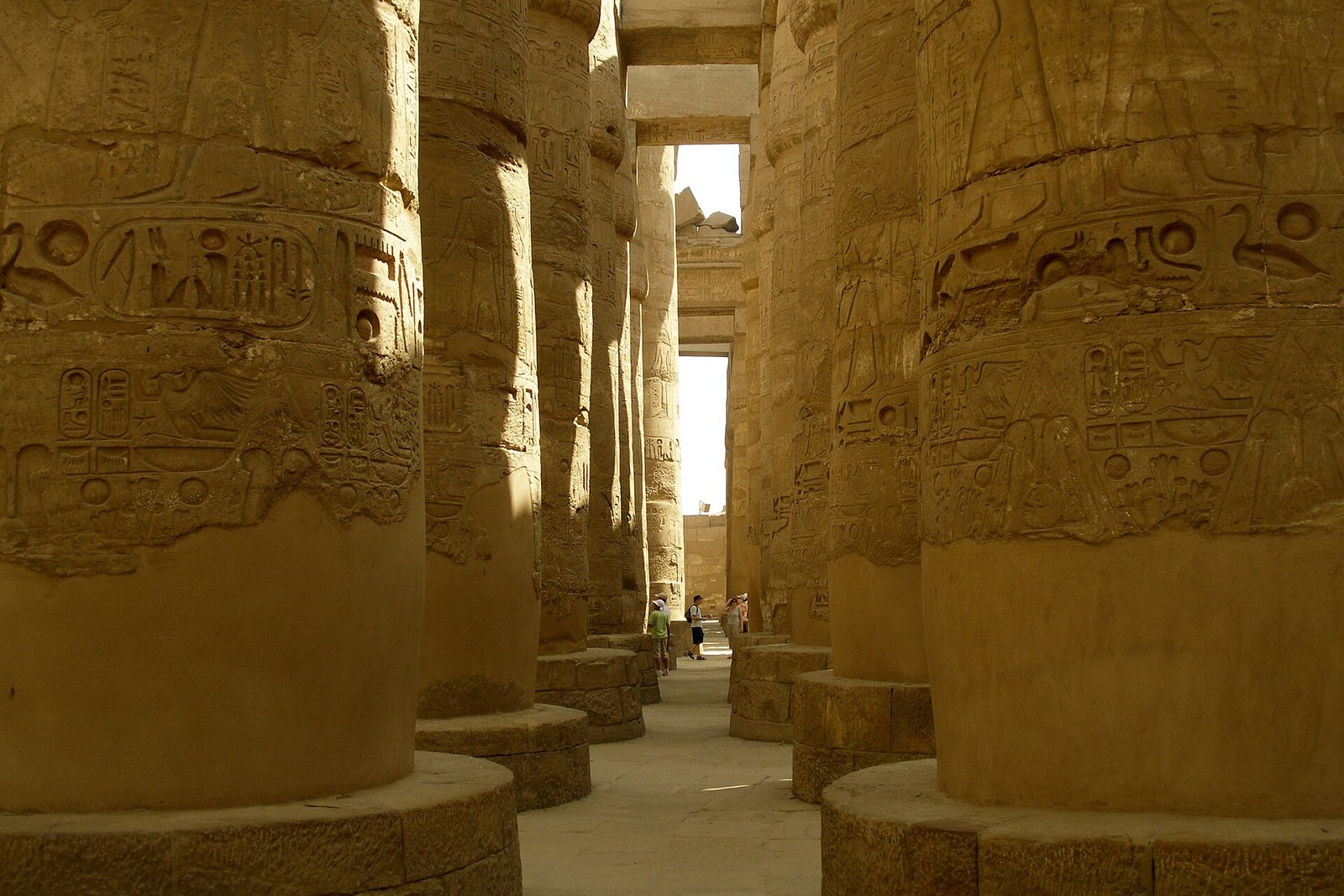
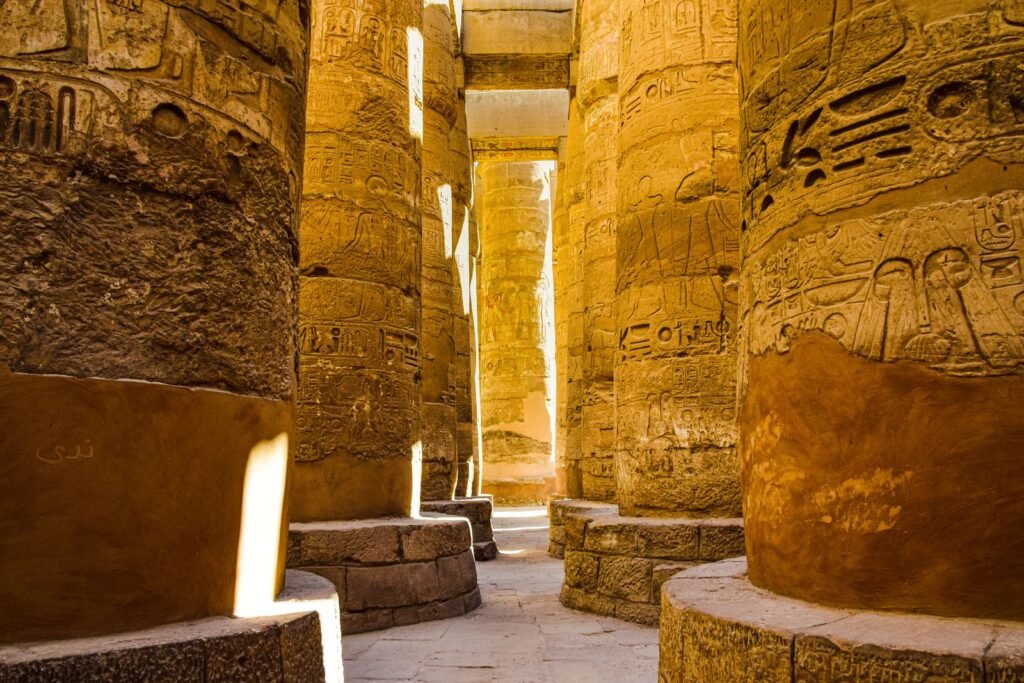
No photograph prepares you for this room. The Great Hypostyle Hall covers about 54,000 square feet (5,000 square meters), and 134 sandstone columns hold it up in 16 rows. The 12 columns of the central aisle rise 69 feet (21 meters) with open papyrus capitals wide enough to stand a crowd on. The other 122 are about 40 feet (12 meters) tall with closed bud capitals.
That difference in height is the design secret. Between the two roof levels the builders set stone grille windows, a clerestory, and several are still in place. With the roof complete the hall lived in half darkness, light falling in bars across a stone papyrus marsh, the primeval swamp from which creation rose.
Seti I began the hall and Ramesses II finished it in the thirteenth century BC, and you can tell their halves apart. Seti's north half is cut in delicate raised relief. Ramesses switched to deep sunk relief in the south half, faster to carve and impossible for a successor to recut. Outside, Seti's Hittite campaigns run along the north wall and the Battle of Kadesh along the south. Look up, too: high on the architraves, where the sun never reached, the blues, reds and ochres of 3,300 years ago survive.
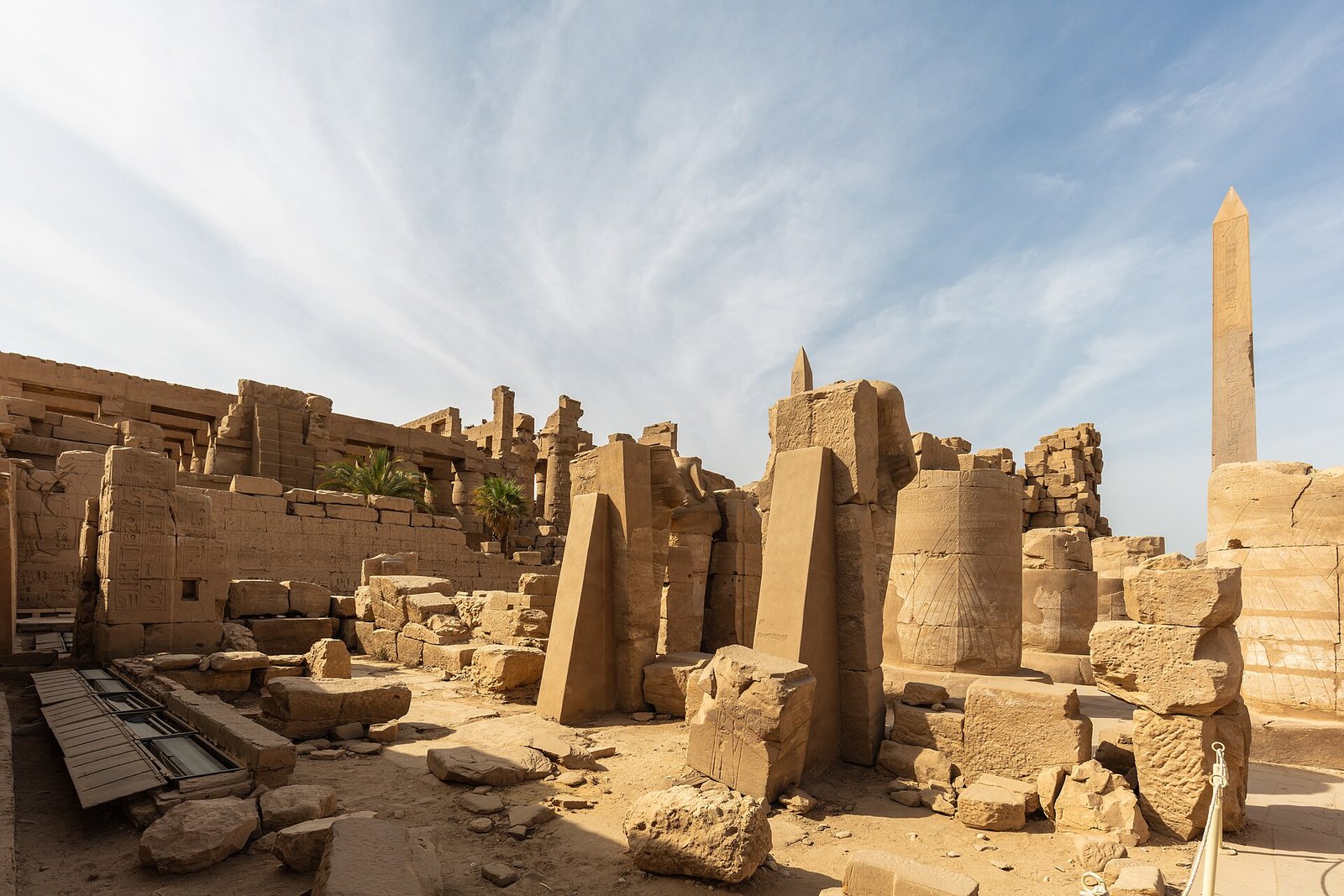
Past the Third Pylon the axis narrows and the obelisks begin. Thutmose I raised a pair before his Fourth Pylon. One still stands, about 71 feet (21.5 meters) of red Aswan granite weighing roughly 143 tons.
His daughter Hatshepsut went bigger. Between the Fourth and Fifth Pylons she raised two obelisks close to 97 feet (29.5 meters) and around 320 tons each, shipped down the Nile as single blocks. The standing one is the tallest surviving obelisk in Egypt. Its inscription says the pair took seven months to cut, and in Aswan you can see what that work looked like at the Unfinished Obelisk, which cracked before it left the bedrock.
The politics are written on the stone. After Hatshepsut died, Thutmose III had the lower part of her obelisks walled in to hide her name. The masonry also shielded the inscriptions from sun and vandals, so the sections he tried to bury are the best preserved. Her second obelisk eventually fell, and its upper section now rests near the sacred lake, the one place at Karnak where you can read royal hieroglyphs at eye level.
South of the main axis the ground opens and the sacred lake appears, a stone-lined rectangle roughly 393 by 253 feet (120 by 77 meters), fed by groundwater. Priests washed in it before rituals, the sacred geese of Amun were kept on it, and on festival days the god's bark was floated across it. Along the south side you can trace the foundations of the priests' houses.
At the northwest corner, on a tall pedestal, sits the giant granite scarab of Amenhotep III, dedicated to Khepri, the rising sun. Local tradition says seven circuits bring luck, a marriage or a child, depending on who is telling you. Just past the scarab lies the fallen upper section of Hatshepsut's obelisk.
The lake is also where you sit down. From the raised far side you get the one view that shows the scale of the place: pylons stacked behind each other, obelisks over the hall, walls running into the distance. It is the moment Karnak becomes a single city.
On the north side of the Great Court, behind its own gate and its own ticket, archaeologists have reassembled the small shrines that later kings dismantled and hid inside their pylons. It is the finest carving at Karnak and most visitors never see it.
The White Chapel of Senusret I is a Middle Kingdom bark shrine of pale limestone, about four thousand years old, rebuilt from blocks pulled out of the Third Pylon. Its relief work is the sharpest on the site, and around the base runs a list of the provinces of Egypt, a stone atlas of the country.
The Red Chapel of Hatshepsut, red quartzite on black granite, shows the Opet procession, the oracle of Amun choosing her as king, and the queen in the full regalia of a pharaoh. Read alongside her erased obelisks, it is the most moving thing at Karnak. Allow half an hour.
Karnak did not stand alone. A paved processional road about 1.7 miles (2.7 kilometers) long ran south to Luxor Temple, flanked by sphinxes, and once a year during the Opet festival the statues of Amun, Mut and Khonsu were carried along it. After decades of excavation the full length has been restored and runs as one continuous avenue through the modern city. At the Karnak end the sphinxes are ram-headed, each sheltering a small figure of the king between its paws; along most of the road they are human-headed.
You can walk the whole avenue in about an hour in cool weather, with no shade. Our preferred version is to be driven between the temples and walk the last stretch into Luxor Temple in the late afternoon, when the avenue is lit.
The precinct is large enough to lose an hour walking in circles. This is the order we follow, with rough timings for a relaxed pace.
That adds up to about three hours. Trim the Festival Hall, the southern pylons and Khonsu and you have a two hour version that still covers what most people come for.
Plan two and a half to three hours inside the gate, plus half an hour for the open-air museum. Ninety minutes shows you the hall, the obelisks and the lake, but you leave having walked past columns rather than understood them.
Time of day matters more here than at almost any site in Egypt, because there is very little shade. Karnak opens early, and the first two hours are the best of the day: golden light on the sandstone, mild temperatures and a near-empty precinct before the cruise groups arrive mid-morning. The second best window is the last two hours before closing, when the stone turns orange and the shadows run long.
| Season | Typical afternoon high | What it means for Karnak |
|---|---|---|
| October and November | 85 to 95 F (29 to 35 C) | Workable at any hour with a hat. The best balance of weather and crowds. |
| December to February | 70 to 77 F (21 to 25 C) | Ideal days, chilly at opening at 45 to 55 F (7 to 13 C). The busiest months. |
| March and April | 80 to 95 F (27 to 35 C) | Very good, with occasional dusty khamsin winds. Mornings still comfortable. |
| May to September | 100 to 110 F (38 to 43 C) | Dawn or the last hour only. Two liters of water per person and a real hat. |
Bring water, a wide-brimmed hat, sunscreen and closed shoes, because the floors are uneven and you cover a couple of miles. If your dates are open, our guide to the best time to visit Egypt lays out the whole year by region.
After dark the precinct becomes a stage. The show runs for roughly an hour and a quarter and moves the audience through the temple on foot, with the pylons, the obelisks and the hypostyle hall lit in sequence while a recorded narration tells the story of Thebes. The finale is seated across the sacred lake. It is a separate ticket, and the language rotates by evening, so check the current schedule for an English performance.
Our honest opinion after many viewings: do not expect projection mapping or special effects. What you get is the hypostyle hall rising out of darkness, and that image has a force the daytime visit cannot give. Worth an evening if you are staying overnight in Luxor; if your time is short, spend it on the daytime walk.
The general ticket covers the Precinct of Amun: sphinx avenue, pylons, hypostyle hall, obelisks, sanctuary and sacred lake. The open-air museum and the evening show are separate tickets, students with a valid international card pay a reduced rate, and Luxor sells a multi-site pass that can make sense over several days on both banks. Tickets are sold at the visitor center in Egyptian pounds; card readers are unreliable, so carry cash. Fees change regularly, and we keep the current picture on our page about Egypt monument entrance fees.
Now the guide question, the one that decides the visit. Without a guide, Karnak is a spectacular field of columns with no story. Ours will:
Karnak is rarely visited alone. It anchors Luxor's east bank, and the natural plan is one full day on this side and the next on the west bank. Our page on Luxor's east bank and west bank explains both sides; this is how the east bank day runs with us.
Explora Egipto is a local agency in Egypt with its own vehicles and licensed Egyptologist guides. For Karnak that means a private car, a guide who has walked the precinct hundreds of times, tickets handled in advance, and a day built around the light. The east bank day is day one of our two day Luxor tour, the first stop on every Nile cruise that sails from Luxor, and the most requested of our Luxor excursions. The next morning you cross the river for the Valley of the Kings.
Tell us your dates and where you are sleeping in Luxor, and we send you the quote.
The Great Hypostyle Hall has 134 sandstone columns in 16 rows over about 54,000 square feet (5,000 square meters). The 12 central columns stand 69 feet (21 meters) tall; the other 122 are about 40 feet (12 meters). Seti I began it and Ramesses II completed it, and it remains the largest columned hall of the ancient world.
Two and a half to three hours to walk the Precinct of Amun at a relaxed pace and understand it, from the sphinx avenue to the sacred lake. Add thirty minutes for the open-air museum. Ninety minutes is possible but feels like a walk past columns, especially in summer heat.
The first two hours after opening. The light is golden, the temperature is mild and the precinct is close to empty before the cruise groups arrive mid-morning. The second best window is the last two hours before closing, when the sandstone turns orange. Avoid late morning and early afternoon between May and September, when Luxor regularly passes 100 F (38 C).
Yes if you are spending the night in Luxor and want a second look at the temple, no if your time is short. The show lasts about an hour and a quarter, moves you through the lit pylons and hypostyle hall on foot and ends seated beside the sacred lake. Check the language schedule before buying the separate ticket.
You can. The restored Avenue of Sphinxes runs about 1.7 miles (2.7 kilometers) between the two temples and takes around an hour on foot, with no shade along the way, so do it in the cooler months or late in the day. Most of our travelers are driven and walk only the final stretch into Luxor Temple.
You can enter on your own with a general ticket and wander freely. What you lose is the story: without someone reading the cartouches and reliefs, Karnak is an impressive maze of columns with no thread. With a licensed Egyptologist it becomes two thousand years of history told in order. Our private visits include guide, transport and tickets.
Karnak is on the East Bank of the Nile in Luxor, about 3 km north of Luxor Temple. The two temples were once joined by the Avenue of Sphinxes, which has been restored and can be walked today. Most hotels on the East Bank are a short drive away, so Karnak fits easily into a morning or a late afternoon visit.
Karnak was the main temple of the god Amun and the largest religious complex of ancient Egypt. It was built and enlarged over roughly 2,000 years, from the Middle Kingdom to the Ptolemies, by about 30 pharaohs, each adding pylons, halls, obelisks or chapels. Its Great Hypostyle Hall has 134 columns, and the site was listed as a UNESCO World Heritage Site in 1979 as part of ancient Thebes.
Send us your dates, where you are staying in Luxor and how many are traveling, and we come back with an east bank plan built around the early light at Karnak, an Egyptologist who turns the columns into a story, and the tickets handled. No prices on this page, just a quote in your inbox.
Keep exploring