The Sound and Light Show at the Pyramids of Giza
The Sound and Light Show at the Pyramids of Giza
Most travelers meet the sound and light show as a line item on an evening itinerary and have no idea what they are agreeing to. It is worth knowing in advance, because this is a floodlit narration with a recorded voice-over, not projection mapping. People who understand that beforehand tend to enjoy it. People who expect drones and 3D mapping do not.
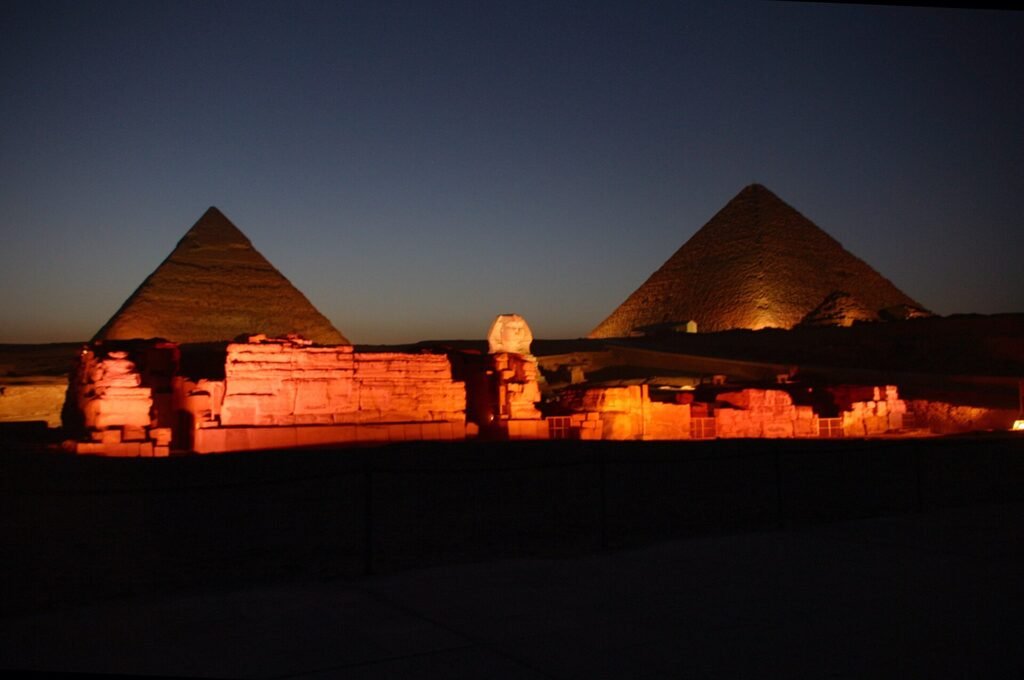
What you are really buying is an hour in front of the pyramids after dark, when the plateau is cool, quiet and almost empty compared with the middle of the day.
What the show actually is
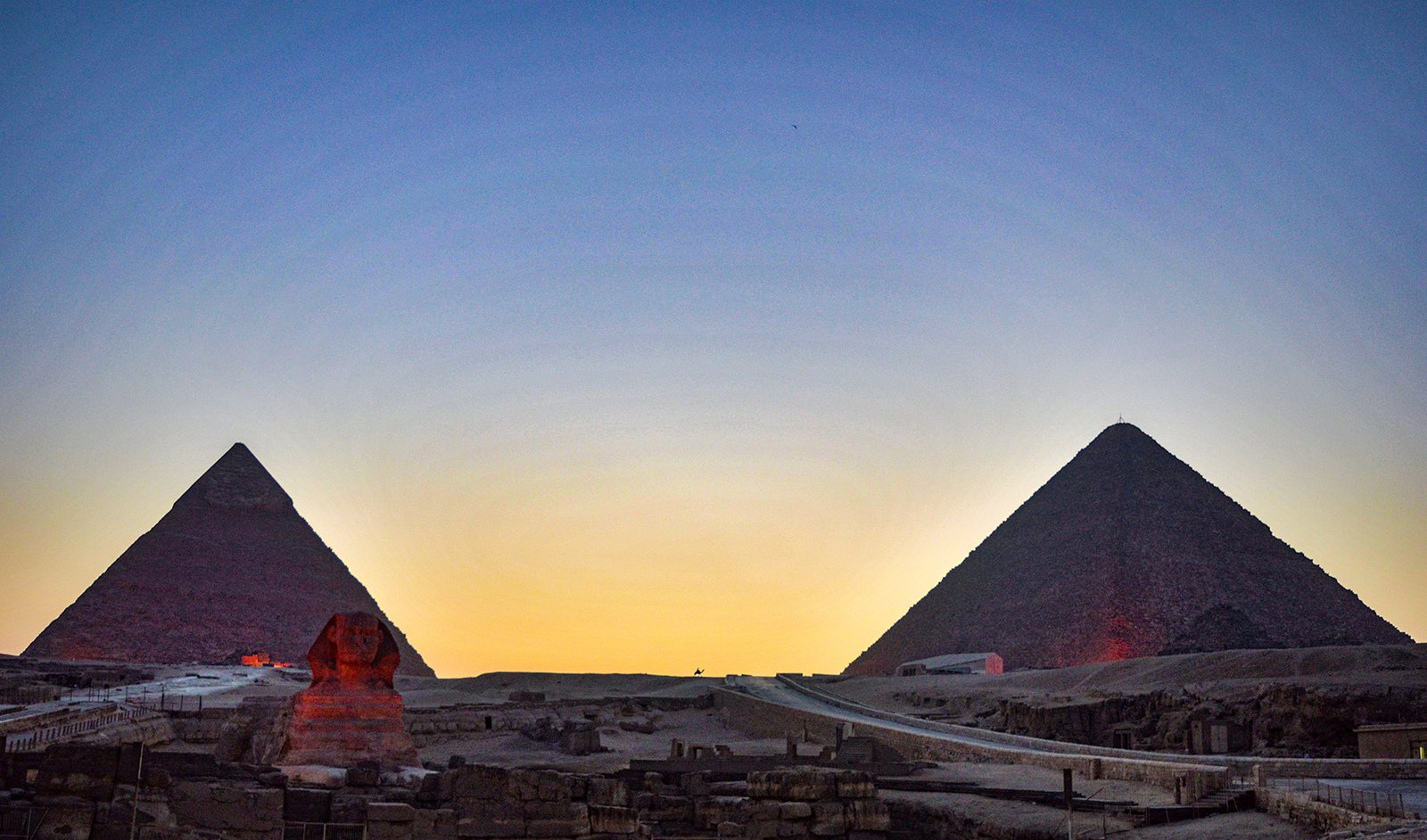
Powerful colored floodlights are aimed at the pyramids and the Sphinx from a fixed position. Images and effects are thrown across the stone, colors shift from one monument to the next, and a recorded narration runs over an orchestral soundtrack. The audio comes through public address speakers, not headsets, so everyone in the grandstand hears the same thing at the same time.
The performance runs about 45 minutes. There are usually two or three sessions a night, the first starting shortly after dark, which means the clock moves through the year with sunset. No fixed start time is worth memorizing, and any timetable you find printed in a guidebook should be treated as a rough idea rather than a fact.
| Length | About 45 minutes |
| Sessions | Typically two or three per night, beginning after nightfall |
| Format | Colored floodlighting and projected effects with a recorded narration |
| Audio | Loudspeakers across the seating area, no headsets, one language per session |
| Seating | Fixed open-air grandstand facing the Sphinx, pyramids behind |
| Arrive | 20 to 30 minutes before the start |
As a piece of technical stagecraft it is simple and its aesthetic is dated. That is the honest assessment, and it is the reason some people walk out underwhelmed. The monuments do the heavy lifting. Seeing the Great Pyramid lit against a black desert sky, from a seat a few hundred meters away, is a genuinely strange and memorable thing, and no amount of modern kit would improve on the object itself.
The Sphinx is the narrator
The narration is voiced by the Sphinx, speaking in the first person. It introduces itself as the witness that has watched over the plateau since these monuments were built, and the script runs from the construction of the complex through to the modern excavations that uncovered it. It is theatrical writing in an old-fashioned register, closer to a 1960s documentary than to anything made this decade.
If you have read anything about Khufu, Khafre and Menkaure beforehand, the script lands better, because it moves quickly between reigns and does not pause to explain who is who. Half an hour with a decent overview of the site before you go is time well spent.
Each session runs in one language only
This is the detail that catches people out. The show is offered in several languages, including Arabic, English, French, Spanish and German, but a given session is in a single language from beginning to end. There is no simultaneous translation and no headset channel to switch. If you arrive for the wrong pass you will sit through 45 minutes of a language you do not speak.
The order of languages changes by day of the week and by season. English sessions are frequent, but frequent is not the same as guaranteed at a particular hour on a particular date. Confirm the schedule for your exact date, ideally the day before, rather than trusting a printed guide or a web page that may not have been updated in years. When we arrange the evening as part of a Cairo program, we check which pass carries the English narration for your date and time the transfer around it.
One further caution. The Giza plateau has been through significant redevelopment, with changes to visitor entrances and to how the site is managed in the evening. The show has run in essentially this form for decades, but its operating status, its entrance and its timetable are the parts most likely to have changed since anything you read online was written. Treat confirmation for your specific night as part of the booking, not as an optional extra.
Where to sit in the grandstand
Seating is a fixed open-air grandstand facing the Sphinx, with the pyramids rising behind it. The frame is not the same from every row.
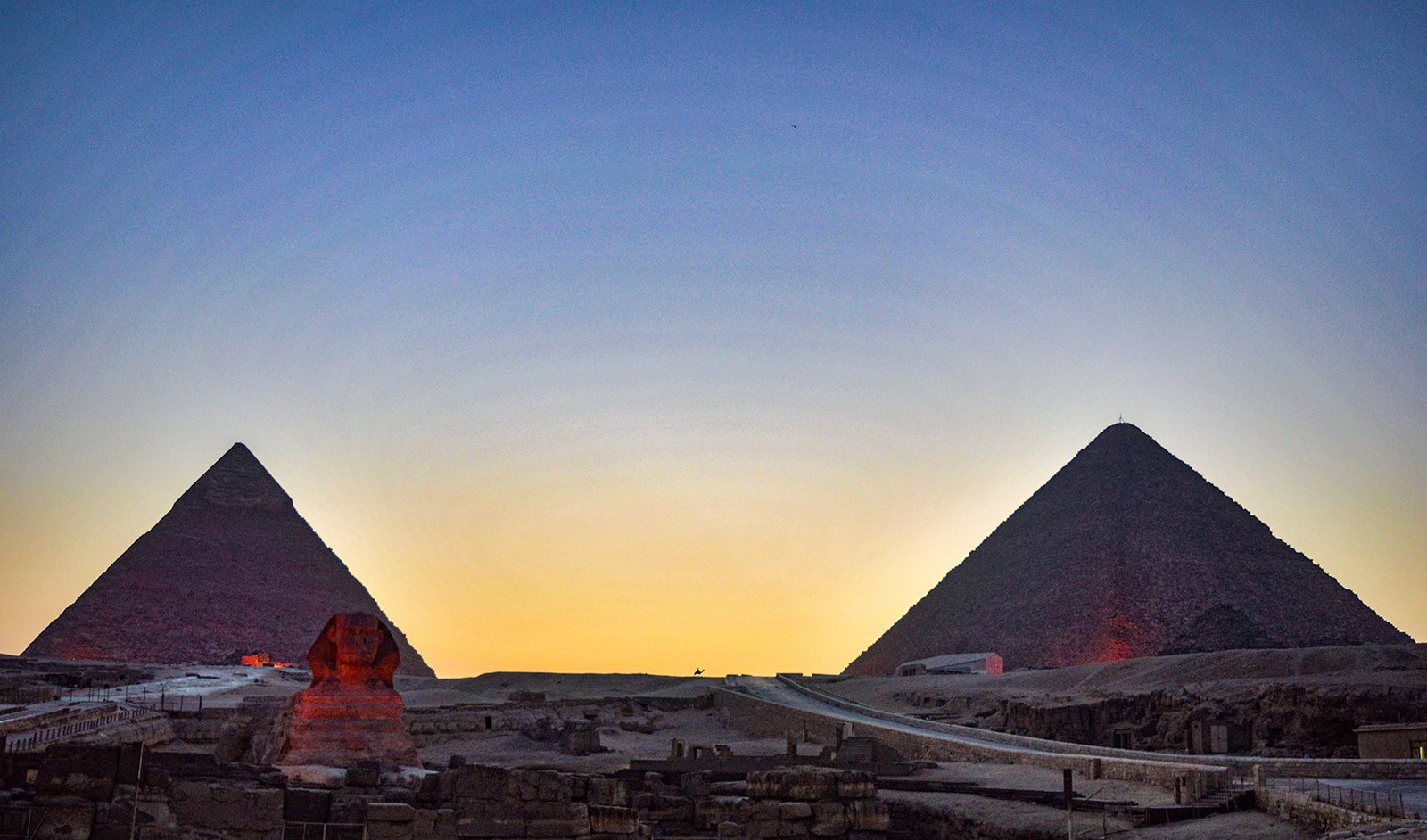
- Center rows give the most balanced composition, with the Sphinx in the foreground and Khufu and Khafre stacked behind it. Menkaure, the smallest of the three, sits further back and reads as a minor shape rather than a third headline act.
- Side rows put you closer to the Sphinx but push the pyramids into a flattened, foreshortened angle.
- Middle rows beat front rows for photographs. The front gives you proximity, the middle gives you the whole scene in one shot without craning.
Entry to the evening venue uses a different access point from the daytime visit, and there is a security check on the way in. There is also a walk from the gate to the seating, so wear something you can cover uneven ground in. Arriving 20 to 30 minutes early means you choose your row rather than taking whatever is left after the coaches unload.
The temperature drop nobody packs for
Giza sits on the edge of the desert. Once the sun goes down the temperature falls fast, and the grandstand is stone, open to the sky, with nothing to break the wind. From October through April a jacket or a warm layer is not optional, however warm the afternoon was. This catches out travelers who have spent the day in a T-shirt and cannot imagine needing a coat in Egypt.
In summer the reverse applies, and the evening is the most pleasant part of the day. Thin long sleeves are enough for the cool that comes in after dark. Nights are also far less crowded than the daytime plateau, which for many people is half the appeal. Our guide to what to wear in Egypt covers the wider seasonal picture, and the best time to visit page explains how far the day and night temperatures separate month by month.
Short list to bring
- A warm layer from October through April. Thin long sleeves in high summer.
- Water. There is little on sale inside the venue, so do not count on buying it there.
- Comfortable closed shoes for the walk in and the steps up to the seating.
- A camera or phone that handles low light. Small tripods are normally restricted, so plan to shoot handheld.
- Insect repellent in the warm months.
- Small notes for tips if a driver or guide is waiting for you at the end.
How it fits into a day in Cairo
Two patterns work well. The first is to visit the pyramids in the morning, keep the afternoon free in the city, and come back to the plateau after dark. You see the same monuments in two completely different registers on the same day, which is a stronger experience than either one alone.
The second is to save it for your last night in Cairo, particularly if you fly out the following day. It closes the trip where it started, and it does not eat into a day you need for anything else.
What we do not recommend is stacking it onto a day that already contains a long excursion to Alexandria or a day trip south. Those days end with a long drive, and nobody enjoys 45 minutes on a stone bench after nine hours in a vehicle. If you are still working out the shape of your itinerary, our Cairo day trips page shows what a realistic Cairo day holds, and the how many days guide covers the trade-offs across a whole trip.
It also pairs neatly with a Nile dinner cruise on a different evening, so that you have two distinct nights out in the capital rather than two versions of the same one.
Other ways to see the pyramids after dark
Dinner facing the plateau
Several restaurants and hotels in Giza have terraces oriented towards the monuments and serve dinner with the pyramids lit behind you. For couples this often works better than the grandstand: you get the view and the atmosphere without committing to 45 minutes of narration on a stone bench.
Rooftops in Nazlet el Samman
From some rooftops in the Nazlet el Samman neighborhood, immediately below the plateau, you can see the show's lighting without entering the venue. Be clear about what this is. These are cafes and hotel terraces, so you will be paying for a table rather than watching for free, the narration is difficult to follow from that distance, and the angle is worse than from the seating. It is an option for people who want the image and not the story.
An evening in Islamic Cairo instead
If the show does not appeal, the other good use of a Cairo night is the medieval city. Al Muizz street is lit after dark and Khan el Khalili stays open late. It is a completely different kind of evening, busy and street-level rather than monumental, and it costs you nothing but the taxi. Whichever you choose, check your government's travel advice before you travel and use the same common sense you would in any large city at night.
Karnak and Philae have their own shows
Giza is not the only site with an evening program. Karnak in Luxor and the temple of Philae in Aswan both run sound and light performances, and the lighting on those ancient walls creates something arguably more atmospheric than Giza, because at both sites you move through the temple rather than sitting in a stand. If you are traveling south, the Luxor excursions and Aswan excursions pages set out how those evenings sit alongside the daytime visits.
Who it is worth it for
In one line: it is worth it if the idea of standing in front of the pyramids at night genuinely appeals and you are not expecting a modern audiovisual production. Older children can usually sit through it, and photographers get shots daylight will not give them.
It suits you less well if you are traveling with young children who will not sit still for 45 minutes, if you are already exhausted from a full day of sightseeing, or if your interest in the pyramids is archaeological rather than atmospheric. In that last case the money and the evening are better spent on a longer daytime visit with a good guide.
Tickets and arranging the evening
Tickets are best secured in advance, particularly in high season, and the sound and light venue is ticketed separately from the daytime archaeological site. Fees at Egyptian monuments are payable in Egyptian pounds and are revised periodically, so rather than quote a figure that will be out of date, we keep the current picture on our monument entrance fees page.
When we build the evening into one of our tailor-made Egypt packages, the transfer and the tickets are handled together, and we confirm which session carries the English narration for your date. If you want to ask about a specific night before committing to anything, write to us on WhatsApp at +201032295513 and we will check the schedule for you.
Planning this trip yourself takes hours. We build it for you, and we answer every question before you commit to anything.
Common questions about the sound and light show
What is the sound and light show at the pyramids?
What languages is the show in?
Is it worth seeing the pyramids at night?
How long does the sound and light show last?
Are there other sound and light shows in Egypt?
What should you take to the sound and light show?
Let us put the trip together
We are a local agency in Egypt. Tell us your dates and what you want to see, and we will come back with a plan, the practical details sorted and someone to ask when you are here.
Part of our guide to
Experiences and Activities 2 guides
This article is part of that pillar. The rest of it:
Keep exploring
To finish planning your trip to Egypt
- ▸The best sunsets in Egypt, and exactly where to stand for each one
- ▸Adventure Travel in Egypt: Desert, Red Sea and Sinai
- ▸Hammam in Cairo: Turkish Bath, Scrub and Steam Guide
- ▸Snorkeling in Hurghada: Best Reefs, Boats, Season and Gear
- ▸Camel Ride at the Pyramids of Giza: Is It Worth It?
- ▸Luxor Day Trip from Hurghada: How It Works, Is It Worth It
- ▸Time Difference Egypt USA: What Time Is It in Egypt Now
- ▸See all our Egypt tours