Ancient Egyptian Gods and How to Recognize Them
This is the single piece of preparation that changes a temple visit most, and it takes about ten
minutes.
How Egyptian gods are drawn
The convention is consistent for thousands of years, which is what makes it learnable. A god is
identified by a combination of three things: the head, the crown, and what they hold. An
animal-headed figure is not a person wearing a mask; the head tells you who it is.
Once you know that, you stop seeing a crowd and start seeing names.
The ones you will actually see
- Ra, the sun. Falcon-headed with a sun disk above him. If a figure has a disk on
its head, the sun is involved somewhere. - Amun, and later Amun-Ra. A man in a flat-topped crown with two
tall plumes. Karnak is his temple, and the scale of it tells you what he was worth. - Osiris, ruler of the afterlife. Wrapped like a mummy, holding a crook and
flail, often with green or black skin standing for regeneration and the fertile silt. - Isis, his wife. A woman with a throne shape on her head, which is literally her
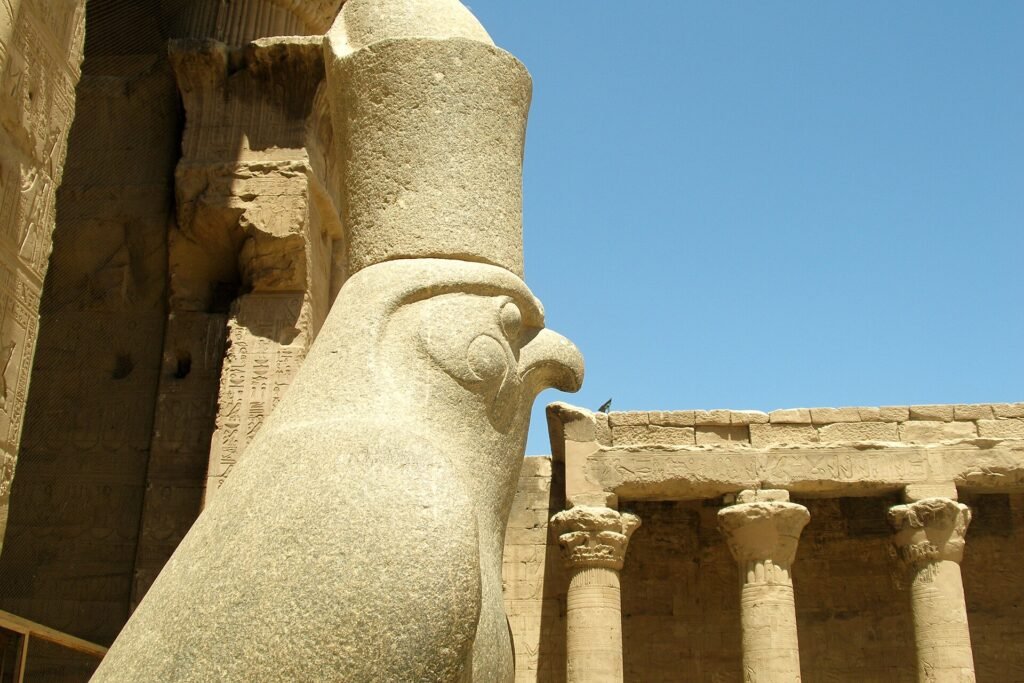
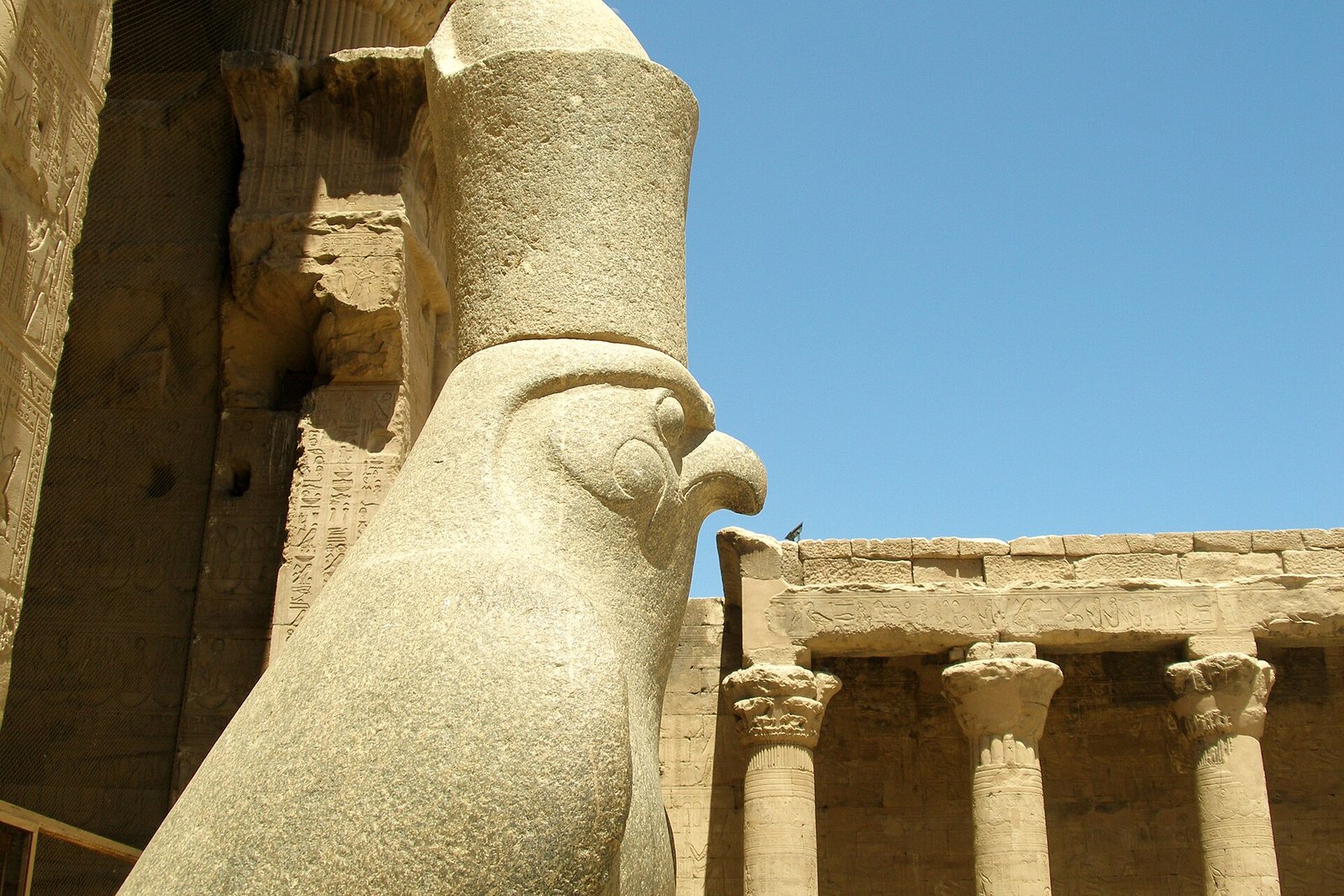
name written as a hieroglyph. At Philae she is everywhere. - Horus, their son. Falcon-headed, usually wearing the double crown of a unified
Egypt. The temple at Edfu is his and it is the best preserved in the country. - Anubis, embalming and the care of the dead. Jackal-headed, black. The jackals
that scavenged desert cemeteries were made the guardian of them instead. - Hathor, love, music, motherhood. Cow horns with a sun disk between them, or a
human face with cow ears on a column capital. Once you spot a Hathor capital you will see them
everywhere. - Thoth, writing and knowledge. Ibis-headed, often shown recording something,
because that is his job. - Sobek, crocodile-headed, the Nile's danger given a shape you can bargain with.
Kom Ombo is half his. - Sekhmet, lioness-headed, war and plague and also healing. Karnak holds many
statues of her.
The story that holds it together
Most of what you will see on a tomb wall assumes one story, so it is worth having.
In the myth, Osiris rules Egypt and is killed by his brother Set, who wants the throne. Isis
recovers her husband's body and, through her own skill, conceives their son Horus. She raises him in
hiding in the marshes of the Delta. Grown, Horus contests the throne against Set and wins it, and
Osiris rules the dead instead of the living.
That single story does an enormous amount of work. It explains why the dead were mummified in
imitation of Osiris, why the living king was identified with Horus and the dead king with Osiris,
and why so much funerary art is about a body being made whole again. When you stand in a tomb in the
Valley of the Kings, this is the story the walls assume you already know.
Why there seem to be so many
Visitors often find the number overwhelming, and there is a reason beyond simple quantity.
Egyptian religion was comfortable with a god being several things at once and with two gods merging
into one. Amun and Ra become Amun-Ra without either being canceled. Local gods rose and fell with
the fortunes of their cities.
So the answer to "how many are there" is that the question does not quite fit. What matters for
looking at a wall is the ten above, plus Maat, who is less a character than a
principle: truth and cosmic order, drawn as a woman with a feather, and the feather your heart is
weighed against.
Where to see them
- Karnak, for Amun-Ra at maximum scale, and for Sekhmet.
- Edfu, for Horus, and for the best sense of what a complete temple felt like.
- Philae, for Isis, on an island, which suits her.
- Kom Ombo, for Sobek, in a temple built symmetrically for two gods at once.
- The Valley of the Kings, for the funerary material, where the Osiris story is
doing the work.
Entry to each of these is covered in
Egypt monument entrance fees.
Common questions
Did Egyptians worship animals?
quality the animal had. The falcon's sight and reach for Horus, the jackal's presence at cemeteries
for Anubis.
Who is the most important Egyptian god?
Kingdom, and Osiris matters most for the afterlife throughout. There is no single answer and any
page that gives you one is simplifying.
Is Set (Seth) a villain?
some texts he defends the sun barque at night. Egyptian gods are rarely purely one thing.
What is the ankh?
are giving him life.
Do I need to know all this before I go?
above just means you spend that explanation recognizing rather than memorizing.
Who were the Egyptian gods of the underworld?
Osiris ruled the underworld as king of the dead, shown as a mummified man with green or black skin and the white crown. Anubis, with a jackal's head, guided the dead and oversaw embalming, and in the judgment scene he weighs the heart against the feather of Maat while Thoth records the result. A heart that failed was eaten by Ammit, part crocodile, part lion and part hippo.
Which Egyptian god is a cat?
Bastet is the cat goddess, shown as a cat or as a woman with a cat's head, a protector of the home, women and children, with her main cult center at Bubastis in the Delta. Her fierce counterpart is Sekhmet, a lioness-headed goddess of war and healing. Cats were loved in ancient Egypt, and thousands of mummified cats were offered at Bastet's temple.
What powers did the main Egyptian gods have?
Each major god looked after one part of life and death. Ra was the sun and the power behind creation; Osiris ruled the afterlife and resurrection; Isis was the great magician and protective mother; Horus stood for kingship and the sky; Anubis guarded embalming and the dead; Thoth governed writing, wisdom and the moon; Hathor brought love, music and joy; Sekhmet sent war and plague but also healing; and Set was the god of storms, deserts and chaos. Temples usually honored one main god, so knowing who it was tells you what the reliefs are about.
Which Egyptian god has a falcon head?
Horus is the falcon-headed god, the sky god linked to the living king, and you will see him everywhere, most famously at his temple in Edfu. Ra, the sun god, is also shown with a falcon head, but he wears a sun disk with a cobra on top of it, which is the easiest way to tell the two apart.
Related reading: Luxor excursions,
visiting Abu Simbel,
Egypt monument entrance fees, and
Egypt tour packages.
Seeing it with someone who reads the walls
Our guides are licensed Egyptologists and this is exactly what they are for. Tell us if the mythology is the part you care about and we will pace the temple days around it rather than marching you through. Message us on WhatsApp.
Keep exploring
To finish planning your trip to Egypt
- ▸Ancient Egypt: the complete guide to its history, pharaohs and gods
- ▸Egyptian Hieroglyphs: What They Mean and How to Read Them
- ▸Egyptian Cotton: How to Spot the Real Thing in Egypt
- ▸Imhotep was the architect of the first pyramid, and Egypt later made him a god
- ▸Queen Hatshepsut: The Woman Who Ruled Egypt as a Pharaoh
- ▸Cleopatra: The Last Queen of Egypt and Where to See Her
- ▸Coptic Christmas in Egypt: January 7, Liturgy and Feast
- ▸Solar Eclipse Egypt 2027: Luxor, the Path and How to See It
- ▸See all our Egypt tours