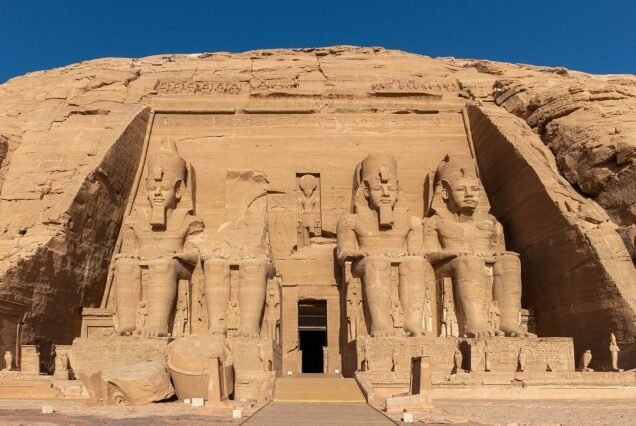
Four seated giants at the end of the desert road
If you have one spare day in Aswan and you want to stand in front of the four seated giants of Ramesses II without committing to an overnight, this is the trip. It is a private, air-conditioned run down the desert road, out and back in a single day, with an English-speaking Egyptologist beside you the whole way and both temple tickets already paid.
It is also a long day, and we would rather you know that now than find out at 3:30 in the morning. You leave Aswan before sunrise, drive roughly three hours across the Nubian desert, spend the best of the morning at the temples, then drive back and reach Aswan in the afternoon. Nobody gets home fresh. Almost nobody regrets it.
What it is not: a coach tour with forty strangers, and it does not involve a plane. There is a domestic flight between Aswan and Abu Simbel and it is not part of this program, and neither is your international flight to Egypt, which we do not sell, book or quote. We handle everything between your hotel door and the temple gate, and back.
Three things separate this from the identical-looking listings on the aggregator sites. It is genuinely private, so the vehicle carries your group and nobody else. Both temple tickets are already paid, so nobody walks you to a window and asks for cash you did not budget for. And you are booking with a company that operates in Egypt rather than reselling from abroad, which is the difference between a guide who answers to us and one a third supplier assigned last night.
One note on timing. The day starts in the dark, so most travelers slot it into the middle of an Aswan stay rather than onto an arrival day. Whatever route you fly, you land off a long flight with your body clock still somewhere else. Do not make this your first morning in Egypt.
Your guide and driver collect you at your Aswan hotel, or at your cruise ship if you are moored on the corniche, well before first light. The early start is not for the sake of drama. It buys the low, raking morning sun on the facade, which is when the carved faces read properly instead of flattening out, and it gets you there ahead of the midday heat.
Bring a light jacket: the Nubian desert loses its heat overnight and the hour before sunrise is cold even in July. Meals: none at this hour, so arrange a breakfast box with your hotel the night before. Where you sleep: nowhere, this is a day trip, and you are back in your own bed in Aswan tonight.
The road south runs roughly three hours, mostly straight and mostly empty, with Lake Nasser off to the east and sand to the horizon everywhere else. There is a stop to stretch and use a restroom.
Your guide uses the drive to set up what you are about to see, because Abu Simbel is transformed by knowing the story first. Ramesses II ruled for sixty-six years and built the Great Temple as political architecture aimed squarely at Nubia. Then the rescue: in the 1960s the Aswan High Dam was going to put both temples under the rising water of Lake Nasser, so a UNESCO campaign cut them into more than a thousand blocks, lifted them roughly two hundred feet, over sixty meters, up the cliff, and reassembled them inside an artificial mountain. You will be looking at a monument that has been moved, and you will not be able to tell.
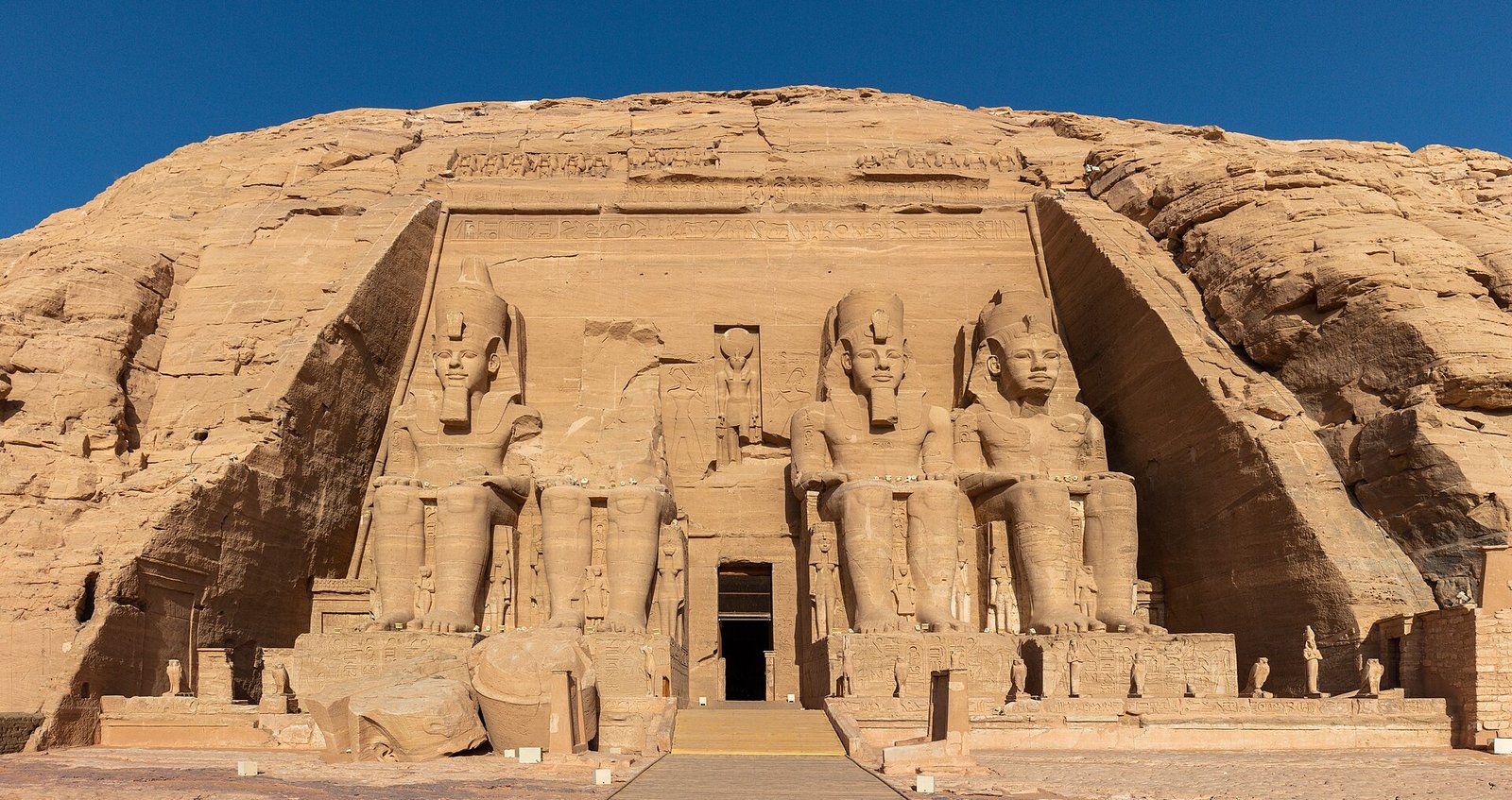
You reach the site mid-morning. The modern path curves around the back of the artificial hill, so the whole facade opens at once: four seated colossi of Ramesses II, each roughly sixty-five feet, about twenty meters, tall, staring east across the water. Photographs do not prepare anyone for the scale. One of the four collapsed in antiquity, and its head and torso were left where they fell when the temple was moved.
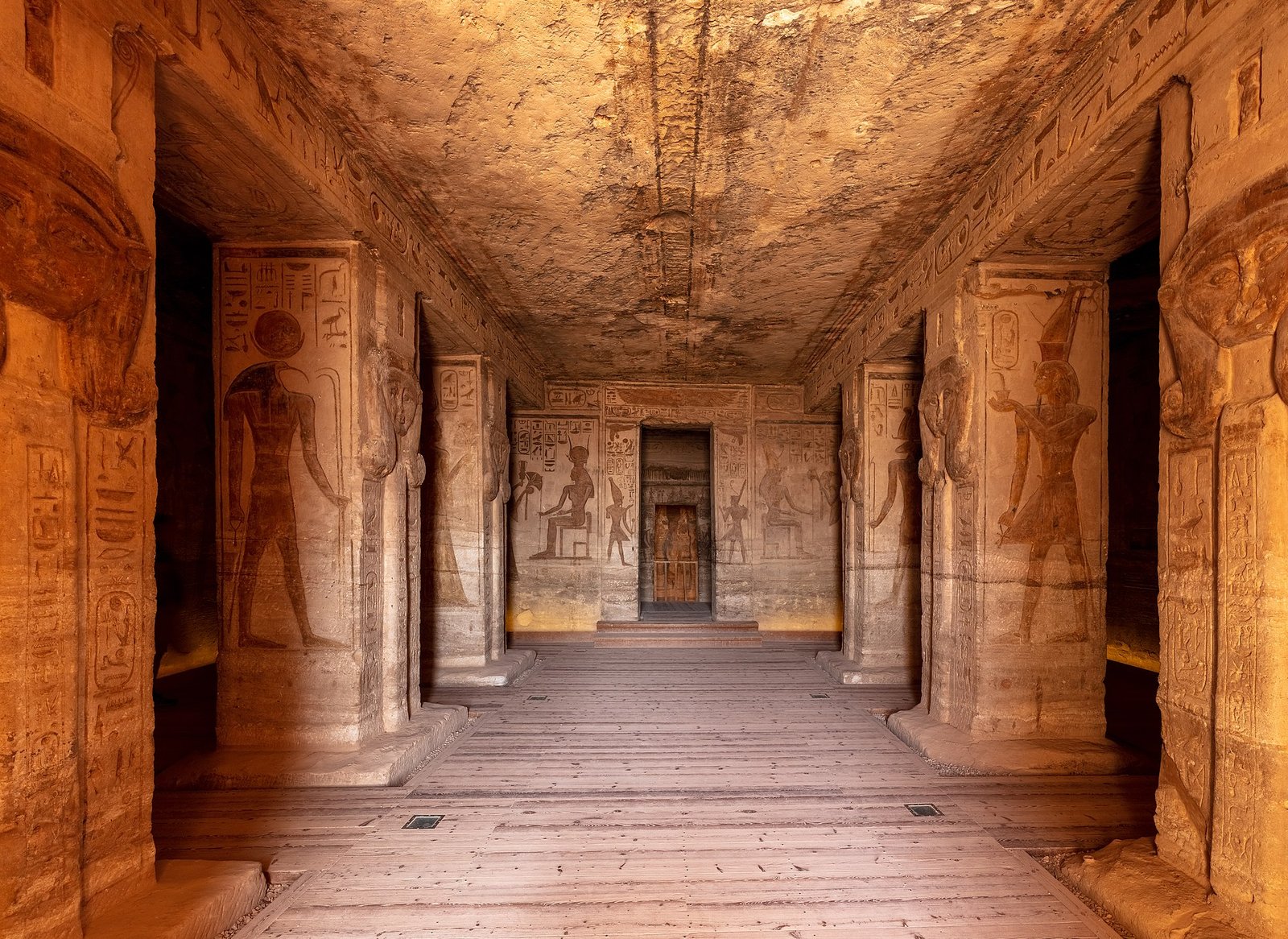
Your guide takes you inside, through the hall of Osiride pillars, past the reliefs of the Battle of Kadesh, and down the axis to the sanctuary. Twice a year, in February and October, the rising sun enters the door and travels roughly two hundred feet, some sixty meters, through solid rock to light the seated gods in that innermost chamber. The alignment was calculated three thousand years ago and the engineers who moved the temple had to reproduce it. Exact dates are published each year by the ministry, and the site is extremely busy on those mornings.
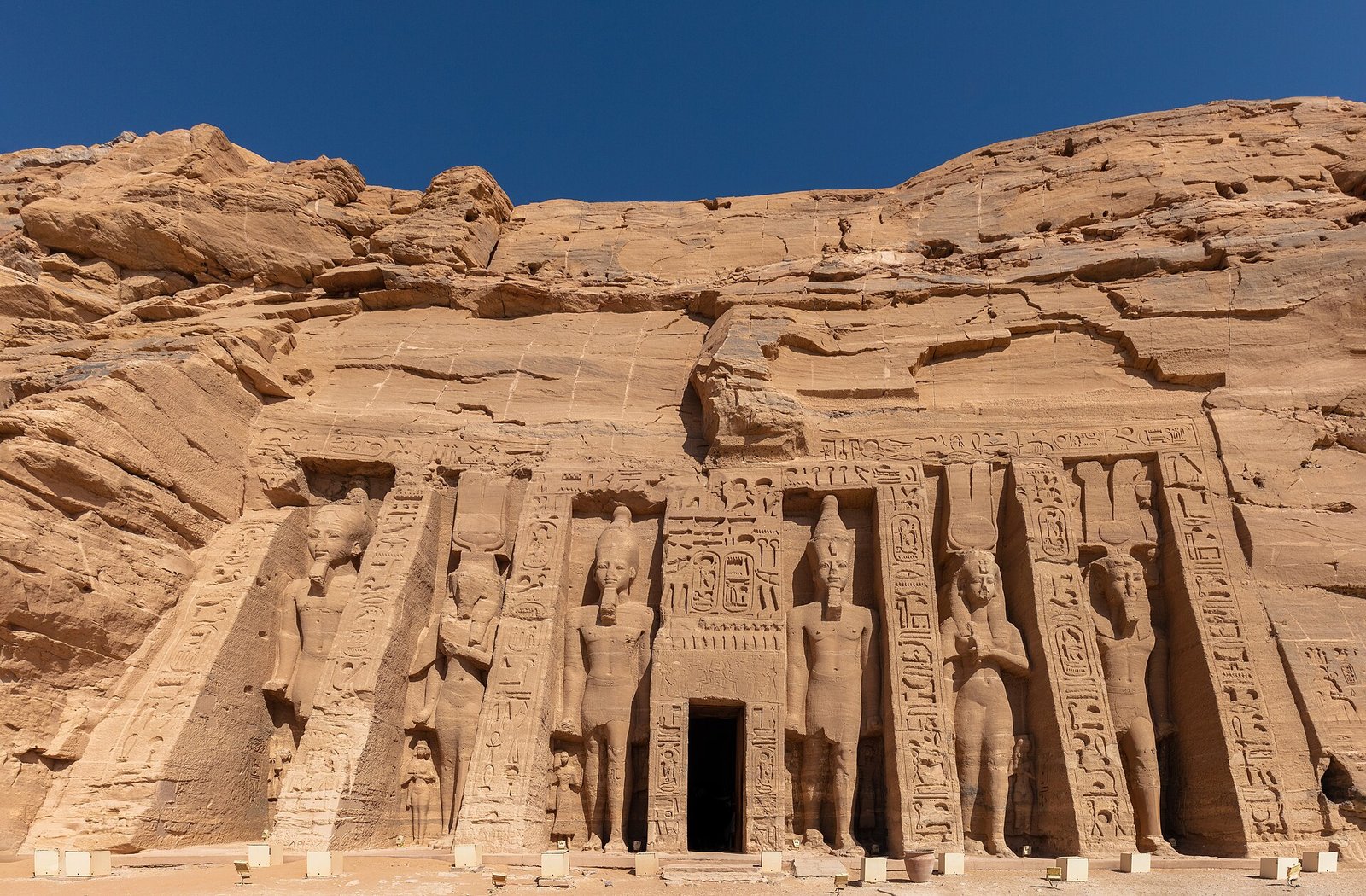
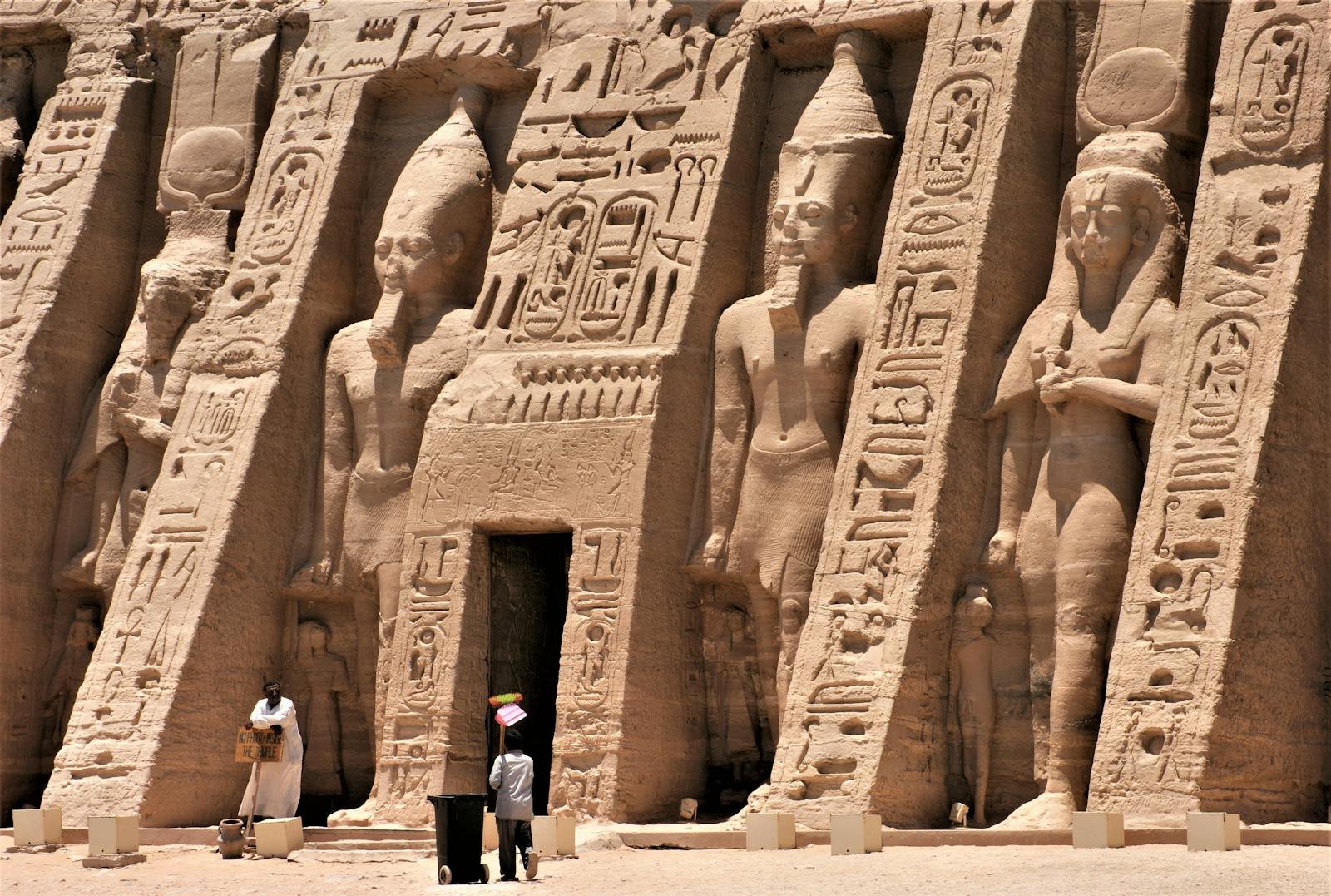
Then the second temple, a short walk along the same terrace. Ramesses built it for his principal wife, Nefertari, and dedicated it to the goddess Hathor. Nefertari is carved at the same height as the king on its facade, which almost never happens in Egyptian royal art. It is smaller, quieter, less crowded, and plenty of travelers end up preferring it.
After the guided walk you get free time for the photographs you actually want. Meals: nothing included, though there is a cafeteria at the visitor center. Where you sleep: not here, we head back after this.
Back the same way, arriving in Aswan in the afternoon. The rest of the day is yours, and the standard local answer is a felucca on the Nile at sunset. If you are on a Nile cruise, we time the return around your ship. Meals: not included. Where you sleep: your own hotel or cabin in Aswan, where you started.
Want it in writing?
Day by day, hotels, what is included and the price for your dates. We send it on WhatsApp in a few minutes.
If something is not named on either list, it is included. There is no small print, and no second invoice waiting for you at the temple gate.
These are the official 2026 gate fees published on the Ministry of Tourism and Antiquities ticketing platform, per person, and they are already inside your price. You do not queue and you do not pay again at the gate.
| Gate | Official 2026 fee |
|---|---|
| Abu Simbel archaeological site, Great Temple of Ramesses II and Small Temple of Nefertari, one ticket | 822 EGP |
| Total already paid, per person | 822 EGP |
Roughly 17 USD per person at an exchange rate of 1 USD = 49.79 EGP. We print the Egyptian pound figure as the real number, because that is the one the ministry sets. Treat any dollar conversion as approximate: the rate moves, and it has already moved since these fees were checked. Fees are subject to change.
One ticket covers both temples inside the walled enclosure, so there is no second gate and no upsell once you are through. Where a site charges extra, such as a photography permit in a given season, it is paid at the ticket office on the day and we will not quote a figure we cannot verify.
from US$120
Per person, double occupancy. All monument entries on this program included.
The rate starts at 120 US dollars per person based on two travelers sharing, and reaches around 179 depending on season and the level of service you choose. It is per person, never per group.
What moves the number:
What does not move it: the entrance tickets, quoted in Egyptian pounds and already paid at the official rate above. You do not pay the full amount up front either. You hold the date with a deposit and settle the balance in Egypt, on terms agreed in writing before anything is confirmed.
WhatsApp +20 103 229 5513, or use the enquiry form on this page. A person answers, usually the same day.
No. This program travels by road in both directions and no flight of any kind is included. A short domestic flight between Aswan and Abu Simbel does exist, but it is not part of this product. Your international flight to Egypt is separate too, and we do not sell, book or coordinate it. We handle everything on the ground.
Pickup is before sunrise, and the exact time depends on where you are staying in Aswan. Your guide confirms it the evening before. The drive is about three hours each way, so the day runs from the small hours to mid-afternoon, with a restroom stop on each leg. If a 4:00 alarm is a deal-breaker, ask about the two-day version instead.
Two separate questions. On the country: check your own government's current travel advice for Egypt before you book. Advisory levels change, so read the live page rather than a date-stamped number on any operator's site, this one included. Where advisories single out a region of Egypt to avoid, it is North and Middle Sinai. None of our itineraries enter North or Middle Sinai, and Abu Simbel sits in the far south on Lake Nasser, well over six hundred miles, close to a thousand kilometers, from that region.
On the road itself: the Aswan to Abu Simbel highway is one of the most closely supervised tourist routes in Egypt, vehicles run on coordinated schedules with checkpoints, and our drivers cover it several times a week. We will not promise security anywhere at any future date, because nobody honest can.
Most visitors need a visa: 30 US dollars single entry, 65 US dollars multiple entry. The 25 dollar figure printed on many travel sites is out of date, and the higher numbers on embassy pages are a consular service with its own fee, not the e-visa. Apply at visa2egypt.gov.eg, the Egyptian government portal, or on arrival. One detail catches people out: the visa on arrival must be paid in US dollars, in cash. Bring crisp, unmarked bills, because worn and older series notes are routinely refused and there is no card option at that window.
Yes. The 822 EGP ticket admits you to the whole walled site, both the Great Temple of Ramesses II and the Small Temple of Nefertari, and it is already paid inside your price. The only things you might pay on site are a photography permit, if one is in force that season, and small change for restroom attendants.
Abu Simbel is an archaeological site, not a mosque, so covering your hair is not required and nobody will ask you to. The real adversary is the sun: brimmed hat, high-factor sunscreen, sunglasses, and closed shoes for sand and stone. From November to March the pre-dawn hour is cold, so add a layer you can take off. For women, knee-length or longer with shoulders covered is comfortable and unremarked-upon anywhere in Upper Egypt and doubles as sun protection. Shorts are not prohibited, but very short shorts draw attention. A scarf only matters if a mosque appears elsewhere on your itinerary.
Bottled water is included and there is plenty in the vehicle. Meals are not, so ask your hotel for a breakfast box the evening before, and there is a cafeteria at the visitor center. Do not drink Egyptian tap water and do not brush your teeth with it. Sealed bottles only, and be careful with ice. Raw salads and unpeeled fruit cause most stomach trouble, while hot cooked food and fruit you peel yourself are fine. Carry your own sanitizer and tissues, because site restrooms do not reliably supply paper.
Tipping is normal and expected, and the question is usually how much and how often rather than whether. On a private full-day excursion, travelers commonly land around 10 to 15 US dollars per person for the Egyptologist guide and roughly half that for the driver. Restroom attendants expect a few Egyptian pounds. Nobody gets tipped twice here, because there is no cruise crew, no porter chain and no hotel staff inside the program. Small pound notes are the most useful thing to carry.
Yes, and plenty of travelers do. We pick up and drop off at the ship. Check your sailing schedule, because a cruise leaving Aswan in the early afternoon will not wait. Send us your ship's name and itinerary and we will tell you plainly whether the timing works. If not, the two-day version is usually the fix.
Both, for different jobs. Dollars in cash for the visa on arrival, and small bills are widely accepted for tips. Egyptian pounds for everything small and local: drinks, restroom attendants, a souvenir. ATMs are easy to find in Aswan city and effectively absent on the desert road, and cards fail outside the main hotels, so draw cash before the trip. Rates move constantly, which is why we quote gate fees in pounds and treat the dollar figure as an approximation.
We do not sell insurance and it is not included, but we do think you should have it. Most domestic health plans, public schemes included, provide little or no coverage abroad, and Egypt has no reciprocal health arrangement to fall back on. Look for a policy covering medical treatment abroad, medical evacuation, and trip cancellation. Evacuation is the piece people skip and the one that matters most where the best-equipped hospitals sit in Cairo, several hundred kilometers north.
For most travelers the day trip is enough: both temples with a guide, unhurried free time, and your evening back in Aswan. The overnight version suits two people, the photographer who wants early or late light without the day-trip crowd, and the traveler who cannot face six hours in a car inside twelve. If that is you, the two-day program with a hotel night is the better buy, and we will say so even when that is the cheaper option.
Explora Egipto is based in Egypt, and that is an operational fact rather than a marketing line. When a vehicle has a problem on the desert road at six in the morning, the person solving it is in the same country and time zone as the problem. When you message on WhatsApp the night before to ask what time pickup actually is, you are messaging the office that dispatched the car, not a call center that forwards it to a supplier.
In practice: your guide is a licensed Egyptologist working through us, briefed on your booking, and answerable to us if the day goes badly. We buy your entrance tickets at the official ministry rate, which is why we can print the gate fee on this page instead of burying it. Your price is confirmed in writing before you commit.
The trade-off, stated plainly: booking direct with an Egyptian operator means your consumer protection sits with your payment method and your travel insurance rather than a bonding scheme at home. One more argument for the insurance point above.
If Abu Simbel is one piece of a longer trip, the same team builds the rest. The Nile cruise from Aswan to Luxor pairs naturally with this excursion, the Aswan and Luxor land itinerary works if you would rather sleep on shore and flex around your own flight times, and the two-day Abu Simbel program with a hotel night is the slower version of this same trip. The ten-day Egypt itinerary already has Abu Simbel built into it, or browse every Egypt tour package we run. It is also worth reading what past travelers have written about us and seeing what else is worth your time in Aswan.
Send the days you will be in Aswan and we come back the same day with a written price for your party. One message, a real answer, no endless forms.
Tell us the essentials in 30 seconds. When you send it, WhatsApp opens with your message already written and someone from our team takes it from there.
A real person from our team replies, not a bot, almost always the same day. A quote is free and commits you to nothing.
We use your details only to prepare your quote. We do not share your information or send you advertising.