
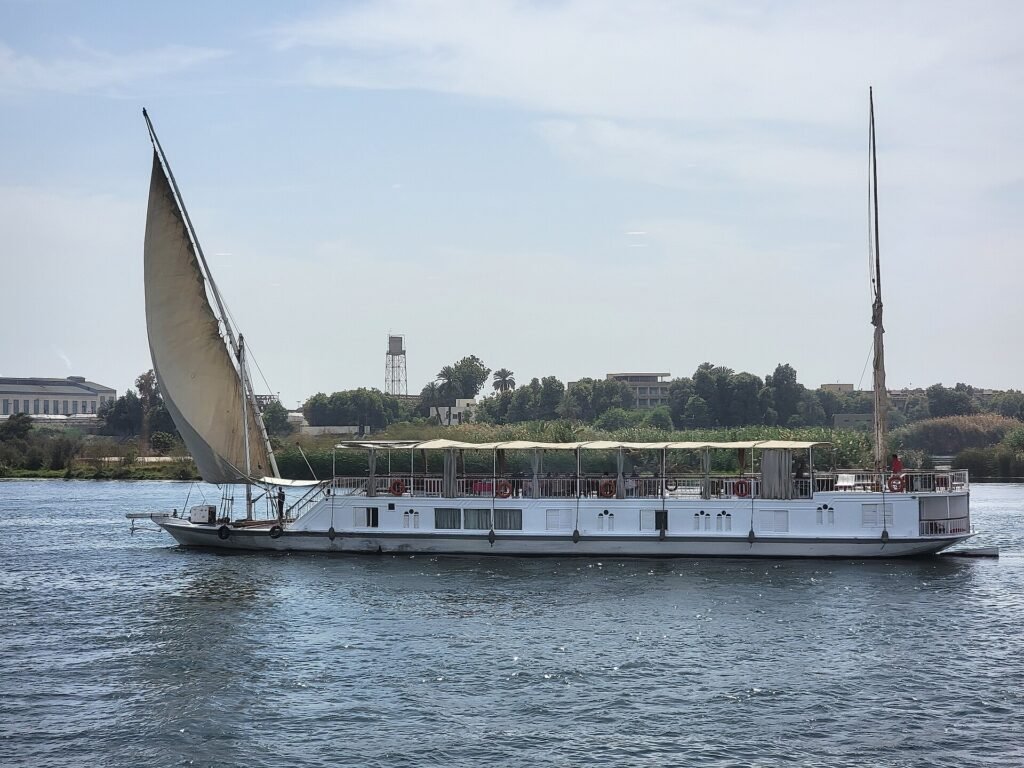
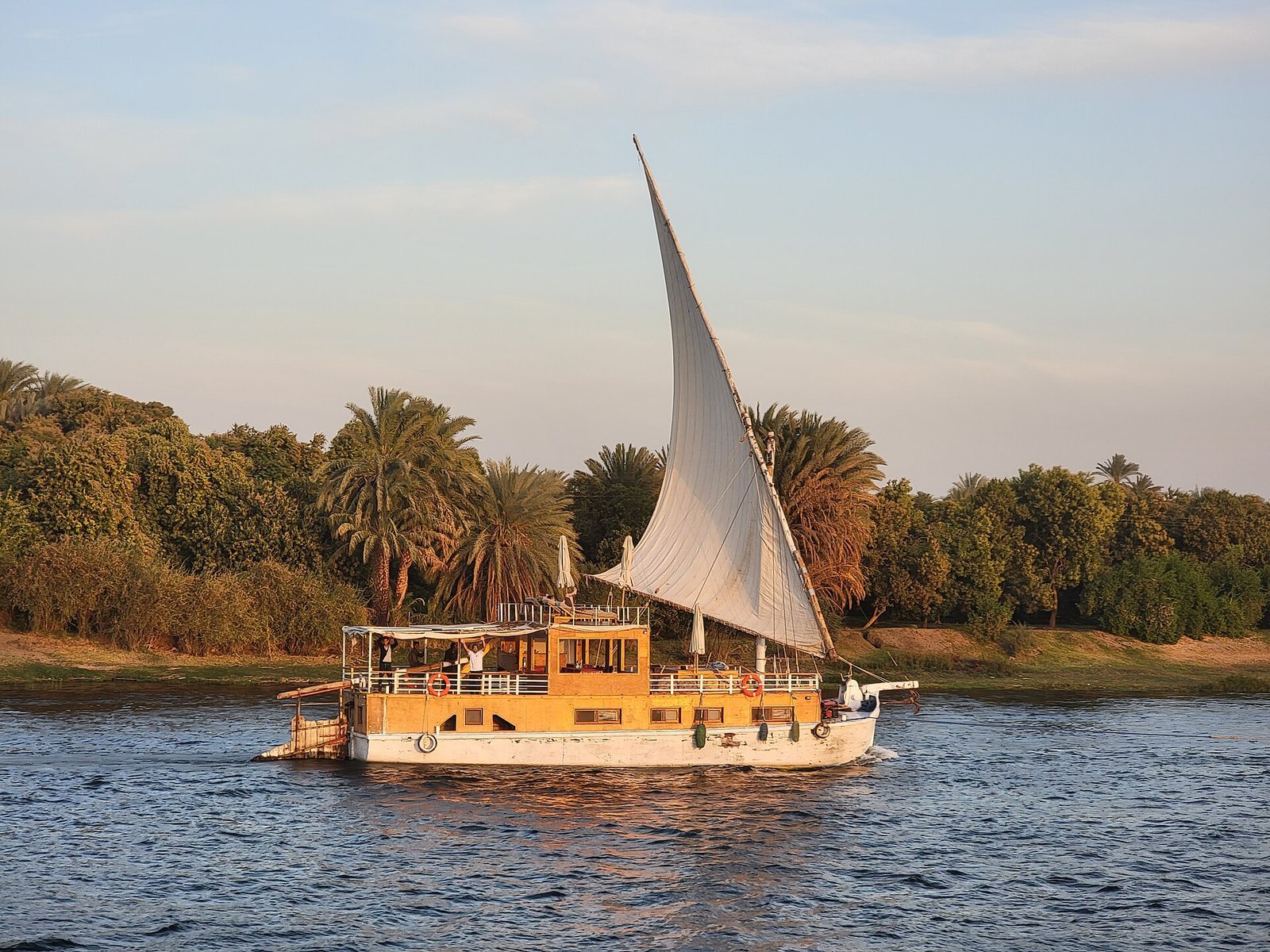
A dahabiya is a small wooden sailing boat with two lateen sails and usually six to ten cabins, the way the Nile was travelled in the nineteenth century. It carries a fraction of a motor ship's passengers, moors at islands and villages the big vessels cannot reach, and moves at the pace of the wind rather than a timetable.
The word comes from the Arabic for golden, after the gilded barges the rulers of ancient Egypt were carried on. On the river today it means something narrower: a two-deck wooden sailing boat, two triangular lateen sails, six to ten cabins. You will also see it written dahabeya and dahabiyya.
This is the vessel travellers hired for a whole winter in the eighteen hundreds. It nearly disappeared when steamers and motor ships took over, and Egyptian owners revived it in the past couple of decades.
Two things get confused with it. A felucca is an open day boat with one sail and no cabins, fine for an afternoon at Aswan but not for sleeping aboard. A motor ship is a floating hotel with engines and dozens of cabins. The dahabiya sits between them.
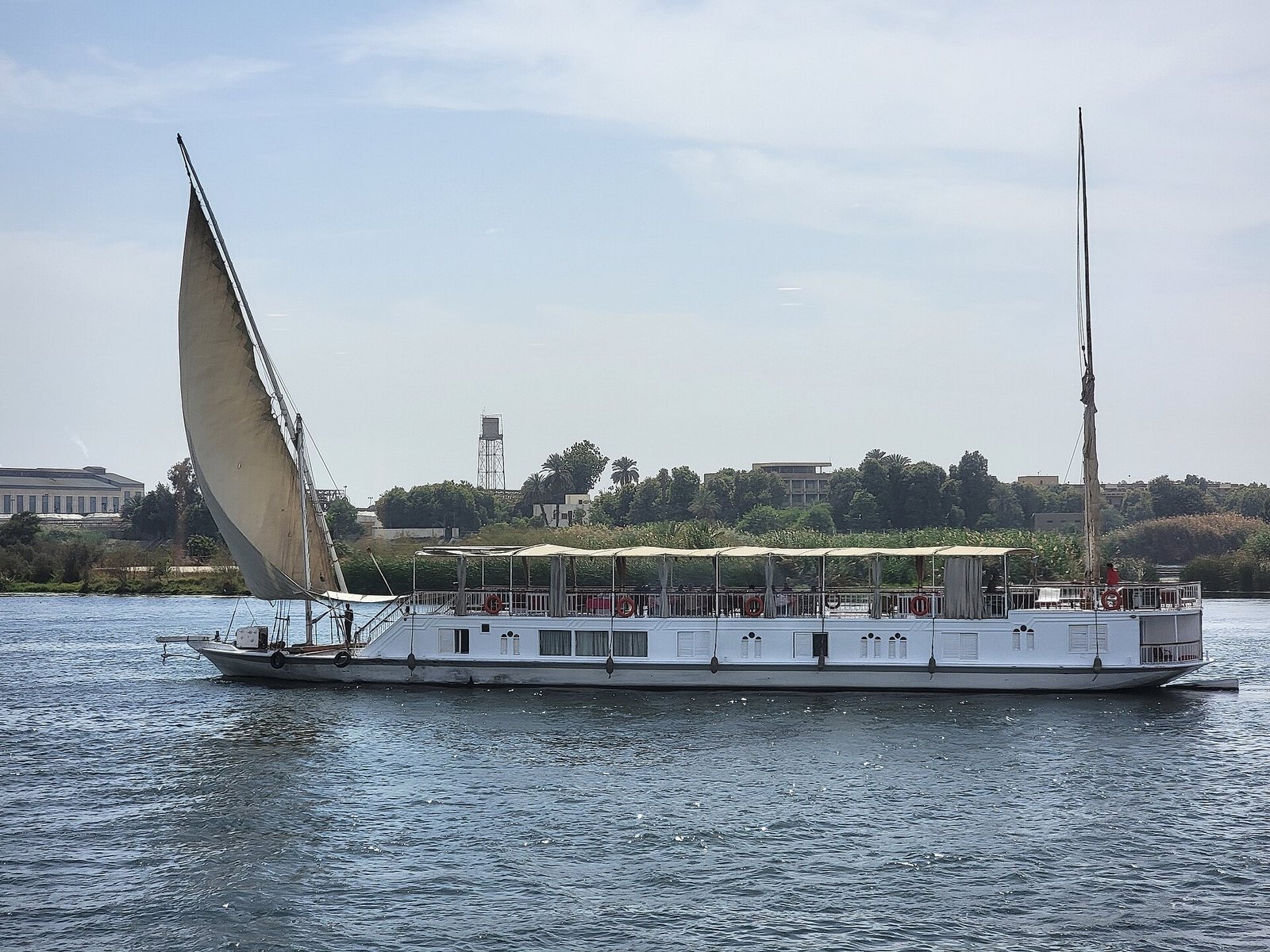
The Nile runs north and the prevailing wind blows south. That single fact is why sailing boats worked this river for thousands of years: ride the current going down, raise the sails going up. A dahabiya heading upstream towards Aswan is doing what it was built for, and on a good afternoon it does it in near silence.
When the wind drops, or when the boat is travelling downstream, a small tug takes it in tow. Brochures rarely show this, and some travellers feel misled when they see it. It is simply how these boats have always been handled.
The practical consequence matters more than the romance: a boat that depends partly on wind cannot publish a schedule to the minute. If that flexibility sounds like the point of the holiday, this is your boat. If it would nag at you, a motor ship on a fixed timetable is the honest recommendation.
Most people arrive already leaning one way. This is the comparison we use when someone asks us to choose.
| What changes | Dahabiya | Motor ship |
|---|---|---|
| Cabins | Usually six to ten, a few smaller | Commonly forty to eighty |
| Propulsion | Lateen sails, tug assist when needed | Own engines, no wind dependency |
| Schedule | Flexible, decided by wind and group | Fixed and published in advance |
| Dining | One sitting, one long table, cooked to order | Buffet, several sittings, set hours |
| Moorings | Islands, sandbanks, village banks | The main quays at Luxor, Edfu, Kom Ombo, Aswan |
| Facilities | Shaded deck, small lounge, rarely a pool | Pool, bar, gym, sometimes a spa |
| Sociability | You will know everyone by the first dinner | Easy to keep to yourself |
| Cost per person | Higher, and higher again for a full charter | The better value at every star level |
Read the sociability row carefully. On a small boat you cannot disappear from the group, and that is what people most often fail to picture.
A dahabiya with eight cabins carries fewer than twenty guests. There is no buffet, no seating plan and no entertainment programme, because none of that makes sense at this scale. Dinner is one table, usually one menu with the kitchen working around what you cannot eat, cooked aboard from what the crew bought on the bank that morning.
The crew will know your name by the second day. Some find that the warmest part of the trip; others find it slightly exposing after a life of anonymous hotels.
The shaded upper deck is the real living room. People read there, sleep there in the afternoon and stay out after dinner. Upper Egypt has very little light pollution once the boat is moored away from town.
Cabins on a good dahabiya are often larger than the equivalent on a motor ship, because the boat carries a tenth of the guests over a similar hull. Upper deck cabins usually have proper windows rather than low portholes, and air conditioning is normal.
Beyond that, temper your expectations on purpose rather than on arrival. There is no lift, and the stairs between decks are wooden, steep and narrow. Bathrooms are compact. Power often runs off a generator with quiet hours, so sockets are not always live overnight. There is rarely a pool. That is the trade, and our full list for either kind of boat is in what to pack for a Nile cruise.
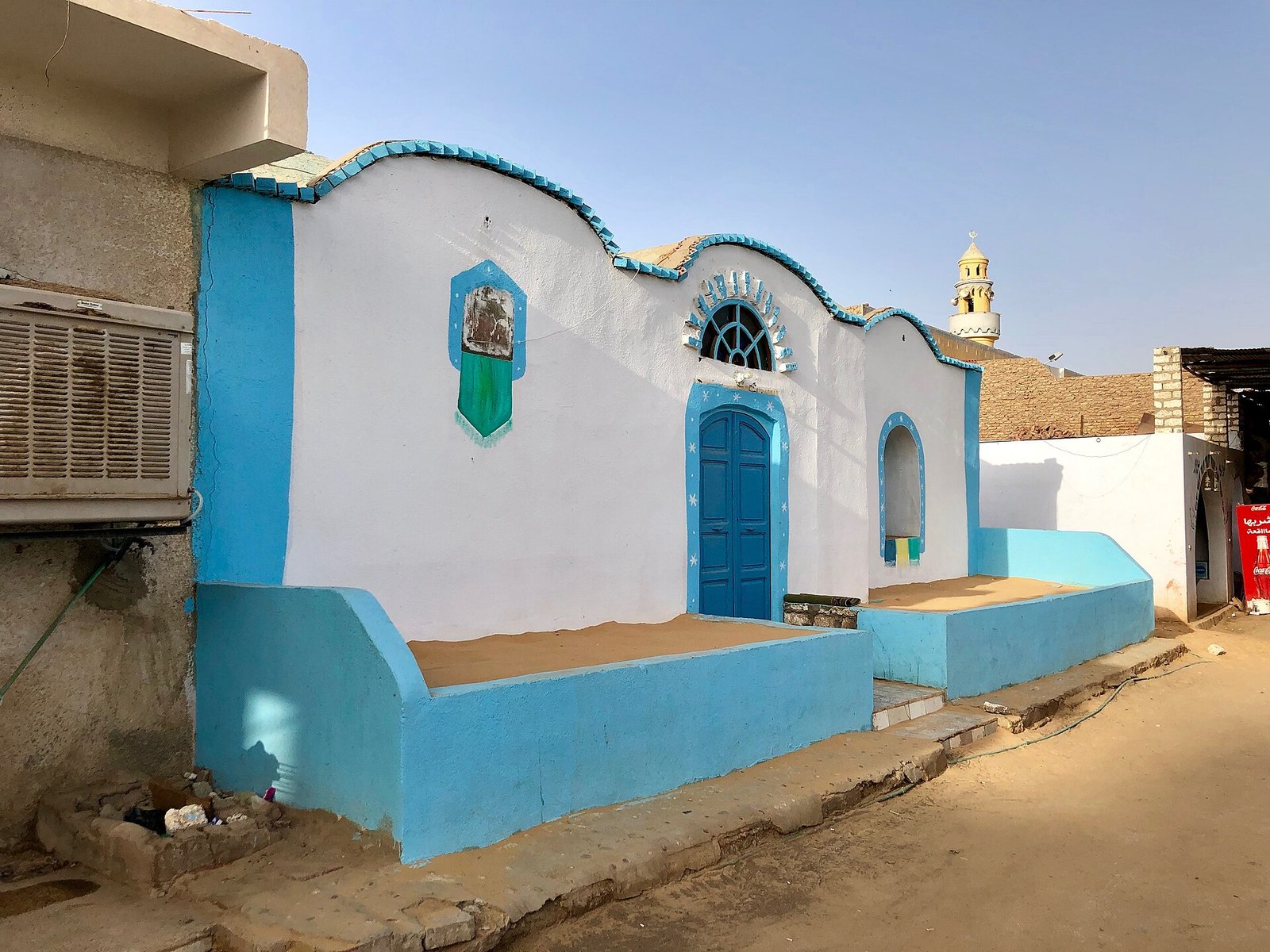
This is the argument for the whole format, and it is practical rather than poetic. A dahabiya is short, light and shallow. It needs no quay and no berth booked behind five other vessels. It can put a plank onto a sandbank or tuck behind an island.
That changes the evenings. A motor ship at Edfu moors side by side with others, sometimes so tightly that your cabin window looks into someone else's. A dahabiya on the same night is likely to be alone.
It changes the days too. The itinerary can include things on no ticketed site list: a walk through a village where nothing is being sold to you, tea with a family the crew know. Whether you swim is the captain's decision on the day, so treat it as a possibility rather than a promise.
Almost all dahabiyas work the reach between Esna and Aswan rather than the full Luxor to Aswan run motor ships advertise. There is a lock at Esna, slow and unpredictable for a sailing boat, so most operators begin south of it. You are driven from Luxor to the boat, about an hour.
Sailing upstream towards Aswan is the classic direction and usually the longer programme, because the wind is with you. The northbound version tends to be a night shorter and leans more on the tug and the current.
Luxor itself is normally done on land, before or after the water, and that is better than it sounds: Karnak and the Valley of the Kings deserve unhurried mornings from a hotel rather than a rushed slot from a moored boat. Our guide to choosing a Nile cruise covers route and length together, and Luxor excursions covers the land side.
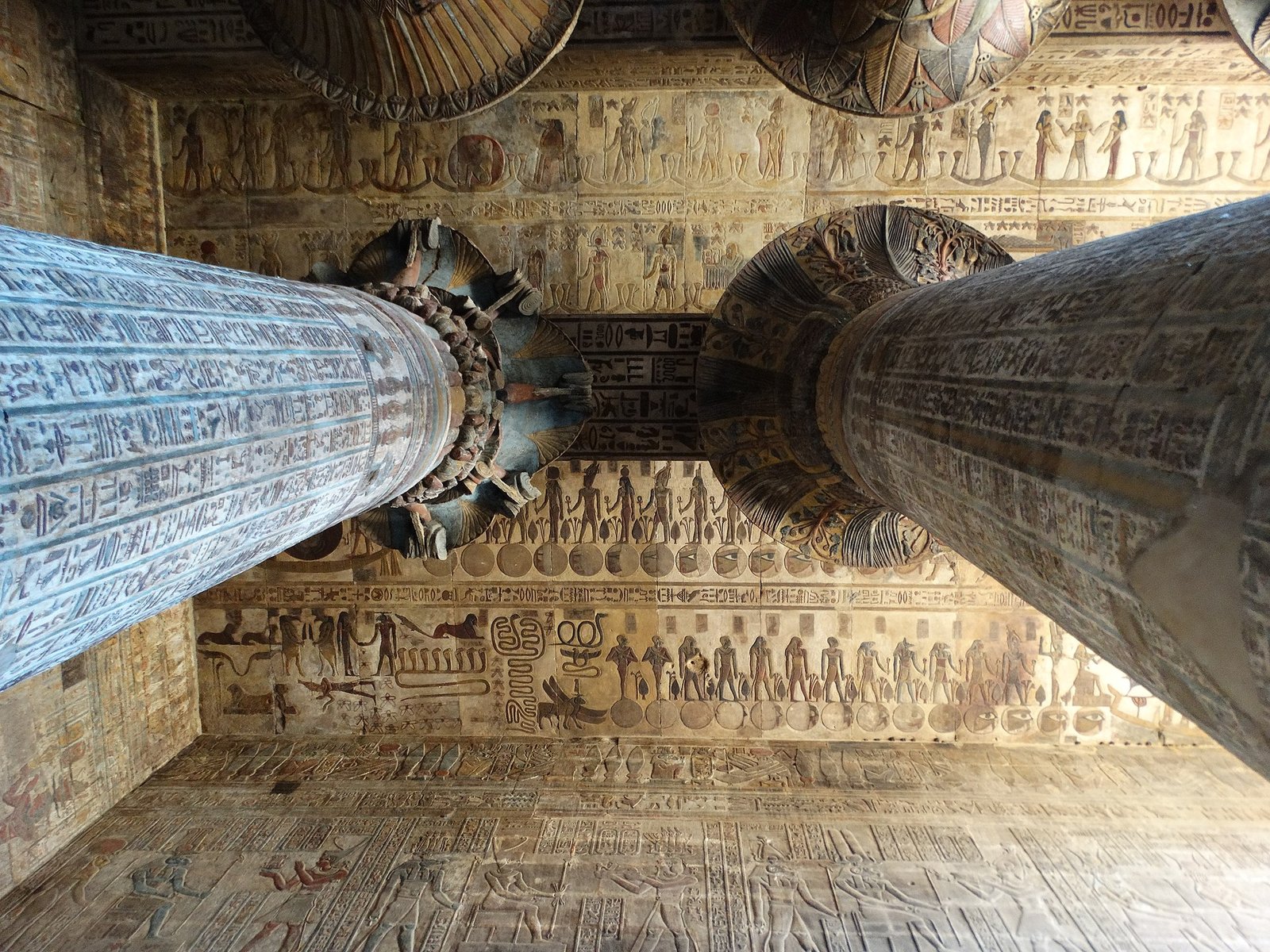
The dahabiya itinerary keeps the famous temples and adds several that motor ships skip because there is nowhere to tie up. The list varies by operator:
The crowd difference is mostly about timing. A dahabiya reaches Edfu and Kom Ombo at hours the fleet does not, which is why the same temple can feel like two different places.
Because the cabin count is so low, taking the entire vessel is a normal request rather than an extravagance. A family of ten, or friends filling eight cabins, can have the boat, the crew and the schedule to themselves. That is not realistic on a ship with sixty cabins.
A charter changes more than the passenger list. Meal times bend to your group, a morning can start late, and the week can be reshaped if everyone would rather have a long afternoon on a sandbank than a fourth temple.
It changes the arithmetic too. Split across a group that genuinely fills the boat, a charter can land close to a shared booking, while a half-empty charter is expensive per head. How many cabins you can fill is the first thing we ask.
We would rather talk someone out of this than have them find out on night two. It fits:
It fits badly on a tight budget, for travellers who want a pool and evening entertainment, and for anyone with reduced mobility, because of the stairs and the gangplank. For families, read cruising the Nile with kids first.
A dahabiya costs more than a comparable motor ship, and the reason is structural rather than a mark-up. A crew of fifteen or so serves fewer than twenty guests, meals are cooked to order, and a wooden hull needs work every season. Those costs are spread over a handful of cabins instead of dozens.
What moves the figure for your trip is the boat, the season, the length of the programme, whether you share or charter, and what is bundled in: a dedicated Egyptologist, site entrance tickets, drinks, the transfer from Luxor. Two quotes that look far apart often quote different things, so compare inclusions before totals.
We publish no fixed figure here, because a real number depends on your dates and your group. Tell us both and we will price the boat we would put you on. First-time enquirers get our best first-trip conditions. For budgeting, see what a trip to Egypt costs.
Upper Egypt is hot, and the further south you go the hotter it gets. The cooler months are the comfortable ones on an open deck and also the busiest, so the river is at its most pleasant and its most booked at once. The shoulder months are warmer but quieter, and high summer is punishing on a boat whose living space is outdoors.
Wind is the other variable. The prevailing northerly is more reliable in some months than others, which affects how much of the southbound leg is genuinely under sail. No operator can promise a windy week.
Lead time is simple maths: far fewer dahabiyas than motor ships, each with a handful of cabins, so peak dates and full charters go early. See the best time to visit Egypt and high and low season month by month.
A normal Egypt packing list still applies. These items are specific to a small wooden boat:
Dahabiyas differ from each other far more than four-star motor ships do, and the brochure will not tell you which one you are getting. Ask these before you pay:
The last one is the one people skip and then regret. If boat, transfers and guide come from three parties, a problem mid-week becomes yours. More in choosing an Egypt tour operator.
Very few people come to Egypt only to sail. The usual shape is Cairo first for the pyramids and a museum, a domestic flight south to Luxor, land days on the Theban west bank, the boat from Esna to Aswan, then Aswan with Philae and Abu Simbel.
Sequencing matters. The dahabiya is the slow part of the holiday, and it lands better after the intensity of Cairo than before it.
We are a Cairo-based agency running our own trips, so the Cairo nights, the domestic flight south, the transfers, the guiding and the boat sit on one booking. See how the pieces fit in our Egypt tour packages, the wider Nile cruise guide and the comparison of Nile cruise boats, and read our traveller reviews.
A traditional two-deck wooden sailing boat with two lateen sails and usually six to ten cabins. It is the vessel travellers hired to sail the Nile in the nineteenth century, revived as a much smaller alternative to the modern motor ship.
Scale and pace. A motor ship has four or five decks, dozens of cabins, engines, a pool and a fixed timetable. A dahabiya has two decks, a handful of cabins, sails with a tug assist, and a flexible schedule.
Most carry between six and ten, and the smallest have as few as four. That is why one family or group can take the whole boat, and why specific weeks sell out early.
Both, and that is normal. Heading south it uses the prevailing north wind and genuinely sails. When the wind drops, or when travelling downstream, a small tug tows it. Anyone implying it is under sail all week is overselling it.
Nearly always the reach between Esna and Aswan, in either direction, after a road transfer of about an hour from Luxor. Stops usually include Esna, El Kab, Edfu, Gebel Silsila and Kom Ombo.
The good ones are a kind of luxury, but not a hotel kind. You get space, silence and a crew looking after very few people. You do not get a lift, a spa or a large pool. If luxury means those, a top-category motor ship suits you better.
Typically four to six nights, the southbound Esna to Aswan leg usually the longer one because the boat can take its time under sail. A charter can be shaped to whatever length the group wants.
Yes, and it is a common request. With so few cabins, a family or group can take the whole vessel and set their own rhythm. The cost per person depends heavily on how many cabins you fill, so tell us the group size first.
Children are fine on a charter and harder work on a shared boat with a fixed dinner table and no pool. For limited mobility it is genuinely difficult: no lift, steep stairs, and boarding often over a plank. A motor ship handles both better.
Sail the Nile the way it used to be sailed
Tell us your dates and how many of you are travelling, and we will tell you which dahabiya we would put you on and how it fits around Cairo, Luxor and Aswan.
Nothing here quite the trip you had in mind? Tell us what you want to see and the team in Cairo builds the itinerary around your answers.
Build a custom Egypt trip