The Bibliotheca Alexandrina is the library of Alexandria reborn, and this is how a visit works
The Bibliotheca Alexandrina is the library of Alexandria reborn, and this is how a visit works
The Bibliotheca Alexandrina is a working library and cultural complex on the Alexandria corniche, opened in 2002 as the modern heir to the ancient Library of Alexandria. Nothing of the original survives above ground, so this tilted granite disc by the sea is the library you actually visit. Inside are a stepped reading room the size of a stadium floor, a manuscript museum, an antiquities museum, the Sadat museum and a planetarium in a separate sphere. The guided walk takes about an hour; with the museums, give it a full morning. It fits into a one day trip from Cairo with Qaitbay, the catacombs of Kom el Shoqafa and Pompey's Pillar.
What the ancient Library of Alexandria actually was
The ancient library was founded under the first Ptolemies in the early third century BC, when Alexander's general Ptolemy made Alexandria the capital of a Greek kingdom in Egypt. It was not a public reading room. It was a state funded research institute attached to the Mouseion, where scholars were paid to live, eat and argue at the king's expense.
The collection ran to hundreds of thousands of papyrus scrolls, gathered with a ruthlessness that reads like fiction. Ships docking in the harbor were searched, any scroll on board was copied, and the copy went back to the owner while the original stayed on the shelf. Athens lent its official texts of the great tragedians against a large sum as security, and Alexandria kept the originals and let the money go.
The people are why the name still carries weight. Euclid wrote the geometry textbook schools used for two thousand years. Eratosthenes, the head librarian, measured the circumference of the Earth from noon shadows in two cities. Aristarchus put the Sun at the center centuries before anyone listened. If this thread grabs you, our list of books about ancient Egypt to read before the trip includes a couple on the Ptolemaic city.
The fire myth, and what the facts say about how it disappeared
Ask most Americans what happened to the Library of Alexandria and you get one word: fire. The truth is slower and less cinematic.
- Caesar's fire, 48 BC. His troops burned ships in the harbor and the flames reached warehouses on the docks. Some scrolls were lost, but the institution kept working for centuries.
- Purges and budget cuts. A second century BC Ptolemy expelled the foreign scholars during a feud, and later kings never funded the place like the first three. Institutions starve before they burn.
- Roman civil wars. In the 270s AD the emperor Aurelian's campaign flattened the palace quarter where the library stood. This is the likeliest end of the main building.
- The Serapeum, 391 AD. The daughter library in the temple of Serapis went down with the temple during the suppression of pagan cults.
- The Arab conquest story. The tale of scrolls burned to heat the bathhouses appears many centuries later and historians reject it.
So no single night of flames and no single villain, just a decline over roughly six centuries. Nothing of the main library has been found and its exact site under the modern downtown is still argued over. That absence is the whole point of the new building.
The Bibliotheca Alexandrina: a tilted disc on the corniche
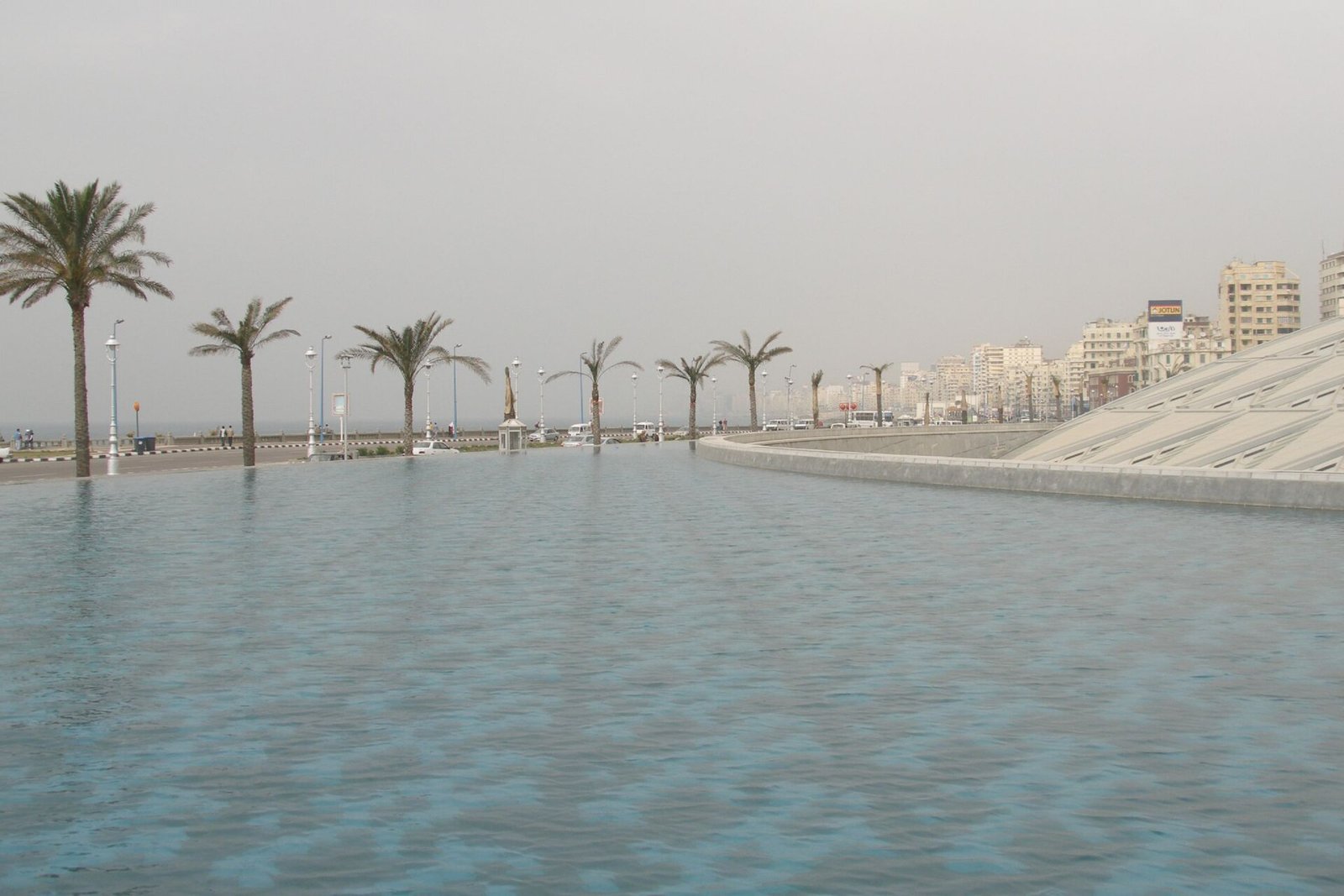
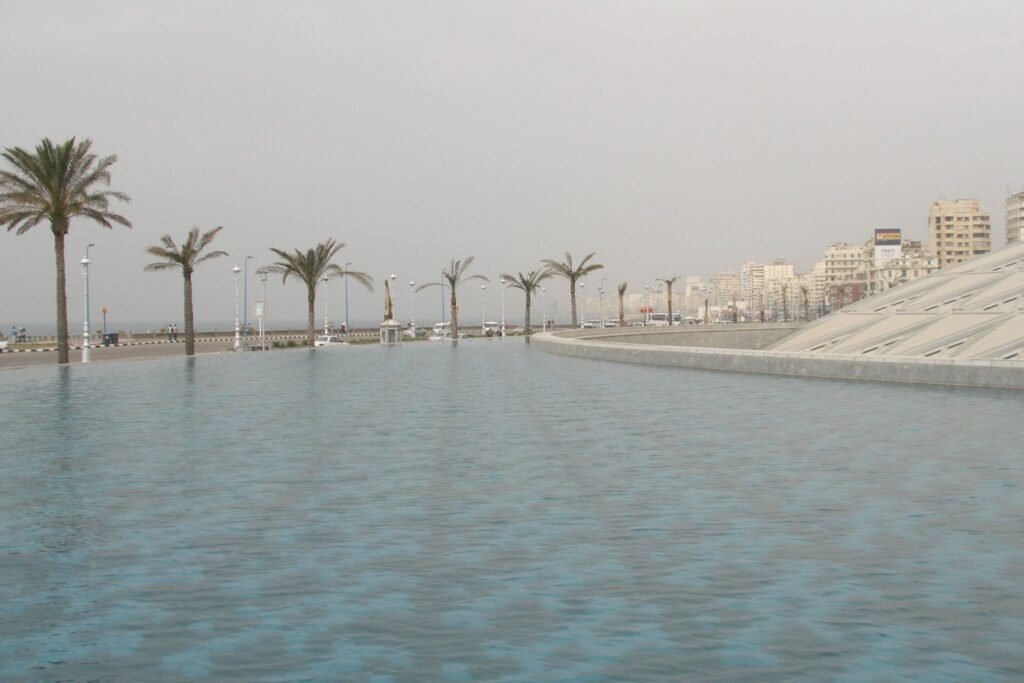
The modern library opened in 2002 after an international design competition, with UNESCO and dozens of governments behind it. It stands in the Shatby district on the eastern harbor, on the corniche road that curves around the bay, roughly where the Ptolemaic royal quarter is thought to have been. From the seafront it reads as a giant disc tipped toward the Mediterranean, a sun rising or setting depending on your mood.
The roof is a circle about 160 meters across, sloped so one edge sits below street level and the other rises several stories above it. The outer wall is a curving drum of Aswan granite carved with characters from about 120 writing systems, from cuneiform and hieroglyphs to Braille and musical notation. Walk the curve and find the letters you know; Americans spot the Latin alphabet first, then hunt for Cherokee.
A spherical planetarium stands free in the plaza and a reflecting pool doubles the disc on a calm day. And this is not a museum of the ancient library: it is a functioning national library with shelf space for millions of volumes, where Alexandria's students come to study. That living quality sets it apart from every pharaonic site on your itinerary.
Inside the building: the reading room and the wall of scripts
The reason to go inside is the main reading room, and no photograph prepares you for it. The floor descends from the entrance in eleven stepped terraces, each a broad platform of desks and low shelves, all of it under that tilted disc. Light comes through hundreds of narrow skylights set into the slope, angled so the sun never lands directly on a page. It feels like a wood and glass amphitheater tipped gently toward the sea.
Visitors walk the upper perimeter and look down over the terraces. On a weekday morning the room is full of university students. Keep your voice down and move along the rail. Inside the curve you can also get close to the carved granite of the wall of scripts; the characters are not a text, they are a sample of humanity's ways of writing.
Guided tours of the building leave from the main entrance at intervals through the day. With an Explora Egipto guide the slot is booked ahead, so you are not standing in a line while the group ahead of you is called.
The museums inside the library
Most day trippers walk the reading room and leave. That is a mistake, because three museums inside the complex are genuinely good and rarely crowded.
The Manuscript Museum
Rare handwritten books and early printed works: illuminated Qurans, Coptic and Arabic manuscripts, old maps and scientific treatises, with a conservation lab where you can sometimes watch restorers through the glass. If the ancient copying frenzy caught your imagination, this is where the thread continues.
The Antiquities Museum
Small, well lit and unusually well labeled. Much of it came out of the ground when the foundations were dug, since the site sits over the Ptolemaic and Roman city, and the rest was lifted from the seabed of the eastern harbor where the royal quarter slid into the water during ancient earthquakes. Look for the Greek and Roman sculpture and the mosaic floors.
The Sadat Museum
A room dedicated to President Anwar Sadat, who signed the peace treaty with Israel in 1979 and was assassinated two years later. His belongings, documents and recordings are here, including the uniform he was wearing on the day he was killed. For Americans who remember Camp David it is a quiet, affecting stop.
Rotating exhibitions come and go; check what is open on the day, because galleries close for rehangs without much notice.
The planetarium and the science center
The sphere standing apart from the main disc houses the Planetarium Science Center: a domed theater running astronomy and science films in Arabic and English, plus a hands on gallery aimed at school groups. It belongs to the library but runs as its own attraction, with its own entry and timing.
Two honest notes. English screenings are not guaranteed at every hour, so confirm on the day rather than promising the kids. And the planetarium is a strong addition with children or teenagers who have just spent three days in tombs, but for a couple on a tight one day schedule it is the first thing to drop. Our guide to Egypt with kids covers pacing museum days so nobody melts down before lunch.
How a visit runs and how long to give it
The sequence on a normal day with a guide:
- Arrival on the corniche. Photos of the disc and the reflecting pool. Ten minutes.
- Security and bags. An airport style scanner at the entrance. Large backpacks go to a cloakroom, so carry a small bag.
- The guided walk. The wall of scripts, the entrance hall, the reading room from the upper rail. About an hour.
- The museums. Manuscripts, antiquities and the Sadat rooms. Forty five minutes to an hour.
- The planetarium. Optional, about an hour including the wait for the next show.
- The bookshop. One of the best in Egypt for English titles on Alexandria.
So the range is one hour for the building alone to three hours for everything. On a day trip from Cairo we plan two hours with the museums and skip the planetarium unless there are children. Opening days change with the season and public holidays, so we confirm them the week before you travel rather than printing them here.
Building the Alexandria day: Qaitbay, the catacombs, Pompey's Pillar and the corniche
The library is one stop in a city that deserves a full day, and the other classic sites each tie back to the ancient library story.
| Stop | What it is | Why it belongs with the library | Time |
|---|---|---|---|
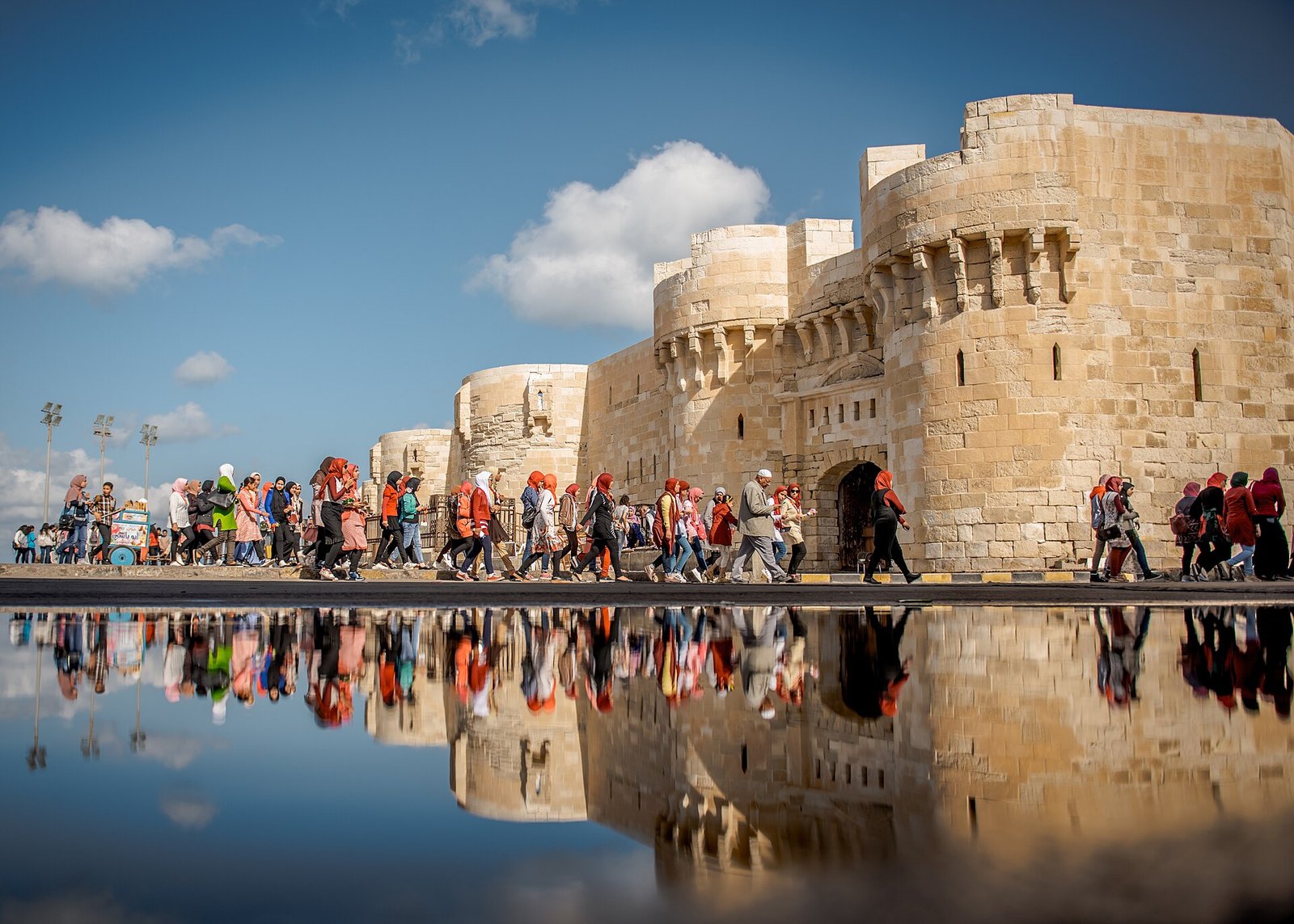
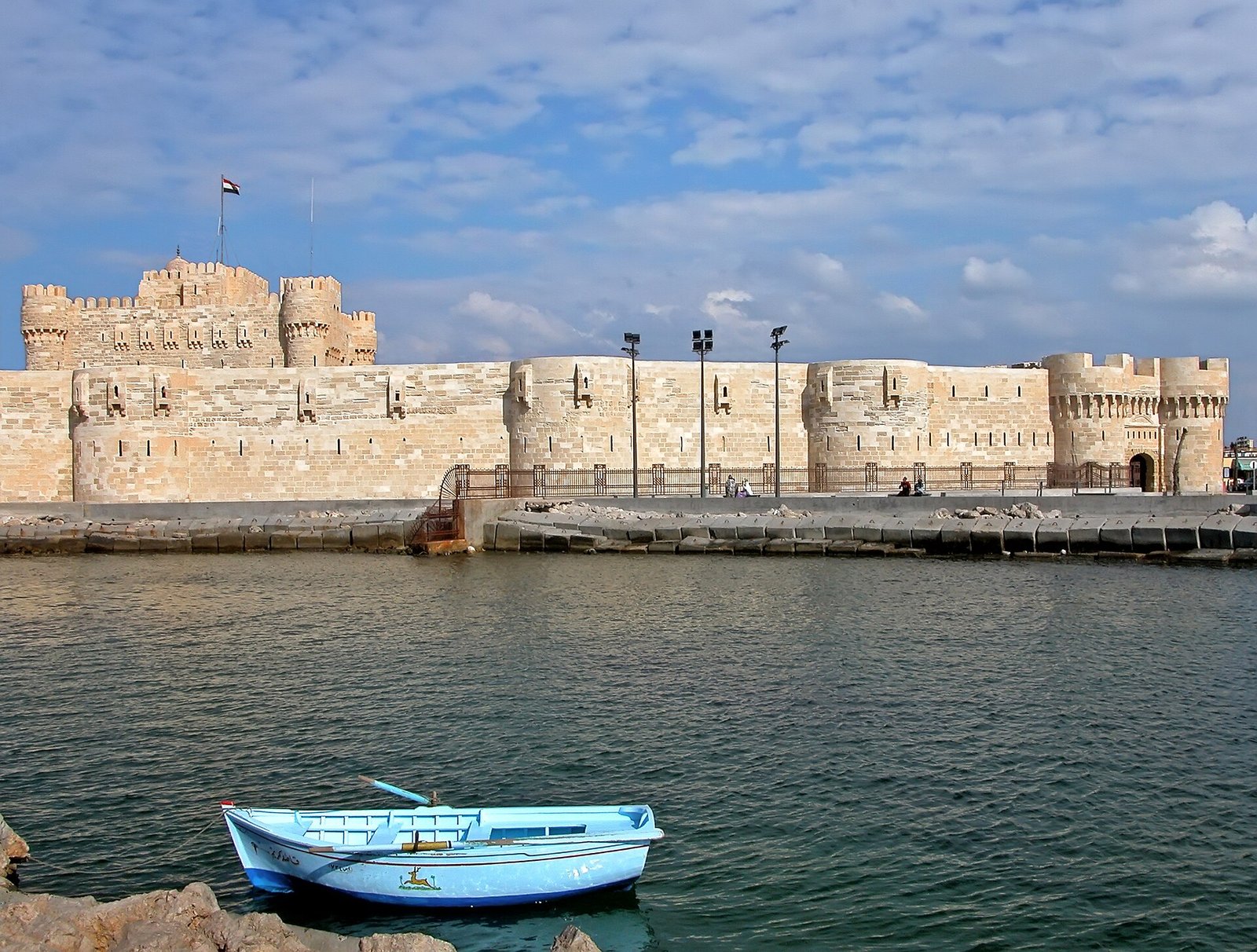
| Qaitbay Citadel | Fifteenth century Mamluk fort at the tip of the eastern harbor | Built on the foundations of the Pharos lighthouse with its stones, the other wonder of Ptolemaic Alexandria. | One hour |
| Pompey's Pillar and the Serapeum | A single Aswan granite column on a hill in a working class district | The temple of Serapis that held the daughter library. Its rock cut galleries with scroll niches are the only place you can stand inside the ancient library system. | Forty five minutes |
| Catacombs of Kom el Shoqafa | Three level Roman era tomb complex, found in 1900 when a donkey fell through the roof | Egyptian gods carved in Roman armor, the same Greek and Egyptian mix the library's scholars lived in. | One hour |
| The corniche | The seafront road around the eastern harbor | Follows the bay where the royal quarter sank. Lunch is here, fish grilled by the water. | Ninety minutes with lunch |
The order we use is Pompey's Pillar and the catacombs first, because they are next to each other and inland, then lunch on the corniche, then Qaitbay and the library in the afternoon light. If your priority is the reading room at its quietest, do the library first.
Lunch matters more here than anywhere else in Egypt. Alexandria is the seafood city, and grilled sea bream with rice and tahini by the water is part of why people come back. Our guide to Egyptian food and what to eat has the dishes to ask for by name.
The drive from Cairo and what the day looks like
Alexandria is about 220 kilometers, roughly 140 miles, northwest of Cairo on the desert road, two and a half to three hours each way depending on Cairo traffic. A day trip is ten to twelve hours door to door. Long, but it works.
- Departure. Pickup at your Cairo hotel early, around seven, to clear the city before it clogs.
- The road. A modern highway through farmland and new suburbs, with a rest stop with clean bathrooms and coffee about halfway.
- The city. Four sites plus lunch, with the vehicle waiting at each one so nobody walks between neighborhoods in the heat.
- Return. Leave in the late afternoon and reach your Cairo hotel for a late dinner.
There is a train too, but with a private vehicle the same car takes you around the city and you are not negotiating taxis at the station. People with more time stay a night, see the corniche after dark, and drive back the next morning. Both versions sit on our Cairo excursions page with the other day trips.
Alexandria runs cooler than Cairo year round thanks to the sea breeze, with summer highs around 30 C, about 86 F, while Cairo pushes past 38 C, or 100 F. Winter is mild but wet.
Dress, photos and the small rules that matter
The library is a civic building, not a religious site, so the dress code is common sense rather than rule. Shoulders and knees covered is the comfortable choice, doubly so in a room full of students. Our what to wear in Egypt guide has the packing list by season.
Photography is allowed in the public areas and from the reading room rail, without flash or tripod, and discreetly around people studying. The museums vary gallery by gallery and the sign at each door is the rule that counts. Drones are not permitted near the building or the harbor. Our page on camera rules and photography in Egypt covers the general picture.
- Carry a passport or photo ID. Entry desks sometimes ask, particularly for the museums.
- Leave the big bag in the car. The cloakroom works but adds a line at the end.
- Comfortable shoes. The perimeter walk plus the Serapeum hill plus the catacomb stairs is more steps than you expect.
What a guide adds, and how Explora Egipto runs the Alexandria day
You can walk into the library alone and admire the reading room. What you will not get is the story that turns a striking building into the high point of a trip: which Ptolemy paid for what, what Eratosthenes did with two sticks and a shadow, and how the new building quotes the old one. A guide who studied in Alexandria tells that in English, then connects it to the Serapeum galleries and the Pharos stones at Qaitbay, so the day becomes one narrative instead of four tickets.
This is how we run it. A private vehicle from your Cairo hotel with a driver who does the Alexandria road every week. One licensed English speaking guide for the whole day. Tickets bought ahead so you never wait at the gate. Lunch at a seafood place on the water we would eat at ourselves. Timing built around the library's tour slots and the light at the citadel.
The Alexandria day slots into any Cairo stay. Travelers on our Egypt tour packages usually add it as an extra Cairo day before or after the Nile cruise. Tell us who is traveling, whether kids are in the group and how much of the library you want, and we send you the day mapped out and the quote.
Frequently asked questions
Can you visit the ancient Library of Alexandria?
No, because nothing of it survives above ground and its exact site under the modern city is still debated. You can visit the Serapeum, the temple that held the daughter library, where rock cut galleries with scroll niches stand beside Pompey's Pillar. The Bibliotheca Alexandrina, opened in 2002 on the corniche, is the modern institution built to carry the name forward.
Was the Library of Alexandria destroyed by fire?
Not in one event. Caesar's harbor fire in 48 BC damaged scrolls in the warehouses, but the library kept working. The real damage came from political purges, shrinking royal funding, the destruction of the palace quarter under Aurelian in the 270s AD and the demolition of the Serapeum in 391 AD. The Arab conquest story appears centuries later and historians reject it.
How long does a visit to the Bibliotheca Alexandrina take?
About an hour for the guided walk through the building and the reading room. Add forty five minutes to an hour for the manuscript, antiquities and Sadat museums, and another hour for a planetarium show. On a day trip from Cairo we plan two hours including the museums, which leaves time for Qaitbay, the catacombs, Pompey's Pillar and lunch.
Is the Bibliotheca Alexandrina worth it on a one day trip from Cairo?
Yes, and for many travelers it is the highlight of Alexandria. The reading room is one of the great interior spaces anywhere, the antiquities museum shows a Greek and Roman Egypt the pharaonic sites never do, and the building is the answer to a story everyone already knows. Pair it with the Serapeum and Qaitbay.
Can I take photos inside the library?
In the public areas and from the reading room rail, yes, without flash or tripod and discreetly around students. The museums inside vary gallery by gallery and the sign at each door is the rule. Drones are not allowed near the building or the harbor. The best exterior shot is from the corniche in the late afternoon.
How far is Alexandria from Cairo and how do you get there?
About 220 kilometers, roughly 140 miles, on the desert highway, two and a half to three hours each way by private vehicle. We pick you up at your Cairo hotel early, drive with a guide, cover the four main sites and lunch, and return for a late dinner. The same car takes you around the city.
Stand in the library the whole world has heard of
Tell us your Cairo dates, who is traveling and whether you want the museums and the planetarium or just the reading room. We come back with the Alexandria day built around the library, the citadel, the catacombs and lunch on the water, and the quote in your inbox.