The Ramesseum in Luxor is the quietest great temple on the west bank, and the one that gave the world Ozymandias
The Ramesseum in Luxor is the quietest great temple on the west bank, and the one that gave the world Ozymandias
The Ramesseum is the mortuary temple of Ramesses II on the west bank of Luxor, a few minutes from the Valley of the Kings and right below the Tombs of the Nobles. It is known for two things: the fallen granite colossus of the king, the largest single-block statue ever carved in Egypt, and Shelley's sonnet Ozymandias, which turned that wreck into the most quoted lesson on power in English. The pylons carry the Battle of Kadesh, the hypostyle hall still stands under its astronomical ceiling, and behind the stone lie acres of vaulted mud-brick storerooms. Most tour buses skip it, so you often have it to yourself. Plan about an hour, go early, and pair it with Medinet Habu and the Tombs of the Nobles.
What the Ramesseum is, and why it was never a tomb
Ramesses II was buried in the Valley of the Kings, in a tomb cut into the cliffs behind the Theban hills. The Ramesseum is something else: his temple of millions of years, the place where his cult was meant to be fed, sung to and kept alive after his death, joined with Amun of Thebes. Every New Kingdom pharaoh built one at the desert edge of the west bank, facing the river and Karnak.
The name is modern. Jean-Francois Champollion, the man who cracked hieroglyphs, visited in 1829 and called it the Ramesseum. Greek writers had known it as the tomb of Osymandyas, a garbled version of Usermaatre, the throne name of Ramesses II. The historian Diodorus Siculus described it in the first century BC, with an inscription on the great statue daring any king to outdo its works. Shelley read that description and never saw the temple.
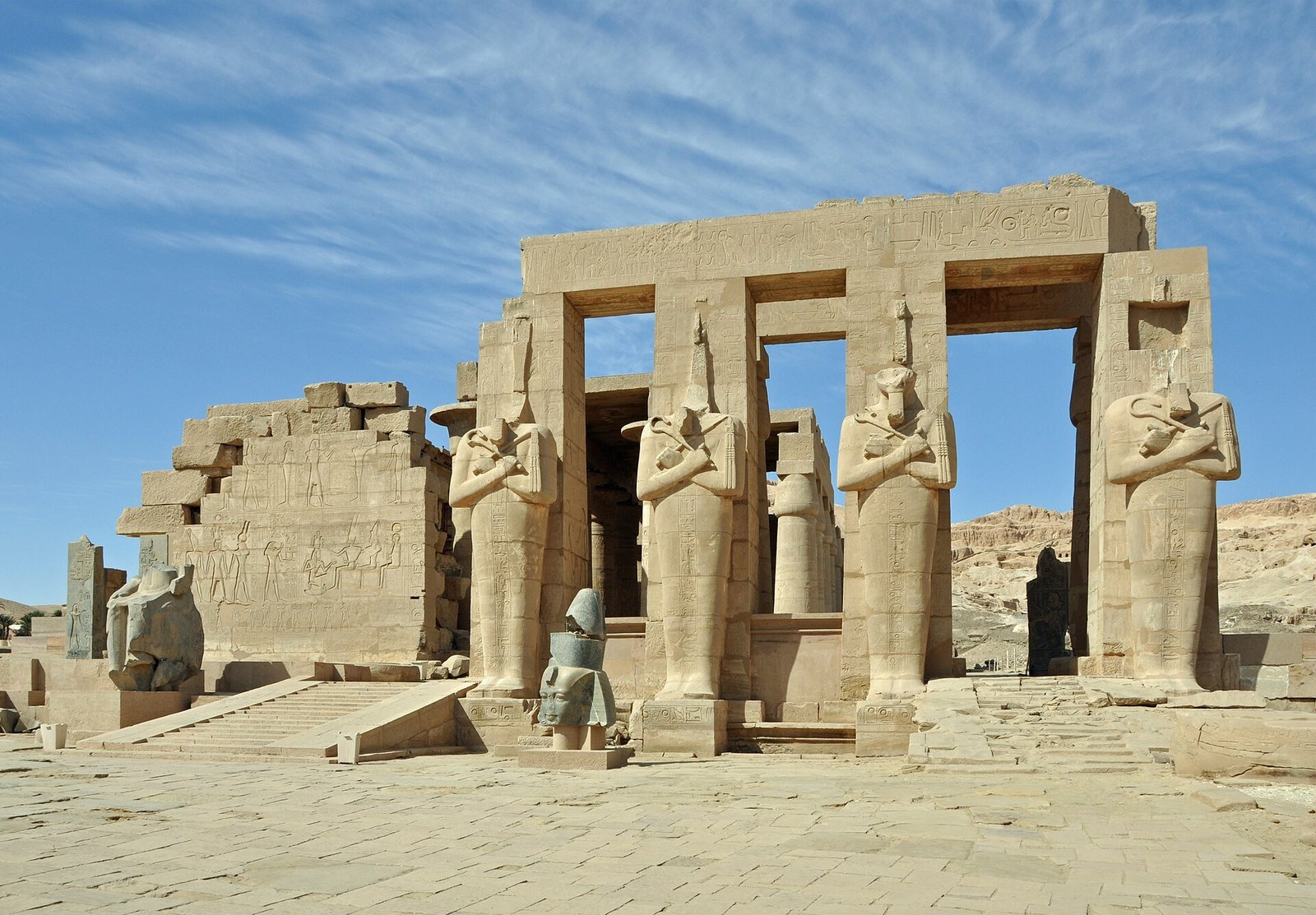
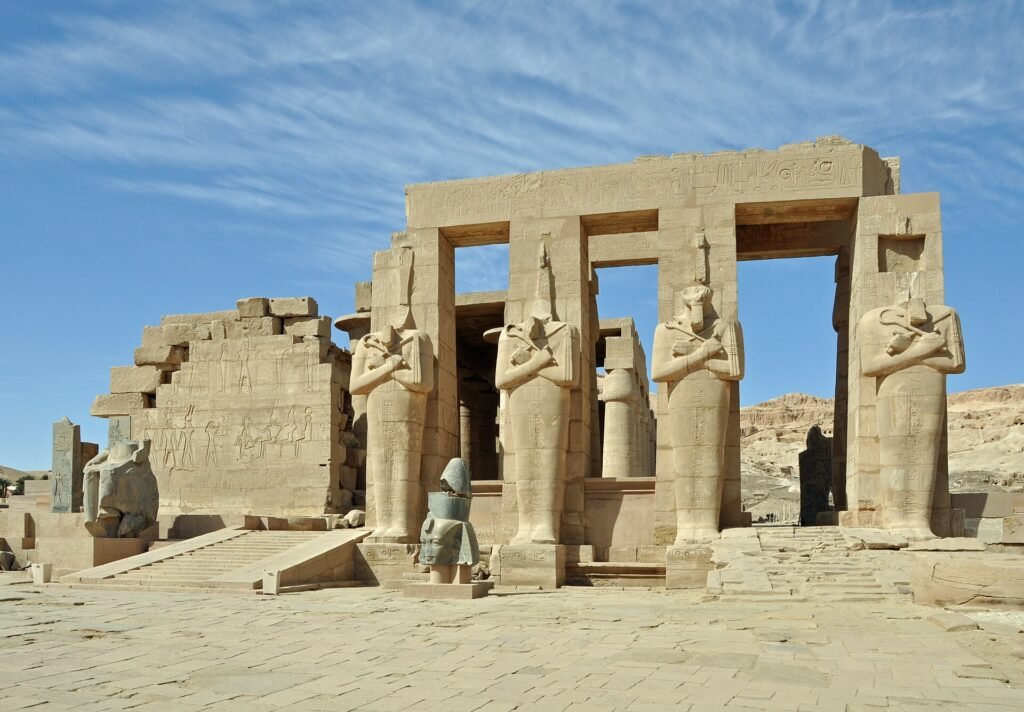
What you walk into today is roughly half a temple: two pylons, two courts, the hypostyle hall and a few rooms behind it. The sanctuary at the back is mostly gone. On three sides stretch the brick magazines that once made the whole thing work.
The fallen colossus, and what Shelley was really writing about
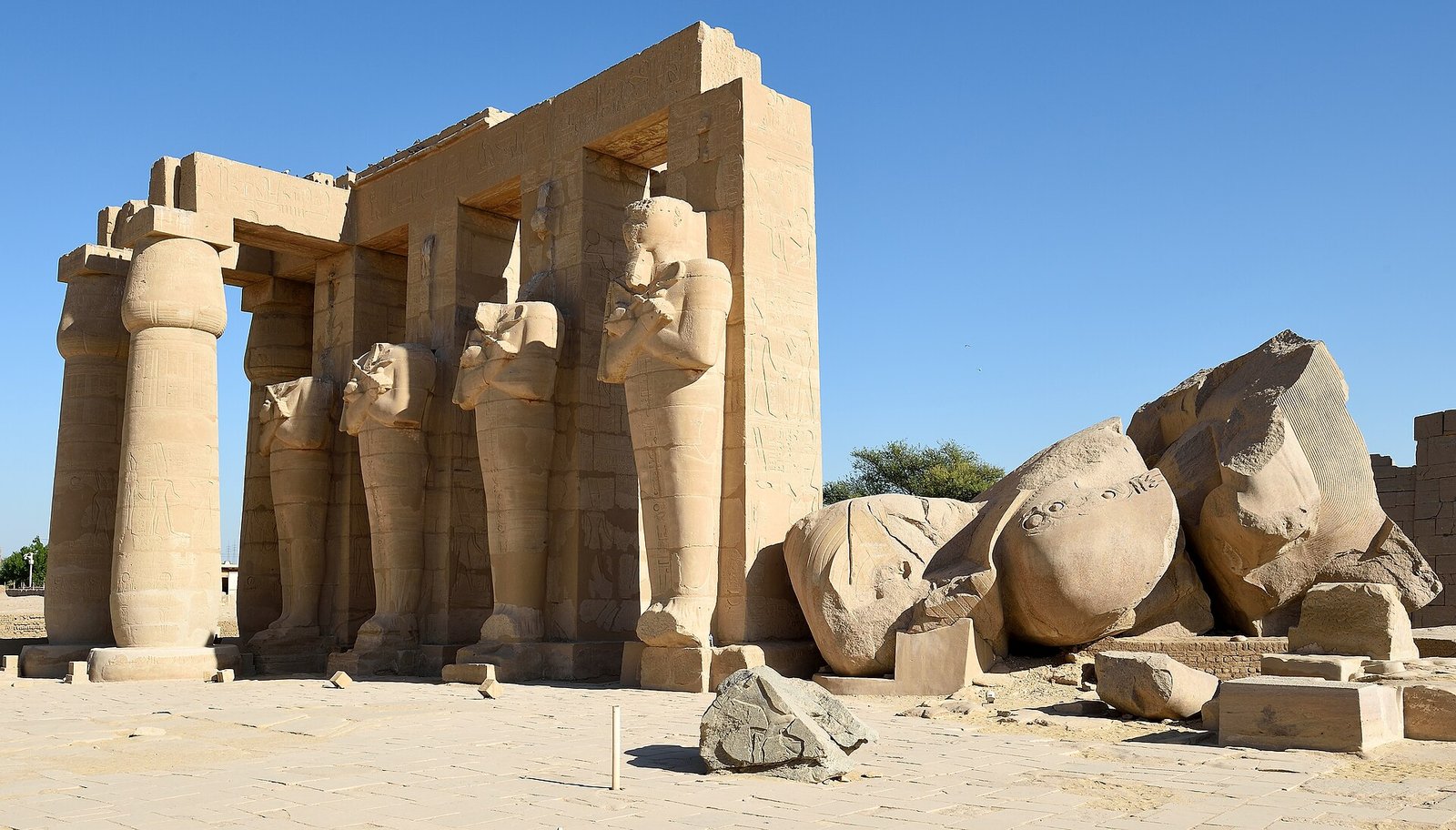
Walk through the first pylon and the king is lying in the court. The seated colossus of Ramesses II, cut from a single block of Aswan granite, once stood about 60 feet high (roughly 18 meters) and is estimated at close to 1,000 tons. It is the biggest monolithic statue known from pharaonic Egypt, and it came from the quarries near Aswan by river.
It did not survive. The torso lies face up, the head has rolled away, and pieces are scattered across the court. The scale only lands when you stand next to a fragment: the ear alone is longer than your forearm, and a single toe is the size of a suitcase.
Ozymandias, written by a poet who never came
Percy Bysshe Shelley wrote Ozymandias in late 1817 and published it in January 1818, in a friendly sonnet contest with his friend Horace Smith. The trigger was the news that Giovanni Belzoni had hauled a granite bust from this temple, the so-called Younger Memnon, and shipped it to the British Museum. That bust came from the second court, not from the giant in the first one, but the shattered visage and trunkless legs of the poem fit what you are looking at almost exactly.
The poem never mentions Egypt or Ramesses by name. It takes the boast Diodorus quoted, gives it to a king of kings, and answers it with sand. Read it in the first court; it is fourteen lines and a better companion than any audio guide for that one spot.
The Battle of Kadesh on the pylons
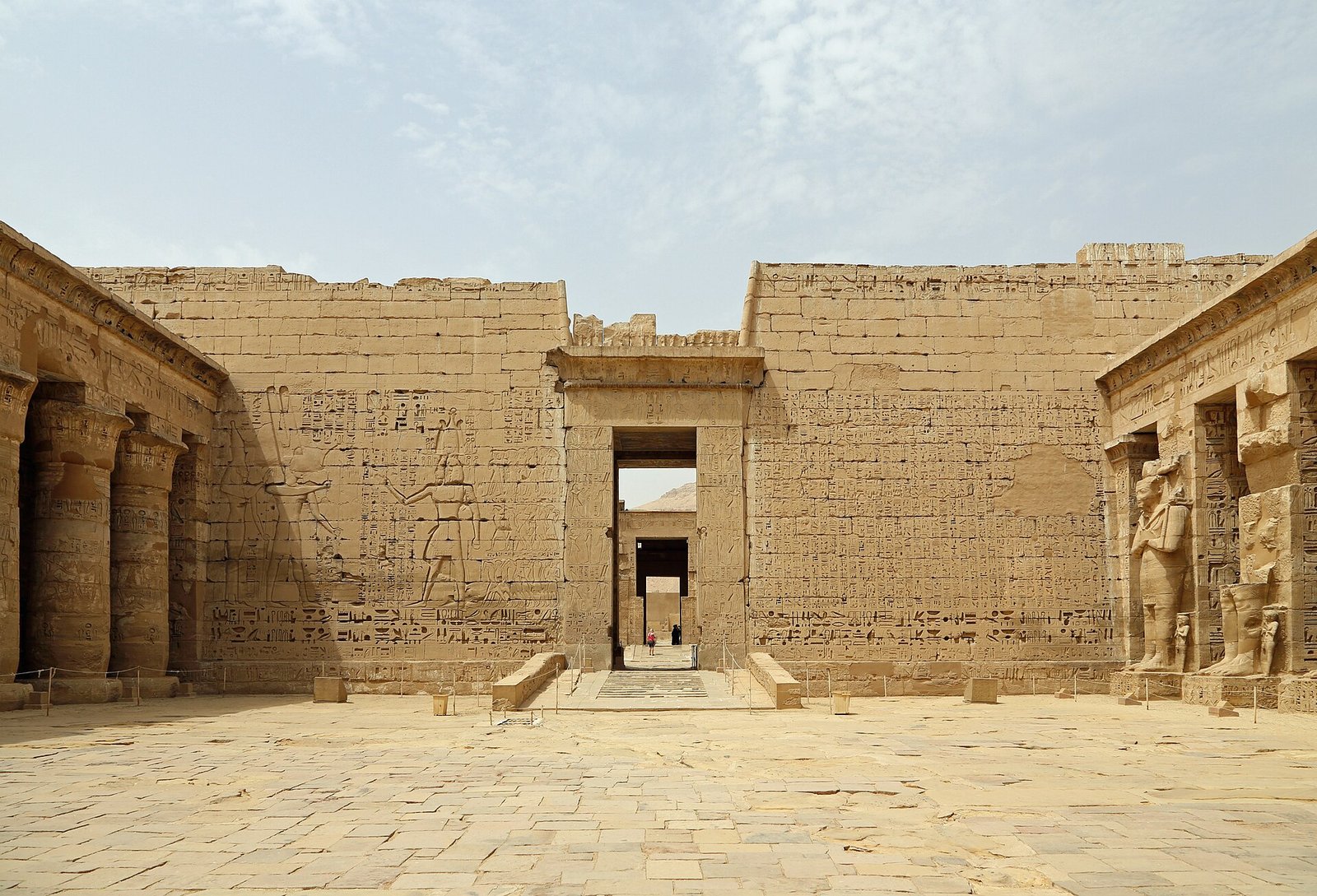
The inner faces of the first pylon and the second pylon carry the Battle of Kadesh, the clash between Ramesses II and the Hittite king Muwatalli on the Orontes river in what is now Syria, early in the reign. The same story is carved at Abu Simbel, Luxor Temple and Karnak. Here the pylons are damaged, but the sequence is readable: the Egyptian camp inside its shield wall, the Hittite chariots crossing the river, the king alone in his chariot with the reins tied at his waist, bow drawn.
The reliefs claim a crushing victory. The historical record says otherwise. The Egyptian army was caught strung out on the march, one division broke, and Ramesses fought his way out. Neither side took Kadesh. Roughly fifteen years later the two powers signed a peace treaty, which survives both in Egyptian on temple walls and in Akkadian cuneiform on clay tablets from the Hittite capital. It is the earliest international treaty known from both sides, and a copy hangs at the United Nations.
That is what makes the wall interesting rather than just big. It is not a chronicle, it is the official version, carved in temple after temple so nobody in Thebes would remember it any other way. Once your guide points out the moment the Hittites surprise the camp, the panel reads like a press release with pictures.
The hypostyle hall and the astronomical ceiling
Beyond the second court, with its Osiris-form pillars of the king wrapped like a mummy, a short ramp climbs to the hypostyle hall. It was built with 48 columns; 29 still stand, the central ones taller with open papyrus capitals so clerestory windows could light the middle aisle. The scale is close to Karnak with none of the crowd.
Look for two scenes on the walls. The king's sons file past in a long procession, each with his name, a reminder that Ramesses had dozens and outlived many. Nearby is the Festival of Min, the fertility god carried in procession while the king cuts a sheaf of emmer wheat.
The room behind the great hall is the one to ask for. Its ceiling is painted with the oldest known twelve-month calendar in Egypt, the months laid out with their festivals alongside the decan stars and the northern constellations, the hippopotamus and the bull's foreleg among them. The vault is high and the pigment is faint, so use your phone light. If you enjoy this, the guide to the pharaonic calendar and where our 365-day year comes from explains what those decans were doing up there.
The mud-brick storerooms, the scribes and the Ramesseum papyri
Most people leave after the hypostyle hall. Walk out the north side instead. Row after row of vaulted mud-brick magazines run around the temple on three sides, some collapsed to knee height, several still roofed with their original barrel vaults intact after more than three thousand years. This is the part that explains everything else.
A mortuary temple was an estate with fields, herds, boats, workshops and hundreds of staff, and its income paid for the daily offerings to the king. These vaults held grain, oil, wine and linen, enough by one estimate to feed several thousand people for a year. Limestone flakes with tallies, ration lists and attendance notes turned up all over the site.
A tomb under the storerooms
In 1896 the archaeologist James Quibell, digging in these magazines, found a shaft that predated the temple by several centuries. Inside was a Middle Kingdom burial with a wooden box of papyri: medical treatises, magical spells, hymns, a dramatic text for a royal ritual and literary works including a copy of the Tale of Sinuhe. The Ramesseum papyri are among the most important manuscripts to survive from ancient Egypt, and they were sitting under a granary of Ramesses II the whole time.
The site later housed a school for scribes, and after the temple fell out of use priests were buried in the storerooms and a Coptic church went up in the second court. Seen brick first and stone second, the Ramesseum stops being a monument and becomes a company town with a temple in the middle.
Why the Ramesseum is so quiet when Hatshepsut is packed
Hatshepsut's temple at Deir el-Bahari is on the standard west bank itinerary sold to every cruise ship and day tour from Hurghada, with the Valley of the Kings and the Colossi of Memnon. The Ramesseum is a separate ticket and a separate stop, and it is not on that list. So the buses do not come.
The result is odd and wonderful. You can stand in a hall of columns the size of a cathedral at ten in the morning in high season and hear the birds in the palms behind the magazines. Often the only other people are the guardian and his tea.
There is a trade-off. The labels are sparse, and without someone who knows it you will see a broken statue and some columns and wonder what the fuss was about. Guided, it is the most rewarding hour on the west bank for anyone who reads, which is why we build it into itineraries for people who want more than the standard Luxor east bank and west bank circuit.
Why it is more ruined than Medinet Habu next door
A fair question when you arrive: Ramesses II built more than any other pharaoh, so why is his own temple in worse shape than Medinet Habu, which is later, or Karnak, which is older? The main answer is water. The Ramesseum was laid out too close to the floodplain, and for centuries the annual Nile flood crept into the foundations, dissolving the brick under the stone. Medinet Habu sits farther back, behind a massive enclosure wall, and stayed dry.
Then came the quarrying. An abandoned temple is a stockpile of cut sandstone, and blocks from the Ramesseum went into buildings all over the district for a thousand years. Earthquakes probably brought down the colossus; nobody knows when.
None of this is a reason to skip it. Medinet Habu shows you what a Ramesside temple looked like whole; the Ramesseum shows you what time does to one, which is exactly what the poem is about.
How long it takes, and the best light
Allow 45 minutes to an hour and a quarter. That covers the two courts, the colossus, the hypostyle hall, the astronomical room and a walk through the storerooms, with time to sit.
- Early morning, from opening. The temple faces east toward the river, so the pylon and the first court take direct sun and the reliefs read best. In winter the air is fresh, around 60 degrees Fahrenheit (about 16 Celsius); in summer be done before the heat passes 95 Fahrenheit (35 Celsius) by late morning.
- Late afternoon. The light comes over the Theban hills behind the temple, the columns throw long shadows across the hall and the granite of the colossus goes warm. Fewer people again.
- Midday. Flat light, hard shadows and real heat between the storerooms. Fine in December, punishing in July; if it is your only slot, do the hall and the colossus and leave the vaults.
If you are taking a hot air balloon over Luxor, the flight often drifts across this stretch of the west bank at first light, and you will spot the rows of vaults from above before you walk through them an hour later.
A west bank morning: Ramesseum, Medinet Habu and the Tombs of the Nobles
The three sites sit within a few minutes of each other and none of them is on the crowded circuit, which is why we like them as a set. Start at Medinet Habu at opening for the color, move to the Ramesseum while the light is low, and finish in the shade of the hillside at the Tombs of the Nobles. You are back at the boat or the hotel by early afternoon.
| Stop | What it gives you | Time | Best moment |
|---|---|---|---|
| Medinet Habu | The intact version of a Ramesside temple, painted ceilings, the reliefs of Ramesses III against the Sea Peoples | About 1 hour | Opening, before the few groups that do come |
| Ramesseum | The fallen colossus, Kadesh, the hypostyle hall, the astronomical ceiling, the storerooms | 45 to 75 minutes | Mid-morning while the sun is still on the pylon |
| Tombs of the Nobles | Daily life painted in small chapels: harvests, banquets, fishing, the tomb of Sennefer's grape vine ceiling | 1 to 1.5 hours | Late morning, the tombs are cool inside |
It works as a second day in Luxor after the Valley of the Kings, or as the substitute day for a traveler who has seen the standard set before. Our guide to the Tombs of the Nobles explains which chapels to pick, since the ticket is by cluster. If it is your first time, do the Valley of the Kings and its ticketed tombs on the day before, and keep this morning as the reward.
What a guide adds, and how Explora Egipto slots it in
The Ramesseum is the least self-explanatory temple in Luxor. There are few signs, and the best things are small: a cartouche on a shoulder, a broken calendar on a ceiling, a vault that has not moved since the reign. An Egyptologist guide turns those into a story in the right order, brick first, colossus second, poem last, and knows which storerooms you can walk into safely this season.
Our guides are Egyptian, licensed, and they walk this bank every week. They know where the light lands on the Kadesh wall at each hour and will tell you plainly when a chamber is closed rather than promising it. The car waits in the shade with water in the cooler.
In practice we add the Ramesseum in three ways. On a two-day Luxor tour it is the natural second morning. On a Nile cruise we build it into the Luxor day for guests who ask for more than the ship's standard shore program. On any custom Egypt itinerary it goes in wherever a quiet hour fits, often right after the Valley of the Kings so the two versions of a pharaoh's afterlife sit side by side. Tell us your dates and what you have already seen, and we send you the plan.
Frequently asked questions
Is the Ramesseum worth visiting?
Yes, if you care about the story behind the stones. It is quieter than every other major temple in Luxor, the fallen colossus is one of the most striking objects in Egypt, and the Kadesh reliefs, the astronomical ceiling and the intact mud-brick vaults give you three things you will not see together anywhere else. It rewards a guide more than Karnak does, because there is little signage.
Did Shelley visit the Ramesseum before writing Ozymandias?
No. Shelley never traveled to Egypt. He wrote the sonnet in England in late 1817, prompted by news that Belzoni had removed the Younger Memnon bust from this temple for the British Museum, and by the ancient description of the great statue by Diodorus Siculus. The colossus in the first court matches his lines so closely that most visitors assume he stood here.
How big is the fallen colossus of Ramesses II?
The seated statue stood about 60 feet tall, roughly 18 meters, and weighed close to 1,000 tons. It was carved from a single block of Aswan granite and is the largest monolithic statue known from ancient Egypt. Today it lies broken in the first court, with the torso, the head and separate fragments scattered around it. The ear alone measures over three feet.
How long do you need at the Ramesseum?
Between 45 minutes and an hour and a quarter is right for most people. That includes both courts, the colossus, the hypostyle hall, the small astronomical room and a walk through the mud-brick storerooms. Photographers who want the late light will stay longer, and since it is rarely crowded nobody moves you along.
Can you combine the Ramesseum with the Valley of the Kings?
You can, in one long west bank day: Valley of the Kings first, then Hatshepsut, then the Ramesseum after lunch when its neighbors are busiest. The better plan, if you have two days in Luxor, is to keep the Ramesseum for a second morning with Medinet Habu and the Tombs of the Nobles, when you are fresh and the light is right.
Why is the Ramesseum more damaged than other Luxor temples?
Mostly because of water. It was built close to the edge of the Nile floodplain and the annual flood undermined the foundations for centuries. Later the temple was quarried for cut stone, reused by a Coptic community, and probably shaken by earthquakes, which is the likeliest reason the colossus fell. Medinet Habu, set farther back behind a thick wall, escaped most of that and is the intact comparison a short drive away.
Stand in the first court before the buses find it
Tell us your Luxor dates, whether you are on a cruise or staying on land, and what you have already seen, and we come back with a west bank plan that puts the Ramesseum in the right hour, with an Egyptologist who knows it and the rest of your Egypt trip built around it. No prices on this page, just a quote in your inbox.